


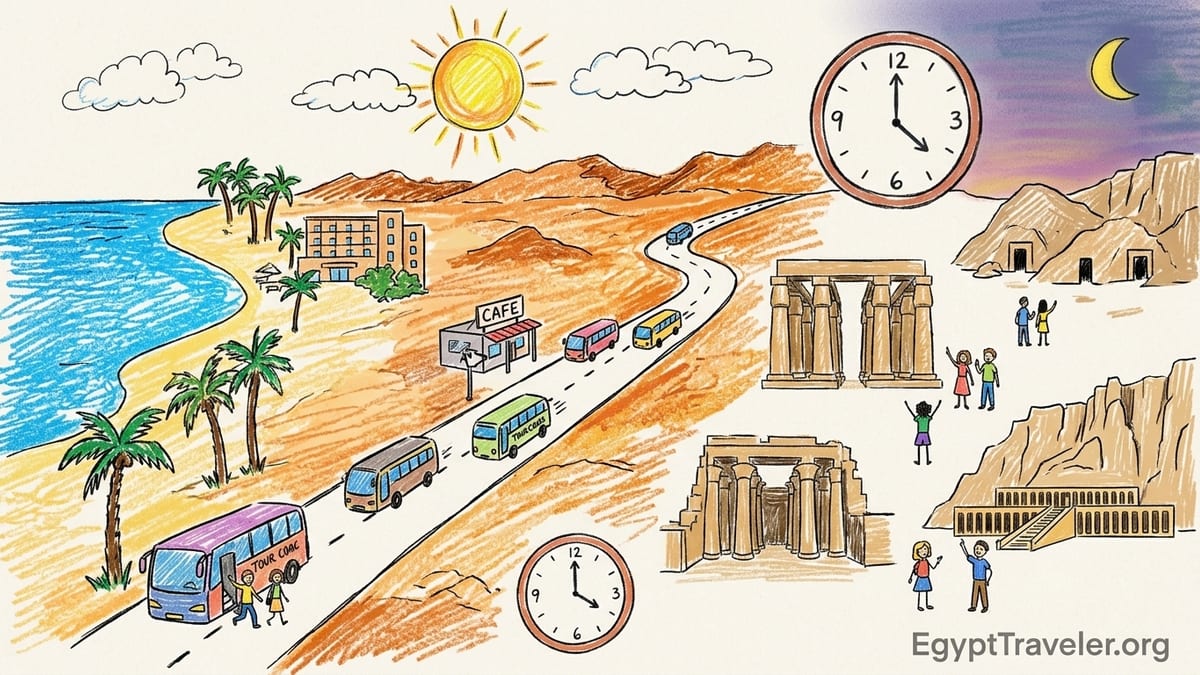
At 3:25 a.m. my phone alarm shattered the quiet of my Hurghada hotel room. By 4:10 I was in the lobby, bleary-eyed, clutching a packed breakfast box and waiting for a bus that promised to unlock "the real Egypt" in a single day. By midnight, back at the Red Sea with sunscreen and dust still baked into my skin, I was asking myself a very different question: not what I had seen, but whether the Hurghada to Luxor day trip had been worth the cost in comfort, time and energy at all.
Booking the Dream: What the Brochures Promise
The idea is seductively simple. Spend a beach holiday in Hurghada, then add a one-day coach tour to Luxor to tick off Karnak, the Valley of the Kings and Hatshepsut’s temple. In 2026, big-bus excursions from companies like Coral Tours and Hurghada-based agencies are typically advertised around 55 to 65 euros per adult, with children’s fares about half that amount. The glossy descriptions suggest an early pickup, a comfortable air-conditioned coach, an Egyptologist guide, lunch by the Nile and a return to your resort by late evening.
I booked through a local operator’s desk inside a mid-range Hurghada resort. The brochure listed a 4:30 a.m. departure, “approximately 4 hours each way” and visits to Karnak, three tombs in the Valley of the Kings, the Temple of Hatshepsut and a photo stop at the Colossi of Memnon. Lunch was included, drinks and tips were not. Like most packages at this price, there was no mention of optional tombs, no guarantee of which ones we would see and only a vague reference to “shopping opportunities.”
Crucially, nothing in the sales pitch spelled out how long the day would really be. Hurghada and Luxor are roughly 280 to 300 kilometers apart by road, depending on your hotel location and the chosen route across the Eastern Desert. Official information and recent transport guides put the pure driving time at just over four hours in good conditions, but that is before factoring in hotel pickups, checkpoints, rest stops and city traffic on both ends. Even a conservative estimate points to a 14 to 16 hour day.
Still, the idea of seeing the Nile Valley and pharaonic tombs while still sleeping in my Hurghada bed that night felt irresistible. I handed over my euros at check-in and wrote my room number on a paper form, trusting that the fine print would somehow bend in my favor.
The Pre-Dawn Reality: Hotel Pickups and the Long Road Out
The operator confirmed my pickup for “about 4:10 a.m.” The bus actually arrived at 4:35, a full 25 minutes later, which is common when a coach has to collect guests from multiple hotels spread along Hurghada’s long coastal strip. By the time we had progressed from my resort in the northern part of town to the last pickup near Sahl Hasheesh, it was 5:20. Nearly an hour had evaporated and we had not yet left the metropolitan sprawl for the main road.
Once we cleared the city limits and turned south toward Safaga, the bus joined an informal convoy of tour coaches and minibuses, a standard security practice on this route. We passed the police checkpoint near Safaga shortly after sunrise and turned inland across the Eastern Desert. Here the geography becomes stark. For roughly 160 kilometers the road cuts across rock and sand towards Qena, with only a few fuel stations and basic rest houses on the way. A recent local transport guide puts the full Hurghada to Luxor road distance at around 295 kilometers, with most of it on this desert highway.
Our first rest stop came around 7:15 a.m., just under two hours after leaving the last hotel. It was a predictable mix of toilets of varying standards, a cafe serving instant coffee and sodas priced higher than in town, and a souvenir shop stocked with alabaster figures and papyrus prints. We were given 20 minutes. In reality it stretched to nearly 35 as passengers queued for bathrooms and coffee. Back on the bus at 7:50, we had already spent more than three hours on the move, counting hotel pickups, and Luxor was still at least two hours away.
By the time the road dipped out of the desert escarpment and the first glimpse of green Nile Valley fields appeared, it was after 9:30 a.m. Date palms and sugarcane suddenly replaced rock and sand, and the bus crossed the river to reach the East Bank and the city of Luxor. At this point, my eyes felt grainy and my energy reserves suspect. We had spent close to five hours in the coach since my hotel pickup, not counting the half-awake shuffle in the lobby.
Karnak on a Stopwatch: How Much Time Do You Really Get?
Karnak is one of Egypt’s most important complexes, with temples dedicated to Amun, Mut and Montu spread across a vast site. Official information from the Ministry of Tourism and Antiquities describes it as a precinct rather than a single temple, and the standard daytime visiting hours often run from early morning to late afternoon. The scale alone demands time and attention. A methodical visit could easily fill half a day.
Our reality was very different. The coach pulled into the Karnak parking area around 9:50 a.m. There was a quick regrouping as our guide handed out paper tickets and marched us past the visitor center, through security and along the central processional way flanked by ram-headed sphinxes. The guide launched into a compressed lecture in English and German, stopping in the Great Hypostyle Hall to describe the forest of papyrus-bundle columns and the remaining painted reliefs above our heads.
By 10:05 a.m. we were told we had “one hour maximum” before we needed to meet back at the bus. That hour had to accommodate photography, a toilet break, time to absorb the site and, for some, a detour into the on-site shops. Checking my watch carefully, I spent about 40 minutes actively exploring: 10 minutes in the Hypostyle Hall, another 10 near the obelisk of Hatshepsut, perhaps 5 minutes by the sacred lake, and the rest moving between them. The rest of the group splintered instantly, some chasing photos for social media, others trailing the guide for more commentary.
By 11:05 a.m. everyone had been shepherded back into their seats. Including walking to and from the bus, the total time at Karnak was around 70 minutes, of which no more than 45 to 50 minutes were actually inside the temple area and not queued, listening at a single point or crossing the parking lot. By contrast, we had already logged more than five hours in transit that morning.
Into the Tombs: Valley of the Kings, Optional Tickets and Tight Schedules
From Karnak, most itineraries cross back over the Nile or continue through the city to recross by a road bridge, reaching the West Bank by late morning. We did not go directly to the Valley of the Kings. Instead, we were diverted to a so-called alabaster workshop, one of the common shopping stops built into many tours. There, in a shaded courtyard, we were shown how stone vases are carved and then steered past shelves of souvenirs. This demonstration and shopping break took almost 40 minutes from arrival to departure.
Only then did we continue to the Valley of the Kings, pulling into the parking area shortly after 12:30 p.m. The heat by this point was punishing. In late spring and summer, temperatures in Luxor can easily climb to the high 30s Celsius or more in the early afternoon, and the reflective cliffs amplify the effect. Even in shoulder seasons, standing in full sun for extended periods with minimal shade drains energy quickly.
Standard Valley of the Kings admission, based on recent ticket tables, covers entrance to the site plus access to three of the open tombs from a rotating list that often includes tombs such as Ramesses III, Ramesses IV, Ramesses IX or Seti II. More famous tombs, such as Tutankhamun (KV62) or Ramesses VI (KV9), usually require separate, higher-priced tickets that are not included in group tour prices. Our guide made it explicit on arrival that Tutankhamun’s tomb was “extra” and that anyone wishing to see it would have to buy their own ticket at the office.
Photography inside the tombs has long been a moving target, but recent visitor reports and information notices show that handheld photography is frequently allowed if you buy a camera ticket at the entrance, while tripods and flash remain prohibited. Our guide strongly discouraged taking cameras down at all, warning that rules could be enforced unpredictably and that fines for breaking them were expensive. To avoid problems, many passengers left their bulkier cameras on the bus and used phones only where the guards nodded.
We were given around 90 minutes total at the valley. That had to cover purchasing any extra tomb tickets, waiting for the internal shuttle train, walking to the tomb entrances, queuing, descending and ascending steep ramps or stairs, and catching the return shuttle. In practice, I managed to enter three included tombs and spend about 8 to 10 minutes inside each, lingering over painted scenes of the Book of the Dead and the star-studded ceilings. A rough tally gave me around 30 minutes of actual time inside tomb chambers and around 60 minutes of walking, queuing or listening to commentary under the sun.
Hatshepsut, Colossi of Memnon and the Cost of “Shopping Stops”
Leaving the Valley of the Kings around 2:05 p.m., we drove the short distance to the Temple of Hatshepsut at Deir el-Bahari. The dramatic setting beneath limestone cliffs deserves a generous visit. Reliefs inside the terraces show the expedition to Punt and scenes of Hatshepsut’s divine birth, while the colonnades open westward toward the desert. Under a well-paced itinerary, you might spend upwards of 90 minutes here, taking time to climb at least two levels and examine the reliefs up close.
Our bus schedule allowed for about 50 minutes from drop-off to pick-up. After a quick shuttle ride from the parking area, we followed the guide at a brisk walk across the plaza. He stopped twice for condensed explanations of Hatshepsut’s reign and the temple’s later defacement under Thutmose III. By the time the talk ended, we had about 25 minutes left. I managed to climb one terrace, spend roughly 10 minutes walking the length of a colonnade, and take a handful of photographs before we were briskly directed back to the shuttle.
The Colossi of Memnon, enormous seated statues that once fronted the mortuary temple of Amenhotep III, were next. Here the time imbalance became even more obvious. We spent only about 10 minutes on site, enough for the guide to deliver a short explanation while we took photos with the statues in the background. The stop felt more like a content tick-box for the brochure than a meaningful visit.
More frustrating, on the way to lunch, our driver swung into another commercial stop, this time a perfumery and “essence factory.” We were ushered inside for complimentary tea and a smooth sales pitch on lotus and papyrus oils. This detour absorbed approximately 35 minutes. Combined with the earlier alabaster workshop, we had spent well over an hour of our already tight Luxor window on shopping experiences many passengers had not asked for. Those 70 to 80 minutes, if reassigned to Karnak or Hatshepsut’s temple, would have materially changed the depth of what we saw.
Heat, Exhaustion and the Toll on Different Travelers
By the time we sat down for a buffet lunch on a moored restaurant boat on the Nile, it was almost 3:30 p.m. The interior was mercifully air-conditioned, and the food, a spread of grilled chicken, rice, vegetables and salads, was perfectly adequate. Drinks were extra and priced noticeably above street level, which is normal on these tours. We had about 45 minutes to eat. Many passengers used part of that time not to enjoy the river view, but simply to recover from the heat and hours of walking and standing.
This is where the human cost of a same-day Hurghada to Luxor trip becomes clearest. Including my pre-dawn alarm, I had been awake for more than 12 hours; nearly eight of those had been spent either sitting on the bus or under strong sun on archaeological sites. Despite liberal sunscreen and a hat, I felt the sluggishness that precedes sun headaches. Fellow passengers with young children looked visibly strained, juggling tired kids and the pressure not to hold up the group.
In the height of summer, when midday temperatures often climb well beyond 40 degrees Celsius in Luxor, this schedule borders on punishing, especially for older travelers or anyone with health conditions affected by heat. The rapid sequence of sites allows limited time for shade or proper hydration stops. The combination of lack of sleep, dehydrating heat, walking on uneven stone and constant time pressure makes meaningful engagement with the history difficult. You may physically stand in front of some of the world’s most important monuments, but your capacity to absorb them is compromised.
By late afternoon, as we reboarded the bus for the return journey, conversation had dwindled. Many simply slumped into their seats, drawing curtains against the sinking sun. The mood contrasted starkly with the nervous excitement of the early morning. The day’s promise of “seeing ancient Egypt” had been partly kept, but at the price of near-total exhaustion.
Numbers That Matter: Hours in Luxor vs Hours on the Bus
Looking back over my notes, the balance sheet was sobering. From hotel pickup in Hurghada at 4:35 a.m. to re-arrival at around 10:45 p.m., the total excursion length was just over 18 hours. Of that, approximately 10 to 11 hours were spent in the coach, including city traffic, desert driving, rest stops and the evening return. Time on archaeological sites and at lunch accounted for the remaining seven to eight hours, but even that figure is generous once you subtract walking between buses and entrances, queuing and listening to fixed-position commentary.
Breaking it down more strictly, my estimates were as follows: around 45 to 50 minutes of active exploration at Karnak, roughly 30 minutes inside tombs at the Valley of the Kings, maybe 30 minutes of focused time at Hatshepsut’s temple and 10 minutes at the Colossi of Memnon. That adds up to about two hours of genuine, eyes-on-antiquities time. Add another 90 minutes for walking within the sites and you still land under four hours of archaeological immersion in an 18-hour day.
Shopping stops, which the operator had not highlighted during booking, consumed between 70 and 80 minutes collectively. Lunch, while welcome, was another 45 minutes. These necessary or commercial interludes are not inherently bad, but they eat into a finite pool of time that is already squeezed by geography and road conditions. When you put a stopwatch on the day, the trade-off becomes undeniable: the Hurghada to Luxor excursion is primarily a long-distance transport operation with brief, intense bursts of sightseeing attached.
The cost is not only measured in minutes. At 60 to 65 euros for a big-bus tour, plus tips for the driver and guide, drinks at lunch, optional tombs and perhaps a soft drink at the rest stops, my real expenditure crept toward 90 to 100 euros for the day. Small-group minibus tours, which typically carry 12 to 18 passengers and shave some time off pickups, often run around 80 euros per adult. Private day trips with a dedicated guide and vehicle, widely advertised on major booking platforms, can range from roughly 120 to 180 US dollars per person depending on group size and inclusions, but they distribute that cost across fewer people and often cut out most shopping detours.
Alternatives: Smaller Groups, Private Guides and Staying Overnight
Contrasting my big-coach experience with other options highlights how much itinerary quality depends on group size and pacing. Recent comparisons from local agencies show that small-group minibus tours usually depart slightly later than the large buses, yet still reach Luxor earlier because they collect from fewer hotels. That can gain you 30 to 60 additional minutes on the ground. More importantly, smaller groups move faster through ticket offices, security and toilets, leaving more of the limited Luxor window for actual sites.
Private day trips represent a further step up. These typically use a car or minivan with a dedicated driver and, in many cases, a licensed Egyptologist guide who meets you in Luxor. They cost markedly more upfront than a big-bus tour, but they allow for departure around 5:00 or 5:30 a.m., a flexible order of sites and the ability to linger at Karnak or in a favorite tomb if you wish. Some private itineraries skip commercial stops entirely or restrict them to a quick, optional visit at the traveler’s request.
However, all same-day road options share one limitation: they compress both East Bank and West Bank into a single afternoon of sightseeing. This is where an overnight stay in Luxor changes the equation completely. By sleeping in Luxor, either in a Nile-side East Bank hotel or a West Bank guesthouse, you can split Karnak and Luxor Temple into one day and tackle the West Bank sites the following morning when temperatures are cooler and crowds slightly thinner.
Hotel rates in Luxor span from budget guesthouses to international chains, with many comfortable mid-range options under the cost of an extra excursion. When you factor in that a private Hurghada to Luxor transfer by road in each direction can be spread over two or three days of sightseeing, the price gap between a rushed day trip and a richer overnight experience narrows considerably. The main sacrifice is not money, but one or two nights away from your Red Sea resort’s all-inclusive wristband.
Who Should Still Consider the One-Day Trip?
After all this criticism, it is only fair to ask whether there is anyone for whom the Hurghada to Luxor day excursion does make sense. The answer is yes, but the group is more limited than tour marketing suggests. If you are on a tight overall itinerary, perhaps with only four or five nights in Hurghada and no flexibility to add a separate Luxor stay, a long same-day tour may be your only realistic way to glimpse the Nile Valley and walk inside a pharaonic tomb. For travelers in good health, accustomed to early starts, long drives and heat, the physical toll will be significant but tolerable.
It can also be an acceptable compromise for those who approach the day with calibrated expectations. If you board the bus understanding that you will spend most of your time in transit and that your actual on-site hours will be squeezed, the disappointment is less sharp. You may decide that simply standing between Karnak’s colossal columns or descending into a single painted tomb justifies the effort, even when your visit is timed by a guide checking their watch.
Families with young children, older travelers, anyone sensitive to heat and those who prefer slow, immersive travel are poor candidates for this excursion in its standard large-coach form. For them, the long hours, rigid schedule and crowded bus are more likely to breed frustration than wonder. In such cases, reallocating budget from additional resort activities or high-end hotel upgrades to a one- or two-night stay in Luxor often produces a far richer overall experience of Egypt.
Ultimately, the question is not whether Luxor is worth seeing. It is whether you want your encounter with some of humanity’s greatest monuments to be framed by fatigue, or whether you can reconfigure your trip to meet them on less hurried terms.
The Takeaway
From the first pre-dawn shuffle in the hotel lobby to the final step off the bus back in Hurghada, my Hurghada to Luxor day trip spanned about 18 hours. Of that, only a small fraction was spent in meaningful contact with Egypt’s ancient sites. Measured in minutes, I had less than an hour inside Karnak, half an hour inside tombs in the Valley of the Kings, and brief fragments of time at Hatshepsut’s temple and the Colossi of Memnon. The rest was consumed by desert highways, hotel pickups, group logistics, commercial stops and the inescapable constraints of geography.
When weighed against the marketing language that promises to “visit Luxor” from your Red Sea sun lounger, the reality is stark. The classic big-bus day trip is a compromise that prioritizes accessibility and price over depth and comfort. While it delivers headline sights on paper, it does so in a way that often leaves travelers overwhelmed, dehydrated and only partially aware of what they have seen. In my case, the strongest memory from the day was not a specific relief or inscription, but the heavy, unrelenting fatigue that settled in sometime after lunch.
If Luxor is a once-in-a-lifetime destination for you, it deserves more than a handful of rushed hours at the tail end of a marathon bus ride. Consider investing in a small-group or private tour, cutting out unnecessary shopping stops, or, best of all, reshaping your itinerary to include at least one night in the Nile Valley. You will still be tired at the end of the day, but the balance of your time will have shifted from the coach seat to the colonnade, from the roadside souvenir stand to the painted tomb wall.
For travelers with genuinely inflexible schedules who accept the trade-offs with open eyes, the Hurghada to Luxor day trip can still serve as a compressed, imperfect window onto pharaonic Egypt. For everyone else, the most honest answer to whether this excursion is “worth it” is that Luxor is worth far more time than a single exhausting day allows.
FAQ
Q1. How long does a Hurghada to Luxor day trip really take door to door?
Most large-coach excursions run 14 to 18 hours door to door, including hotel pickups, rest stops, sightseeing and the return drive, so expect a very long day.
Q2. How much time will I actually spend at Karnak and the Valley of the Kings?
On a typical coach tour, you may get around 45 to 60 minutes at Karnak and 90 minutes at the Valley of the Kings, of which only a portion is inside tombs.
Q3. Is Tutankhamun’s tomb included in standard Valley of the Kings tickets?
No. General admission covers entry to the site and a selection of three open tombs. Visiting Tutankhamun or some other famous tombs requires separate, extra tickets.
Q4. Are the Hurghada to Luxor buses comfortable and air-conditioned?
Most tour coaches and minibuses are air-conditioned and reasonably comfortable, but the long hours seated, early start and heat outside still make the day tiring.
Q5. How hot does it get in Luxor and is summer a bad time for the day trip?
Summer daytime temperatures in Luxor often exceed 40 degrees Celsius, and combined with strong sun and limited shade, this makes the one-day trip especially demanding.
Q6. What do large-coach tours usually include in the price?
Big-bus excursions around 55 to 65 euros per adult usually include transport, an Egyptologist guide, main site tickets and lunch, but exclude drinks, tips and optional tombs.
Q7. Are shopping stops like alabaster workshops mandatory on these tours?
On many group itineraries they are built into the schedule, and while you do not have to buy anything, you usually cannot skip the stop to gain more time at sites.
Q8. Is it safer or better to book a private day trip instead of a coach?
Private trips cost more but allow later departure, more flexible timing, fewer shopping detours and generally a calmer experience, which many travelers find worthwhile.
Q9. Why is staying one night in Luxor often recommended instead?
An overnight stay lets you split East Bank and West Bank sightseeing across two cooler parts of the day, dramatically increasing both comfort and depth of your visit.
Q10. Who is best suited to attempt the Hurghada to Luxor day excursion?
Physically fit travelers with very limited time, realistic expectations and a high tolerance for early starts, long drives and heat are the ones most likely to benefit.