


The taxi from Dahab to the Blue Hole took twenty minutes. By the time we left the palm trees of the lagoon behind and followed the coast north toward the bare brown mountains of South Sinai, I already knew more about this dive site’s reputation than I wanted to. The driver talked about “the most dangerous dive in the world” and pointed to a crumpled newspaper clipping on his dashboard. I had come to see whether that reputation matched what an ordinary visitor actually experiences at the surface, and whether this famous hole in the reef is really worth the money and the hype.
Getting There: Checkpoints, Cash Fees and First Impressions
This is the Blue Hole in Egypt’s South Sinai, a few kilometres north of Dahab on the Gulf of Aqaba, not the Great Blue Hole in Belize that dive magazines love to put on their covers. The drive follows the shoreline, past clusters of low-rise camps and cafes, until the asphalt thins and the sea on the right goes from bright turquoise to an abrupt dark navy circle. Even before I stepped out of the taxi, it was obvious why the name stuck.
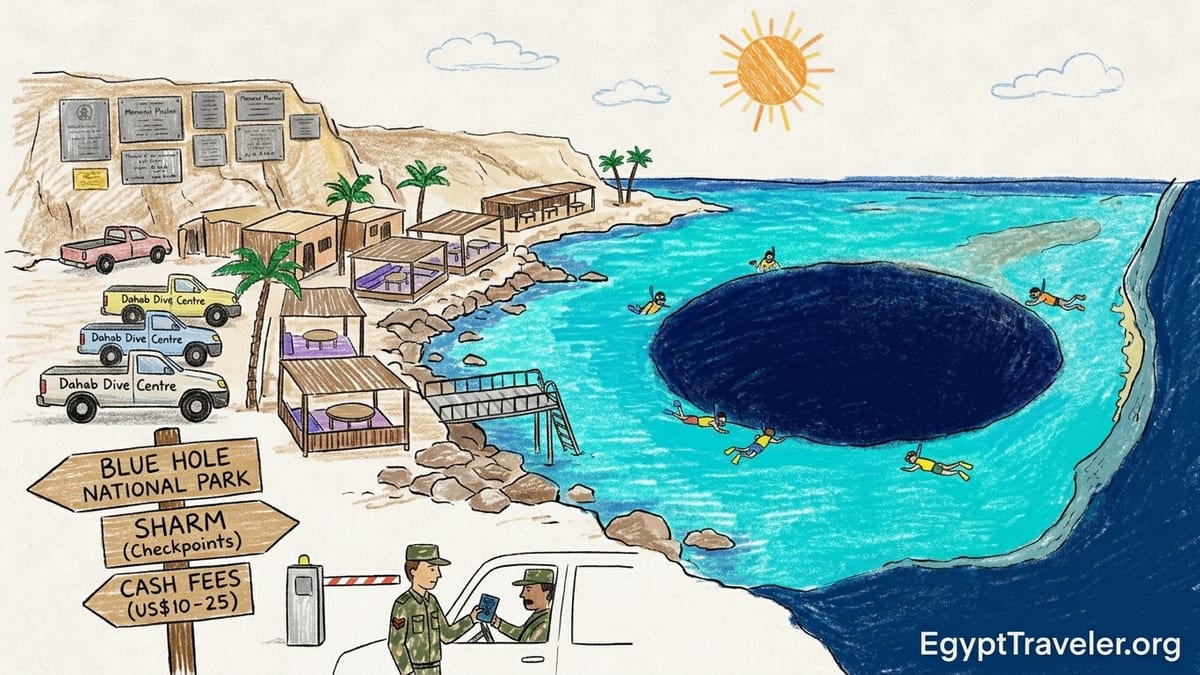
Reaching the site involves at least one security checkpoint on the road out of Dahab. On my most recent visit in 2026, the officer leaned into the window, checked passports and hotel names, and waved us through without drama. Travelers coming from Sharm el Sheikh typically encounter several additional military and police checkpoints along the coastal highway, part of the broader South Sinai security apparatus rather than anything specific to divers.
The money part is murkier. There is a road checkpoint and then a separate collection area closer to the water where guards and local representatives handle the entry fee. Recent rate sheets from dive operators quote a “Blue Hole National Park” or “entrance” charge in the range of 10 to 25 US dollars per foreign visitor, sometimes split between vehicle and per-person fees and sometimes rolled into a package price. Some 2026 operator documents still list around 10 dollars per person, while others and several travel guides now state about 20 to 25 dollars. No one publishes an official, fixed figure, and several local guides I spoke to described the amount as “changing a lot” and “always cash only.” What is clear is that by 2026, visiting the Blue Hole is no longer free, and you should expect to pay a significant, but inconsistent, access charge at the gate.
Once you walk down from the parking area, the scene is jarringly informal for such a famous site. A string of Bedouin-owned cafes lines the rocky shoreline, their shaded platforms looking straight over the void. Metal ladders and rough-cut rock entries drop into startlingly clear water. Tables are stacked with snorkels and fins for rent, and dive trucks from Dahab’s centers park in a ragged line. On the cliffs above the main entry point, rectangular metal memorial plaques catch the sun. The contrast between casual seaside bustle and the reminder of real deaths sets the tone for the whole visit.
The Hole Beneath the Surface: Saddle, Arch and Outer Wall
Seen from above, the Blue Hole looks like a perfectly round ink stain on the turquoise shallows of the Red Sea’s fringing reef. Underwater, it is a vertical marine sinkhole cut into that reef, dropping hundreds of metres into the depths of the Gulf of Aqaba. A narrow lip of coral separates it from the open sea. That geography matters because most of the site’s infamous risk lies not where snorkellers float, but where a submerged tunnel called the Arch connects the sinkhole to the outer reef wall.
The shallowest and most important feature for ordinary visitors is the Saddle, a notch in the outer reef at about six to seven metres deep that forms a natural pass between the inner hole and the open sea wall. This is where most recreational divers and freedivers cross to start or end their dives, and where snorkellers often hover above the drop-off looking down into the blue. At this depth, an experienced guide can keep beginner divers on the wall in safe, well-lit water with a hard depth limit and a direct line back to the surface.
Far below, beginning around 55 metres and extending to roughly 120 metres, is the Arch. It is a long, sloping tunnel eroded through the reef wall that emerges on the outside, facing the open Gulf. The ceiling of the Arch is beyond the depth limit of standard recreational scuba training, which for most agencies is 30 metres, or 40 metres with specific deep-diver certifications under ideal conditions. The Arch is what attracts deep technical divers with mixed gases, redundant gear and complex plans. It is also what has killed a disproportionate number of them when plans, training or conditions were not up to the task.
For a surface visitor, the key point is simple. You will not see the Arch while snorkelling. You will barely, if ever, see it on a supervised recreational dive that obeys normal depth limits. The horror stories that drive social media clicks mostly take place tens of metres below any sensible holidaymaker, in a part of the site that should never be sold as a casual challenge.
Why Divers Really Die Here: Depth, Narcosis and Misplaced Confidence
The Blue Hole’s extreme reputation often gets reduced to a single label: the world’s deadliest dive site. Some articles quote totals of 130 or even 200 deaths without explaining where those numbers come from. Egypt does not publish an official statistic, and the best that local dive professionals can point to are community estimates and the growing number of memorial plaques on the cliff. Unofficial counts make clear that this site has seen more diving fatalities than any other well-known recreational location, but none of them are precise or comprehensive.
Almost all of the serious fatalities cluster around the Arch and deep technical dives rather than shallow wall tours. The physics and physiology are well understood in professional diving safety material. At depths beyond about 30 metres on regular air, nitrogen narcosis alters a diver’s perception and judgment, similar to being mildly intoxicated. At 50 to 60 metres, that impairment can be dramatic. Tasks that feel simple in a classroom, such as reading a depth gauge or managing buoyancy, become significantly harder just as air consumption soars and the opportunity for error shrinks.
Technical divers mitigate those risks with staged decompression gases, redundant regulators, high-capacity cylinders or rebreathers, and extensive training. Even then, deep diving is unforgiving of mistakes, and the Blue Hole’s topography amplifies problems. The Arch runs at an angle so that divers who miss its entrance can easily continue downward on the inner wall, misreading computers or believing they are heading toward the tunnel when they are not. Stories from instructors describe finding bodies far below the Arch ceiling, often with equipment that was inappropriate for the depth attempted or gas mixtures that were never intended for a 90 or 100 metre descent.
One of the best-known modern cases is the Russian diver Yuri Lipski, whose helmet camera recorded his uncontrolled descent and death at over 100 metres in 2000. More recently, in 2017, safety diver Stephen Keenan died while assisting world champion freediver Alessia Zecchini during a deep freedive attempt involving the Arch. Technical divers have also died during training or record attempts in Dahab’s deep sites. None of these people were casual snorkellers or newly certified open-water tourists. Their accidents highlight how thin the margin can be at extreme depths, not how dangerous it is to float on the surface in a life jacket.
Snorkelling and Recreational Diving: Safer, But Not Automatically Safe
At water level, the scene looks less like an extreme sports arena and more like a busy beach club. On my visit, small groups of snorkellers in rental vests kicked along the inner rim, peering down at scattered corals. A handful of guided dive teams geared up beside them, instructors telling students, in multiple languages, to stay with their buddy, follow the wall and ignore the temptation to go deeper than agreed. This mundane safety briefing stands in stark contrast to the internet mythology, yet it is what most visitors actually experience.
Recreational dive operators in Dahab generally treat the Blue Hole as a straightforward wall or drift dive when they are not catering to technical teams. Open Water divers might enter from the Bells site to the north, drop to around 18 metres along the spectacular outer wall, then cross the Saddle back into the hole at six or seven metres and finish with a safety stop. Advanced Open Water divers might go a bit deeper on the wall, to 25 or 30 metres, but a reputable guide will keep them well above any contour that leads toward the Arch. Several local dive centres explicitly state in their briefings that they do not conduct Arch dives on regular air and that no one on a standard day trip will see it.
For snorkellers, the main variables are ladder access, surface chop and how comfortable you feel swimming over a blue void. There are a few narrow entry points where you step across wet rocks and hold onto a rope in light surge. Currents are usually mild inside the hole, stronger along the outer wall when wind and swell pick up. A local guide earns their fee by choosing an appropriate entry, watching less confident swimmers and knowing when to bring the group back in before conditions change. The Blue Hole is not inherently more dangerous for a guided snorkeller than any other Red Sea site, but it demands the same basic respect that many visitors forget the moment they see the famous circle of deep water.
Reef Reality: How Good Is the Marine Life, Really?
Once I was actually in the water, a more awkward question floated up. If this were not called the Blue Hole, and if there were no plaques on the cliffs, would the site’s ordinary snorkelling and recreational diving live up to its fame? For me, the answer is mixed.
The outer wall, accessed via the Bells to Blue Hole route or by swimming across the Saddle, is world-class Red Sea scenery. Hard coral buttresses run down into clear cobalt water, schools of anthias shimmer in purple and orange, and the visibility on my dives exceeded 30 metres. Turtles and pelagics are possible but not guaranteed. This side of the reef fully deserves the attention it gets. Many experienced divers rank the outer wall of the Blue Hole alongside Dahab’s Canyon or some of the better drop-offs in Ras Mohammed National Park.
The interior of the hole is a different story. Below the surface ring of coral and shallow reef, there is mostly just blue water and bare rock. Nutrient flow is more limited than on the outer wall, so there is less soft coral and fewer fish. From a snorkeller’s perspective, the main spectacle is the feeling of hanging over an abyss rather than the richness of the reef itself. A ten-year-old with a mask will absolutely remember peering down into the darkness, but a serious underwater photographer may find the inside of the hole visually monotonous compared with other Dahab sites.
Water access is functional rather than pretty. Ladders rattle, platforms are patched together, and at busy times queues form as groups try to exit at the same spot. There is very little beach, and almost nowhere to sit directly by the water that is not part of a cafe. For some visitors that is part of the charm. You rent a mattress in the shade, order sweet Bedouin tea, and watch the stream of divers. For others it will feel cramped and chaotic, especially once a few large day-trip groups from Sharm arrive mid-morning.
Crowds, Hype and the Business of Death
By late morning on my most recent day at the Blue Hole, I counted more than a dozen guided dive teams, three or four freediving schools running line training sessions near the Saddle, and several busloads of snorkellers in matching life jackets. The water still did not feel dangerously crowded, but the shoreline did. Guides shouted to be heard, tanks clanged on rocks, and everyone seemed to be photographing the same view of the circle from slightly different angles.
That popularity stems in part from the site’s mythology. Many Dahab tour desks still market the Blue Hole primarily by its nickname as a “divers’ cemetery” or “world’s most dangerous dive.” Some cafes near the entry sell T-shirts with skull motifs. Taxi drivers and touts repeat exaggerated death counts without any nuance about who died there, at what depth and under what circumstances. This kind of sensational framing may fill jeeps, but it also blurs the crucial distinction between deep technical dives and ordinary recreational use.
The fatality plaques themselves tell a quieter, sobering story. Names, ages and sometimes short messages from families line a section of cliff just above the entry. Community articles that have attempted to count these plaques in recent years describe dozens rather than hundreds, and they are clear that many deaths never receive a marker. Walk past them after a shallow snorkel and it is easy to misinterpret the risk. The plaques do not say “attempted unqualified 100 metre dive on air” or “lost during deep cave-style penetration.” They simply remind you that this is a place where mistakes at depth have final consequences.
I left with the uncomfortable sense that the Blue Hole’s fame is now driven at least as much by its association with death as by the quality of its everyday diving. That trade in fear and fascination may suit some operators, but it does not serve first-time visitors trying to make an informed decision about where to spend their limited days and money.
Costs and Comparisons: Blue Hole vs Dahab’s Other Reefs
Because operators bundle fees, transport and guides differently, comparing costs is not straightforward, but some patterns are clear. As of 2026, several Dahab dive centres quote a specific Blue Hole site supplement or national park fee on their rate sheets, in addition to their normal day-dive prices. That supplement often falls somewhere around 10 to 20 US dollars per person, and sometimes more once local taxes and vehicle charges are included. Package snorkel trips from Dahab that visit only the Blue Hole, with transport and guide but excluding equipment rental, commonly retail in the equivalent of 30 to 40 euros per person through established shops.
By contrast, Dahab’s in-town sites such as Lighthouse and Eel Garden do not involve the same level of formal entrance fees. You may pay for a local guide, but the shore access is effectively free aside from your transport, which for many visitors is an inexpensive tuk-tuk ride or a short walk from their hotel. Three Pools, south of town, does involve checkpoint control and modest local charges, but recent visitor reports and dive center notes still describe the total as noticeably lower than the Blue Hole’s current structure.
In practical terms, this means that a diver who spends a day doing two reef dives at Lighthouse or Eel Garden will usually pay only the core diving rate and any equipment rental, while the same diver at the Blue Hole will likely see an extra line on the bill just for the privilege of entering the site. For a couple or family over several days, that difference adds up quickly. When you then compare the actual in-water experience, the calculus becomes more nuanced than brochures imply.
Lighthouse offers a gently sloping reef with rich coral gardens and easy entries ideal for beginners, plus night dives with Spanish dancers and hunting lionfish. Eel Garden, on calm days, delivers a surreal meadow of garden eels, sandy gullies and healthy coral heads in clear light. Three Pools combines shallow table corals, natural sand pools and an attractive drop-off with far fewer crowds. None of these spots have the psychological drama of a bottomless hole, but many regular visitors quietly rank them higher than the Blue Hole for photographic opportunities and relaxed exploration.
Who Really Benefits: Matching Visitors to the Site
After several days of conversations with local guides, dive instructors and ordinary travellers, my view of the Blue Hole settled into something more conditional than the brochures suggest. The site does have genuine highlights. Experienced divers under responsible supervision can enjoy superb outer-wall profiles and a scenic Bells-to-Blue-Hole route. Freedivers training on lines near the Saddle get clear deep water with reliable depth markers and an established safety culture. Cafes on the cliff offer one of Dahab’s most iconic views for anyone who is content to watch from above.
For a first-time snorkeller or holiday diver, however, the equation is less convincing. The inner hole’s reef is not Dahab’s richest. Access ladders and rocky entries are more intimidating than the sandy entries at Lighthouse or some hotel house reefs. Crowds at peak times undermine any sense of solitude. Fee structures remain opaque enough that you may not know exactly what you are paying for until cash changes hands at the gate or your dive centre adds a supplement to your invoice.
Most problematic is the mismatch between the Blue Hole’s extreme reputation and the reality of what most visitors actually do there. You cannot, and should not, treat the Arch as a bucket-list challenge unless you are a properly trained technical diver on an appropriately planned expedition. Yet brochures, social media clips and sometimes even casual conversations in Dahab blur that line, giving some tourists the impression that “diving the Blue Hole” inherently includes something much more dangerous and glamorous than a 20-metre wall dive and a swim across the Saddle.
As a travel writer and diver, I came away thinking that Dahab’s Blue Hole is worth visiting for a narrow slice of travellers and overrated or even misleading for others. Its geological fame is real, its death toll significant, but its value as a straightforward snorkelling stop is less clear when set against Dahab’s many alternative reefs.
The Takeaway
If your primary goal in Dahab is to log a safe, colourful snorkelling session or a relaxed first few dives, sites like Lighthouse, Eel Garden and Three Pools deliver more reef for less money, with softer entries, easier logistics and less morbid marketing. You will see abundant coral, schooling fish and classic Red Sea drop-offs without paying a premium for a name that carries baggage you may not want.
If you are an experienced diver interested in deeper walls and you book through a reputable Dahab centre, a Blue Hole day that focuses on the outer wall and the Bells route can be rewarding. Treated as a normal deepish reef dive within recreational limits, under tight supervision and on appropriate gas, it is no more hazardous than many other advanced sites in the region. You should still question any operator who plays up death statistics in their sales pitch while downplaying conservative depth and time planning.
If you are drawn to the Blue Hole primarily because of its deadly legend or because you have seen viral videos of failed extreme dives, consider whether that fascination is a sufficient reason to direct your tourist dollars here. The Arch and the very deep dives that have made this place notorious have no place on a casual holiday checklist. There is value in quietly acknowledging the plaques on the cliff, understanding that most of those people died chasing depth dreams in a risky environment, and then choosing not to repeat that story.
Ultimately, Dahab’s Blue Hole is worth visiting if you know exactly what you want from it and approach both the sea and the sales pitches with clear eyes. For many travellers, especially those who will snorkel only once or twice, an unheralded patch of reef closer to town will provide a richer, calmer, and far less complicated encounter with the Red Sea.
FAQ
Q1. Is Dahab’s Blue Hole the same as Belize’s Great Blue Hole?
This article is about the Blue Hole in South Sinai, Egypt, a sinkhole inside the Red Sea fringing reef north of Dahab. Belize’s Great Blue Hole is a separate, distant site in the Caribbean.
Q2. How deep is the Blue Hole in Dahab?
The Blue Hole drops to several hundred metres, effectively beyond normal diving limits, but recreational visitors usually stay between the surface and about 30 metres on the walls.
Q3. What is the Saddle, and will I cross it?
The Saddle is a shallow notch in the reef at about six to seven metres that links the inner hole with the outer wall. Many guided dives and some snorkel routes cross it as part of a standard circuit.
Q4. What exactly is the Arch and why is it so dangerous?
The Arch is a sloping tunnel that begins around 55 metres, far below recreational limits, and exits on the outer wall. Its depth, length and slant increase the risk of narcosis, disorientation and gas exhaustion for divers who are not appropriately trained and equipped.
Q5. Are the death statistics for the Blue Hole reliable?
Widely repeated figures of 130 or 200 deaths come from community estimates, not official government data. Memorial plaques and local accounts confirm many fatalities, but no authoritative total exists.
Q6. Is snorkelling at the Blue Hole safe?
With a competent guide, a flotation vest if needed and attention to entry and exit points, snorkelling here is broadly comparable in risk to other Red Sea sites, though depths below can feel intimidating.
Q7. How much does it cost to visit the Blue Hole in 2026?
Recent operator price lists and travel reports suggest foreign visitors now pay a site entrance fee in roughly the 10 to 25 US dollar range, often plus transport and guide costs, but exact charges vary and are not clearly published.
Q8. How does the reef compare with Dahab’s Lighthouse or Three Pools?
The Blue Hole’s outer wall is dramatic, but the inner hole has relatively sparse coral. Many visitors find Lighthouse, Eel Garden and Three Pools offer richer shallow-reef life and easier entries for similar or lower overall cost.
Q9. Can I dive the Arch on a normal holiday dive trip?
No. The Arch lies far beyond standard recreational limits and requires advanced technical training, specialised equipment and serious planning. It should never be attempted as a casual or opportunistic dive.
Q10. Who is the Blue Hole best suited for?
The Blue Hole suits experienced divers seeking a famous wall dive and freedivers training under professional supervision. Casual snorkellers and new divers will often enjoy Dahab’s less famous reefs more, with fewer crowds and less emphasis on the site’s fatality history.