


I thought I understood what “quiet Red Sea resort” meant when I booked Marsa Alam. I had read about pristine reefs, relaxed all inclusive hotels and the convenience of an international airport nearby. What I had not understood was how that same remoteness plays out day to day: the transfers, the distances between resorts and towns, the thin nightlife, and how hard it can be to do anything spontaneously once you are checked in. If you are picturing an easy evening stroll to a strip of bars or a choice of restaurants, Marsa Alam may surprise you in ways you do not intend.
First Impressions: Landing Somewhere That Feels Far Away
Flying into Marsa Alam International Airport, the remoteness looks romantic. From the plane window you see desert stretching to the horizon and a thin ribbon of deep blue Red Sea. On the ground the airport is compact and relatively quiet compared with Hurghada or Sharm el Sheikh. That peace is part of the appeal, but it also signals how small and spread out the region really is once you leave the terminal.
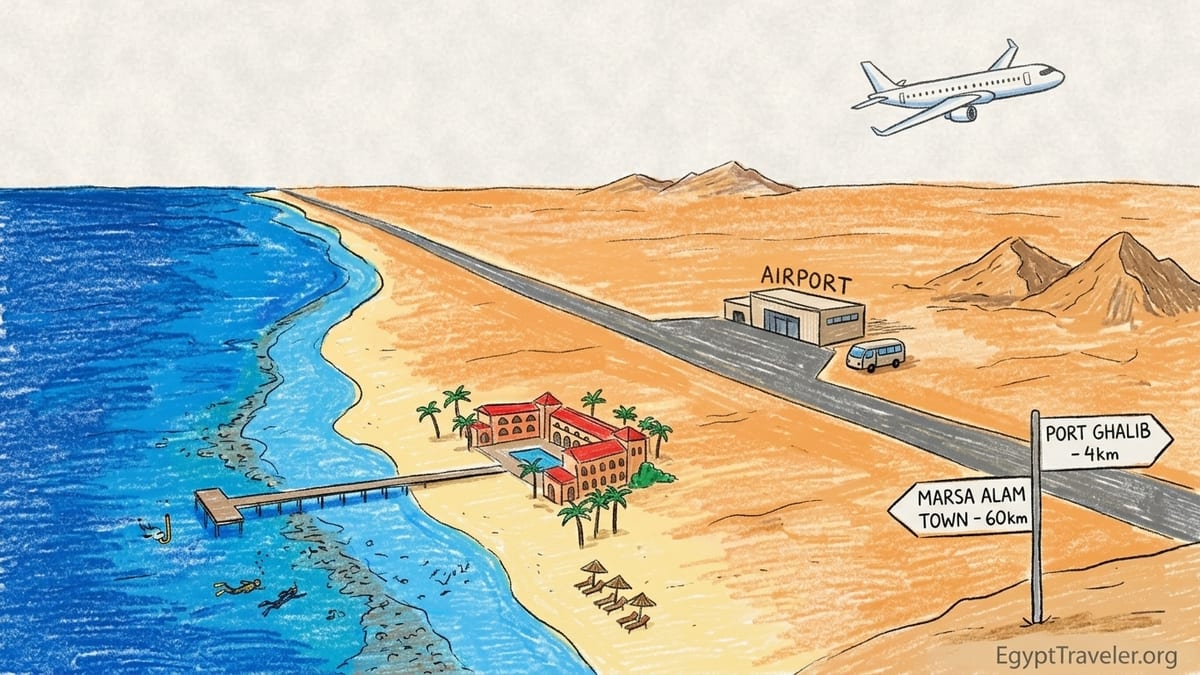
The airport sits inland from the coast, with most visitor infrastructure strung out along roughly 60 to 80 kilometres of shoreline. Port Ghalib, the main marina development and nightlife hub, lies only about 4 kilometres north of the airport, and taxis can cover that 7 to 8 kilometre trip in around 10 to 15 minutes in light traffic. By contrast, Marsa Alam town itself is roughly 60 to 70 kilometres to the south depending on which district you are heading for, and the transfer time from the airport is usually around 45 to 60 minutes by car. Once you add check in waits and luggage, even a “short” arrival can feel like a half day of transit.
On my own trip I had chosen a resort further down the coast for what brochures described as “seclusion” and house reef access. The transfer by pre booked minibus, shared with a few other guests, took a little over an hour from the airport. At night the desert road is unlit for long stretches, with only the occasional checkpoint or resort gate breaking the darkness. It felt safe but undeniably isolated, and by the time we pulled into the hotel driveway it was clear spontaneous evenings anywhere else would not be part of this holiday.
This is the first practical reality many visitors underestimate. Marsa Alam is technically “served” by an international airport, but unless you stay in Port Ghalib itself or in one of the closer bays such as Madinat Coraya, you should expect a fairly long drive after you land and a sense of being far from any actual town once you arrive.
Airport Transfers, Taxis and the Cost of Being Spread Out
On paper, airport to resort logistics in Marsa Alam look simple. Many package holidays bundle in a group coach transfer. Independent travellers often arrange a private car through their hotel or a local operator. The reality on the ground is that the region’s long, linear layout magnifies every distance. A resort 25 kilometres north of the airport might be a relaxed 25 minute drive. One 60 kilometres south may be closer to 70 or 80 minutes, especially if your vehicle drops other guests along the way.
Prices vary by operator, but a typical pre booked private transfer from the airport to Port Ghalib or nearby resorts often runs in the region of 25 to 40 US dollars one way per car. Journeys to resorts around Marsa Alam town or beyond can cost more, sometimes around 50 to 70 US dollars one way, because they involve longer distances and the return drive for the driver. Shared buses included in packages soften that blow, but they also mean multiple hotel stops and slower journeys. None of this is unreasonable for a remote coastline, but it is important to factor in if you are used to quick, cheap airport shuttles that drop you in a dense resort town.
Taxi availability shapes your stay even more. Near Port Ghalib, there are local taxi and transfer companies that serve the airport, marina and nearby hotels, and some restaurants such as those around the marina promenade even offer free hotel pick up if you reserve a table in advance. Once you stay 30 or 40 kilometres away from that hub, taxis exist but are less visible and almost always need to be pre arranged via hotel reception. There is no ride hailing app network, no meter based city taxi rank waiting outside, and no easy way to flag down a passing cab on the coastal highway.
On one evening when I decided at 20:30 that I wanted to leave the hotel for a drink elsewhere, the receptionist politely explained that the earliest a car could be arranged was in around 45 minutes and that a return after midnight would need to be negotiated in advance because the driver might be coming from another town. The price quoted for a return trip to the closest small cluster of cafes was more than I would normally spend on a good dinner in Cairo. In the end I stayed in the resort bar, which was comfortable but not the varied night out I had imagined when I booked a “Red Sea week” months earlier.
Where Are the Towns: Distances to Port Ghalib and Marsa Alam
To understand why Marsa Alam can feel isolating, it helps to picture the geography. Port Ghalib is a purpose built marina town just north of the airport, designed as a resort city with waterfront hotels, bars, cafes, a promenade and a cluster of shops. It is the closest thing the area has to a walkable nightlife strip, with venues along the marina open from late morning into the early hours, including sports bars, tapas and grill spots, shisha terraces and ice cream cafes.
Marsa Alam town, by contrast, is a modest local community some 60 or so kilometres down the coast. It has supermarkets, a bus station, workers’ housing, a few basic restaurants and cafes and a more Egyptian feel. From many of the big all inclusive resorts, especially those built south of the airport, a round trip taxi into town and back can mean more than 120 kilometres of driving. For guests staying three or four nights that may not feel worthwhile. The result is that the majority of visitors experience almost nothing of Marsa Alam town itself and instead shuttle between airport, hotel and organized excursions.
This long coastal strip layout also affects simple errands. Want to buy sunscreen, snacks or snorkel gear outside hotel prices. In Port Ghalib there are small minimarkets and tourist shops along the marina and in adjacent complexes. If you are based 40 kilometres down the road, however, your “local shop” may in practice be the resort’s gift store. On my stay, when I realized I had forgotten a charging cable, the concierge explained that the nearest external electronics shop was in Marsa Alam town, a 90 minute round trip. The resort convenience shop stocked a single kind of universal adapter at a steep mark up. I bought it, but it underscored how self contained the hotel ecosystem really was.
None of this is a problem if you arrive prepared and plan to stay mostly on site. Yet it can frustrate travellers who are used to strolling out from their hotel to explore side streets, pick up groceries or find a casual local restaurant five minutes’ walk away. In Marsa Alam, unless you deliberately book into Port Ghalib or a similar integrated marina style development, that sort of everyday exploration is not part of the deal.
Excursions, Early Mornings and the Long Day Out
The remoteness of Marsa Alam shines when it comes to nature excursions, but that also means long days and early starts. Many of the region’s headline experiences, such as boat dives on offshore reefs, snorkelling trips to popular bays, or desert safaris into Wadi El Gemal National Park, involve significant road or sea travel. Operators collect guests from dozens of resorts spread along the coast, and the first pick up can be very early.
On one dive day the minibus arrived outside my hotel shortly after 05:30 for a transfer to a port north of the airport. We then spent almost 90 minutes stopping at other hotels up the coast before reaching the marina and boarding the boat around 07:15. The sea day itself was wonderful, but there was no avoiding that the combined transfer time approached three hours out of a long, hot day. Other guests staying much closer to the departure point, around Port Ghalib itself, stepped onto the boat looking noticeably more rested.
Trips into Wadi El Gemal highlight the same pattern. Many tours from coastal resorts involve a late afternoon departure by 4x4 or minibus, a drive inland to the park’s desert valleys, stops in Bedouin style encampments and a sunset over the mountains before a return to the hotels well after dark. Distances vary depending on where you start, but if your resort is closer to the northern part of the strip you can expect both a longer drive down the coast to reach the park’s access points and the inevitable evening drop off circuit to other hotels before your own.
For travellers who love structured full day adventures bookended by quiet resort time, these long transfers can be part of the rhythm. For those who imagine a quick, casual outing that still leaves the evening free for town exploration, the practicalities may come as a surprise. After a 12 hour day that begins at dawn, many guests end up simply eating at the main buffet and going to bed, which reinforces the feeling that the hotel is the whole destination.
Nightlife, Dining Choices and the Reality of Resort Isolation
When it comes to nightlife, Marsa Alam is not built on the same model as Hurghada, Sharm el Sheikh or even El Gouna. Outside Port Ghalib marina and a couple of smaller bays with multiple hotels facing the same cove, there is effectively no independent bar or club scene lining the streets. Evening entertainment happens inside resort gates: lobby bars, pool bars, low key live music, occasional beach parties or theatre style shows. Some large hotels have several bars spread between pools and lounges, but they all belong to the same property and share the same clientele.
Port Ghalib itself provides a concentrated pocket of options, with a marina promenade lined by sports bars, tapas places, shisha lounges and cafes staying open until midnight or later. Restaurant terraces look onto moored yachts, and visiting divers and liveaboard crews mix with resort guests out for a change of scene. If you are staying in the town’s hotels, a 10 minute walk can take you from a beachfront bar to an Italian dinner and then to an ice cream kiosk. If you are staying 35 or 50 kilometres away, that same evening becomes a pre booked taxi night out that costs as much as an extra excursion.
Independent dining choices reflect the same pattern. Inside my resort the main buffet rotated themes but remained broadly similar each night. There were two à la carte venues available with reservations, an Italian style restaurant and a seafood terrace. After four evenings, the loop of buffet, same bars and familiar seating areas began to feel repetitive. I asked about nearby alternatives and learned that the closest off site restaurant was in another resort more than 10 kilometres away, reachable only by arranging a transfer through reception. It was feasible but felt disproportionate just to vary dinner.
Over several days this physical separation from any town or external cluster of venues can build into a sense of cabin fever, especially for travellers who do not dive and are less occupied during the day. Parents with restless teenagers, couples who enjoy bar hopping, or solo travellers hoping to meet others outside their hotel may find the atmosphere pleasant but a little static. The remoteness that keeps the beaches quiet also keeps the evenings comparatively subdued, which is either perfect or frustrating depending on your expectations.
Why Remoteness Is Also Marsa Alam’s Greatest Strength
It would be unfair to frame Marsa Alam’s remoteness as purely a drawback. The same characteristics that make spontaneous nightlife and independent exploration difficult are precisely what protect the region’s strongest assets. Compared with more built up Red Sea resorts, there is less continuous urban development, fewer high rise hotels on top of one another and more stretches of wild or lightly developed shoreline.
For divers and snorkellers, this often translates into quieter reefs and less congested boat traffic. Offshore sites can still become busy at peak times, but the sheer distance from major cities limits casual weekend crowds. Many resorts boast direct access to fringing reefs via long jetties that lead guests over shallow coral shelves into deeper water, and these house reefs can remain in relatively good condition because each is shared among fewer properties.
On land, access to large protected areas like Wadi El Gemal National Park is one of Marsa Alam’s defining advantages. The park covers a vast mix of desert mountains, wadis and coastal habitats. Day trips from coastal hotels can include time on uncrowded beaches south of the main resort strip, mangrove lined inlets and sparsely visited viewpoints. The experience feels more like entering a genuine wilderness than taking a quick desert tour outside a large city, precisely because there is little else around.
For travellers who crave nature, silence and distance from urban light pollution, these qualities outweigh the frustration of limited nightlife. Stargazing from the beach, hearing almost nothing but wind and waves at night, and waking up to a horizon uninterrupted by other towns all become part of the appeal. The important thing is recognizing that you are choosing a nature destination first and a typical resort town only very distantly second.
Who Should Probably Avoid Marsa Alam’s Remote Coastline
Given these trade offs, there are certain types of travellers for whom Marsa Alam’s more isolated stretches are likely to disappoint. If your ideal holiday revolves around changing restaurant every night, browsing boutiques after dinner and ending up in a busy bar at 01:00 without pre planning, you will find far more options in Hurghada, Sharm el Sheikh or El Gouna than on this southern Red Sea coast.
Shoppers who enjoy wandering pedestrian zones lined with independent stores will also feel constrained. Outside Port Ghalib, most of the shopping that an average visitor will see consists of hotel gift shops, small minimarkets within resort complexes and the occasional cluster of tourist stores at excursion departure points. Bargain hunting, café hopping and people watching are not central themes here. Even Port Ghalib, pleasant as it is, is a small marina city rather than a large urban centre.
Spontaneity is another test. If you like to wake up and see where the day leads, hopping on local buses or deciding over breakfast to walk into the nearest neighbourhood, Marsa Alam’s lack of public transport and its distances between settlements will frustrate you. Without pre arranged taxis or tours, most visitors are effectively limited to walking the grounds of their own resort and its immediate beachfront.
For first time visitors to Egypt who want a mix of culture, city life and the sea, basing a full week exclusively within one isolated Marsa Alam resort can feel unbalanced. Pairing a shorter stay here with time in Luxor, Aswan or Cairo may create a more rounded trip. The region shines as a second or third Egyptian destination for people who already understand the country’s rhythms and are intentionally seeking a quiet, sea and desert focused break, rather than as a standalone introduction to Egyptian life.
How I Would Plan My Next Marsa Alam Trip Differently
Having learned these lessons the slow way, I would not avoid Marsa Alam in future, but I would structure the trip much more deliberately around its remoteness. Rather than a full week at an isolated resort 60 kilometres from the airport, I would reduce the classic all inclusive component to perhaps three or four nights, enough time to enjoy the house reef, recharge by the pool and take one early morning boat trip without feeling rushed.
I would then base myself in or very close to Port Ghalib for the remaining time, accepting the slightly more built up feel in exchange for walkability and independent evening options. Being able to leave the hotel after dinner, wander along a lit marina promenade and choose between a few different bars and dessert spots on foot makes a big difference when you have already spent hours in transfer vehicles for sea or desert excursions.
On the activity side, I would bundle experiences strategically. One day would be dedicated entirely to a Wadi El Gemal safari from a hotel located closer to the park, minimizing road time. Another early morning would be reserved for a boat or shore based diving day with a local operator, with no other plans in the evening beyond a casual dinner in Port Ghalib. I would also block a completely empty day with no excursions at all, giving space simply to enjoy the sea and the stillness that are Marsa Alam’s greatest strengths.
Most importantly, I would adjust my expectations. Marsa Alam is not a place to improvise nights out or to expect surprises around every corner. It is a destination you choose precisely because it is quieter and more remote, where the main events are the reef drop off outside your hotel, the dolphin pod that might pass at noon and the shadow of mountains turning orange at sunset. Framed that way, the long transfers and thin nightlife are trade offs that feel acceptable rather than frustrating.
The Takeaway
Marsa Alam’s reputation for pristine reefs, uncrowded beaches and protected natural areas is deserved, but those qualities exist because the region remains relatively isolated, with infrastructure stretched along a long coastal strip rather than concentrated in one busy town. Airport to resort transfers can be longer than many visitors expect, taxis are largely pre arranged rather than on demand, and both nightlife and independent dining options are limited outside the small hub of Port Ghalib marina.
For travellers who thrive in quiet surroundings, are happy to plan excursions in advance and see their hotel as a base camp between nature experiences, these constraints will hardly register. A few early mornings, some long road or boat transfers and evenings spent under the stars instead of neon lights will feel like part of the charm. The payoff is access to healthy reefs, broad desert landscapes and relatively low levels of urban development compared with other Red Sea destinations.
For others, particularly those who prioritize bars, shopping, frequent restaurant changes or casual day to day exploration, Marsa Alam’s remoteness can become a source of cabin fever after several days. In that case, a shorter stay here combined with time in a more urban resort or a cultural city may strike a better balance. Understanding these dynamics before you book is the key. Marsa Alam is neither a failure nor a secret paradise; it is simply a remote coastal region that rewards travellers who accept its limitations as the price of its greatest strengths.
FAQ
Q1. How long is the transfer from Marsa Alam Airport to most resorts.
The drive from Marsa Alam Airport to Port Ghalib hotels is usually around 10 to 20 minutes, while resorts near Marsa Alam town can take 45 to 60 minutes or more depending on distance and stops.
Q2. Is it easy to get taxis in Marsa Alam for spontaneous trips.
Outside Port Ghalib, taxis are not usually waiting outside resorts and almost always need to be booked in advance through hotel reception or a transfer company, which limits spontaneous outings.
Q3. Can I walk from my resort to nearby bars and restaurants.
In most of the coastal strip resorts are isolated and separated by long stretches of road, so walking to outside venues is often impractical; only in Port Ghalib and a few bays is a genuine evening promenade realistic.
Q4. What is nightlife like compared with Hurghada or Sharm el Sheikh.
Marsa Alam’s nightlife is far quieter, with most evening entertainment confined to hotel bars and low key shows, plus a handful of livelier venues in Port Ghalib marina rather than full club districts.
Q5. Are there many independent restaurants outside the hotels.
There is a compact cluster of independent restaurants and cafes around Port Ghalib, but along the wider coast dining is dominated by hotel buffets and in house à la carte venues inside resorts.
Q6. Is Marsa Alam a good choice for non divers.
Non divers who enjoy quiet beaches, snorkelling from shore and desert scenery usually do well here, but travellers who rely on buzzy towns and varied nightlife may find the atmosphere too subdued.
Q7. How often will I need to wake up early for excursions.
Many boat trips and desert safaris involve early morning or late afternoon departures with hotel pick ups, so expect some days to start around sunrise if you want to see offshore reefs or Wadi El Gemal.
Q8. Is it possible to combine Marsa Alam with cultural sightseeing.
Yes, many visitors pair a shorter Marsa Alam stay with time in Luxor or Cairo, using internal flights or road transfers, which balances the region’s quiet coast with richer historical and urban experiences.
Q9. Who is Marsa Alam best suited for.
Marsa Alam suits travellers who prioritize nature, diving, snorkelling, stargazing and relaxed resort time rather than nightlife, shopping or frequent changes of restaurant and bar.
Q10. How can I reduce the feeling of isolation on a Marsa Alam trip.
Staying part of the time in Port Ghalib, planning key excursions in advance, packing essentials and limiting your stay in the most remote resorts to a few nights can all help the trip feel more balanced.