


I arrived in Sharm El Sheikh expecting Egypt in widescreen: dusty backstreets, sidewalk falafel stalls, and the layered history I had found in Cairo and Luxor. What I stepped into instead felt closer to a polished Mediterranean resort city than the Egypt of my imagination. Sharm was clean, convenient, and remarkably easy, with coral reefs nearly touching the shore and hotel staff who remembered my coffee order by day two. Yet outside the hotel gates, the everyday life I associated with Egypt felt curiously distant. That gap between expectation and reality shaped my entire stay, and it is the dilemma many travelers run into when they assume every Egyptian destination will deliver the same dose of history and street life.
A Purpose-Built Red Sea City, Not a Historic Egyptian Town
Sharm El Sheikh is, by design, a modern resort city. Official Egyptian tourism describes it as a former dive outpost that has grown into a full-fledged destination of five-star hotels, golf courses, shopping centers, and conference venues, sandwiched between Ras Mohammed National Park to the south and the Nabq protected area to the north. The emphasis here is on sun, sea, and service infrastructure, not on medieval alleys or Ottoman architecture. You feel that the moment you leave the airport and drive along wide, landscaped roads that could be almost anywhere on a warm coastline.
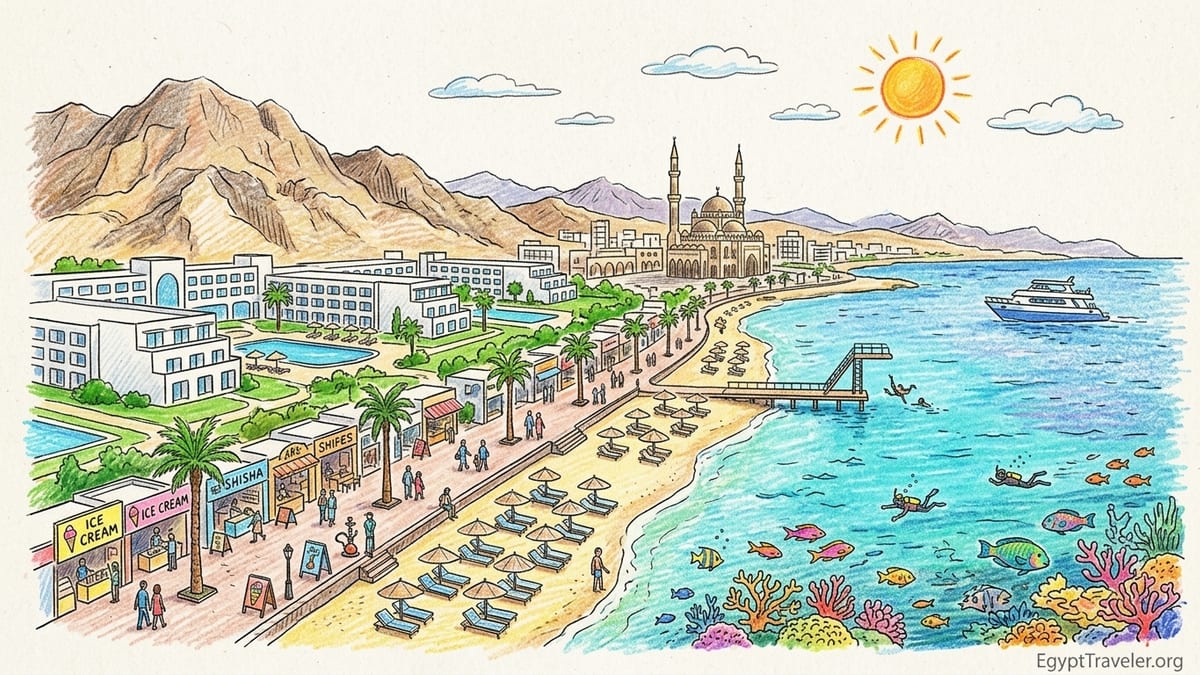
On my stay I based myself for a week at a large beachfront resort on the Naama Bay side of town, one of the original hubs of Sharm’s tourism boom. Naama Bay is a natural curve of sand in central Sharm, with a pedestrian promenade running along the water and a long line of hotels, cafes, restaurants, and dive centers sharing the same beach strip. The atmosphere reminded me less of Cairo’s old quarters and more of European resort strips, with neon-lit restaurant boards, shisha lounges, and gelato counters facing the sea.
Sharm is also a significant conference and events city. It has hosted major international summits including the UN climate conference, which explains the high concentration of upscale hotels, security presence, and polished infrastructure. This layer of diplomacy and business travel sits on top of the classic Red Sea holiday formula of diving, snorkeling, and beach relaxation. It is efficient and well-oiled, but it does mean you are moving through planned zones rather than an organically grown Egyptian town center.
All of this is important context. Sharm is not pretending to be another Luxor or Aswan. It was never a historic capital and it does not have a dense old city with centuries of monuments. It is a purpose-built Red Sea holiday city that happens to sit beside protected natural areas. When you arrive expecting mosques that have watched over markets for hundreds of years, you may feel something is missing. When you arrive expecting clear water, coral reefs, and resort comfort, it delivers almost exactly what is advertised.
Where I Stayed: Inside the Resort Bubble at Naama Bay
My base was a mid-range beachfront resort on the Naama Bay promenade, the longest-established resort strip in Sharm. It had the classic Red Sea formula: low-rise whitewashed buildings, rooms facing pools, an all-inclusive restaurant, and its own section of the shared beach with sunbeds lined up in neat rows. From my balcony I could see the curve of Naama Bay and the Sinai mountains behind it, while below, staff raked the sand each morning before guests emerged with beach towels and inflatable rings.
The appeal of this kind of resort life is obvious the moment you check in. Within an hour of arrival I had collected a wristband, found my way to the beach bar, and reserved a spot on a house reef snorkeling platform. The on-site dive center could arrange everything from introductory dives to advanced trips, and reception could book desert quad-bike excursions, star-gazing nights, or a day by boat to Ras Mohammed. For a traveler who wants maximum relaxation with minimal decision-making, Sharm’s resort compounds work brilliantly.
However, they also create a clear boundary between visitor life and local life. My package included three buffet meals a day, so there was little practical reason to leave the hotel complex other than curiosity. Room charges and bracelets made it easy to avoid using local currency, and most of the staff visible to guests worked in hospitality or tourism services. It was possible to spend days moving between pool, beach, and spa without setting foot on an actual city street.
This “bubble” has safety and convenience built into it, but travelers expecting to wander into a lived-in Egyptian neighborhood will find that the resort gates mark a real psychological line. Once you pass through security and out onto the main road or down to Naama Bay promenade, you are back in a curated environment aimed primarily at tourists, not a multi-purpose local city center.
Naama Bay vs Old Market: Two Faces of Sharm
During my stay I split my evenings between Naama Bay and the Old Market area around Sharm El Maya, which is often described as the more “local” and atmospheric part of town. Both areas are shaped by tourism, but they give different flavors of Sharm.
Naama Bay, a short taxi ride from my resort, is the main entertainment strip. From late afternoon the pedestrian promenade fills with visitors walking between beach bars, shisha cafes, souvenir shops, and dive shops closing up after the day’s boat trips. Music pulses from open-fronted bars, vendors call out offers of fresh juice or mixed grills, and digital screens advertise football matches and live music. This is where you go for convenience: you can have sushi one night, Lebanese the next, and a burger after that, all within a ten-minute walk. Much of Sharm’s nightlife still concentrates here, though it can feel quieter outside peak holiday seasons.
The Old Market, by contrast, sits near the port at Sharm El Maya. Here narrow streets fan out around the striking Al Sahaba Mosque, a large, ornate structure that has become one of Sharm’s most photographed landmarks. The surrounding market streets are packed with spice stalls, clothing shops, perfume sellers, and traditional restaurants grilling kebabs and kofta over open coals. There is more local flavor here, more Arabic spoken around you, and a closer sense of the Egyptian everyday economy, though it is still heavily oriented towards visitors.
Yet even in the Old Market, the experience is mediated by tourism. Shopkeepers expect bargaining as a matter of course, and many stalls are stacked with the same mass-produced souvenirs you see in Naama Bay: pyramids, papyrus prints, hookah pipes, and t-shirts featuring Red Sea fish. Restaurant menus are often printed in multiple languages and the prices are calibrated for outsiders. It felt more authentic than the resort compound, but not equivalent to walking through a Cairo neighborhood market where tourists are a minority.
Comparing the two, Naama Bay delivered the smoothest experience in terms of walking, dining, and people-watching, while the Old Market gave a better sense of Egypt’s sensory overload and market culture. Neither area, however, gave the feeling of being in a historic city with deep roots. They are both, in different ways, commercial districts built around the needs of visitors to a modern resort city.
What Sharm Gets Brilliantly Right: Sea, Safety, and Simplicity
The strongest part of my Sharm El Sheikh experience was almost everything connected to the sea. The Red Sea coast here is famous among divers for good reason. Coral gardens start surprisingly close to shore, and on house reefs in Naama Bay I saw clouds of anthias, parrotfish, and butterflyfish while still within sight of my hotel sunbed. Visibility was excellent on most days, and the combination of calm water and sheltered bay makes it appealing even for first-time snorkelers.
Day trips by boat to Ras Mohammed National Park and the Straits of Tiran were the highlight of the week. Local dive centers typically offer full-day packages that include two dives, lunch on board, and hotel transfers. Recent price examples from visitors and dive operators suggest that a guided day of boat diving around Ras Mohammed may be around 80 to 120 euros per person depending on equipment rental and park fees, while combined snorkeling and introductory dive trips tend to be priced lower per person for non-divers. These are not bargain-basement costs, but relative to the quality of reefs and the included services they feel fair.
From a practical point of view, Sharm is also easier to navigate than many other Egyptian cities. Roads between the main districts are straightforward, resort areas are signposted in English and Arabic, and taxis or ride services can cover most journeys in 10 to 20 minutes. Security checkpoints are visible on main approach roads and at resort entrances, which can feel reassuring for visitors who are new to the region. I felt comfortable walking along the Naama Bay promenade at night, and in the Old Market I encountered the usual mix of persistent sales pitches and invitations to browse, but nothing that felt threatening.
For travelers who want a holiday that largely runs on autopilot, Sharm excels. Airport transfers are quick, resort staff speak multiple languages, and many hotels now include on-site COVID-era health protocols as standard background practice. Families appreciate the kids’ clubs and water slides. Older travelers like the ability to stroll along a flat promenade rather than climbing historic staircases. For all-inclusive guests in particular, daily logistics nearly vanish, and the Red Sea becomes the centerpiece around which everything else revolves.
Where It Feels Artificial: Compounds, Pricing, and Packaged Culture
For all its strengths, Sharm often feels more like a carefully controlled holiday product than a living Egyptian city. Inside the hotel compounds the experience is designed for maximum predictability. The same international pop songs play by the pool each afternoon, buffets cycle through themed nights, and entertainment teams lead aqua aerobics sessions with cheerful enthusiasm. If you have stayed in other large resorts around the Mediterranean or Caribbean, you will recognize the patterns almost instantly.
The commercial promenades continue that sense of repetition. In Naama Bay, many shops stock similar souvenirs, beach clothing, and brand-echo perfumes, and the restaurant boards can blur together after a few evenings. There are excellent meals to be found, yet it can be surprisingly hard to identify where residents themselves like to eat, because so much of the frontage is pitched to short-term visitors. Tourist pricing is common, particularly for things like camel rides on the beach, private speedboat trips, or spur-of-the-moment desert excursions. It pays to compare offers from different operators, check reviews, and be willing to negotiate when appropriate.
Excursions marketed as opportunities to “see the real Egypt” can also feel scripted. I booked one combined desert and Bedouin evening trip that included quad biking, a brief sunset stop on a hill, and dinner in a camp-style setup. The scenery was unquestionably beautiful, with rocky desert lit by pink light, but the sequence of activities was timed to the minute, and our interactions with hosts were clearly rehearsed for each group that cycled through. It was enjoyable as an outdoor evening, but it did not offer deep cultural insight into Sinai’s Bedouin communities.
Perhaps the most significant missing piece for culture-focused travelers is historic depth. Unlike Cairo, there is no medieval street network here, no centuries-old mosques layered into markets, no pharaonic temples a short taxi ride away. Sharm’s landmarks tend to be recent, such as the Al Sahaba Mosque in the Old Market or modern sculptures on roundabouts. When I spoke to Egyptian staff from other cities, several mentioned that they come to Sharm for work, sometimes for weeks at a time, and then take overnight buses or flights back to their families in Cairo or the Nile Valley. Their lives, in other words, are anchored in a different Egypt than the one you see along Sharm’s promenades.
None of this means that Sharm is “not real Egypt.” It is Egyptian in governance, workforce, and geography. But it is also a resort ecosystem that filters and packages the parts of Egypt that fit a beach holiday, while leaving out much of the everyday street-level experience that travelers may imagine when they book flights to the country.
Adjusting Your Expectations: What You Will Love and What You Might Miss
Understanding Sharm’s nature as a purpose-built Red Sea city helps reset expectations. If you arrive with a primary goal of diving incredible reefs, floating in clear water, and spending evenings in casual bars or cafes with a hookah and a sea view, Sharm will probably exceed your expectations. You can dive different sites every day for a week, walk to dinner along a pedestrian promenade, and sleep in a comfortable room steps from the sand. The logistics of gear, transport, and permits are taken care of by experienced local operators.
If, however, your dream of Egypt centers on walking through narrow lanes that have existed for centuries, listening to the call to prayer echo off historic facades, and sharing bowls of ful or koshari at simple neighborhood restaurants filled with locals, you are likely to miss that in Sharm. There are glimpses of everyday life, especially if you travel beyond the main tourist districts or chat with staff about their backgrounds, but it is not the central offering of the destination. The city’s architecture is functional and modern, and the daily rhythm is shaped by flights and tour buses rather than by age-old patterns of trade and worship.
During my stay I found that holding both ideas at once was the key to enjoying Sharm. I stopped looking for a Khan el-Khalili style bazaar in Naama Bay and instead appreciated the promenade for what it is: a safe, easy place to stroll, people-watch, and choose between international and Egyptian restaurants. I treated the Old Market as an accessible introduction to Egyptian market culture rather than as an untouched relic. I accepted that the most memorable stories I would bring home from Sharm would be about fish and reefs rather than monuments and museums.
For some travelers, especially those on their first trip to Egypt, it can help to think of Sharm as one component in a wider itinerary. A week in Sharm followed by several days in Cairo, Luxor, or Aswan can deliver both sides of the equation: the Red Sea relaxation and the deep cultural immersion. Approached this way, Sharm’s relative lack of historic streets becomes less of a disappointment and more of a contrast that highlights the diversity within Egypt.
Who Sharm Is Perfect For, and Who Should Combine It
Sharm El Sheikh shines for travelers whose priority is the sea. Divers and snorkelers could easily spend ten days here exploring Ras Mohammed, Tiran, local house reefs, and perhaps a longer trip inland to other Sinai dive areas. Families who want predictable weather, shallow swimming areas, and hotel kids’ clubs will find Sharm easy to navigate. Couples looking for a simple winter-sun break with a mix of beach days and low-key nightlife often leave satisfied, especially if they choose accommodation in or near Naama Bay or the more self-contained squares that cluster hotels, fountains, and restaurants.
Sharm is also a strong option for travelers anxious about navigating busy cities. The controlled environment of resort zones can feel more approachable than downtown Cairo’s traffic and intensity. Older travelers or those with mobility concerns may prefer flat promenades and modern hotel elevators to uneven historic streets. The presence of major international hotel brands, private medical clinics, and a hyperbaric chamber for dive accidents further reassures some visitors.
On the other hand, culture-first travelers, history enthusiasts, and those who prefer homestays or small guesthouses over resort compounds should seriously consider pairing Sharm with other Egyptian destinations. Cairo offers layers of Islamic, Coptic, and modern history, from the mosques and markets of the old city to the new museum complexes housing pharaonic treasures. Luxor and Aswan put you in close contact with temples, tombs, and the Nile itself, often in far smaller-scale hotel settings. Alexandria introduces a Mediterranean urban flavor with literary cafes and 19th-century architecture. Spending at least four to six days across one or two of these cities before or after Sharm can transform your understanding of Egypt.
Sharm can also feel limiting for travelers on tight budgets who dislike all-inclusive models. While it is possible to stay in simpler hotels away from the main strips and dine at lower-cost local eateries, many of the most visible experiences, from boat trips to desert excursions, are priced for package-holiday visitors from Europe and the Gulf. If your goal is slow, low-cost travel with a strong sense of integration into local life, cities like Dahab, Luxor, or certain Cairo neighborhoods may be a better fit, with Sharm reserved for a short, targeted taste of the Red Sea.
The Takeaway
Sharm El Sheikh is best understood not as a missing piece of Egypt, but as a specialized corner of it. The city exists primarily to connect visitors with the Red Sea and to provide a comfortable, controlled environment in which to enjoy it. Its strengths are clear: accessible reefs, professional dive infrastructure, clean resort beaches, straightforward logistics, and a sense of security that many first-time visitors appreciate. Within that frame, places like Naama Bay and the Old Market offer different evening atmospheres, from polished promenade to more traditional bazaar energy.
At the same time, if you come expecting every Egyptian destination to look and feel like the historic cores of Cairo or Luxor, Sharm will likely surprise you. The hotel compounds, tourist-oriented promenades, and packaged excursions can feel disconnected from the deeper currents of Egyptian life. The city’s modern skyline and recent landmarks do not carry the same emotional weight as buildings that have stood for centuries. For some travelers this is a welcome break, for others a source of quiet disappointment.
The most satisfying way to approach Sharm is with both clarity and curiosity. Recognize it as a purpose-built Red Sea holiday city whose greatest treasures lie under the water and along its carefully maintained beachfronts. Then, if you crave more, build an itinerary that also takes you to Cairo’s old streets, Luxor’s temples, or Aswan’s riverfront neighborhoods. In doing so, you will experience both the resort sheen and the historic depth that together make up contemporary Egypt.
FAQ
Q1. Is Sharm El Sheikh a good first stop for a trip to Egypt?
Sharm can be an excellent first stop if you want a gentle introduction focused on sea and relaxation. It is modern, relatively easy to navigate, and offers plenty of English-speaking services. For a fuller sense of Egypt, follow it with time in Cairo, Luxor, or another historic city.
Q2. Where is the best area to stay in Sharm for a first-time visitor?
Naama Bay is a strong choice because you can walk from many hotels directly to the beach, promenade, restaurants, and bars. If you prefer a quieter, more self-contained environment, newer resort clusters and squares offer landscaped plazas, fountains, and restaurants within a compact area, though you may rely more on taxis to reach other districts.
Q3. How expensive are diving and snorkeling trips in Sharm El Sheikh?
Prices vary by operator and season, but recent examples suggest a full-day boat trip with two guided dives around sites such as Ras Mohammed might cost in the region of 80 to 120 euros per person, including lunch and hotel transfers, with snorkeling and introductory dives often priced lower. Always confirm current rates on the ground and check what equipment and fees are included.
Q4. Is Sharm El Sheikh safe for independent travelers?
Most visitors experience Sharm as safe, with visible security around hotel areas, roads, and public spaces. As in any tourist destination, standard precautions apply: keep valuables secure, agree taxi fares in advance where meters are not used, and be cautious with late-night alcohol consumption. Solo travelers often report feeling comfortable walking the main promenades in the evening.
Q5. Will I experience everyday Egyptian culture in Sharm?
Only to a limited extent. You will interact with Egyptian staff in hotels, dive centers, and shops, and the Old Market area offers a livelier, more local-feeling environment. However, Sharm’s layout and economy are focused on tourism, so you will not encounter the same density of everyday street life and long-standing neighborhoods you would find in Cairo or the Nile Valley.
Q6. How does Naama Bay compare to the Old Market for evenings out?
Naama Bay is more polished and geared to international visitors, with seafront bars, cafes, and restaurants in a pedestrian-friendly strip. The Old Market has a more traditional market feel, centered around the Al Sahaba Mosque, with spice shops, souvenir stalls, and grill restaurants. Both are worth visiting, but neither is a historic old town in the sense of Cairo’s ancient quarters.
Q7. Are all-inclusive resorts in Sharm worth it?
All-inclusive resorts suit travelers who plan to spend most of their time on-site, enjoying pools, private beaches, and included meals. They are convenient for families and those who dislike thinking about daily budgets. If you prefer exploring local restaurants and smaller guesthouses, a bed-and-breakfast or room-only option in a well-located hotel may give you more flexibility and a greater sense of place.
Q8. Can I visit Cairo, Luxor, or other historic sites on a day trip from Sharm?
There are long day tours by air or bus advertised to Cairo and Luxor, but they tend to involve very early departures, long travel times, and tightly packed itineraries. For a more relaxed and meaningful experience, it is better to plan at least one or two nights in those cities rather than trying to visit them as quick side trips from Sharm.
Q9. What is the nightlife like in Sharm El Sheikh?
Nightlife centers on areas such as Naama Bay and certain resort squares, with a mix of bars, shisha lounges, and clubs. The scene can vary by season, holiday periods, and cultural factors such as Ramadan. In quieter periods, evenings may feel more about relaxed promenades and cafe culture than about packed dance floors.
Q10. Who will enjoy Sharm most, and who should look elsewhere?
Sharm suits travelers seeking warm weather, clear sea, reliable resort infrastructure, and easy access to world-class diving and snorkeling. Those who care most about street photography in historic districts, local food in everyday neighborhoods, and a strong sense of urban history should either combine Sharm with cities like Cairo and Luxor or choose those cultural centers as the main focus of their trip.