


Egypt’s Mediterranean coast has quietly transformed from a locals’ summer escape into one of the region’s most intriguing beach destinations. From old-world Alexandria to the crystalline coves of Marsa Matruh and the rising luxury strips of New Alamein, Sidi Abdel Rahman and Ras El Hekma, choosing where to stay now shapes the entire feel of your trip. This guide compares the main hubs side by side so you can match each area to your travel style, budget and expectations.
Orienting Yourself: How the Egyptian Mediterranean Is Laid Out
Egypt’s Mediterranean coastline runs in a long arc from Alexandria in the east to Marsa Matruh in the west, a stretch of roughly 500 kilometers along what many Egyptians simply call “El Sahel.” Alexandria is the historic, lived-in city at the eastern end, with year-round life, traffic and culture. Driving west along the coastal road, you reach New Alamein and a dense cluster of gated North Coast resorts, then the upscale bays of Sidi Abdel Rahman and the emerging mega-project of Ras El Hekma, before the coast softens again into the laid-back provincial town of Marsa Matruh.
In practical terms, that means you can land in Cairo and drive around 2.5 to 3 hours to Alexandria, or continue a similar distance from Alexandria to Marsa Matruh, with New Alamein, Sidi Abdel Rahman and Ras El Hekma spread between them along the highway. Many Egyptians treat this coast as a series of “kilometers” and compounds rather than cities, but for travelers, the five hubs in this article are the clearest anchors for choosing a base.
Each area has a distinct personality. Alexandria is about heritage, museums and a lively waterfront. New Alamein brings high-rise towers and public beaches. Sidi Abdel Rahman and Ras El Hekma lean into private, design-driven beach life, beach clubs and branded resorts. Marsa Matruh offers spectacular coves like Agiba and Al Gharam with a more traditional, family-centered atmosphere and lighter price point.
When planning, it helps to decide what matters more to you: historical sightseeing, nightlife, beach quality, resort standards or authenticity. With that in mind, the following sections break down the strengths and trade-offs of each destination and suggest pairings that work well in a one or two-week itinerary.
Alexandria: History, Everyday Egypt and Urban Beaches
Alexandria is the natural choice if you want your Mediterranean stay wrapped in history and city life. This is an active port city of more than six million people with layered Greek, Roman, Ottoman and modern heritage, plus a long waterfront corniche lined with cafes and public beaches. Attractions such as the Bibliotheca Alexandrina, the Catacombs of Kom el Shoqafa, Qaitbay Citadel and the Royal Jewelry Museum make it the most rewarding base for travelers who like to alternate between culture and the sea.
Beaches in Alexandria are more urban and functional than dreamy. Many have coarse or imported sand and sit directly below the corniche road. Beach clubs here are often attached to mid-range hotels or municipal facilities, with day-use sunbed fees that can be modest by Mediterranean standards, sometimes starting at prices that feel inexpensive compared with the North Coast compounds. The trade-off is that water clarity is not as striking as farther west, especially near the harbor, and summer crowds from Cairo can be intense.
For couples and culture-minded travelers, staying in a seafront hotel near the corniche puts you within walking distance of cafés and restaurants serving seafood platters, grilled fish and traditional Alexandrian dishes. Evenings are animated rather than glamorous, centering on strolls along the corniche and casual shisha cafés rather than beach clubs with international DJs. Families benefit from easy access to pharmacies, malls, cinemas and public transport, which keeps logistics simple if you are traveling with children or older relatives.
Alexandria is also the easiest place on this coast to do without a car, thanks to taxis and ride-hailing services, though traffic can be heavy in peak season. For beach purists and honeymooners, however, the city’s atmosphere might feel too hectic. In that case, Alexandria works well as a two-night cultural opener before moving west to a quieter, brighter stretch of coast.
New Alamein: Public Beaches, Towers and a City-in-the-Making
New Alamein sits roughly halfway between Alexandria and Marsa Matruh and represents Egypt’s attempt to build a year-round city on the North Coast. Unlike most nearby gated compounds, its beachfront is designed with public access in mind, framed by promenades, landscaped parks and a skyline of residential and hotel towers. Signature projects like the North Edge Towers and the tall Iconic Tower have made New Alamein instantly recognizable on the horizon, signaling a move away from purely seasonal beach villages to a mixed-use city environment.
For visitors, this translates into a walkable, planned waterfront with public beaches, bike paths and family zones, especially lively in July and August. You will find mid-range to higher-end hotels, furnished apartments, cafés and restaurants that stay open beyond the summer, though the city still feels seasonal in mood. Compared with Alexandria, the sand and water quality are significantly better, but New Alamein’s beach experience still feels urban, framed by towers and broad avenues rather than tucked-away coves.
New Alamein suits travelers who want something between a city and a resort. Families appreciate the open public spaces, playgrounds and the sense of security that comes with a master-planned city. Couples who enjoy skylines and modern architecture may like staying in one of the seafront high-rises, waking up to wide balcony views over the Mediterranean. Nightlife leans toward cafés, casual lounges and seasonal open-air events rather than the private, invitation-only beach parties that define parts of Sidi Abdel Rahman and Ras El Hekma.
From a budget perspective, New Alamein offers more variety than pure-resort areas. You can rent serviced apartments on weekly rates that undercut some of the enclosed North Coast compounds, while still having access to a maintained public beach. If you are planning a road trip, New Alamein makes a convenient base for visiting the World War II sites around El Alamein and then continuing west to Sidi Abdel Rahman or Ras El Hekma.
Sidi Abdel Rahman: The Classic Luxury North Coast Bay
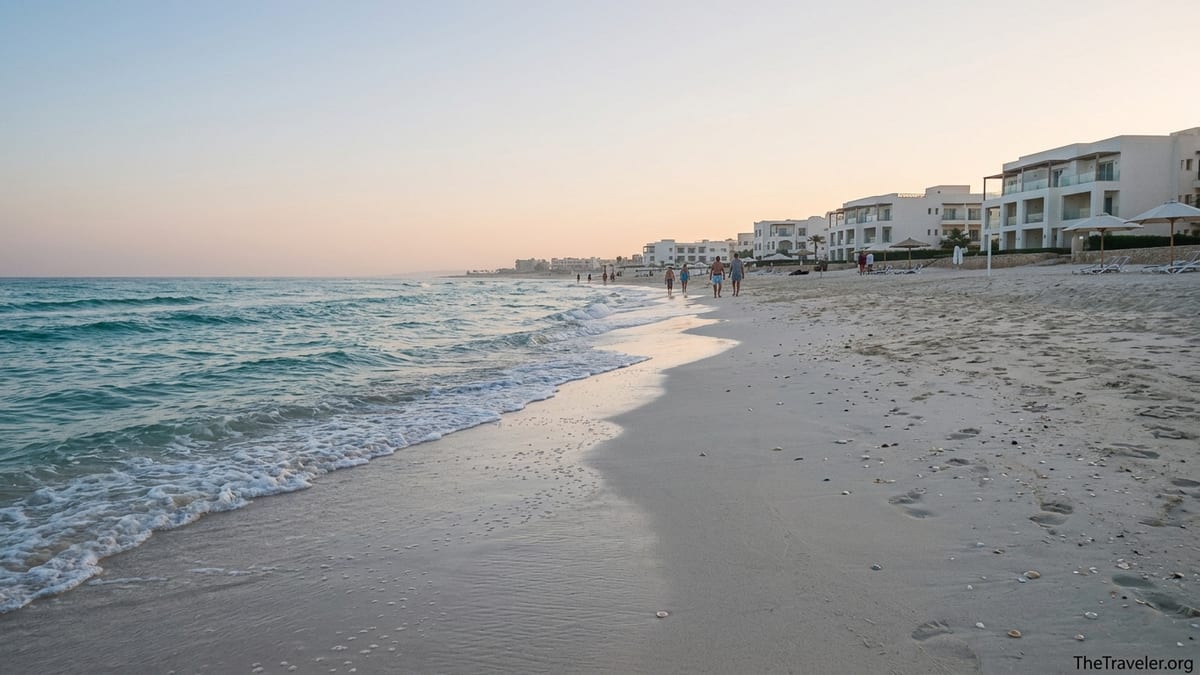
Sidi Abdel Rahman lies west of New Alamein and has become synonymous with the North Coast’s upscale beach scene. Often described by local hoteliers and tourism boards as one of the crown jewels of Egypt’s Mediterranean, the bay is famous for its soft, pale sand and unusually clear, turquoise water that can rival Greek islands in the right conditions. Much of the coastline here is taken up by gated resorts and residential compounds, including well-known names that bundle hotels, villas and private beaches inside controlled entrances.
The resort ecosystem in Sidi Abdel Rahman is designed for guests who want resort-level service and privacy. High-end hotels in the area combine private beaches with multiple pools, spa facilities and a choice of restaurants. Boutique properties have appeared alongside larger branded hotels, offering contemporary Mediterranean architecture and design. The atmosphere is aspirational and social, with stylish beach clubs and restaurants that have become seasonal institutions among Egyptian and regional visitors.
For couples, Sidi Abdel Rahman offers perhaps the most polished romantic beach experience on Egypt’s Mediterranean coast. A typical day might begin with breakfast overlooking the bay, followed by hours on a private stretch of sand where the resort handles towels, loungers and food orders. Evenings can be spent at marina-side venues, rooftop lounges or in-resort fine dining restaurants that blend international and Egyptian menus. Prices for rooms and day passes are usually among the highest on the coast, reflecting both the quality of facilities and the strong seasonal demand.
Families will find Sidi Abdel Rahman comfortable as long as the budget allows. Many resorts offer kids’ clubs, shallow pools and family suites, while still keeping a sophisticated atmosphere. If you are price-sensitive, it can be more economical to rent a chalet within a residential compound for a week, sharing costs with friends or extended family, and then paying for a handful of beach club or restaurant outings instead of relying solely on hotel services.
Ras El Hekma: Emerging Mega-Project and Next-Generation Beaches
Farther west, Ras El Hekma is rapidly evolving from a quiet Bedouin stretch of coast into one of the most ambitious new developments on the Mediterranean. A multi-billion dollar partnership between Egyptian authorities and international investors is turning the headland into a large-scale, planned destination with a long timeline for completion. While many elements are still under construction, several resort projects and residential communities are already attracting early visitors drawn by the area’s striking turquoise water and broad, gently shelving beaches.
The appeal of Ras El Hekma lies in its combination of natural beauty and next-generation planning. Resorts here are being designed with lagoon networks, low-rise architecture and branded hospitality components that aim for international standards. Announced partnerships with luxury hotel brands and global beach club operators indicate that Ras El Hekma is being positioned as an ultra-upscale extension of the North Coast. New phases within large resorts are marketed around curated lagoon living, with residents a short distance from main beachfronts while enjoying landscaped water features on their doorstep.
For travelers, Ras El Hekma is still a work in progress, which can be either a pro or a con. If you like being among the first to experience an emerging destination, you may enjoy staying in one of the early-opening resorts, where occupancy can be lighter outside peak summer and the surroundings feel spacious. The beaches already accessible often deliver some of the clearest water on the Egyptian Mediterranean, and the lack of dense urban build-up preserves a sense of sky and horizon that more developed areas have partly lost.
However, you should arrive with realistic expectations. Construction in certain zones can be visible or audible, and off-resort infrastructure is still catching up. Dining, shopping and nightlife remain concentrated inside individual projects rather than spread along a mature seafront strip. Ras El Hekma suits couples and groups who prioritize beach quality, design-forward resorts and a feeling of being in a new, curated enclave. Families can consider it if they are comfortable spending most of their time inside a resort and using a car for any excursions.
Marsa Matruh: Turquoise Coves and a More Traditional Seaside Town
At the western end of this guide’s arc sits Marsa Matruh, a smaller city that feels markedly different from the North Coast compounds. Here, the urban center is modest in height and energy, and the coastline is punctuated by natural coves that have long been famous among Egyptian tourists. Beaches such as Agiba, a cove framed by white cliffs, and Al Gharam, a long, gently shelving shoreline sometimes called Lover’s Beach, showcase some of the most photogenic waters in the country, with multiple shades of blue and green over pale sand and rock.
Accommodation in Marsa Matruh ranges from basic local hotels in town to more polished beach resorts on the outskirts. Prices tend to be lower than at Sidi Abdel Rahman or Ras El Hekma for a comparable room size, especially outside the peak domestic season of July and August. You will find simple seafood restaurants, local dessert shops and evening promenades along the seafront that feel firmly Egyptian in character, with families strolling, buying corn on the cob and renting pedal cars for children.
For travelers seeking authenticity and value, Marsa Matruh offers a relaxed pace and easier access to public beaches. The town still operates primarily in Arabic, so independent travelers who do not speak the language should be ready to navigate with translation apps and a bit of patience. Beach services can be more modest, but the natural setting compensates, particularly at viewpoints above Agiba where you can look down on the cove and see the gradient of colors in the water.
Marsa Matruh suits families on tighter budgets, independent travelers, and anyone who wants strong landscapes without the formality or expense of gated North Coast resorts. It can also be combined with a night or two in a higher-end all-inclusive resort nearby if you want one pampered interlude within a mostly low-key stay. Because of its distance from Cairo, many visitors choose to fly into Marsa Matruh during the main summer period when seasonal flights operate, or to include the town as the endpoint of a longer coastal road trip.
Matching Destinations to Vacation Styles and Budgets
Choosing between Alexandria, New Alamein, Sidi Abdel Rahman, Ras El Hekma and Marsa Matruh depends on how you like to balance beach time with culture, nightlife and cost. If history and urban life matter most, Alexandria is the obvious first choice: you can spend mornings exploring museums and Roman sites, then take a taxi to a city beach club in the afternoon. Prices there cover a broad range, making it suitable for mid-range travelers and culture-focused couples who are less concerned with postcard-perfect sand.
For a contemporary, planned-city feel with better beaches than Alexandria and relatively accessible pricing, New Alamein works well. It bridges city and beach, with public promenades and tower hotels that appeal to younger travelers and families wanting modern amenities without the exclusivity of gated compounds. Seasonal events, fireworks and outdoor concerts give summer evenings a festive, open-to-all atmosphere that contrasts with the private guest lists farther west.
Travelers with a larger budget and a taste for luxury will gravitate toward Sidi Abdel Rahman and, increasingly, Ras El Hekma. In Sidi Abdel Rahman, you are paying for a mature, fully serviced North Coast lifestyle: private beaches with attentive staff, chic restaurants and established marinas. Ras El Hekma, meanwhile, caters to early adopters of high-end travel who are comfortable with a developing setting in exchange for newer properties, dramatic sea colors and the cachet of an emerging hotspot.
Marsa Matruh serves as the coastal option that prioritizes scenery and local flavor over polish. Here, you are more likely to spend modest amounts on guesthouses or simpler hotels, allocate a bit more to guided trips to beaches like Agiba and Al Gharam, and enjoy inexpensive street snacks instead of fine dining. For many travelers, a blended itinerary works best: for example, two nights in Alexandria, three in Sidi Abdel Rahman, and two in Marsa Matruh offers a cross-section of culture, luxury and tradition along the same Mediterranean arc.
The Takeaway
Egypt’s Mediterranean coast is no longer a monolithic concept. Alexandria, New Alamein, Sidi Abdel Rahman, Ras El Hekma and Marsa Matruh each offer a different way of experiencing this shoreline, from old port city to futuristic mega-project and from white-sand coves to public promenades. The best place for you depends less on a universal ranking and more on whether you want museums or marinas, busy streets or quiet lagoons, formal resorts or family-run hotels.
If you are planning a first trip, think of Alexandria and Marsa Matruh as your bookends of heritage and authenticity, and of New Alamein, Sidi Abdel Rahman and Ras El Hekma as increasingly upscale expressions of resort life in between. Couples seeking romance and design-forward stays will likely feel most at home in Sidi Abdel Rahman or an early-opening Ras El Hekma project. Families and budget-conscious travelers may be happier in Alexandria, New Alamein or Marsa Matruh, where costs and atmospheres are more forgiving.
Whichever hub you choose, the practical rhythm of travel along Egypt’s Mediterranean stays similar: long summer days of sea and sun, evenings of outdoor cafés and promenades, and easy combinations between destinations by car. With a bit of planning around your interests and budget, this stretch of coast can deliver anything from a quick long-weekend getaway out of Cairo to a full-length summer holiday that blends culture, relaxation and discovery.
FAQ
Q1. Which destination has the best beaches on Egypt’s Mediterranean coast?
For sheer water color and sand quality, Sidi Abdel Rahman, Ras El Hekma and the coves around Marsa Matruh usually stand out, with clearer, more turquoise water than urban Alexandria.
Q2. Where should couples stay for a romantic beach holiday?
Couples who value privacy, stylish design and curated dining tend to prefer Sidi Abdel Rahman or one of the newer high-end resorts in Ras El Hekma, both of which focus on upscale, adults-friendly experiences.
Q3. Which area is most suitable for families with young children?
New Alamein and Sidi Abdel Rahman are particularly convenient for families, thanks to their combination of modern infrastructure, supervised resort pools, kids’ clubs and relatively calm sea conditions in summer.
Q4. Is Alexandria worth visiting if I mainly care about beaches?
If your priority is perfect sand and crystal-clear water, Alexandria is not the top choice, but it becomes very worthwhile when combined with beach-focused days farther west in a single itinerary.
Q5. How expensive are the North Coast luxury areas compared with Marsa Matruh?
In high season, nightly rates and beach club spending in Sidi Abdel Rahman and Ras El Hekma can be substantially higher than hotel and dining costs in Marsa Matruh, which generally offers better value.
Q6. Can I visit these destinations without renting a car?
Alexandria is the easiest to navigate with taxis and ride-hailing services, while New Alamein, Sidi Abdel Rahman, Ras El Hekma and Marsa Matruh are more comfortable with a private car or arranged transfers.
Q7. When is the best time of year to go to Egypt’s Mediterranean coast?
Late June through early September brings warm sea temperatures and full resort operations, while May, late September and early October can offer milder weather and fewer crowds.
Q8. Is nightlife better in Alexandria or on the North Coast?
Alexandria offers year-round cafés and local venues, but in summer the liveliest nightlife usually shifts to North Coast resorts, especially around Sidi Abdel Rahman and New Alamein.
Q9. Are these destinations suitable for solo travelers?
Yes, particularly Alexandria and New Alamein, where there is more street life, public space and independent accommodation, though solo travelers can also enjoy resort-based stays if they value downtime.
Q10. How many days do I need to experience this part of Egypt?
A one-week trip is enough to combine at least two hubs, such as Alexandria with Sidi Abdel Rahman, while ten days allows you to add Marsa Matruh or Ras El Hekma for a deeper coastal circuit.