


From Dahab’s easygoing seafront, the Abu Galum Protectorate looks like a faint line of mountains beyond the last cafes. It is sold in town as a simple escape: a taxi to the Blue Hole, then a camel, boat or short hike to a cluster of Bedouin camps and the fabled Blue Lagoon. Remote, they say. Rustic. A place for wind, sea and silence. I went north to find out what that actually means in practice, with a small backpack, too much camera gear and an overnight booking scribbled on WhatsApp.
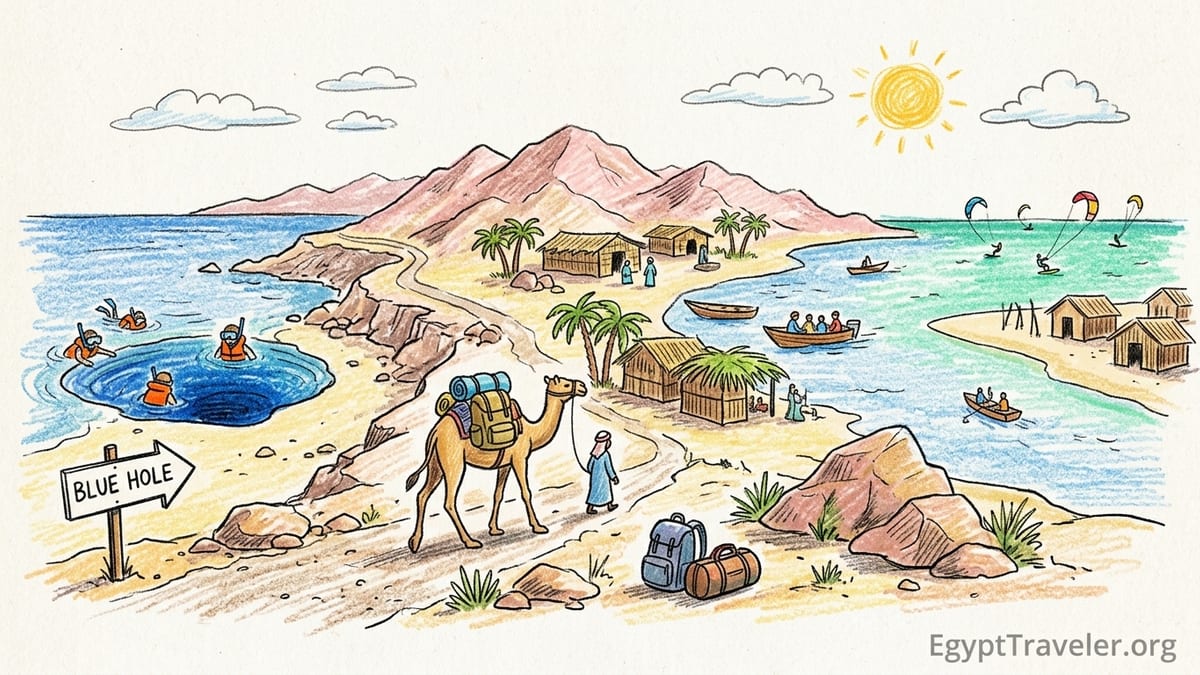
Leaving Dahab’s Promenade for the Protected North
I started where most Dahab days begin, on the central promenade between Lighthouse and Mashraba. At 8 a.m. the cafes were only just opening; divers were loading tanks onto pickups, and the wind that would later whip the kites out at the lagoon was still a light breeze. To reach Ras Abu Gallum and Blue Lagoon you do not leave from here, but almost every tour office along this strip will sell you the dream. In their photos, the sea is glassy turquoise, the huts are empty and there are no wires in sight. The reality, as I learned, is both harsher and more interesting.
Rather than book a package, I arranged the classic do-it-yourself route that many independent travelers are now using: taxi to the Blue Hole, hike the coastal path to Ras Abu Gallum, then take a small boat onward to Blue Lagoon. In person, several Dahab taxi drivers quoted between 120 and 180 Egyptian pounds one way from Assalah to the Blue Hole in October 2026, matching recent traveler reports that place the ride in the rough 80 to 150 pound range depending on negotiation and starting point. The distance is only about eight kilometers, but there is no meter and prices rise with demand, so agreeing the fare before you get in is essential.
The road north leaves town past the last low-rise guesthouses and the checkpoint where permits are sometimes checked for private cars. My driver stopped briefly while an officer glanced inside, then we rolled on. There is a second layer of fees at the Blue Hole gate. Recent visitors report a per-person entrance fee quoted in United States dollars, typically around 10 to 20, when arriving by road. I paid the lower end of that range in Egyptian pounds after some back-and-forth, plus a small amount listed as a local environmental fee. Regulations and amounts change often here, and the only constant is that you should bring cash and expect to contribute to the protected area budget before you ever see the famous sinkhole itself.
The Taxi to Blue Hole and the First Taste of Isolation
The paved road ends in a chaotic strip of restaurants and dive shacks perched on the rocks. The Blue Hole itself is just beyond, a dark circle ringed by snorkelers and freedivers. Even if you are not here to dive, the stop is instructive. Once you step beyond the last wooden platforms, Dahab falls away quickly. Phone signal becomes patchier and the soundtrack shifts from beach-bar playlists to the hum of generators and the slap of waves on rock.
My taxi dropped me at the far end of the Blue Hole car park, where a line of Bedouin men waited with camels tied to makeshift rails. When I said I planned to hike to Ras Abu Gallum instead of riding, one man shrugged and pointed along the coastline: "One hour and half," he said, repeating the official estimate of roughly seven kilometers on foot along the sea. Another offered a camel for what started at 700 pounds for the one-way ride, settling around 500 when it was clear I was serious about walking. For comparison, some organized camel safaris from Dahab that include jeep transfer to Blue Hole, camel to Abu Gallum and lunch still advertise around a couple of hundred Egyptian pounds on outdated brochures, but on the ground in 2026, direct negotiation tends to produce higher, more realistic prices.
Even if you hike, these men are central to the logistics. I had a small daypack, but a heavier duffel with a sleeping bag and warm clothes for the night. For 200 pounds, one of the younger men lashed it behind the saddle of a camel already booked by another pair heading to Abu Gallum. This shared-luggage arrangement is common: you hike light while your bag arrives by camel or by boat, depending on what you agree. It is worth asking explicitly who will take responsibility, when you can expect your bag to arrive, and what happens if you decide to continue straight to Blue Lagoon. Receipts are rare and arrangements are personal, so clarity matters more than paperwork.
Hiking the Coastal Path to Ras Abu Gallum
The coastal path from Blue Hole to Ras Abu Gallum is the part that most brochures compress into a single romantic line. In reality, it is a narrow track skirting the edge of the Gulf of Aqaba, squeezed between steep desert cliffs and a strip of coral shelf. According to Egypt’s environmental authority, the distance from Blue Hole to Ras Abu Gallum is around seven kilometers, which matches both the 1.5-hour hiking time quoted by tourism offices and my own pace with photo stops.
The trail is not technically difficult in dry weather, but it is exposed. There is no shade beyond occasional overhangs and no fresh water along the way. I carried three liters, which felt excessive leaving Dahab and exactly right by the time the sun climbed higher. Footing alternates between compact sand and loose stones, and in a few sections the path drops right to the waterline where waves wash the rocks. Here you get a preview of why currents matter in this part of the Red Sea. Even in calm conditions there was a steady pull along the shore, the same longshore current that kitesurf reports warn about outside the protected Blue Lagoon basin.
About forty minutes in, the sense of being "remote" arrived in a tangible way. Looking back, Dahab was a smudge over the water. Ahead, the jagged coastline ran empty towards Saudi Arabia. There were no cars, no snack stalls, no shade structures. Twice, small motorboats passed heading toward Abu Gallum, each carrying fuel cans, crates of vegetables and a few guests who had chosen sea over sand. From the water, the ride reportedly takes about thirty minutes in good conditions and is described by many visitors as more comfortable than the long camel sway, especially for those prone to saddle soreness.
I reached the edge of Ras Abu Gallum in about an hour and twenty minutes at a steady but unhurried pace, stopping often to watch the reef flats glowing in water too shallow to snorkel. The camp line appears suddenly: a string of low, palm-frond huts and stone rooms right on the high-tide mark, a handful of moored boats and a backdrop of pink-brown mountains folding into the sky.
Life in a Remote Bedouin Camp: Power, Toilets and Sleep
I had arranged to stay in one of the simple beach huts that now dot Ras Abu Gallum, similar in style to places like Camp Ras Abu Galum and Galluma Camp, which are listed on regional accommodation guides as basic, family-run Bedouin camps on the waterline. My hut was typical for the area: woven palm walls, a sand floor mostly covered by rugs, and a mattress on a raised wooden platform with several heavy blankets.
The first and most tangible adjustment is electricity. Unlike Dahab, where the grid is now stable enough that most guesthouses do not even mention generators, Ras Abu Gallum sits entirely off-grid. The camp I stayed in had a small solar panel system powering a single light bulb in the common area for a few hours after sunset. Phone charging was possible for a short window in the evening on a shared extension strip, but everyone was asked to prioritize mobiles and small power banks over laptops or camera batteries. Travelers who had stayed further out at the Blue Lagoon described similar setups or even complete digital detox conditions at camps like BlueLagoonIsland Camp, where there is reported to be no electricity or mobile network at all, a deliberate selling point for some guests.
Toilets in my camp were basic but workable: a couple of concrete cubicles set a short walk behind the huts, with squat toilets and large plastic barrels of water for flushing. There was no hot water, only a cold-water pipe rigged to a simple shower head. Fresh water arrives here by boat, which makes every liter precious. The camp owner was explicit about this. Showers were allowed, but "short, very short," and guests were asked not to leave taps running or wash wetsuits and kites in fresh water. Dishwashing water was reused to dampen the sandy paths and keep dust down. It is one thing to read that water is scarce in the desert; it is another to watch your host siphon fuel into a boat that will cross the gulf solely to refill the tanks that make your quick rinse possible.
Sleep, by contrast, was abundant. With no nightlife, no loudspeakers and only the dull thump of waves a few meters away, the camp slipped into silence by 10 p.m. The mattresses were thin, and sand crept everywhere, but the blankets were heavy and warm and the air cooled rapidly after sunset, enough that I was grateful for a light sleeping bag liner. The lack of fans on a windless night could be uncomfortable in mid-summer; in shoulder seasons, the sea breeze through the gaps in the palm walls worked better than any air conditioner.
Boat, Camel and Seasickness: Getting Onward to Blue Lagoon
From Ras Abu Gallum, Blue Lagoon lies further north, another pocket of turquoise water tucked behind a spit of sand. While it is technically possible to continue on foot along the coast, in practice most visitors switch to boats or camels at this point. Boatmen in camp quoted me 250 to 300 Egyptian pounds per person for the thirty-minute ride to Blue Lagoon in a shared wooden boat, matching prices independently reported by other travelers for similar short hops. A private charter, often arranged by kitesurf camps operating from Dahab, can cost significantly more but includes gear transport and a rescue presence on the water.
I chose the boat, partly out of curiosity and partly to spare my knees from more uneven terrain with a camera bag. The sea that morning was rippled but far from rough. Even so, the flat-bottomed wooden hull slapped and rocked enough that one passenger turned a shade paler than usual. If you are prone to seasickness, this is important. There are no enclosed cabins here, only open skiffs with exposed benches. Sitting near the stern, focusing on the horizon and avoiding a heavy breakfast helped me; I watched the cliffs go by and chatted with the captain about how the boat also carries fresh water, propane and food supplies back and forth for the camps.
Camels, which remain a romantic icon of the route, lined up on the sand when we landed at Blue Lagoon. Their handlers quoted 400 to 600 pounds for a one-way ride back to Ras Abu Gallum or Blue Hole, depending on the time of day and bargaining. For many visitors, the boat in one direction and camel in the other is the compromise: one leg by sea, the other swaying slowly along the rocks. Whether this is comfortable is another question. Several fellow travelers I spoke with later in Dahab described the camel ride as memorable but physically punishing, especially in the heat of the afternoon. Those with back problems or limited mobility may find the boat the kinder choice, even if it means gritting your teeth through a little motion.
Snorkeling at Ras Abu Gallum and Understanding “Remote”
Back in Ras Abu Gallum before continuing to Blue Lagoon, I took the chance to snorkel. The house reef here is part of the same protected system that makes the Blue Hole famous, but it is accessed very differently. There are no concrete steps, only natural gaps in the coral shelf where the Bedouin families have long launched their fishing boats. My host walked me to one such sandy cut, pointed to the current line and said, "You go out here, come back there," gesturing fifty meters downshore.
Entering the water required care. The tidal range in this part of the Gulf of Aqaba is modest, but even ankle-deep water can hide fragile coral heads. I shuffled gently through sand until the shelf dropped away. Immediately I felt the same longshore current I had noticed earlier from the hiking trail, sliding along the reef edge toward the north. It was not dangerously strong that morning, but strong enough that a distracted snorkeler could drift well past their intended exit. There are no lifeguards, no marked entry and exit points, and often no other swimmers in the water, especially outside peak season. Good fins, a mask you trust and the discipline to stay within a comfortable distance of shore are essential.
The reward is that, for long stretches, it was just me and the fish. Soft corals hung from the slope in oranges and purples, and schools of anthias flared in the filtered light. Unlike the crowded snorkeling platforms at Blue Hole, where tanks and groups compete for space, Ras Abu Gallum still felt quiet beneath the surface. The only other sound was the occasional crackle of parrotfish biting coral and the distant putter of a boat engine overhead.
That sense of remoteness, however, shifted sharply around midday. As the wind rose, a flotilla of day-trip boats began to appear from Dahab, some heading only as far as Abu Gallum, others continuing to the Blue Lagoon. Groups in bright lifejackets spilled onto the narrow beach. Within an hour, the tidy line of huts was fronted by clusters of plastic chairs, and the once-empty reef entry was a queue of fins and selfie sticks. Remote, in this context, did not mean untouched. It meant nowhere to escape the crowds once they arrived, no alternative cove around the corner, and no separate "residents only" stretch of shore like some resorts offer.
Blue Lagoon: Wind, Kites and Stripped-Back Camps
By the time I reached Blue Lagoon later that afternoon, the wind had filled in from the north and the fabled turquoise rectangle was slashed with kites. I did not kitesurf myself, so I will not pretend to review the spot from the water, but conversations with riders and guides painted a consistent picture. The inner lagoon is a shallow, sandy-bottomed basin sheltered by a sand spit, popular with intermediates and those on kitesurf camps based in simple Bedouin huts. Outside that basin, along the open Ras Abu Gallum shoreline, the same strong current I felt while snorkeling is a real factor, and there are no formal rescue services beyond what individual camps organize for their guests.
The camps themselves are variations on a theme. Some names, like Shoky Kite Paradise, BlueLagoonIsland Camp and Abo Aid Surf Camp, appear frequently in kitesurf forums and trip reports. All share certain characteristics: no mains electricity, limited or inconsistent solar power, brackish or limited fresh water, and little or no mobile signal. One recent guest described BlueLagoonIsland Camp specifically as providing a "digital detox" because of the total lack of network and charging points. Another kitesurfer on a popular discussion forum noted that electricity and running water were "hit or miss" and recommended bringing stomach medicine and even a head net for flies on windless days.
My own camp at Blue Lagoon, booked via a Dahab-based kitesurf school, followed the Ras Abu Gallum template with a few tweaks for kite storage. Huts were arranged in a crescent directly on the sand. Sleeping was on simple mattresses with heavy blankets, identical to Abdul Gallum, and toilets were shared squat cubicles with cold bucket showers. Meals were included in the overnight price, which in late 2026 ran around 900 to 1,200 Egyptian pounds per person for full board and boat transfers from Dahab, based on the quotes I and several other travelers received from kite operators. Dinner was fish grilled over coals, rice, salad and flatbread; breakfast was eggs, foul, cheese and tea. Portions were generous and, contrary to some older reviews, hygiene felt careful: hands washed at a shared basin, dishes rinsed in boiled water and food covered from flies.
Here, the meaning of "remote" took on a different flavor. At dawn, with only a few sleepy kiters rigging lines, the lagoon was hushed and the mountains glowed rosy in the first light. There was no traffic noise, no hum of town infrastructure, and no glow from streetlights. As the day wore on, however, inflatable kites multiplied until twenty or thirty danced above the sand spit, and downwinder groups arrived from Dahab by boat. The beach remained narrow, ringed by huts, and there was nowhere else to walk except along the waterline past more camps. Remoteness here meant distance from urban services and 24-hour power, not necessarily solitude.
Rubbish, Fresh Water and Respecting a Fragile Place
The Abu Galum Protectorate was declared in the early 1990s to safeguard not only its coral reefs but also its desert ecosystems and Bedouin culture. On the ground in 2026, that protection feels like a work in progress. In both Ras Abu Gallum and Blue Lagoon, I saw signs of effort: metal drums for rubbish by some camps, hand-painted boards urging visitors not to step on coral, and large water barrels catching run-off from dishwashing to reuse on the paths. Camp owners spoke openly about the cost of transporting both fresh water in and solid waste out by boat, especially as visitor numbers rise with the popularity of kitesurfing and social-media images.
At the same time, litter was visible. Wind-blown plastic bags snagged on shrubs just behind the beach. In one gully used as a makeshift dump, crushed water bottles, old flip-flops and broken buckets sat in a pile clearly older than this season. The contradiction is stark: guests travel here for pristine seascapes, yet every finite bag of supplies they bring also needs to leave somehow. One camp owner explained that organized waste collection from the protectorate is sporadic, and that he pays out of pocket for private boats to carry garbage back to collection points near Dahab when he can. When fuel prices rise, those trips become less frequent.
This is where visitor behavior matters. Practical steps are not complicated. Bringing a refillable water bottle and large shared jerrycans rather than dozens of individual plastic bottles reduces waste. Packing out small trash like snack wrappers instead of relying on overflowing drums helps. Respecting the "short showers" rule, and resisting the temptation to ask for laundry or gear rinses in fresh water, acknowledges just how many logistics sit behind every drop. On the reef, wearing a rash guard instead of slathering on sunscreen right before entering can reduce chemical load, and following the Bedouin guides' advice on entry points and no-go zones avoids trampling fragile coral heads.
Equally important is cultural respect. The camps are extensions of local families, not anonymous resort franchises. Dress norms are relaxed by Egyptian standards, especially among kitesurfers, but away from the immediate waterline and in shared eating areas, covering shoulders and thighs felt appreciated and was sometimes gently requested. Asking before photographing people, paying for tea rather than occupying a camp’s shade for free, and accepting that alcohol may be limited or discouraged are all part of traveling through a Bedouin-run landscape that is adapting to tourism on its own terms.
The Takeaway
Looking back from a cafe on Dahab’s promenade, with espresso in hand and my phone charging at a wall socket that worked on demand, the night I spent between Ras Abu Gallum and Blue Lagoon felt both very close and very far. Officially, the protectorate is just a short taxi ride, coastal hike and boat hop away. In lived experience, it is a genuine step down in comfort and convenience that many travelers may underestimate if they trust only the romantic posters in town.
Would I go again as a day trip or stay overnight next time? For Ras Abu Gallum, I would lean toward an overnight if conditions were mild and I had time. The combination of the hike, unhurried snorkeling and a quiet evening in a low-lit camp felt worth the extra effort, and waking up with nothing between me and the sea but a strip of sand was memorable. For Blue Lagoon specifically, I would consider a focused kitesurf stay only if I planned to spend most of my daylight hours on the water. Without kiting, the narrow strip of huts, the lack of shade away from camp, and the busy midday scene made it feel more like a specialized sports outpost than a general beach escape.
Who will love it? Travelers who already enjoy stripped-back conditions, are comfortable using squat toilets and cold bucket showers, and find the absence of phone signal liberating rather than alarming will likely thrive here. Kitesurfers seeking steady wind in a dramatic setting, and divers or snorkelers interested in quieter reefs than the Blue Hole platforms offer, will find rich rewards if they come prepared. On the other hand, those who need reliable electricity for medical devices, who are anxious about basic hygiene, or who expect resort-style privacy and service may be happier treating Abu Galum as a scenic boat excursion from Dahab rather than a place to sleep. In the end, the protectorate delivers exactly what its bare huts promise: not a polished eco-resort, but a raw edge of desert and sea where comfort depends as much on your expectations as on your mattress.
FAQ
Q1. How long does it really take to get from Dahab to Ras Abu Gallum?
From central Dahab to the Blue Hole by taxi takes around 20 to 30 minutes, and the coastal hike from Blue Hole to Ras Abu Gallum takes most people 1.5 to 2 hours each way, depending on heat and photo stops.
Q2. What does the full journey cost by taxi, hike and boat?
In late 2026, typical quotes were 120 to 180 Egyptian pounds for a taxi from Dahab to the Blue Hole, 200 to 300 pounds per person for a shared boat between Ras Abu Gallum and Blue Lagoon, and a protected-area entrance fee at the Blue Hole gate of roughly 10 to 20 United States dollars equivalent, all payable in cash.
Q3. Is it better to go by camel or boat between Blue Hole, Ras Abu Gallum and Blue Lagoon?
Camels offer a classic desert experience but can be physically uncomfortable, especially in midday heat. Boats are faster and easier on the body, but motion on the small, open skiffs can trigger seasickness in choppy conditions.
Q4. How basic are the camps at Ras Abu Gallum and Blue Lagoon?
Expect simple palm-frond huts or stone rooms with mattresses on the floor, shared squat toilets, cold bucket showers and very limited or no electricity. Some camps have small solar setups for a few lights and brief phone charging; others have none at all.
Q5. Is there mobile phone signal or internet at the camps?
Signal around Ras Abu Gallum is weak and often limited to one corner of camp or a nearby rise. At several Blue Lagoon camps, guests report having no mobile network at all and no Wi-Fi, so communication and navigation apps cannot be relied on.
Q6. What should I know about snorkeling conditions at Ras Abu Gallum?
The reef is healthy and close to shore, but entry is through natural sandy cuts in the coral shelf and there is often a noticeable current running along the shore. Good fins, reef-safe behavior and awareness of your planned exit point are important, especially when there are no lifeguards.
Q7. Can non-kitesurfers still enjoy the Blue Lagoon?
Yes, the scenery is beautiful, but during windy days the narrow beach can feel crowded with kites and lines, and there is little to do away from the water. Non-kiters often find one night or a long day trip enough unless they particularly enjoy very simple camp life.
Q8. How limited is fresh water in the camps, and how should guests adapt?
All fresh water is brought in by boat, so camps encourage very short showers, minimal laundry and no rinsing of gear with fresh water. Bringing a reusable bottle, using water sparingly and accepting that you will feel a bit salty and sandy are part of being a considerate guest.
Q9. What are the main environmental issues visitors should be aware of?
Key concerns include coral damage from careless entry and fin kicks, plastic waste that is difficult and costly to remove, and pressure on scarce fresh-water supplies. Packing out small rubbish, avoiding sunscreen on the reef and following local guidance on where to walk and swim all help reduce impact.
Q10. Who is likely to dislike staying overnight in Ras Abu Gallum or Blue Lagoon?
Travelers who need reliable electricity and phone signal, prefer Western-style bathrooms, or are uncomfortable with shared, sand-floored huts and basic hygiene facilities may find the experience more stressful than rewarding and might be better suited to a short day trip from Dahab instead.