


By my third day in Sharm El Sheikh, every hotel rep and street agency was pushing the same glossy promise: a full day by boat to Ras Mohammed National Park and the fabled White Island. I booked it partly for the reef, partly to understand what this much-hyped excursion actually feels like in 2026. What I found was one of the most beautiful marine reserves I have ever snorkeled, wrapped in a very busy, very commercial day that still delivered real moments of wonder.
Why I Chose to Visit Ras Mohammed by Boat, Not by Road
Ras Mohammed lies at the southern tip of Egypt’s Sinai Peninsula, roughly 20 kilometers southwest of Sharm El Sheikh, where the Gulfs of Suez and Aqaba meet. Protected as a national park since 1983, it is famous for steep reef walls, mangroves, an 8 kilometer stretch of coral platforms and extraordinary fish life. Park information from Egypt’s environmental authorities confirms that the protected area combines both marine and terrestrial zones, with fringing reefs, lagoons and a small mangrove forest separated by a shallow channel at the southern end of the peninsula.
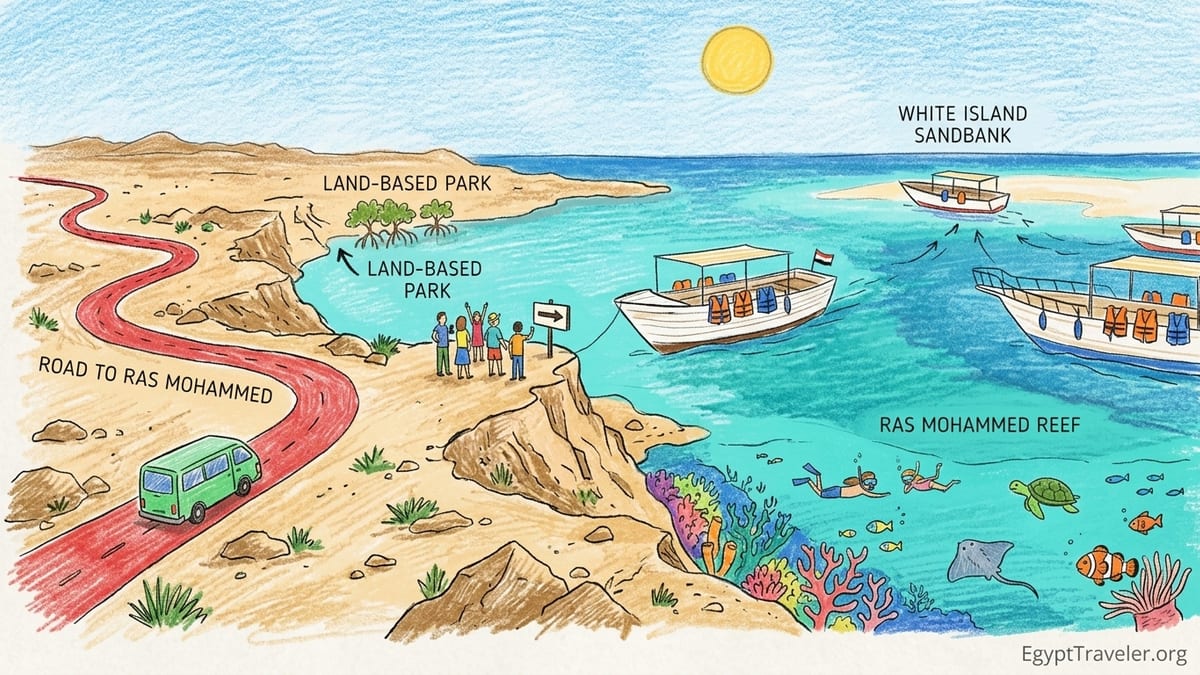
Travel agencies in Sharm sell two main versions of a Ras Mohammed day: by road, usually in a minibus that takes you through the park gates to several beaches and viewpoints, and by boat, leaving from Sharm’s marina for open-water snorkeling stops and a visit to the sandbank known as White Island. After talking to divers and staff at my hotel, I chose the boat option for one clear reason: I wanted to spend the bulk of the day on the reef itself, not shuttling between onshore viewpoints with only brief swims from the beach.
Several local operators I checked in October 2026 advertised similar itineraries. A standard shared-boat day with hotel pickup, park and marina fees, lunch on board and basic snorkel gear was typically priced between the equivalent of about 35 and 55 US dollars per person, with some including a short “try dive” for first-time divers at no significant extra cost. A road-based day inside the park, by contrast, was often priced only slightly lower, but focused more on scenery stops such as the mangrove channel, Magic Lake and the main cliff viewpoints, with shorter snorkel sessions from shore.
I knew I was trading something away by choosing the boat. I would not see the famous mangrove lagoon from land, and I would only glimpse the rocky desert headlands from offshore. But for this trip I wanted to understand how Ras Mohammed feels as a marine reserve rather than as a general sightseeing stop, and that meant accepting the crowds and structure of a classic Sharm boat excursion.
Departure from Sharm Marina and First Impressions On Board
The day started with a minibus pickup from my hotel in the Hadaba district shortly after 8 a.m. We reached the main marina area about 30 minutes later, passing long rows of similar white yachts lined up for Ras Mohammed and Tiran Island trips. Before boarding, our guide collected park and marina fees in cash for those who had not prepaid and checked that everyone had fins and masks. I had brought my own mask and snorkel, which I strongly recommend for comfort and hygiene, while the boat provided fins and life jackets at no additional charge.
Our vessel was a typical Red Sea day boat, about 25 meters long, with a shaded main deck, indoor saloon and a sun deck on top. Including crew, we had just under 40 people on board. That is less than the 80 to 100 people you sometimes hear about on cheaper high-volume boats, but it still felt quite busy once everyone suited up for the first snorkel. There were two guides in the water to lead the group and one safety spotter remaining on the boat.
The safety briefing covered national park rules, including no touching or collecting coral, no feeding fish, and no standing on the reef. The guide explained that we would make three water stops in total: two reef snorkels around the Ras Mohammed area and one stop at White Island, provided the tide was low enough for the sandbank to appear. He also mentioned that currents could be moderate in some places and that people who were not strong swimmers should use life jackets or pool noodles, both available on board.
As the boat left the marina around 9 a.m., Sharm’s hotel-lined coastline slowly dropped behind us. Within an hour, the water shifted from deep blue to a lighter turquoise as we approached the outer reef line of the national park. Even before the first stop, I could see the pale shapes of reef platforms rising abruptly from the deep, which is exactly what makes Ras Mohammed such a legendary place for divers and snorkelers.
Snorkel Stop One: Clear Water, Crowds and a Living Wall of Coral
The first snorkel stop was at an exposed reef wall on the eastern side of Ras Mohammed, not far from the line of sites that includes Anemone City, Shark Reef and Yolanda Reef, although the exact mooring was not labeled with a name for guests. Several other boats were already anchored when we arrived. In the water, there were probably 120 to 150 people spread out along the reef, a reminder that this is one of Egypt’s most popular marine reserves and not a hidden spot.
Visibility, however, was excellent. The guide estimated around 25 to 30 meters, and that matched what I saw: the wall dropped into deep blue, and I could clearly make out schools of fish mid-water and the textures of coral formations well below the depth we were allowed to dive. There was a mild current running along the reef, so our group drifted slowly in one direction while the boat moved ahead to pick us up near the end of the swim.
The reef condition was better than I had braced for after hearing warnings about overuse. I saw healthy stands of branching and table corals, piles of boulder coral and soft corals swaying in the current. There were some broken patches and areas with fewer live polyps, especially close to the surface where waves and careless fins do the most damage, but much of the wall still felt vibrant. A large school of yellowtail fusiliers flickered past, and I spotted at least three blue-spotted stingrays resting on the sand at the foot of the wall.
Fish life was varied rather than overwhelmingly dense. Common Red Sea species showed up quickly: masked butterflyfish in pairs, green and purple parrotfish grinding at the coral, sergeant majors hovering in the shallows and a few sizeable groupers loitering in small overhangs. Near the end of the drift, a pair of giant trevallies cruised by in deeper water. I did not see sharks on this particular day, although local dive reports indicate that white tip and black tip reef sharks, as well as larger pelagic species in season, can be spotted at some Ras Mohammed sites during winter months.
Snorkel Stop Two: A Gentler Reef Plateau and Time Pressure
Our second snorkeling session took place on a shallower plateau closer to the tip of the peninsula, where the reef rose to within a meter of the surface in places before sloping down in terraces. Here, the current was weaker and the water felt more like a giant aquarium, with sandy pockets between coral heads that made it easy to kneel briefly and adjust a fin strap without touching anything living.
Visibility was slightly reduced compared to the first stop, closer to 15 to 20 meters. Some of that seemed due to fine sand stirred up by so many fins. By this point at least six boats were sharing the same general area, which meant dozens of people kicking in relatively shallow water. The guides did their best to keep groups spaced out, but there were still moments when I looked up and saw a line of life jackets stretching almost continuously along the reef edge.
Even with the crowding, this stop delivered some of my favorite encounters of the day. In one sandy patch a cornetfish hovered vertically to blend in with a soft coral stalk. A pair of clownfish guarded their anemone home aggressively, dashing towards any mask that came too close. Near the outer edge of the plateau, I followed a small hawksbill turtle for a few minutes as it grazed on algae, keeping a respectful distance while the guide gestured people not to chase it.
The main frustration here was time. Our total in-water window was about 40 minutes, which included life jacket fitting and regrouping. Real swimming time felt closer to 25 minutes. Several people in our group commented that just as they stopped worrying about their mask and breathing, the guide was already signaling the return to the boat. This is the unavoidable trade-off on large shared trips: tight schedules and the need to keep multiple groups broadly synchronized across the park.
White Island: A Sandbank That Appears and Disappears
After the second snorkel, the crew served lunch as we motored towards White Island. The buffet was simple but decent: grilled chicken, kofta, rice, salads, pasta and bread, along with soft drinks, tea and coffee. Eating while the boat moved meant a shorter total day but also less lounging at anchor. By around 1:30 p.m., the pale strip of White Island began to take shape ahead of us.
White Island is often marketed in Sharm brochures as a pristine “island” in the middle of the sea, but it is more accurate to describe it as a tidal sandbank inside the national park. Local operators and recent guides note that it is only exposed at low tide, and sometimes only partly, which matches what we experienced. On our October visit, the tide was low enough for a long crescent of powdery white sand to sit just above the waterline, surrounded by turquoise shallows that reached little more than knee-to-waist deep for several hundred meters.
Our boat joined at least ten others moored a short distance away. The crew ferried us closer in a small zodiac and then had everyone step down into calf-deep water. Once on the sandbank, it felt far from the untouched paradise that promotional photos suggest. There were lines of people posing for photos, groups kneeling in circles for social media videos and children splashing in the shallows. In total, there were probably several hundred visitors spread along the sand at the same time.
The experience was still striking in its way. Looking down, the white sand was almost blinding, and the water clear enough to see ripples and tiny shells with no distortion. Small fish, including juvenile parrotfish and wrasse, darted between ankles. But this was not a place for serious snorkeling. The water was too shallow to float face down without scraping the bottom, and much of the original reef structure there appears to have been severely degraded by years of trampling. After about 30 minutes of wading, taking a few quick photos and simply enjoying the feeling of standing on a temporary strip of sand in the middle of the sea, I was ready to leave.
Water Conditions, Safety and What I Actually Saw Underwater
Across the day, water visibility ranged from very good to excellent. At the first deep reef stop, it was in the twenty-plus meter range, with light beams cutting clearly into blue depths. On the second, shallower plateau visibility dropped slightly but remained more than enough to appreciate both the big picture of the reef and small details like Christmas tree worms and tiny blennies peeking from holes in the coral. Around White Island, clarity stayed high but depth was so limited that it felt more like wading in a clear pool than snorkeling.
Current was manageable on both reef stops but strong enough that less confident swimmers relied on life jackets and sometimes on ring buoys tugged by the guide. The boat crew watched carefully for anyone drifting too far from the group and repeatedly reminded people not to cross behind the boat where engines were idling. For those comfortable in the water, the mild current actually enhanced the experience, turning parts of the swim into a relaxed drift along the reef wall with minimal effort.
In terms of marine life, my log for the day included multiple species of butterflyfish, angelfish and parrotfish, schools of fusiliers and goatfish, several blue-spotted stingrays, a hawksbill turtle, a small moray eel retreating into its hole and a handful of larger hunting fish like trevallies. Coral cover along the primary wall sites still looked impressive, with plenty of branching and plate formations and some dramatic overhangs that dropped abruptly into deep water. On the second, shallower stop, I noticed more patches of broken coral and algae-covered rubble closer to the main entry points from the boats, a clear sign of how concentrated tourism pressure tends to damage the same few meters of reef.
From a safety perspective, the operation felt organized. Life jackets were available in multiple sizes, and the guides kept a headcount after each entry and exit from the water. There was a first-aid kit visible on board and oxygen cylinders stored near the saloon. What I did not see, however, was any strong attempt to limit the total number of boats sharing a single site at the same time. The national park has regulations on mooring and reef protection, but in practice at peak times the density of boats at popular sites still appears very high.
What Disappointed Me: Crowds, Time Limits and Missing the Land-Based Park
As beautiful as the reef was, parts of the day were undeniably disappointing. The first was the sheer volume of people at the most popular stops. Looking down at the reef wall and seeing a line of bright orange life jackets every few meters slightly broke the illusion of wilderness that national parks are supposed to provide. On several occasions I had to pull my fins in to avoid kicking someone or being kicked, which is not relaxing for anyone and certainly not ideal for the coral just below us.
The second frustration was the rushed feel of each in-water session. With transfer time, briefings and herding dozens of people on and off the boat, the actual snorkel windows felt short, especially if you are used to shore snorkeling where you can enter and exit as you please. Several guests mentioned they would have gladly skipped White Island in order to add a third proper reef stop or extend the first two, but on this shared excursion the itinerary was fixed and heavily oriented towards what sells in brochures rather than what delivers the best pure snorkeling.
A quieter disappointment came later, when I reflected on what I had not seen. Because I chose the boat option, I missed the chance to walk along the cliffs of the Ras Mohammed headland, peer down into the intense blue of the deep gulfs from the lookout points and see the small mangrove forest that park documents describe at the southern end of the peninsula. A road-based day typically includes stops at the main park gate, the Visitor Center, mangrove channel, Magic Lake and at least one or two beach entries for snorkeling. That would have rounded out my understanding of Ras Mohammed as a landscape, not just a set of mooring coordinates.
Finally, White Island itself felt more like a crowd-management tool than a genuine nature experience. It soaked up an hour that could have been spent on a quieter section of reef and, despite its undeniable visual drama, mostly served as a backdrop for photos rather than as a living habitat. Recent traveler reports and local guides are frank that repeated trampling has left the surrounding shallow reef in poor condition, and what I saw on the day aligned with that. It is beautiful in a postcard sense, but it no longer feels like a fragile, thriving ecosystem.
Road vs Boat: Which Access Suited the Experience I Wanted
Having now done Ras Mohammed by boat, talked with travelers who visited by road and looked at current descriptions of both options, I can see a clear divide in what each mode of access offers. A road trip into the park gives you direct contact with the terrestrial part of the reserve: you pass under the sculptural stone gate on the highway south of Sharm, stop at the Osprey or Visitor Center, walk to Magic Lake and the mangrove channel, and swim from specific beaches or shore entries with relatively small groups. It is easier to find quiet moments on land, watch birds and appreciate how stark desert plunges straight into intense blue water.
A boat day, in contrast, is almost entirely about being offshore. You skip the formal park gate and the sequence of onshore lookouts in favor of deeper reef walls and plateaus that cannot be reached easily from land. You trade the freedom to linger in one bay for longer stretches of time actually floating above coral. On my day, even with the crowds, I spent more than an hour in total in very clear water over impressive reef, something that would have required more planning and local knowledge to replicate from shore without a boat.
For the kind of experience I wanted on this trip, the boat was the right choice. I was willing to accept large-group logistics, time pressure and a slightly theme-park atmosphere in exchange for seeing Ras Mohammed’s underwater world in a straightforward, low-effort way from Sharm. If I return, however, I will almost certainly visit the park again by road with a private driver or a small-group operator, specifically to explore the mangroves, Magic Lake and clifftop viewpoints that I missed, and to snorkel from quieter beaches away from the main boat moorings.
If your priority is long, unhurried snorkeling sessions with as much solitude as possible, you may ultimately prefer a tailored road-based day or a more expensive small-group or private boat that avoids peak sites and timings. If your goal is to sample several of Ras Mohammed’s classic reefs in a single, simple package and you do not mind sharing the experience with many others, then the standard boat excursion, crowds and all, still delivers flashes of why this remains Egypt’s most famous marine reserve.
The Takeaway
Ras Mohammed National Park deserves its reputation as a world-class marine reserve. Now that I have seen it by boat, I understand both the magic and the compromises of the classic Sharm excursion that combines reef walls with a stop at the tide-dependent White Island sandbank. On my October 2026 visit, I snorkeled through clear water over healthy stretches of coral, watched a hawksbill turtle grazing on the reef and drifted above blue depths where trevallies patrolled, all within a single day trip that was easy to book from a Sharm hotel lobby.
At the same time, I came away very aware that what most visitors experience is not a quiet wilderness but a carefully packaged product. Boats cluster on the same sites, snorkel groups follow the same routes, and White Island absorbs hundreds of people at low tide as they pose and wade across a sandbank that exists only for a few hours before the sea reclaims it. The park’s official status and regulations help protect the reef from the worst abuses, but high visitor numbers inevitably leave a mark on the most accessible areas.
If you are planning your own Ras Mohammed day, the choice between road and boat matters more than any brochure admits. A boat will immerse you in the park’s marine side from the first snorkel briefing to the last wet footprint on the deck, but you will share that experience with many others and you may wish you had more time at each stop. A road trip will connect you to the desert, mangroves and viewpoints that give Ras Mohammed its sense of place, with shorter but potentially quieter swims from the shore.
For me, the boat day was the right first encounter, because I wanted to feel the power of Ras Mohammed’s reefs and currents more than I wanted to photograph its cliffs at sunset. Next time, I will come back by road to fill in the missing pieces on land. Between the two, Ras Mohammed offers enough variety to reward more than one visit, as long as you arrive with clear expectations about what each way in can and cannot provide.
FAQ
Q1. Is Ras Mohammed better visited by road or by boat for snorkeling?
For pure snorkeling and easy access to dramatic reef walls, a boat is often better, although it can be crowded. By road you gain quieter shore entries and more varied scenery but usually shorter snorkel sessions.
Q2. How long is a typical Ras Mohammed and White Island boat trip from Sharm?
Most shared-boat excursions run for about eight to nine hours door to door, with hotel pickup around 8 a.m., departure from the marina by 9 a.m., three water stops including White Island if the tide allows, and a return to Sharm by late afternoon.
Q3. How much does a Ras Mohammed snorkeling boat day usually cost in 2026?
In October 2026, many operators in Sharm were charging the equivalent of roughly 35 to 55 US dollars per person for a full-day shared boat with lunch, basic snorkel gear, national park and marina fees and hotel transfers included.
Q4. What is White Island and will I always be able to stand on it?
White Island is a tidal sandbank within Ras Mohammed National Park, not a permanent island. It only appears at low tide, so on some days it may be fully exposed, on others only partly visible or not accessible at all.
Q5. What are water visibility and currents like at Ras Mohammed?
On my visit, visibility at the main reef sites ranged from about 15 to over 25 meters, with mild to moderate currents that made some sections feel like a relaxed drift. Conditions can vary with wind and season, so local guidance on the day is important.
Q6. Is the coral at Ras Mohammed still healthy?
Large sections of reef, especially the deeper walls, remain in good condition with abundant hard and soft corals. However, shallow areas near common boat entry points and around White Island show clear signs of damage from years of heavy use.
Q7. What kind of marine life can I realistically expect to see while snorkeling?
Typical sightings include a variety of butterflyfish, angelfish, parrotfish, fusiliers, groupers, blue-spotted stingrays and, with some luck, turtles and larger hunting fish. Sharks are occasionally seen by snorkelers but are more commonly reported by divers at deeper sites.
Q8. Do I need to bring my own snorkel gear for a Ras Mohammed boat trip?
Most shared-boat excursions include basic mask, snorkel and fins in the price, but bringing your own well-fitting mask and snorkel greatly improves comfort and hygiene. Life jackets are normally provided on board at no extra cost.
Q9. How crowded are the standard Ras Mohammed boat trips?
Standard boats from Sharm often carry 30 to 60 passengers, and multiple boats may share the same reef site at once. This can mean dozens or even hundreds of people in the water in popular areas, especially in high season and at White Island.
Q10. Are there quieter alternatives if I want to avoid the big crowds?
Yes. You can look for small-group or so-called VIP boats that limit passenger numbers, or arrange a private charter, both of which cost more but give the crew flexibility to choose less busy sites. Visiting the park by road with a private driver or small operator can also provide calmer shore-based snorkeling away from the main boat moorings.