


The mainland Red Sea coast between Hurghada and Wadi El Gemal is often reduced to a string of all-inclusive resorts and airport transfers. Spend a week to nine days driving it slowly, however, and a very different shoreline appears: Ottoman forts guarding historic trade routes, desert-backed fishing towns, turtle-filled bays and one of Egypt’s most important marine and desert national parks. This itinerary keeps you firmly on the African mainland, building a realistic route from Hurghada to Marsa Alam and Wadi El Gemal that works with current roads, checkpoints, conservation rules and opening hours.
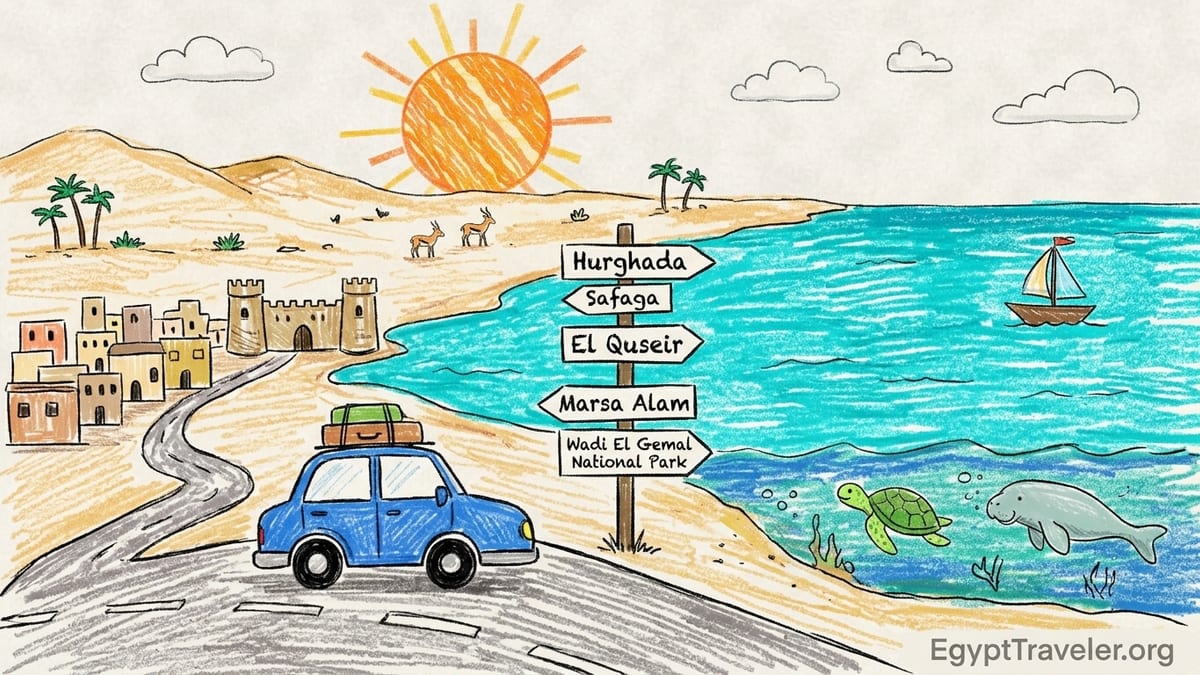
Planning a Mainland Red Sea Road Trip
The Red Sea coastal road from Hurghada to Marsa Alam runs for roughly 270 kilometres, with most of it following Highway 24 along the shoreline. Recent driving time data between Hurghada and Marsa Alam suggests a journey of about 3.5 to 4 hours without long stops, assuming daytime driving and normal checkpoint procedures. This makes the route manageable in sections of one to three hours between overnight bases such as Safaga, El Quseir and the Marsa Alam area.
The region is heavily touristic but still operates under Egypt’s national park and security regulations. You will pass several traffic police or military checkpoints south of Hurghada, especially near Safaga and approaching Marsa Alam. Foreign visitors are usually waved through with a passport and hotel booking, but you should allow extra time in case vehicles are stopped for routine questions. Fuel is widely available at branded petrol stations on the highway near Hurghada, Safaga, El Quseir and around Port Ghalib, but you should not let the tank fall much below half once you get south of Safaga, as distances between stations increase.
For this itinerary, night driving is strongly discouraged. The coastal road is nominally good asphalt, yet it has limited lighting, fast-moving trucks, stray animals and occasionally unmarked speed bumps or roadworks. Local authorities also prefer tourist movements to be traceable in daylight. The safest pattern is to depart after breakfast, change bases early afternoon and be parked up well before sunset, which in winter months can be shortly after 5 pm.
Self-driving on the mainland Red Sea is possible, but not ideal for everyone. Road conditions and habits can feel aggressive if you are used to Western Europe or North America, and rental contracts may restrict which roads you can use. Many visitors therefore combine private transfers on the long highway stretches with local taxis or hotel shuttles for shorter hops. Where this article refers to “driving,” you can generally substitute a booked private car and driver, which often adds only a modest cost when shared between two or three people.
Day 1: Hurghada Beyond the All-Inclusive Strip
Begin in Hurghada itself rather than vanishing straight down the coast. The city has grown from a fishing village into a long north-south sprawl, but its older districts remain walkable and atmospheric. Base yourself around El Dahar, the original town, or in Sakala near the marina for an easy first day on foot. From either area you can explore local markets, waterfront corniches and backstreets that still reflect everyday Red Sea life rather than closed resort compounds.
In El Dahar, the traditional souq district has stalls selling spices, household goods and produce. Prices are not fixed, but a short taxi ride from a hotel to the souq usually costs the equivalent of a few US dollars if you agree the fare in advance. This is also the place to pick up practical road-trip supplies such as large water bottles, snacks and a local SIM card from one of the national mobile operators’ official shops. Around the new Hurghada Marina, cafés and ice-cream parlours line the pedestrian waterfront, a good spot to recover from a flight and adjust to the climate.
Hurghada’s public beaches are limited, but the focus of this first day is the city rather than reefs that you will experience further south. Spend the late afternoon checking your onward transport. If you plan to self-drive, collect your car from a major rental firm at Hurghada International Airport or in the marina area and photograph any existing damage carefully. If you are using private drivers, confirm your next morning’s pickup time and exact drop-off address for El Gouna or your chosen snorkeling excursion harbour.
End your first day with a relaxed dinner in town rather than in a closed hotel buffet. Many seafront restaurants in Sakala or the marina specialise in grilled Red Sea fish, priced by weight and displayed on ice. Ask to see the fish before ordering and confirm how it will be cooked. This is a straightforward way to connect your plate to the fishing fleets that still work the coast, though sustainably minded travellers may want to limit consumption of species known to be under pressure.
Day 2: El Gouna or a Dedicated Snorkeling Excursion
Use your second day to get into the water properly before pointing the car south. One easy option is El Gouna, a purpose-built lagoon town about 25 kilometres north of central Hurghada. The drive from Sakala or El Dahar to El Gouna typically takes less than 40 minutes by car or taxi, passing through one main northbound checkpoint where drivers show ID and vehicle papers. El Gouna’s marinas and lagoon beaches offer calm conditions, organised water sports centres and dive shops where you can ask detailed questions about Red Sea sites and rent or buy well-fitting masks and snorkels.
If you prefer a more natural reef experience, book a full-day boat trip from Hurghada with a reputable operator that focuses on small groups and reef etiquette. Many boats head for offshore reefs such as Giftun area sites, with transfers from hotels in Hurghada included. Expect an early pickup, a 30 to 60 minute boat ride, and guided snorkelling over shallow coral gardens. When comparing offers, ask specifically how many snorkel stops are planned, maximum group size in the water at once, and whether guides enforce no-touch, no-chase rules for marine life. This will prepare you for later encounters with turtles and dugongs further south.
Either way, treat Day 2 as a shake-down for your gear and comfort level. Buy anti-fog solution locally if needed and consider renting a shorty wetsuit if travelling between November and March, when Red Sea surface temperatures can feel cool during long sessions in the water. Check opening times and any harbour access fees with your operator or hotel concierge the day before, as weather or port authority decisions can occasionally delay or cancel departures in high winds.
Return to Hurghada before dark. If you visited El Gouna independently, refuel the car at one of the branded stations on the highway between El Gouna’s gate and Hurghada so that you do not start Day 3 low on fuel. Tonight is also the moment to pack the car systematically, keeping water, hats, sunscreen and travel documents easily reachable for checkpoints, and stowing heavier luggage low in the boot to reduce movement on emergency stops.
Day 3: Hurghada to Safaga via Makadi Bay and Soma Bay
On Day 3 you finally head south. The distance from Hurghada to Safaga is roughly 60 kilometres, but this itinerary stretches that to include short stops at Makadi Bay and Soma Bay. Leaving central Hurghada after breakfast, you join the coastal highway, where the first major resort clusters appear about 30 minutes later. Makadi Bay has a concentration of large hotels built directly on the shore, and even if you are not staying overnight, pre-arranged day use at one of the resorts with a house reef can give you a convenient snorkel session with easy beach access.
Continue another 20 to 30 minutes south and you reach the turn-off to Soma Bay, a peninsula known for clear water and kitesurfing. Day visitors normally enter via a security gate, where your ID, vehicle licence and any resort booking confirmation may be checked. Spend a few hours walking the wind-exposed beaches, observing how the sandbars and reefs project into the turquoise water, then return to the mainland road by mid-afternoon. Because much of Soma Bay’s focus is on wind sports and manicured resort environments, it offers a useful contrast with the historic and natural stops that lie ahead.
From Soma Bay, Safaga is less than 15 kilometres south, usually under 20 minutes’ drive. Here the feel changes again. Safaga is an active port town with ferries and freight traffic, as well as dive centres serving offshore sites. Budget and mid-range hotels cluster along the coast road north and south of the small town centre. Choose an accommodation with on-site parking and ask the reception about the best place to park on the street if the hotel car park is full, as some side roads double as loading areas for trucks.
Before sunset, refuel at one of Safaga’s petrol stations on or near the main road. This sets you up well for the longer run to El Quseir next day. There is no reason to drive at night to “save time”; the total distance from Hurghada to Safaga and then El Quseir is short enough to cover in comfortable daytime legs, and night driving on a truck route with minimal lighting should not form part of a standard tourist plan.
Day 4–5: El Quseir and the Red Sea–Nile Trade Routes
From Safaga to El Quseir is roughly 140 kilometres along the coast. In practice, driving time sits around two hours with a short break and normal checkpoint formalities. Depart after breakfast, keeping your passport and hotel bookings within reach for any roadside inspections. Midway, the stations and resort gates thin out and the sense of distance along the African shore becomes more tangible; this is still the main road, but traffic can be light outside Egyptian holiday periods.
Plan at least two nights in El Quseir to appreciate both its Ottoman fort and its deeper port history. Located near the shore, the fort commonly dated to the 1570s was built under Ottoman rule to secure the harbour that served as one of the shortest links between the Nile Valley and the Red Sea. Historical studies of Quseir’s development confirm that an earlier port, often referred to as Quseir al Qadim or Myos Hormos, lay a few kilometres to the north and functioned in the Roman and Islamic periods as a staging point for trade toward Arabia and India. By around 1571, Ottoman authorities formalised a new harbour and garrisoned fort here to protect both commerce and pilgrimage traffic heading to Mecca.
Today the fort functions as a small museum, with exhibitions that explain the Red Sea–Nile connection. Displays describe camel caravans crossing the Eastern Desert from the Nile town of Qus, Roman and later Islamic trade in spices and textiles, and the role of Quseir in the Hajj routes during periods when pilgrims embarked here for Jeddah. Wall panels also introduce the local Ababda community, whose knowledge of desert tracks and wells made these crossings possible. Check current opening hours locally; they are usually limited to daylight and may close around midday on some days. Entry fees are modest and often collected in cash, so have small Egyptian banknotes ready.
Beyond the fort, El Quseir’s old town preserves tight streets and low-rise houses that pre-date large-scale tourism along this part of the coast. Walk the waterfront where trading dhows once loaded and unloaded goods, then work your way into the alleys to find small grocery shops, bakeries and cafés serving tea and shisha to local patrons. Archaeological and historical research highlights that the route between the Nile and El Quseir passes Roman forts and ancient mining sites, including Qasr el Banat and installations along Wadi Hammamat, although these lie inland and require specialist trips rather than casual detours in a rental car.
Stay in a guesthouse or dive lodge that sits close to the sea rather than on a sealed-off resort strip. Many such places have simple house reefs accessed by jetty, which are ideal for low-impact afternoon snorkelling. If you do not have your own equipment, expect to pay a daily rental fee for a mask, snorkel and fins from a local dive centre. Always ask about current currents and entry points, as shore conditions can change with season and weather. Treat these two days as a blend of coastal history and gently ramping up your comfort in the water before the more intense reef experiences further south.
Day 6–7: Marsa Alam Reefs, Abu Dabbab and Marsa Mubarak
From El Quseir to the Marsa Alam region is roughly 130 to 150 kilometres depending on your exact overnight stop. In modern usage, “Marsa Alam” can refer to three different places: the small original town, a loosely defined strip of coastal resorts stretching tens of kilometres both north and south, and the international airport located about 60 kilometres north of the town itself. When choosing your accommodation, focus less on proximity to the airport and more on direct access to healthy fringing reef or famous bays such as Abu Dabbab or Marsa Mubarak.
Abu Dabbab Bay, sometimes called Marsa Abu Dabab, is a gently sloping sandy bay known for regular sightings of green sea turtles and occasional dugongs grazing on seagrass. Access to the beach is ticketed, with recent reports indicating per-person fees in euros or their local equivalent that usually include a sunbed and umbrella. Some inland eco-lodges and larger resorts package this into their rates. Regardless of how you reach the bay, the key is behaviour in the water. Local regulations and operator terms explicitly prohibit touching, chasing or surrounding turtles and dugongs, with financial penalties for violations. Guides may ask swimmers to stay at least several metres away from large animals and to remain on the surface rather than diving directly above them.
Further north near Port Ghalib, Marsa Mubarak is another bay known for its seagrass meadows and large turtles. Access here is typically by organised boat excursion from Port Ghalib marina, often combined with a second reef stop on the outer side of the bay. During your Marsa Alam days, you can alternate between shore entries at a house reef in front of your lodge, and one or two targeted excursions to these signature bays. Whenever possible, choose operators that brief guests clearly on reef protection, use mooring buoys instead of anchors and limit the number of people in the water at once.
Between snorkelling sessions, pay attention to logistics. Around Marsa Alam there are multiple fuel stations on the highway, but some smaller ones may have only one grade of petrol available on a given day. Top up in the late morning on your way back from an early snorkel or before leaving for Wadi El Gemal, rather than relying on a last-minute stop late in the afternoon. Food options outside resorts include roadside koshari and falafel shops in and around Marsa Alam town and Port Ghalib; these are good places to sample simple Egyptian dishes and support local businesses beyond large hotel complexes.
End Day 7 with all your park plans confirmed. Wadi El Gemal National Park staff and visitor centres, including at Abu Ghosoun and the park offices, can explain which sections of shoreline are currently open to visitors, what the latest fees are, and which licensed guides operate desert and marine excursions within the protected area. Confirm pick-up times, vehicle type and whether snorkelling equipment is included, as some operators expect guests to bring their own fins and masks or rent them in advance from dive centres.
Day 8–9: Wadi El Gemal, Sharm El Luli and Hamata
Wadi El Gemal National Park extends from the Red Sea shoreline into a large wedge of Eastern Desert south of Marsa Alam. It is both a marine and terrestrial protected area, established to safeguard coral reefs, seagrass beds, mangroves and populations of gazelle and other desert species, as well as ancient mining and trade heritage. Entry fees for foreign visitors are currently set at several US dollars per person and per vehicle, payable at designated ticket points or to rangers accompanying authorised tours, with higher charges if visits extend beyond sunset for camping or overnight safaris. Because official figures are periodically updated, check current rates with the Egyptian Environmental Affairs Agency or a licensed local operator just before your trip.
Within the park, one of the most celebrated beaches is Sharm El Luli, a wide crescent of pale sand and shallow turquoise water about 60 kilometres south of Marsa Alam town. Access is typically via a short unpaved approach road from the main highway, used by minibuses and 4x4s under ranger oversight. Do not attempt to leave marked tracks or drive across the dunes; this is both environmentally damaging and can attract fines. Simple shade structures on the beach and basic facilities vary with current management arrangements, so bring drinking water, sun protection and your own snacks.
South of Sharm El Luli, the Qulaan or Al Qulan mangroves form another core attraction of Wadi El Gemal, showcasing hardy mangrove trees rooted in saline shallows where desert and sea meet. Boardwalks or guided walking routes, when open, allow visitors to see the mangroves at close range without trampling sensitive roots or disturbing birdlife. Again, you should only visit with a licensed guide or within the framework of a recognised community-based tourism project, as park authorities regulate where vehicles and people may go on any given season to protect wildlife.
Hamata, near the southern end of this itinerary, serves as a departure point for boat trips to offshore islands that are also under strict conservation rules. For a seven-day itinerary you may not have the time to add these; for an eight or nine day version you can consider one carefully chosen excursion with a licensed operator that has explicit permission to land on or snorkel around the islands. Group sizes, permitted landing zones and daily quotas are controlled to reduce pressure on nesting birds and reef systems, and some islands may be completely off-limits at times. Your operator should explain the current situation during booking and provide reusable cups or bottles on board to reduce plastic waste.
Throughout your time in Wadi El Gemal and around Hamata, resist any suggestion of “off-road adventures” that involve leaving approved tracks in private vehicles or quad bikes. The park’s value lies in its intact desert pavement, archaeological remains of ancient emerald and gold mining, and undisturbed wadis used by wildlife. Unauthorised driving scars the surface and can destroy heritage that has survived for millennia. Similarly, driving at night on unlit desert roads to “stargaze” is a poor trade-off given the risks of collisions with camels or unlit vehicles; instead, arrange stargazing with operators who use safe viewpoints within permitted areas and return on known routes.
Five-Day Condensed Version and Transport Choices
If you only have five days, you can still experience the essence of this mainland Red Sea route by compressing overnight stops and focusing on key highlights. One workable pattern is Day 1 Hurghada city; Day 2 drive via Makadi Bay and Soma Bay directly to El Quseir; Day 3 explore El Quseir’s fort and old town, then continue late afternoon to a Marsa Alam area lodge with a strong house reef; Day 4 dedicated to Abu Dabbab or Marsa Mubarak; and Day 5 full-day excursion into Wadi El Gemal, returning to your lodge or starting back toward Hurghada in the late afternoon with a private driver.
Choosing how to move between these points depends on your budget, comfort with local traffic and the number of people in your group. Private drivers hired through hotels or established agencies typically charge a fixed rate per vehicle for each leg, for example a single daytime transfer from Hurghada to Marsa Alam via the highway, with room for luggage and snorkelling gear. Although rates change with fuel prices and seasons, this option is usually cost-effective for two to four travellers sharing, and it avoids the stress of dealing with checkpoints and unfamiliar road etiquette yourself. Drivers are accustomed to security procedures and know where to stop for fuel, toilets and simple meals.
Organised excursions, sold through hotels and dive centres, bundle transport, guiding and activities into single-day packages. A Hurghada-based full-day trip to Abu Dabbab or Marsa Mubarak, for instance, might include early morning road transfer, boat or beach access fees, a lunch on board or at a beach restaurant, and one or two guided snorkel sessions. These are convenient if you want to avoid changing hotels frequently, but they limit your flexibility to explore El Quseir or Wadi El Gemal in depth, and long pre-dawn departures can feel rushed.
Self-driving is genuinely feasible on this route for experienced drivers who are comfortable with assertive traffic, variable lane discipline and sudden slowdowns. The main challenges are fatigue, sun exposure in vehicles without strong air-conditioning, and the need to remain alert for trucks, animals and pedestrians on or near the road. Rental contracts may forbid driving on unpaved tracks, which aligns well with the conservation message of staying on authorised roads only. If you choose this option, keep daily driving stages reasonable, avoid alcohol entirely when driving, and always err on the side of caution at nightfall by stopping early rather than pushing on to “make distance.”
The Takeaway
A week to nine days on Egypt’s mainland Red Sea coast can be far more than a sequence of buffet dinners and pool bars. By starting in Hurghada’s real city districts, tracing the historic spine of the coast through Safaga and El Quseir, and choosing Marsa Alam area bases for their reef access rather than airport proximity, you build a journey that connects people, landscapes and seascapes in coherent stages. The distances are manageable in daylight, and with sensible planning around fuel, checkpoints and opening hours, the road itself becomes part of the experience rather than an obstacle.
Equally important is a respectful attitude to the fragile environments that draw visitors here in the first place. Turtles and dugongs at Abu Dabbab and Marsa Mubarak, mangroves at Qulaan and the quiet wadis of Wadi El Gemal are not backdrops for thrill rides but living systems under pressure. Responsible operators, adherence to park rules and a willingness to say no to night drives or unauthorized desert forays are small individual choices that collectively protect the coast. Approach the trip as a privilege to move slowly through an ancient corridor between Nile and sea, and you will leave with richer memories than any wristband resort can offer.
FAQ
Q1. How long does it take to drive from Hurghada to Marsa Alam?
The direct drive is roughly 270 kilometres and usually takes about 3.5 to 4 hours in daylight, without extended stops, depending on traffic and checkpoints.
Q2. Is it safe for foreign visitors to self-drive along the Red Sea coast?
The coastal highway is generally considered safe, but driving styles are assertive, night lighting is limited and checkpoints are frequent, so many visitors prefer private drivers.
Q3. Do I need a 4x4 vehicle for this itinerary?
No, the described route stays on paved coastal roads, so a regular car or hired transfer is sufficient; off-road driving inside Wadi El Gemal is neither necessary nor recommended for visitors.
Q4. When is the best time of year for this road trip?
Late October to April offers warm days and comfortable water temperatures, while midsummer can be extremely hot for long drives and midday snorkelling.
Q5. How many days should I spend in El Quseir?
Two nights allow time for the Ottoman fort, old town and relaxed snorkelling, and give you space to understand its role in Red Sea–Nile trade and pilgrimage routes.
Q6. Are there entry fees for Wadi El Gemal National Park?
Yes, visitors pay per-person and per-vehicle conservation fees set in Egyptian pounds or foreign currency; check current amounts locally, as official rates are periodically updated.
Q7. Can I see turtles and dugongs without joining a group tour?
House reefs at some lodges offer good turtle chances, but for iconic sites like Abu Dabbab and Marsa Mubarak you usually access the water through managed beach entries or organised boat trips.
Q8. Is snorkelling equipment easy to rent along the route?
Yes, dive centres in Hurghada, El Quseir and the Marsa Alam area rent masks, snorkels, fins and wetsuits, though serious snorkellers often prefer to bring their own well-fitting masks.
Q9. Are there fuel stations between Hurghada and Wadi El Gemal?
Fuel stations exist near major towns such as Safaga, El Quseir and Marsa Alam, but distances increase in the south, so it is wise to top up whenever the tank drops below half.
Q10. Do I need special permits to visit Hamata and the offshore islands?
Individual travellers do not handle permits themselves; access is regulated through licensed operators who obtain the necessary permissions and follow park rules on routes and landing zones.