


The Egyptian Red Sea coast is not one single destination but a string of very different resort areas, each built around its own style of holiday. Before you book flights or pick a tempting all inclusive, it is worth deciding not just "Red Sea" but whether you want Hurghada, Sharm El Sheikh, Marsa Alam, Dahab, El Gouna, Soma Bay or Sahl Hasheesh. They all promise sunshine, reefs and sandy bays, yet in practice the beach, nightlife, marine life and even how you get into the water can be completely different.
Understanding Egypt’s Red Sea Resort Map
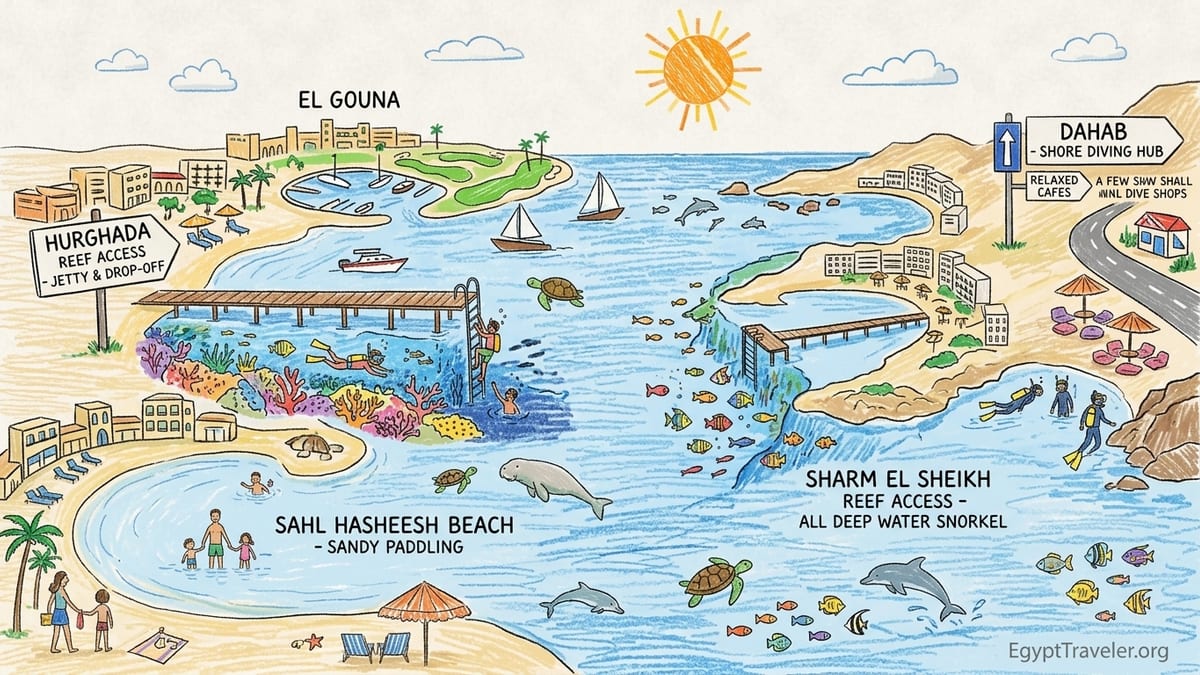
Egypt’s official tourism board and local operators tend to talk about the Red Sea in clusters rather than as one long strip. Hurghada is the main hub on the western mainland coast, with El Gouna, Sahl Hasheesh and Soma Bay classed as neighbouring but very distinct satellite resorts north and south along the shore. Sharm El Sheikh and Dahab sit across the water on the Sinai Peninsula, while Marsa Alam stretches along a more remote, lightly developed section of coast further south on the mainland.
Hurghada has grown from a fishing village into a spreading resort city with everything from downtown guesthouses to sprawling family all inclusives. Its metro area officially includes El Gouna, Sahl Hasheesh and Soma Bay, but on the ground they feel like separate worlds. El Gouna is a privately developed lagoon town with marinas and a small-city feel, Sahl Hasheesh is a gated luxury bay roughly 18 kilometres south of Hurghada International Airport, and Soma Bay sits even further south on a private peninsula known for wind, golf and wellness-focused resorts.
Across the water, Sharm El Sheikh is Egypt’s best-known Red Sea resort, strung along a chain of coves and headlands looking towards Tiran Island. It has its own international airport and several distinct districts, from nightlife-heavy Naama Bay to the self-contained resort strips of Sharks Bay, Nabq and Hadaba. A couple of hours further north by road, Dahab feels like another era entirely: a relaxed, low-rise town of dive shops, guesthouses and waterfront cafés that draws independent travellers, freedivers and long-stay visitors.
Marsa Alam, finally, is less a single town than a region. Its eponymous airport serves a long run of low-density resorts with house reefs and natural bays, particularly around Port Ghalib and Abu Dabbab. This is the stretch usually recommended for travellers who care more about marine life, turtles and dugongs than about nightlife or shopping. Because development is spaced out, a week here often revolves around your chosen hotel and the house reef in front of it.
Reef-Entry vs Sandy Beaches: How You Actually Get into the Sea
One of the biggest practical differences between Red Sea resorts is how you get from your sun lounger into swimmable water. Much of the coastline sits on a broad coral shelf. In these places, the “beach” can look like powdery sand at high tide, yet the shallows are broken coral and seagrass where you cannot simply wade in. Hotels respond by building long jetties that carry you out to the drop-off, where you climb down a ladder straight into deep, blue water over the reef.
Sharm El Sheikh is the classic example of a reef-entry destination. At many hotels in Ras Um Sid, Sharks Bay and along the cliff sections, you will find wooden walkways stretching 50 to 100 metres out over turquoise water. From the end, you can put on mask and fins and fin along the reef edge, but there is no true paddling zone. This is excellent if your dream holiday is snorkelling with anthias and butterflyfish, but it can be disappointing for small children or anyone who pictured standing waist-deep on soft sand.
In contrast, several parts of Hurghada’s coast and its satellite bays have conventional sandy swimming beaches where the sea stays sandy underfoot for some distance. Around Sahl Hasheesh’s 12-kilometre sandy bay, for example, a large section of shore is marketed precisely as swimmable beach, and hotels highlight broad, knee- to chest-deep lagoons ideal for paddling and casual swimming. North of Hurghada, El Gouna’s lagoons provide shallow sand-bottomed water, although the main open-sea beach areas used for kitesurfing can be windy and sometimes choppy.
Marsa Alam mixes both types. Famous spots like Abu Dabbab Bay have soft sand shelving gently into clear water, with seagrass meadows and reefs further out that dugongs and turtles use as grazing grounds. Some resorts in the region still rely on jetties for direct reef entry, but it is easier here than around Sharm to find a true sandy beach combined with excellent off-the-beach snorkelling. When choosing any hotel, it is worth looking specifically at photos and descriptions of the shoreline, as two neighbouring properties can offer very different experiences even within the same bay.
Snorkelling and Diving: House Reefs, Boats and Big Marine Life
If your main reason for coming to the Red Sea is underwater life, your choice of resort can shape how much time you spend actually in the water versus on buses and boats. Sharm El Sheikh is still the gateway to two of Egypt’s signature diving areas: the Ras Mohammed National Park and the Straits of Tiran. Here, boat trips reach famous walls, plateaus and drift dives with schooling fish, soft corals and, in certain seasons, the possibility of big pelagics. Many visitors split time between Sharm and Dahab, doing training dives and relaxed shore entries in Dahab before booking day boats or liveaboards from Sharm.
Dahab itself is a shore-diving hub. Dive centres line the waterfront, and classic sites such as the Canyon and the Blue Hole are reached by jeep within minutes rather than by boat. Much of the diving happens from the rocky shoreline using step entries, but snorkellers can also enjoy reef tables framed by mountain views. The atmosphere suits divers who value repetition and routine: staying a week in a small guesthouse, walking down to the same dive school each morning and sharing simple dinners at the same cluster of cafés.
On the mainland coast, Hurghada is the Red Sea’s original dive hub, with day boats running to the Giftun Islands and local reefs. The choice of dive centres is broad, from budget outfits in the old town to five-star PADI centres attached to large resorts. A typical two-dive day trip including lunch is often priced competitively compared with European diving, and many first-time divers do their Open Water course here. El Gouna has its own marina and dive boats, with access to some of the same offshore reefs, while Soma Bay is widely known among divers for its house reef that drops quickly into deeper water accessed from a long jetty.
Marsa Alam is where house-reef diving and big marine life come together most reliably. Many resorts offer unlimited shore diving on well-preserved reefs, often with sea turtles resident on the seagrass. Places like Abu Dabbab and the offshore reefs further south have reputations for dugong sightings, although no ethical operator guarantees them. Liveaboards operating from Port Ghalib head to offshore sites such as Elphinstone and the southern marine parks, which attract sharks and schooling fish. If you want the highest chance of encountering large marine life from a resort base, this is usually the first area local dive operators mention, balanced against its relative remoteness.
Best Beaches and Swimming: Where the Sand Really Shines
For travellers whose priority is hours of comfortable, sandy swimming rather than reefs, the subtleties of each bay matter more than postcards of colourful coral. Around Hurghada, some stretches of the main city shoreline are more about jetties and breakwaters than natural beaches, but several resort clusters offer classic, wide arcs of sand. Makadi Bay, Sahl Hasheesh and portions of the coast just north and south of Hurghada airport are marketed heavily to families precisely because you can walk straight from lounger to shallow water without coral cuts.
Sahl Hasheesh promotes its 12-kilometre sandy bay as one of the longest swimmable shorelines on the Egyptian Red Sea. The gated master-planned layout means most of this curve is lined with hotels and beachfront residences, broken by a promenade where visitors stroll in the evenings. Here you can step directly into calm, protected water in front of many properties. There are still reefs offshore, reached by swimming or by small jetties, but the perception is of a beach destination first and a reef destination second, which suits travellers who like easy laps before breakfast and casual floating with minimal equipment.
Soma Bay combines both worlds in a different way. The peninsula shelters several sides of coast with wide, pale-sand beaches and shallow turquoise water that appeals to swimmers and beginners. However, the same geography also creates steady winds and a renowned house reef, which are why many hotels host kitesurfing and windsurfing centres and dedicated dive lodges. Guests might spend the morning doing easy swims in the bay in front of the hotel and the afternoon on a dive boat or kiteboard just around the headland.
By contrast, many of Sharm El Sheikh’s most sought-after hotels sit on rocky or coral ledges with narrow, man-made beaches and ladders into deeper water. There are exceptions in places such as Naama Bay and parts of Sharm’s main town where natural sand bays still exist, but anyone who pictures a continuous promenade of flat, wide beach will find reality more broken and vertical. Dahab has a mix of coarse sand and shingle, with most visitors coming for the views, the ambience and the water sports rather than for textbook beach days.
Nightlife, Dining and Overall Atmosphere
Hurghada and Sharm El Sheikh are the primary choices for travellers who want nightlife in the conventional sense: late-opening bars, clubs, busy marinas and a choice of restaurants beyond the hotel buffet. In Hurghada, the Sheraton Road and Marina area has a strip of cafés, shisha lounges and bars, plus late-night venues that attract both visitors and residents. Prices in 2026 vary widely, but it is still possible to find simple Egyptian meals for the equivalent of a few US dollars alongside higher-end rooftop bars charging city-style cocktail prices.
El Gouna markets itself as a “town” rather than a resort complex, with two main hubs: the marina and the downtown area. Both have a cluster of restaurants, ice cream parlours and low-key bars, and there is a modest calendar of events that includes an annual film festival. Here the atmosphere is polished but relaxed, with tuk-tuks and water taxis carrying guests between hotels and evening venues. Visitors who want nights out but not necessarily big-club energy often gravitate here instead of central Hurghada.
Sharm El Sheikh offers the widest spectrum, from all-inclusive resort entertainment and hotel discos to more well-known nightlife districts around Naama Bay. Here you find a mix of shisha terraces, music bars and venues that host DJs or themed party nights, especially in peak seasons and winter sun periods popular with European visitors. In the more self-contained hotel zones like Nabq or some of the big cliff-top resorts, nights out tend to mean staying on property, so travellers who care about nightlife should check how easy it is to reach Naama Bay or Old Sharm from their chosen hotel.
At the quieter end, Dahab, Marsa Alam, Sahl Hasheesh and Soma Bay all lean toward low-key evenings. Dahab’s waterfront has a string of relaxed cafés and restaurants where people linger on floor cushions with tea or simple grilled fish, and there are a few informal bars. It rarely feels like a clubbing destination. Marsa Alam’s resort strip tends to shut down early outside hotel entertainment, and Soma Bay in particular has a reputation as a place to read a book after dinner rather than go out dancing. Sahl Hasheesh sits in between, with a small central “Old Town” style piazza and some beachfront venues, but still far quieter than Hurghada city or Sharm.
Families, Couples, Independent Travellers and Luxury Seekers
For families, the practical questions are shallow water, shade, kids’ facilities and transfer times. Hurghada scores strongly on all these points. The airport is just a short drive from most resort clusters, with transfer times typically 15 to 30 minutes to central hotels and around that to Sahl Hasheesh and the nearer bays to the south. Many large family-focused resorts here have waterparks, kids’ clubs and multi-pool complexes. The blend of sandy beaches and simple off-the-shelf excursions to glass-bottom boats, island trips and desert safaris keeps children and teenagers occupied.
Sharm El Sheikh also works very well for families who want a big resort with strong infrastructure. The airport sits close to the main hotel areas, with typical transfer times in the range of 10 to 25 minutes depending on whether you are in Naama Bay, Sharks Bay or Nabq. Entertainment programs, kids’ pools and small aquaparks are common, and the clarity of the water off hotel jetties means older children comfortable in deep water can experience colourful marine life without long boat rides. Parents, however, should be aware that many of the best reefs here are accessed only from ladders into deep water rather than from beaches.
Couples and honeymooners looking for a quieter, more exclusive feel often focus on Sahl Hasheesh, Soma Bay and certain pockets of Sharm and Hurghada. Sahl Hasheesh has several adults-oriented or romance-marketed hotels fronting long stretches of beach, along with high-end properties such as luxury palace-style resorts on private sandy coves. Soma Bay is home to recognised international hotel names with spacious layouts, golf and spa facilities, and a sense of being away from the bustle; guests often comment that the lack of external distractions is part of the appeal.
Independent travellers are more likely to feel at home in Dahab and, to a lesser extent, in central Hurghada or Sharm’s Old Town. Dahab offers a wide spread of small hotels, apartments and hostels, all clustered close enough that you can walk between dive shops, yoga studios, kitesurfing operators at the Blue Lagoon and simple bakeries or fruit stands. In Hurghada and Sharm, by contrast, independent stays exist but the urban sprawl and distances between districts mean that taxis or ride-hailing apps quickly become part of the daily routine. Marsa Alam’s region can work for experienced independent travellers who are happy to base themselves in a quiet resort and travel longer distances for specific wildlife trips, but it is not set up as a freewheeling backpacker strip.
Kitesurfing, Marine Wildlife and Access
Wind sports are a major reason many repeat visitors keep coming back to this stretch of coast. El Gouna and Soma Bay in particular appear frequently in global kitesurfing spot guides. El Gouna’s lagoon system and gently shelving sandbars provide shallow, relatively forgiving water that has attracted multiple kite schools along beaches such as Mangroovy. The town infrastructure means non-kiters in the group can spend days in cafés or by hotel pools while others chase wind. It is, however, a busy scene, and during peak weeks the main lagoons can feel crowded with learners, making lessons with established schools almost essential for safety.
Soma Bay’s reputation is built on strong, consistent winds over wide, open shallows. Specialist kite lodges and schools dot the main beach, and some hotels provide storage, rescue boats and shuttle services directly to the launch areas. Here, the feeling is of a dedicated water sports resort rather than of a mixed-use town, and many guests plan their days around tide charts and wind forecasts. Further afield, Dahab has its own niche among wind lovers, with the Blue Lagoon a well-known kitesurfing playground where multi-day trips combine riding with simple camping and communal dinners under the stars.
For marine wildlife, particularly turtles, dolphins and occasional dugongs, Marsa Alam has the strongest reputation among the destinations compared here. Abu Dabbab Bay, several house reefs and a string of offshore sites are frequently included on itineraries marketed as “turtle bays” or “dugong grounds.” Ethical operators are careful not to promise specific encounters, but even conservative reports highlight regular turtle sightings and an overall feeling of wilder, less pressured reefs than those beside Egypt’s denser resort cities. Dolphin-watching trips run from Marsa Alam, Hurghada and Sharm, but as everywhere, travellers should seek operators that follow responsible distance and time guidelines.
In terms of airport access, Hurghada and Sharm El Sheikh are by far the most straightforward, with international flights from multiple European cities and domestic connections from Cairo. El Gouna, Sahl Hasheesh and Soma Bay all use Hurghada International Airport, with transfer times generally ranging from about 30 minutes to El Gouna to around 15 to 30 minutes to Sahl Hasheesh and 45 minutes to approximately an hour to Soma Bay, depending on exact hotel location and traffic. Marsa Alam has its own airport, but flight choice can be more limited; some travellers instead fly to Hurghada and take road transfers of three to four hours to southern resorts, which adds fatigue to travel days.
Resort Isolation, Walkability and Excursions
How much you can walk, and how often you will need taxis or organised transfers, is another underappreciated difference. Hurghada city proper is the most walkable in the sense of having real streets, shops and local neighbourhoods. Guests staying near the Marina or Sheraton Road can stroll between cafés, supermarkets and the seafront, though crossing multi-lane roads and dealing with summer heat requires care. Many of the big all-inclusive resorts north and south of the city centre, however, remain self-contained, with walking mostly limited to hotel grounds.
El Gouna is designed as a walkable and rideable town. Tuk-tuks, local shuttle boats and hotel-provided buses link the residential compounds, hotels and main dining areas, so it is practical to go out each evening without a private car. Sahl Hasheesh has a long beachfront promenade and a compact central area, but most visitors still rely on hotel shuttles or taxis for trips into Hurghada or to supermarkets outside the gates. Soma Bay is intentionally isolated. It is a self-contained peninsula with a handful of high-end resorts and a small mixed-use core, but almost no external services within walking distance; visitors go there specifically to stay put.
Sharm El Sheikh is a series of zones rather than a single walkable town. Within Naama Bay or Old Sharm, you can walk between large numbers of shops and eateries. Yet if you base yourself in Nabq or some of the cliff-top resorts, you will almost certainly need taxis for any outing beyond your hotel. Dahab is compact, with a seafront promenade that makes it easy to move between lodgings, dive shops and cafés on foot, and this is a major part of its appeal for independent travellers.
Excursion options differ subtly. From Hurghada and El Gouna, popular day trips include boat excursions to Giftun Island sandbars, quad-bike safaris into the Eastern Desert and overnight tours to Luxor by road. Sharm El Sheikh and Dahab support day and overnight trips to the interior of Sinai, including monasteries and canyons, as well as boat trips to Ras Mohammed. Marsa Alam is more about marine excursions than cultural ones, with many guests choosing turtle and dolphin trips or liveaboard add-ons rather than long overland journeys inland.
The Takeaway: Matching Destinations to Traveller Profiles
Because each Egyptian Riviera resort cluster offers a distinct style of holiday, the most useful question is not which one is “best,” but which one fits the kind of trip you have in mind. For a first Egypt beach holiday, Hurghada or Sharm El Sheikh make strong starting points. Both have short airport transfers, wide accommodation choice across budgets and easy access to boat trips, basic diving courses and organised excursions. Hurghada is more of a working city with resorts attached, while Sharm feels like a pure resort destination laid over desert and cliffs.
For dedicated divers, the classic combination is Sharm El Sheikh for boat diving at Ras Mohammed and Tiran, Dahab for training and shore dives, or Marsa Alam for house reefs and a higher chance of bigger marine life. Many divers plan itineraries that link two of these, for example a week on a Marsa Alam liveaboard followed by a quieter few days in Dahab or El Gouna. Non-diving partners may be more comfortable in Hurghada, El Gouna or Sahl Hasheesh, where beaches and non-diving activities are more developed.
Families often do best in Hurghada’s resort bays, Sahl Hasheesh or certain parts of Sharm with real sandy beaches. Easy walk-in swimming, kids’ clubs and short transfers make days simpler with young children. Nightlife travellers, by contrast, tend to gravitate to Hurghada city, Sharm’s Naama Bay or El Gouna’s marina, where they can alternate between hotel entertainment and evenings out. Couples looking for a quieter, polished break will likely shortlist Sahl Hasheesh, Soma Bay, specific adults-focused resorts in Hurghada and Sharm, or a boutique hotel in Dahab where evenings are about sea views rather than shows.
Solo travellers and independent-minded visitors generally feel most comfortable in Dahab, central Hurghada or El Gouna, where it is easy to join group dives, kitesurfing lessons or yoga sessions and to meet others around shared activities. Those drawn primarily to undeveloped nature, reef conservation and marine wildlife may accept longer transfer times in return for Marsa Alam’s more spaced-out development and quieter reefs. In all cases, the most important practical step is to look closely at where and how you enter the sea from your chosen hotel, as the difference between a reef-entry jetty and a shallow sandy bay will arguably shape your Red Sea holiday just as much as the name on the flight ticket.
FAQ
Q1. Which Egyptian Red Sea destination is best for a first-time visitor?
For a first Egypt beach holiday, Hurghada and Sharm El Sheikh are usually the easiest choices. Both have well-served airports, plenty of mid-range and all-inclusive hotels, straightforward package deals and lots of beginner-friendly excursions. Hurghada suits travellers who like a mix of real city and resort life, while Sharm feels more like a concentrated resort town spread along cliffs and coves.
Q2. Where can I snorkel directly from the beach without using a jetty?
If your priority is walking straight from sand into shallow, swimmable water, look at resorts in Sahl Hasheesh, Makadi Bay and some parts of Hurghada and Marsa Alam where the seabed is sandy. Abu Dabbab Bay near Marsa Alam is often mentioned for its combination of sandy entry and good marine life further out. In Sharm El Sheikh, many hotels have coral shelves and use jetties, so you often enter the water over deeper reef rather than wading from shore.
Q3. Which resort is best for serious scuba diving?
Sharm El Sheikh remains a top choice for access to Ras Mohammed National Park and the Straits of Tiran, with plenty of dive centres and day boats. Dahab is ideal for shore diving and courses, while Marsa Alam stands out for high-quality house reefs and easier access to southern offshore sites via liveaboard. Hurghada and El Gouna are excellent for learning to dive and for relaxed day-boat trips, but serious enthusiasts often pair them with time further south or across in Sinai.
Q4. Where should families with small children stay?
Families usually gravitate to Hurghada’s resort areas, Sahl Hasheesh and selected Sharm hotels that front sandy bays. These areas combine shorter transfers from the airport with kids’ clubs, waterparks and gentler beach entries. All-inclusive resorts in these zones often include family rooms, children’s buffets and simple evening entertainment, so parents can avoid long journeys for meals or activities.
Q5. Which Egyptian Riviera destination has the best nightlife?
The main nightlife hubs are Hurghada city, Sharm El Sheikh’s Naama Bay and, on a smaller scale, El Gouna’s marina and downtown. Here you will find bars, shisha cafés, music venues and some clubs alongside hotel entertainment. Sahl Hasheesh, Soma Bay, most of Marsa Alam and Dahab are noticeably quieter in the evenings, with the focus on relaxed dinners and early starts rather than late-night parties.
Q6. Where is best for kitesurfing and wind sports?
El Gouna, Soma Bay and Dahab’s Blue Lagoon are repeatedly recommended by international kitesurfing schools. El Gouna’s lagoons suit learners and intermediate riders who like having a town and marina nearby. Soma Bay offers stronger, steadier winds and a more dedicated sports-resort feel, with on-site kite stations and shallow water offshore. Dahab appeals to experienced kiters who value a wilder setting and do not mind simple facilities.
Q7. Which area is best if I want quiet, undeveloped nature?
Marsa Alam is the leading choice for a quieter, more natural-feeling coastline. Resorts are spaced farther apart, many focus on their house reefs rather than nightlife, and there is more emphasis on marine life such as turtles and, occasionally, dugongs. Parts of Dahab’s coastline and the desert hinterland around both Sinai resorts also feel wild, but Marsa Alam has the strongest reputation for combining resort stays with a sense of being close to intact reefs.
Q8. Is Dahab safe and practical for solo travellers?
Dahab has long been popular with solo travellers, especially divers and freedivers. Its compact waterfront, numerous small guesthouses and sociable dive centres make it easy to meet people and join activities. While solo travellers should take the usual precautions with valuables and late nights, the general set-up is welcoming to people travelling alone, and many stay longer than planned to enjoy the relaxed rhythm.
Q9. How long are the airport transfers to the main resort areas?
From Hurghada International Airport, central city hotels can be around 15 to 20 minutes by road, Sahl Hasheesh roughly 15 to 30 minutes, El Gouna around 30 to 40 minutes and Soma Bay approximately 45 minutes to about an hour, depending on hotel location and traffic. In Sharm El Sheikh, the airport sits close to most resort districts, with transfers often between 10 and 25 minutes. Marsa Alam’s resorts vary more widely, from short hops near the airport to several hours’ drive for properties further south.
Q10. Do I need taxis, or can I walk everywhere?
In compact areas such as Dahab’s seafront and the central districts of El Gouna, walking is practical and part of the appeal, supplemented by tuk-tuks or boats. In Hurghada city and Sharm El Sheikh, walking works within specific neighbourhoods, but distances between districts mean you will often rely on taxis or hotel shuttles. Purpose-built bays like Sahl Hasheesh and Soma Bay are walkable inside their gated areas, yet most guests still use organised transfers for any trips beyond the resort gates.