


Egypt’s Mediterranean shore has quietly become one of the country’s most desirable road trip routes. Between the layered history of Alexandria, the World War II memorials at El Alamein, the gated resort strip locals simply call "Sahel," and the crescent bays around Marsa Matruh, this is a coastal journey that combines beach time, culture and wide-open desert highways. This guide walks you through renting a car, understanding fuel and road conditions, and planning 3, 5 and 7 day itineraries from Cairo or Alexandria.
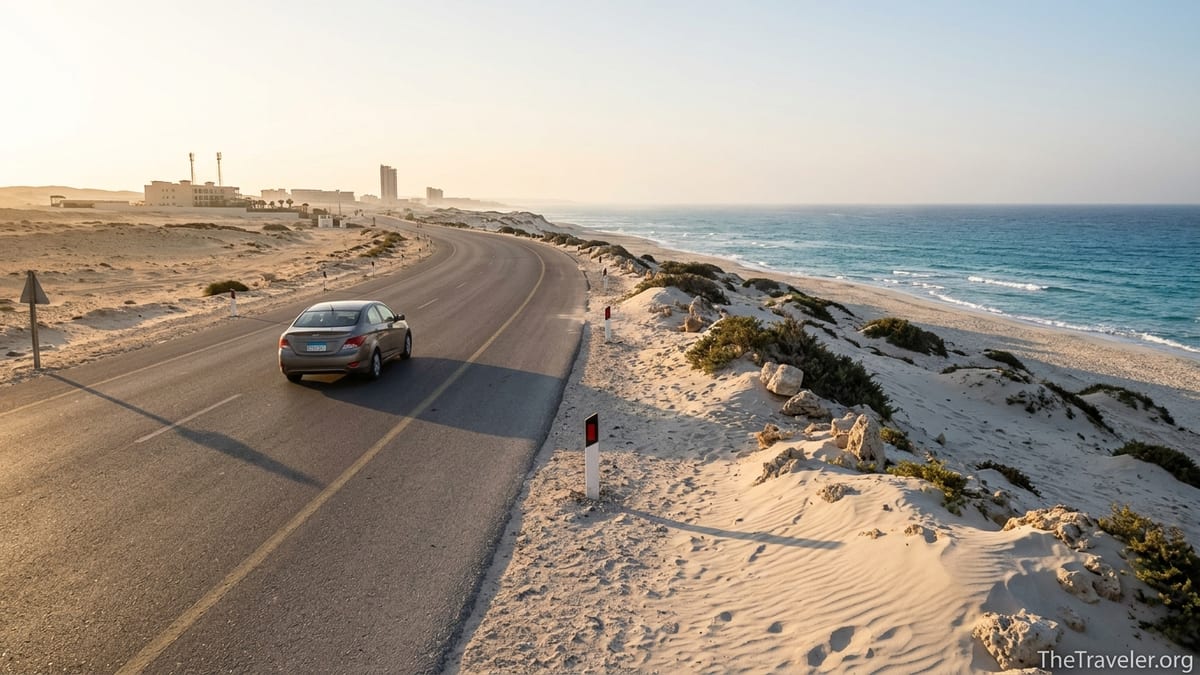
Planning Your Mediterranean Egypt Road Trip
For most travelers, this trip starts either in Cairo or Alexandria. From Cairo, the fastest option today is to take the Cairo–Alexandria Desert Road and then connect to the Alexandria–Marsa Matrouh coastal highway near El Alamein. New infrastructure projects, including the Fouka Road, have shortened driving times to the North Coast considerably, so a run from Cairo to the main resort belt can now be around three hours in light traffic instead of four or more via older routes. From Alexandria, you simply follow the coastal highway west; reaching New Alamein takes about two hours by car, and continuing on to Marsa Matruh typically adds another three hours, depending on summer congestion and checkpoints.
One-way driving distances are manageable for confident drivers. Cairo to Alexandria is roughly 220 kilometers, while Alexandria to Marsa Matruh along the Mediterranean is about 300 kilometers. The modern dual carriageway threads past resort clusters such as Marina El Alamein, Sidi Abdel Rahman, Ras El Hekma and Sidi Heneish before reaching Matrouh. Most road trippers plan their overnight stops in or near New Alamein, one of the major North Coast compounds such as Marassi or Hacienda Bay, and then Marsa Matruh, where a range of mid-range hotels and resorts face the town’s main bay.
Timing is crucial. Peak season on the North Coast runs roughly from late June through early September, when many Cairo families decamp to second homes and private resorts. Weekend traffic can be intense, particularly on Thursday and Saturday evenings when residents commute between Cairo and the coast. If your schedule is flexible, aim to drive these routes on weekday mornings outside public holidays, leaving cities early to avoid inbound commuter traffic. Shoulder months such as May, early June and late September often deliver calmer roads and milder weather while most services remain open.
Before you go, factor in security considerations. This corridor is one of Egypt’s main holiday arteries, and there is a visible police and military presence. Routine checkpoints are common at governorate borders and near Alamein and Marsa Matruh. Keep passports, vehicle registration and rental contracts on hand, and allow a little extra time for ID checks. Regulations are subject to change, so check locally in Cairo or Alexandria, and ask your hotel concierge or rental agency about any recent restrictions on night driving or access west of Marsa Matruh if you plan to continue toward Siwa or the Libyan border area.
Rental Cars, Fuel and Practicalities
Major international and Egyptian rental brands operate from Cairo International Airport and central Alexandria. At Cairo airport, you will find familiar names such as Hertz, Avis and Europcar alongside local operators, with compact sedans, small SUVs and people carriers most common. Daily rates fluctuate seasonally, but as a rough guide a basic compact with automatic transmission can run from the equivalent of around 40 to 60 US dollars per day outside peak summer, rising in July and August. Many companies require a credit card deposit and a valid driving license; an International Driving Permit is strongly recommended even if not always requested at the counter.
Well-known chains often offer one-way rentals between Cairo and Alexandria for a surcharge, which can be a useful option if you prefer to start on the Mediterranean and avoid Cairo’s denser traffic on your return. Ask specifically about mileage limits, included insurance and whether driving to Marsa Matruh is allowed under your contract. Smaller local agencies may offer lower rates but sometimes cap daily distance or exclude certain regions in the Western Desert. As with any rental, walk around the vehicle carefully, photograph existing scratches and confirm the spare tire and tools are present before leaving.
Fuel is widely available on this route, with branded stations such as ENOC, TotalEnergies, Chill Out and government-run outlets spaced at fairly regular intervals along both the Desert Road and the coastal highway. Petrol prices in Egypt are regulated and have risen in recent years, but as of 2026 remain low by Western standards. Filling a compact sedan’s tank for a Cairo to Marsa Matruh run is typically a modest part of your overall budget, though it is wise to check the latest rate for 92 or 95 octane petrol on arrival and factor in several top-ups if you intend to explore side roads to beaches such as Ageeba near Marsa Matruh.
Services at highway fuel stations vary. On the main Cairo–Alexandria Desert Road, larger complexes can feel almost like small rest plazas, with a mix of fast food outlets, coffee kiosks, simple diners and minimarkets selling snacks and cold drinks. As you head west past El Alamein, stations thin out somewhat, but you still encounter regular stops with restrooms and at least a small grocery counter. Try to refuel when your tank drops to half rather than waiting for the warning light, especially if you plan to divert to quieter stretches between the resort clusters or continue south from Marsa Matruh toward Siwa, where distances between services increase markedly.
Road Conditions and Driving Culture
The primary roads on this itinerary are modern, multi-lane highways with asphalt surfaces that are generally in good condition. The Cairo–Alexandria Desert Road has been progressively upgraded, with several lanes in each direction, clear signage in Arabic and English, and central barriers to separate traffic. The Alexandria–Marsa Matrouh coastal road is likewise a major artery, upgraded in phases to support the North Coast’s resort boom and the emergence of New Alamein as a large-scale urban development. Potholes are less of an issue than on secondary roads, though you may encounter occasional rough patches at construction zones or near some resort turn-offs.
More challenging than the pavement is the local driving style. Fast-moving traffic, frequent lane changes without signaling and slow-moving trucks sharing lanes with speeding private cars are all part of the reality. Overtaking is common, even on the right, and tailgating can be aggressive. Defensive driving is essential: keep to the middle or right lanes, leave ample space when overtaking trucks and avoid driving at night whenever possible, when some vehicles may lack proper lighting and occasional unlit carts or pedestrians appear near villages. If your comfort level is low, consider sharing the driving between two experienced drivers or arranging a car with a driver for the Cairo leg and then self-driving shorter hops between resorts.
Speed limits change regularly along these highways, often dropping near tollgates, junctions and built-up areas. While you will see Egyptian drivers exceeding posted limits, mobile speed cameras and fixed radar units are increasingly used. Rental cars are not immune to fines, which can be billed to your contract later. It is sensible to stay within or close to the signed limits, especially in marked control zones near El Alamein and in the New Alamein city area where urban development opens directly onto the highway.
Navigation is straightforward with offline mapping apps. The main junctions, including the Desert Road exits for Alexandria and the coastal highway turn-offs for major resort clusters such as Marina El Alamein, Sidi Abdel Rahman and Ras El Hekma, are well mapped. Mobile data coverage is generally good along the main routes, though it can occasionally drop in more remote stretches west of the densest resort zones. Downloading offline maps for Alexandria, North Coast and Marsa Matruh before departure provides an extra layer of reassurance in case of coverage dips or roaming issues.
Key Stops: Alexandria, El Alamein and the North Coast Resorts
Many travelers choose to start in Alexandria, Egypt’s historically cosmopolitan Mediterranean hub. Even one night here allows time to stroll the Corniche, visit the modern Bibliotheca Alexandrina and enjoy seafood at a shorefront restaurant before heading west. A popular pattern is to spend two nights in Alexandria at a central seafront property, park your car once you arrive and rely on taxis in the city, then set off early on the third morning toward El Alamein and the coastal resorts.
El Alamein itself serves as both a strategic road junction and a historical waypoint. The El Alamein Military Museum and the Commonwealth and Axis war cemeteries, just inland from the highway, offer a sobering glimpse into the World War II battles fought across this stretch of desert. Many road trippers stop here for a couple of hours en route to their resort, combining a museum visit and a walk among the rows of headstones with a coffee in a nearby café. The modern urban development of New Alamein, with its high-rise towers and planned waterfront promenade, is visibly reshaping this section of coast, and it provides additional hotel options if you want to stay within a growing city rather than a gated compound.
West of El Alamein, the North Coast morphs into a nearly continuous band of gated resorts, compounds and hotel complexes that Egyptians collectively refer to as Sahel. Names such as Marina El Alamein, Marassi, Hacienda Bay, Almaza Bay, D-Bay and Mountain View Ras El Hekma appear on highway signs, each marking a cluster of villas, beach clubs and sometimes branded hotels. Within these compounds you find private beaches, beach clubs, restaurants, small malls and nightlife venues that largely cater to residents and guests. Some resorts, such as Marassi and Almaza Bay, feature internationally managed hotels with direct beach access and full-service facilities, making them convenient bases if you prefer hotel living over private rentals.
As you proceed further west, the coast becomes slightly less dense, with pockets of quieter bays such as Sidi Heneish and Ras El Hekma known for clear turquoise water and pale sand. Here, standalone resorts and mixed-use developments are emerging, including high-end projects and independent hotels positioned between larger compounds. If you are seeking a more laid-back atmosphere, consider booking a few nights in resorts toward the western end of the North Coast, closer to Marsa Matruh, where the mood is often calmer and prices can drop compared with the marquee names nearer Alamein.
Marsa Matruh and Surrounding Beaches
Marsa Matruh marks the western anchor of this road trip, a relatively compact coastal city wrapped around a protected bay. Compared with the gated compounds of Sahel, Marsa Matruh feels more like a lived-in town, with a walkable seafront, public beaches and a mix of simple pensions, mid-range hotels and a handful of upscale resorts on the outskirts. Many Egyptian families come here in summer for its famously translucent blue water and milder temperatures, which are often a few degrees cooler than inland cities.
Within or just outside town, several named beaches draw visitors. The main town beach, backed by cafés and ice cream stands, offers a casual local atmosphere. A short drive west, Ageeba Beach is known for its dramatic setting beneath low cliffs and for small coves where shallow, intensely blue water contrasts with rocky outcrops. Farther along the coast, Cleopatra Beach is associated in local lore with visits by Cleopatra VII and features a rocky promontory and flatter stretches suitable for swimming when conditions are calm. Many travelers base themselves in Marsa Matruh for two or three nights, using the car to hop between these beach spots and then returning to town for dinner in fish restaurants overlooking the bay.
Accommodation in and around Marsa Matruh spans family-run city hotels a few blocks back from the water to larger resorts east or west of town that offer private beaches and pools. In high season, seafront hotels in town can demand peak rates, while off-season they may offer attractive deals. If you are traveling outside July and August, check that your chosen hotel remains fully operational, as some seasonal resorts reduce services or close parts of their property once Egyptian school holidays end.
From Marsa Matruh, some adventurous travelers continue by road south to Siwa Oasis, linking Mediterranean beaches with desert dunes and salt lakes. This is a separate undertaking that involves a long desert drive with fewer services and requires careful planning around security advisories, fuel stops and timing. If you are considering adding Siwa to your itinerary, discuss current conditions with a reputable Cairo or Alexandria tour operator or your hotel, as regulations on independent travel in this area can change and organized 4x4 transfers may be recommended.
Sample 3, 5 and 7 Day Itineraries
A three day itinerary works best if you are short on time and primarily focused on the North Coast resort strip. One option is to fly or drive to Alexandria on day one, spend the afternoon exploring the Corniche and staying overnight. On day two, drive about two hours to El Alamein, visit the war museum and cemeteries, then continue another 30 to 60 minutes to your chosen resort near Sidi Abdel Rahman or Ras El Hekma. Enjoy the late afternoon on the beach and dinner within the compound. On day three, make a leisurely return drive to Cairo via the coastal highway and Desert Road, stopping at a large service station for a meal before reaching the city.
With five days, you can comfortably include Marsa Matruh. A typical pattern is to leave Cairo early on day one, drive via the Desert Road and coastal highway to a resort near New Alamein, and spend two nights there. This allows for a full beach day and a half-day side trip to the El Alamein museum complex if you did not visit on arrival. On day three, continue west roughly three hours to Marsa Matruh, arriving in time for a swim in the town bay before sunset. Spend days four and five exploring Ageeba and Cleopatra beaches and sampling simple seafood places along the waterfront before driving back to Cairo or Alexandria on the final morning.
A seven day itinerary provides enough flexibility to slow the pace and sample several flavors of the coast. One approach is to start with two nights in Alexandria to absorb some urban and historical context, then move on to two nights in New Alamein or a nearby resort where you experience the polished, gated side of Sahel life. Continue with two or three nights in or near Marsa Matruh, using one day for a circuit of the surrounding beaches and another simply to relax in town or take a short boat trip if available. The final day can be devoted to the return drive to Cairo, either directly from Marsa Matruh via the coastal highway or with an overnight stop near El Alamein if you want to break up the journey.
During peak summer, consider flipping some of these patterns to avoid the heaviest traffic days. For example, start your trip on a Sunday or Monday rather than a Thursday, and plan long driving segments for midweek mornings. Staying slightly outside the most fashionable compounds, in independent beachfront hotels or smaller resorts west of the main clusters, can also reduce crowding and cost while still delivering excellent beaches and easy highway access.
Budgeting, Seasons and Booking Tips
Costs along this route vary sharply with season. In July and August, nightly rates at marquee North Coast resorts such as Marassi or Hacienda Bay can be significantly higher than Cairo hotels of similar standard, reflecting strong domestic demand. In contrast, during shoulder periods or Ramadan, these same properties may offer promotions that bring them within reach of mid-range budgets. Marsa Matruh, with its mix of city hotels and simpler seafront resorts, often remains more affordable even in peak weeks, though the most popular properties still book out early.
For a typical mid-range couple traveling outside the absolute peak weeks, a rough budget might include daily car rental costs, fuel for several hundred kilometers, mid-range hotel stays in Alexandria and Marsa Matruh and at least one night in a North Coast resort. Dining can be as economical or upscale as you choose: in Alexandria and Marsa Matruh, local fish houses and shawarma stands provide filling meals at modest prices, while within Sahel compounds you can easily spend more at international-style restaurants and beach clubs. Many resorts offer half-board plans, which can simplify costs if you plan to remain inside the compound most of the time.
Booking strategy depends on your travel dates. For high summer, it is wise to secure accommodation in sought-after North Coast resorts several months ahead, especially if you want a specific compound or sea-view room type. Marsa Matruh city hotels and Alexandrian properties also see strong domestic demand in school holiday periods, though same-week bookings are sometimes possible for less central options. In May, June and September, you can often be more spontaneous, booking Alexandria and Marsa Matruh a week or two out and choosing among multiple resort options near El Alamein once you have confirmed your exact dates.
Weather along Egypt’s Mediterranean is one of its main draws. Daytime summer temperatures around the coast are usually warm but tempered by sea breezes, while evenings can be cooler than Cairo, especially in Marsa Matruh. Shoulder seasons can bring pleasantly warm days and cooler nights, with some wind and occasional short-lived showers in winter months. Although many resorts shift into a lower gear outside summer, early autumn can be particularly pleasant for road trips, with busy roads thinning yet sea temperatures still comfortable for swimming.
The Takeaway
A road trip along Egypt’s Mediterranean coast from Alexandria through El Alamein and the North Coast resorts to Marsa Matruh offers a mix of history, contemporary resort life and relaxed seaside town ambience that is hard to replicate elsewhere in the country. Good highways, frequent fuel stations and a wide choice of accommodation make the logistics manageable for travelers comfortable with Egyptian driving conditions.
Whether you choose a compact three day dash that links Alexandria, El Alamein and a single resort stay, a five day loop that pushes on to Marsa Matruh, or a full week that lingers in several spots, the key is to balance driving days with time on the sand. Plan your long transits for weekday mornings, build in pauses at war memorials and scenic beaches, and give yourself at least a couple of unstructured days to do nothing more than swim and watch the Mediterranean change color with the light.
With realistic expectations about traffic and local driving style, a carefully chosen rental car and a flexible itinerary, this stretch of coast becomes more than a transfer between cities. It is a journey in its own right, connecting the layered stories of Alexandria, the desert battlefields of El Alamein, the polished compounds of Sahel and the soft bays of Marsa Matruh into a single, memorable line along the map.
FAQ
Q1. Is it safe for foreign travelers to self-drive from Cairo or Alexandria to Marsa Matruh?
Self-driving along the main highways between Cairo, Alexandria, El Alamein and Marsa Matruh is common and the roads are generally in good condition, but traffic can be fast and assertive. Confident drivers with experience in busy Mediterranean or Middle Eastern cities usually adapt, while nervous drivers may prefer hiring a car with a driver for the Cairo segments and then self-driving shorter resort-to-resort hops.
Q2. How long does the drive from Cairo to Marsa Matruh take?
Under normal conditions, driving from Cairo via the Desert Road to Alexandria and then west along the coastal highway to Marsa Matruh typically takes around six to seven hours of actual driving time. Summer congestion, rest stops and checkpoint delays can add extra time, so most travelers plan for a full day with breaks or split the journey with an overnight stop near El Alamein or a North Coast resort.
Q3. Do I need an International Driving Permit to rent a car in Egypt?
Many rental companies accept a valid foreign driving license printed in Latin script, but an International Driving Permit is strongly recommended and may be requested, especially by international chains. Having both documents simplifies interactions at police checkpoints and helps avoid any ambiguity if you are stopped along the route.
Q4. Are there enough fuel stations between El Alamein and Marsa Matruh?
Yes, there are regular fuel stations on the coastal highway between El Alamein and Marsa Matruh, though they are more spread out than on the Cairo–Alexandria Desert Road. To be safe, most drivers refuel when the tank drops to half rather than waiting for low-fuel warnings, especially if detouring to quieter beaches or considering continuing south from Marsa Matruh toward Siwa.
Q5. When is the best time of year to drive Egypt’s North Coast?
The most popular season is late June to early September, when the resort strip is fully active and beach clubs and restaurants are open, but roads and compounds can be crowded. Many independent travelers prefer May, early June or late September, when the weather is still warm, the sea inviting and traffic and accommodation pressure notably lighter.
Q6. Can I visit El Alamein’s World War II sites on a self-drive trip?
Yes, the El Alamein Military Museum and the main war cemeteries are just off the coastal highway and are straightforward to visit by car. Ample parking is usually available, and many travelers combine a two to three hour stop here with their drive between Alexandria or Cairo and a North Coast resort.
Q7. Are North Coast resorts accessible if I am not staying inside a compound?
Some beach clubs and restaurants within gated compounds are open only to residents and registered guests, while others sell day passes or accept outside diners. If you are staying in Alexandria or Marsa Matruh and want a day inside a well-known resort, it is worth calling ahead or asking a local agent about current day-use policies and prices.
Q8. Is parking easy in Alexandria and Marsa Matruh?
Parking in central Alexandria can be challenging, with dense traffic and limited formal spaces along main streets. Many visitors choose hotels that offer on-site or valet parking. In Marsa Matruh, parking is generally easier, with more open spaces near the seafront and hotels, though peak summer evenings can still be busy along the main bay and public beach areas.
Q9. Can I continue from Marsa Matruh to Siwa Oasis by car?
There is a paved highway running south from Marsa Matruh to Siwa, used by tour operators and local traffic, but it passes through sparsely populated desert with limited services. Security and travel regulations in this area can change, so foreign travelers should check current guidance locally and often find it safer to arrange the Siwa leg with a reputable tour operator or driver familiar with the route.
Q10. Do I need to speak Arabic to manage this road trip?
While basic Arabic phrases are helpful, many road signs on the main highways are bilingual in Arabic and English, and staff at larger fuel stations, hotels and rental agencies usually have at least some English. Downloading offline maps and having your hotel write key destinations in Arabic can smooth interactions with attendants and police at checkpoints.