


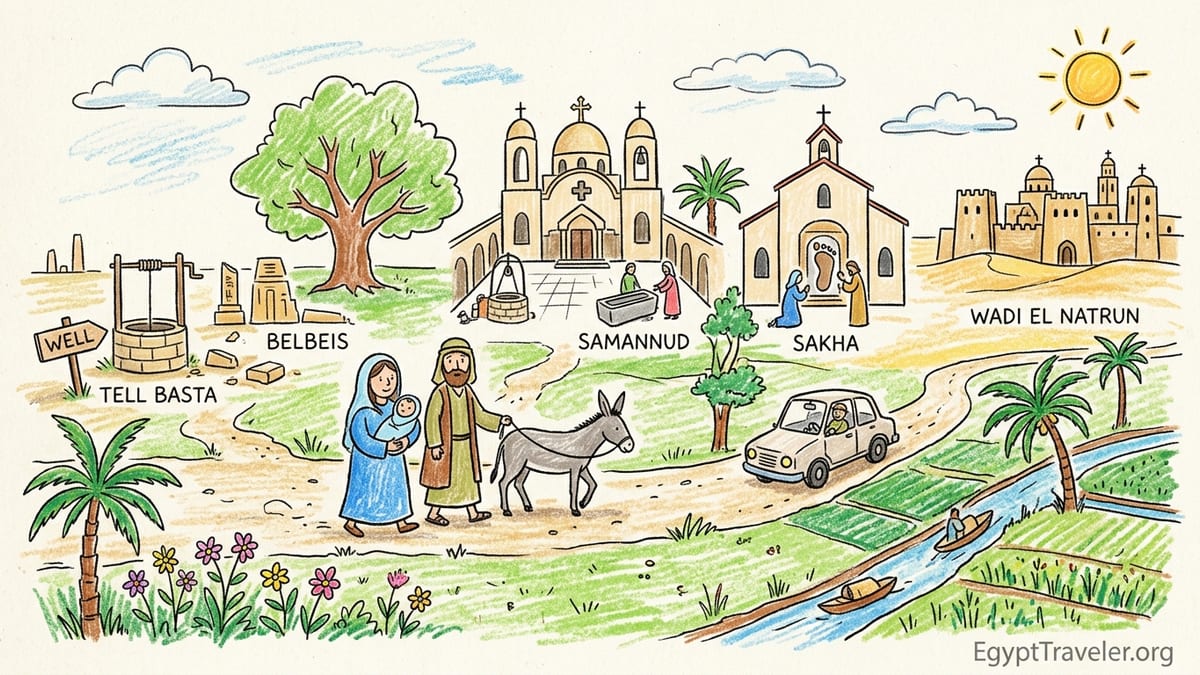
The lower Egyptian reaches of the Holy Family Trail are often overlooked in favor of Old Cairo and the monasteries of Upper Egypt, yet the Nile Delta preserves some of the route’s most atmospheric stops. Between the fields and canals of Sharqiya, Gharbia and Kafr El Sheikh, visitors can trace a sequence of wells, churches, relics and monastic settlements associated with the Flight into Egypt, while also exploring some of the country’s richest layers of ancient and Coptic heritage. This guide focuses on the Lower Egypt section only, helping you link Tell Basta, Belbeis, Samannud, Sakha and Wadi El Natrun into a coherent, realistic journey.
Understanding the Lower Egypt Section of the Holy Family Trail
The Holy Family Trail follows the Coptic tradition that Mary, Joseph and the infant Jesus entered Egypt in the north and moved south along the Nile. Egypt’s Ministry of Tourism and Antiquities has identified a set of official stations, including Tell Basta in Sharqiya, Samannud in Gharbia and the monastic valley of Wadi El Natrun, as part of a national route that is gradually being signposted and developed for pilgrimage and cultural tourism. In the Delta these places lie within a few hours’ drive of Cairo, which makes them realistic side trips or the focus of a dedicated two to four day itinerary.
For modern visitors, the Delta segment offers two intertwined experiences. On one hand there is tangible heritage: archaeological ruins, historic churches, ancient wells and monastic complexes that scholars can date and describe. On the other hand there are living traditions of faith: stories of falling idols at Tell Basta, blessed wells in Samannud, a stone said to bear the footprint of Christ in Sakha, and the long monastic memory of Wadi El Natrun. This article will separate what is historically attested from what rests on religious tradition, while respecting the devotional value of both.
Because these sites are spread across rural governorates, there is little in the way of mass tourism infrastructure. You will not find the dense hotel clusters of Luxor or Sharm El Sheikh. Instead, you are more likely to base yourself in Cairo, Zagazig or Tanta and hire a private car and driver for day trips. This slower, more personal style of travel often leads to encounters with local clergy, guards and parishioners who can open church doors, point out details and share their own understanding of the Holy Family’s journey.
In planning a Lower Egypt only pilgrimage, it helps to think in clusters. Tell Basta and Belbeis form one logical eastern Delta pair. Samannud and Sakha can be linked through the central and northern Delta, while Wadi El Natrun lies to the west in the desert but can be accessed in the same circuit from Cairo. With an early start and private transport, it is possible to cover two or even three stations in a single long day, but many travelers will prefer to spread them out and leave time for quiet reflection.
Tell Basta: Between Bastet’s Temple and the Holy Well
Tell Basta, near modern Zagazig, was once the pharaonic city of Bubastis, renowned as the cult center of the cat goddess Bastet. Archaeological work has revealed temple ruins, red granite columns, cat necropoleis and fragments dating to the New Kingdom and later. Today visitors can walk through a low archaeological park of scattered stones and blocks, with a small local museum that occasionally displays finds from the site. From a historical perspective, this is a major ancient Egyptian city, important centuries before Christianity arrived in Egypt.
Coptic and later Christian tradition holds that the Holy Family passed through Bubastis and that their arrival caused the idols of the pagan temple to fall. Another widely told story relates that while resting under a tree, the infant Jesus asked for water, and Joseph struck the ground, causing a spring or well to appear. Modern Egyptian tourism authorities highlight a Roman era well at Tell Basta that pilgrims connect with this account, and the site is now signposted within the Holy Family Trail project as “The Well of Tell Basta.” Pilgrims commonly collect a little water, cross themselves or simply pause to pray.
From Cairo, most visitors reach Tell Basta by hiring a private car or van for the day with a Cairo based agency or ride hailing driver. As a rough guide, a full day car and driver from central Cairo might cost the equivalent of 80 to 140 US dollars depending on vehicle size, fuel prices and negotiation, often including waiting time at the sites. Public transport exists in the form of trains and microbuses to Zagazig, followed by local taxis, but it is less practical if you wish to combine multiple Holy Family stations in one day.
At Tell Basta the atmosphere is more archaeological park than pilgrimage church. There is usually a ticket booth for the ruins, a gate and a few guards or attendants. Modest dress is advisable out of respect for local norms even though you are technically in an open air ruin rather than a sanctuary. Combine the visit with a stop at the nearby Church of the Virgin Mary or Saint George in Zagazig if time allows, especially for those who want a place to sit quietly after walking through the ruins.
Belbeis: A Quiet Town with a Strong Tradition
Belbeis in Sharqiya Governorate does not yet have the same level of formal development on the national trail as Tell Basta, but it occupies an important place in Coptic tradition. Local stories recount that the Holy Family rested under a sycamore tree here and that the Virgin Mary blessed the town. Several Coptic churches in Belbeis keep this memory alive, usually through icons of the Flight into Egypt and local feast day celebrations.
Historically, Belbeis is an old settlement on the desert road between Sinai and the Nile Valley, mentioned in early Islamic sources and known as the scene of battles and sieges. Yet concrete archaeological evidence specifically tying Belbeis to the Holy Family is lacking. Instead, what visitors encounter is a living devotional landscape: churches where parishioners point out a modern sycamore planted to remember an older holy tree, or an icon corner where pilgrims light candles and recite traditional hymns.
In practical terms, Belbeis is a small, busy Delta town with narrow streets, tuk tuks and a tightly knit community. It pairs naturally with Tell Basta in a single day excursion from Cairo. A driver might take the ring road north, reach Tell Basta in mid morning, then cut back via rural roads for an afternoon visit in Belbeis before returning to the capital. Travel times fluctuate with traffic, but a realistic loop could be six to nine hours door to door, with time at each stop.
Because Belbeis churches are parish spaces, visitors should follow basic Coptic etiquette. That means dressing modestly, asking the doorman or guard before taking photographs inside, and avoiding loud conversation during services. If you happen to arrive during a liturgy, the priest and congregation may welcome you to stand quietly at the back. In quieter hours, a deacon or caretaker may be willing to show you around, point out icons related to the Holy Family, or even unlock side chapels that are usually closed.
Samannud: Blessed Well and Granite Trough
Samannud, ancient Sebennytos, lies in Gharbia Governorate in the heart of the Delta. Archaeologically it was significant in pharaonic times, but for pilgrims its main draw is the Coptic Church of the Virgin Mary and St Abanoub. Local tradition says that the Holy Family stayed in Samannud for several days. During that time, Mary is believed to have baked bread using a granite kneading trough, and the young Jesus to have blessed a well from which they drank. Both the trough and the well are preserved in the church compound and draw visitors from across Egypt and abroad.
The granite trough stands in the church courtyard, protected by a simple structure. Pilgrims often touch its rim or place small cloths upon it as a sign of blessing. Nearby, down a short flight of steps, is the well whose water is considered by the faithful to be blessed. Historically minded visitors will note that it is not possible to prove a direct connection between these objects and the first century. The church building itself has been rebuilt and renovated many times, especially in the late 20th and early 21st centuries. Yet as a continuous focus of local veneration, Samannud offers one of the most concrete and accessible examples of how Coptic communities remember the Holy Family.
To reach Samannud, many travelers base themselves in Cairo or the provincial city of Tanta. From Cairo, the drive typically takes about two and a half to three hours in private transport, while from Tanta it can be under an hour. A realistic day from Cairo might include an early morning departure, mid day arrival in Samannud, a long visit at the church with time for both quiet reflection and photography, and then either a return to Cairo or a continuation to Sakha if you are comfortable with a long day in the car.
Inside the church, etiquette is especially important. This is an active parish with regular liturgies, baptismal services and local pilgrims. Women and men dress conservatively, with shoulders and knees covered; many women cover their hair with a scarf inside the sanctuary. It is polite to ask a deacon or attendant before approaching the well or trough closely, and to offer a small donation in the church box if you have had a guided visit. Photography policies vary, so expect to be asked not to photograph certain icons or worshippers during prayer.
Sakha: The Footprint Stone in the Delta Fields
Further north in Kafr El Sheikh Governorate lies the town of Sakha, home to one of the most distinctive traditions of the Delta. The Church of the Holy Virgin in Sakha keeps a stone known in Arabic as “El Maqtaa,” which many believers say bears the footprint of the infant Jesus. According to local accounts, the Holy Family stopped in this area and Christ’s foot left its mark on the stone while they rested by a water source. The stone is usually kept in a special shrine and brought out for veneration on feast days and at times of pilgrimage.
From a historical perspective, scholars cannot verify the age of the stone or its markings with certainty, and depictions of sacred footprints are found in other religious traditions as well. What can be documented is that Sakha has been a Coptic center for centuries, with a church mentioned in medieval sources and a continuous community that preserved this relic through periods of upheaval. For cultural travelers, the interest lies in seeing how a single object can anchor the identity of a town and its church, and how narratives of the Holy Family interact with an agrarian Delta landscape.
Visiting Sakha often means leaving the main highways and driving along canals and through small villages, passing fields of rice or wheat depending on the season. Many visitors describe the approach to Sakha as part of the experience, contrasting with the urban feel of Cairo or Alexandria. Because there is little tourist signage, traveling with a driver who knows the area or a local guide arranged through a reputable Cairo based agency can save time. A full day loop might combine Samannud and Sakha, especially if you overnight in Tanta or another central Delta city to cut down on driving.
Once at the church, you may find local pilgrims who have traveled from nearby towns to see the footprint stone, especially around Marian feasts in August or the Coptic month of Kiahk in December and January. It is respectful to give priority to worshippers who are praying or touching the relic. If you are visiting as a cultural traveler rather than a pilgrim, you can still stand at the back, observe the devotions, and appreciate the architecture and iconography of the church, which often features rich contemporary Coptic icon painting alongside older pieces.
Wadi El Natrun: Monastic Valley with a Holy Family Memory
Wadi El Natrun is a depression in the Western Desert between Cairo and Alexandria, known since late antiquity as a center of Christian monasticism. Four historic Coptic monasteries are open to visitors today: the Monastery of Saint Macarius, the Syrian Monastery, the Monastery of Saint Bishoy and the Monastery of Baramus. Their earliest phases date back to the fourth century, making Wadi El Natrun one of the oldest continuous monastic landscapes in the Christian world. High mud brick walls, ancient churches layered with centuries of rebuilding, and desert gardens create a distinctive environment very different from the crowded Delta towns.
In terms of the Holy Family Trail, Coptic tradition holds that the Holy Family passed near or through this valley and blessed it. Some written sources place a meeting with desert lions here, with the young Jesus pacifying the animals. Historians note that there is no direct archaeological evidence of a first century visit, and that the monasteries themselves rose centuries later. Yet the Coptic Church and the Ministry of Tourism both treat Wadi El Natrun as one of the key stops associated with the journey, emphasizing its spiritual continuity with early Christian Egypt.
Practically, Wadi El Natrun is the easiest of the Lower Egypt sites to combine with a standard visitor itinerary that includes Cairo and Alexandria. Buses on the Cairo Alexandria highway pass nearby, but for pilgrims and small groups, hiring a private car or joining a church organized minibus excursion is usually more comfortable. Many Cairo congregations organize Saturday trips where parishioners leave early, attend a liturgy or spiritual talk at one monastery, share a simple meal in the guesthouse refectory and visit a second monastery before returning in the evening.
Visitors of all backgrounds are generally welcome, but the monasteries are working religious communities rather than museums. When you arrive, it is customary to check in at the guest reception office, where a monk or lay assistant may assign someone to show you the main church, ancient towers and relic shrines. Dress should be especially modest, and conversations kept low. Some monasteries operate small shops selling icons, prayer ropes, honey and locally produced food items, which can make meaningful souvenirs. Photography is usually allowed in courtyards and from the outside of churches, but interior rules vary, so always ask.
Transport, Guides and Combining Sites into a Realistic Trip
The Holy Family Trail’s Lower Egypt section is not yet a standard mass market tour package, so travelers need to take the lead in planning logistics. The most flexible approach is to hire a private car and driver from Cairo, Alexandria or a provincial city such as Zagazig or Tanta. Many Cairo based agencies are familiar with the route and can provide an English speaking escort in addition to the driver. Typical day hire for a mid range sedan or small van, with fuel and driver included, often falls in the general range of 80 to 160 US dollars, depending on distance and season. Be sure to agree whether tolls and parking are included.
A two day sample itinerary focused on Lower Egypt might look like this in practice. Day one: depart Cairo early for Wadi El Natrun, visit two monasteries with a simple lunch on site, then continue to Tanta for an overnight in a business style hotel. Day two: drive from Tanta to Samannud and spend several hours at the Church of the Virgin Mary and St Abanoub, then continue on rural roads to Sakha before returning to Tanta or driving back to Cairo in the evening. Another option is an eastern circuit: a long day trip from Cairo visiting Tell Basta and Belbeis, or spreading them over two calmer days with a night in Zagazig.
Public transport can work for independent travelers with time and Arabic language skills. For instance, trains run from Cairo to Zagazig and Tanta, and from there microbuses and taxis connect to smaller towns like Samannud and Sakha. However, services may be crowded and infrequent, especially on Fridays and public holidays, and they are not optimized for chaining multiple rural churches in a single day. For many foreign visitors, the money spent on a private driver buys significant time savings and reduces stress.
Guides are helpful but not strictly necessary. At most churches and monasteries, local clergy or deacons are happy to give a brief explanation of the Holy Family tradition in Arabic, and sometimes in basic English or French. For a deeper understanding that links historical evidence, Coptic tradition and modern church life, consider booking a licensed Egyptologist guide who has experience with Christian sites. When speaking to agencies, be specific that you are interested in the Holy Family Trail in the Delta so they assign someone who knows Tell Basta, Samannud, Sakha and Wadi El Natrun rather than only the classic pharaonic monuments.
Church Etiquette and the Balance Between Faith and Heritage
Many travelers approach the Holy Family Trail both as pilgrims and as cultural visitors. Respecting church etiquette is essential in either case. In all Coptic churches and monasteries, dress modestly, with covered shoulders, conservative necklines and hemlines below the knee. Sandals are acceptable, but avoid beachwear or sports shorts. Women may wish to carry a light scarf to cover their hair in more traditional congregations or when entering older sanctuaries. Inside, keep phones on silent, avoid flash photography, and never photograph worshippers without permission.
A simple way to show respect is to follow local behavior. If others remove their shoes before entering a side chapel, do the same. If they line up to venerate a relic, allow worshippers to go first and move calmly. Most churches display donation boxes near the entrance; a small contribution in Egyptian pounds is appreciated, especially if a priest or deacon has spent time guiding you. It is also good practice to ask before touching relics, icons or the water from holy wells. Even if you are not a believer, treating these objects with care acknowledges their sacred meaning for the community.
From a heritage perspective, Lower Egypt’s Holy Family sites sit at the intersection of archaeology, oral tradition and modern religious revival. Tell Basta’s ruined temple grounds tell one story of ancient Egypt and the goddess Bastet, while the Roman era well highlighted by the Ministry of Tourism tells another, rooted in Christian memory. Samannud’s granite trough may intrigue historians of material culture while functioning simultaneously as a living focus of blessing. Wadi El Natrun’s monasteries are active religious institutions and open air museums of late antique architecture. Visitors who are honest about what can and cannot be historically proved, while remaining open to the power of tradition, tend to have the richest experiences.
If you are writing, photographing or filming, be transparent about your intentions. Some monasteries and churches require prior permission for professional shoots, and drone use is generally restricted or prohibited for security reasons. When in doubt, ask at the gatehouse or church office. Respectful communication not only avoids misunderstandings but often leads to deeper access, such as being invited to see older icons, manuscript rooms or rooftops that are normally closed to casual visitors.
The Takeaway
Traveling the Holy Family Trail in the Nile Delta is less about ticking off famous monuments and more about entering the living fabric of Coptic Egypt. Tell Basta, Belbeis, Samannud, Sakha and Wadi El Natrun each offer a distinct blend of tangible heritage and tradition of faith, from archaeological ruins to wells, stones and monastic courtyards that local communities continue to revere. Approached with time, humility and curiosity, these Lower Egypt sites can add a powerful spiritual and cultural dimension to a classic Cairo and Nile Valley journey.
Limiting your pilgrimage to Lower Egypt keeps distances manageable and lets you experience contrasts within a relatively compact area: a pharaonic cat goddess temple and a Christian holy well at Tell Basta, a quiet parish church in Belbeis, a bustling shrine at Samannud, a rural relic in Sakha and desert monasteries in Wadi El Natrun. Whether you travel as a believer seeking blessing or as a cultural traveler after deeper context, you will encounter a side of Egypt that rarely appears in cruise itineraries and brochure images.
As Egypt continues to develop and promote the Holy Family Trail, facilities, signage and access are likely to improve. For now, the route rewards those who are willing to plan ahead, hire local drivers and guides where needed, and accept a level of improvisation. In return you gain not only stories and photographs, but also glimpses into local Coptic life that can alter your understanding of Egypt as a whole.
Most of all, the Lower Egypt section of the trail invites a slower rhythm. Instead of rushing from site to site, consider lingering in a church courtyard, sharing tea with a caretaker or quietly watching a monastic community at prayer. In a landscape shaped by millennia of worship, such moments can be as significant as the most famous relics.
FAQ
Q1. How many days do I need to visit the Holy Family sites in the Nile Delta?
Most travelers need two to four days to visit Tell Basta, Belbeis, Samannud, Sakha and Wadi El Natrun without rushing, especially if basing themselves in Cairo or Tanta.
Q2. Is it safe to visit these Delta towns and monasteries independently?
Security conditions can change, but in recent years these areas have generally been calm. Traveling with a trusted local driver or guide improves safety and reduces logistical stress.
Q3. Can non Christians visit the churches and monasteries on the trail?
Yes. Non Christians are usually welcome as long as they dress modestly, behave respectfully and follow local etiquette, particularly during services and around relics.
Q4. Do I need a special permit to enter Wadi El Natrun’s monasteries?
Individual visitors normally do not need a special permit, but large groups and professional film crews may require prior coordination with the monasteries and local authorities.
Q5. Are there hotels near the Holy Family sites, or should I stay in Cairo?
Most visitors base themselves in Cairo, Alexandria or provincial cities like Tanta or Zagazig, where mid range and business hotels exist, then visit the sites as day trips.
Q6. What should I wear when visiting Holy Family churches and monasteries?
Wear modest clothing that covers shoulders and knees, avoid tight or transparent outfits, and consider carrying a light scarf, especially for women, in more traditional settings.
Q7. Is photography allowed at the wells, relics and inside churches?
Rules vary by site. Photography is often allowed in courtyards and exteriors, but you should always ask before photographing relics, interiors or people in prayer.
Q8. Can I drink water from the holy wells on the trail?
Many pilgrims do, considering the water blessed, but visitors concerned about health usually touch the water symbolically and rely on sealed bottled water for drinking.
Q9. Do I need to book a guide in advance, or can I rely on local clergy?
Local clergy often provide brief explanations in Arabic, but if you want in depth interpretation in another language, pre booking a guide through an agency is recommended.
Q10. How can I combine the Delta sites with a classic Cairo itinerary?
Many travelers add one or two full day Delta excursions to a Cairo stay, for example pairing Coptic Cairo with Tell Basta and Belbeis, or adding Wadi El Natrun between Cairo and Alexandria.