


Tanta is not the Egypt of temple queues and Nile cruise buffets. This Nile Delta city, roughly midway between Cairo and Alexandria, is a place of working factories, crowded markets, Sufi chants echoing late into the night and trays of sticky sweets being loaded onto buses for every corner of the country. For travelers who want to swap ancient ruins for a living religious city, Tanta offers one of Egypt’s most immersive urban experiences.
Understanding Tanta and Its Sufi Heart
Tanta is Egypt’s fifth largest city, capital of Gharbia governorate and a key railway junction in the Delta. Instead of monumental ruins, its energy comes from crowded streets, textile workshops, sweet factories and the constant flow of pilgrims to the Mosque of Ahmad al‑Badawi in the city center. This is a place where visitors share sidewalks with cotton workers and farmers in from nearby villages, not tour groups following flags.
The city’s identity is inseparable from Ahmad al‑Badawi, a 13th‑century Sufi saint and founder of the Badawiyya order. His tomb lies inside the large mosque complex that dominates central Tanta, and his cult of veneration has shaped the city’s history, economy and calendar. During his major moulid, or saint’s festival, Tanta’s population is said to nearly double, as pilgrims from across Egypt pitch tents, book every hotel bed in sight and flood the markets around the shrine.
For travelers, that Sufi presence changes the tone of a visit. This is not a museum city but a religious one, where devotional songs blast from loudspeakers, men in long galabeyas sway in dhikr circles and families line up to touch the silver‑screened tomb. Even outside festival season you will encounter processions, Quran recitations and small gatherings in side streets. Experiencing this respectfully is the core of a Tanta trip.
At the same time, Tanta is solidly working‑class and down‑to‑earth. The cafés are noisy and fluorescent lit rather than atmospheric, the main shopping streets are packed with Delta brands rather than international chains, and the food is hearty and inexpensive. If you are curious about everyday Egyptian life outside Cairo and the tourist towns, Tanta is one of the easiest Delta cities to access and understand.
The Mosque of Ahmad al‑Badawi: Visiting the Shrine
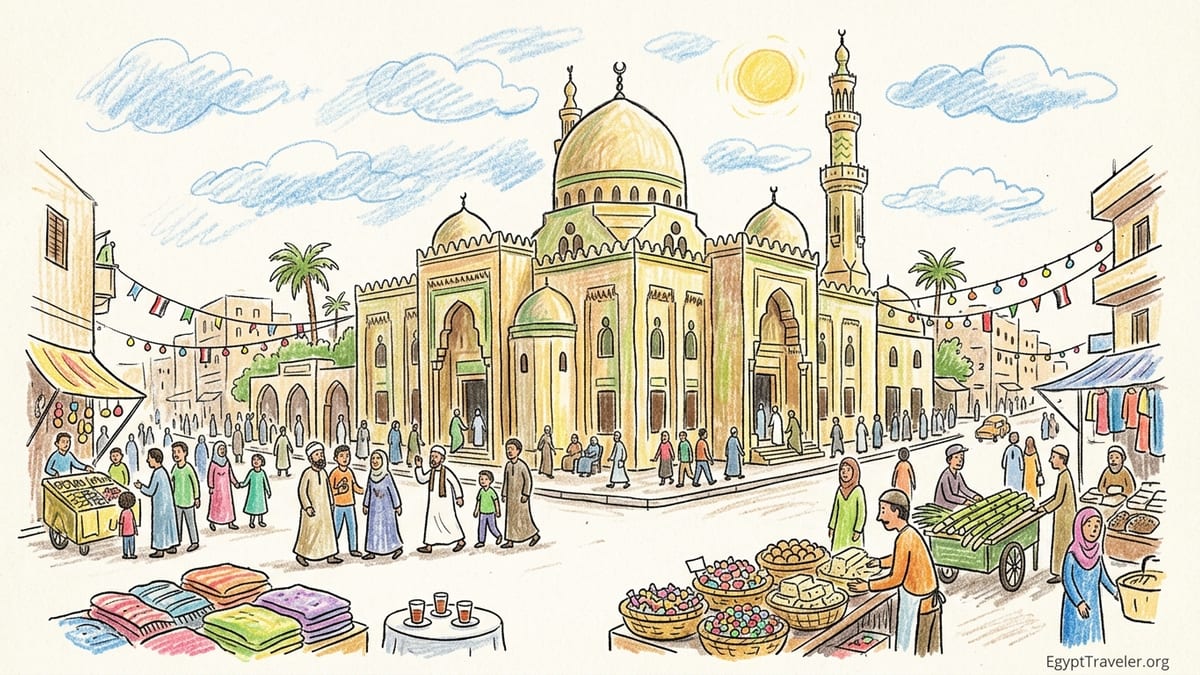
The Mosque of Ahmad al‑Badawi, often called El‑Sayyid el‑Badawy Mosque or simply “el‑Gami el‑Kabir” (the Great Mosque), sits a short walk from Tanta railway station. After a major restoration completed in the mid‑2020s, the complex feels bright and well kept, with polished marble courtyards, a high central dome and several smaller domes marking the tombs of the saint and key disciples. Seven main doors open onto surrounding streets that are busy with worshippers, vendors and sweet sellers.
Non‑Muslim visitors are generally welcome to enter the outer parts of the mosque outside peak prayer times, as long as they dress modestly and behave quietly. Men should wear long trousers and covered shoulders; women should have legs and arms covered and bring a scarf to cover their hair. At busy entrances, attendants may guide you to separate areas for men and women. Shoes must be removed before stepping onto the carpeted prayer halls, so bring a small bag if you prefer to carry them.
Inside, the atmosphere combines bustling devotion with deep emotion. People circle the saint’s tomb, reciting Quran, touching the ornate metal grille and tying small green cloths as votive offerings. You may see pilgrims who have come directly from rural villages still carrying their luggage, and mothers whispering prayers for children pressed against the screen. Photography rules can vary depending on the current mood and crowding, so it is best to keep cameras discreet, avoid shooting worshippers at close range and always follow any instructions from staff.
A practical approach is to visit twice: once during the day to appreciate the architecture and flows of pilgrims, and once after dark when the mosque’s domes are lit and the surrounding streets are at their liveliest. Nearby cafés serve sweet mint tea, Turkish coffee and shisha; many have a clear view of the mosque’s minarets and make a good spot to absorb the rhythm before stepping back into the crowd.
The Moulid: Egypt’s Biggest Sufi Festival in Practice
Tanta’s most famous event is the main moulid, or birthday celebration, of Ahmad al‑Badawi. Today this takes place in October, timed with the cotton harvest, and usually lasts for about a week. There is also a smaller spring moulid known as the “moulid el‑ragabi” around April, but October is the headline event when Tanta earns its reputation as Egypt’s Sufi capital.
During the main moulid, the streets radiating from the mosque become a dense, temporary city. Whole blocks fill with colorful tents where different Sufi brotherhoods host dhikr ceremonies each night. You may walk past one tent where men whirl and chant the name of God in unison, another where a sheikh delivers a fiery sermon over loudspeakers, and another where a group sings poetry to the beat of frame drums. The air is thick with incense and the smell of grilled liver sandwiches, corn on the cob and frying falafel.
Crowds are intense. In the evenings, especially the final two nights, shoulder‑to‑shoulder traffic is normal on the main streets around the mosque, and it can take twenty minutes to move a single block. Hawkers sell plastic toys, glowing headbands, cotton candy and the famous moulid sweets, while families push strollers and groups of young men snake through the crowd in chains to avoid losing each other. For a visitor, it can feel overwhelming but also remarkably good‑natured, with people often happy to chat and ask where you are from.
Respectful behavior is essential. Dress more conservatively than you might elsewhere in Egypt: long, loose clothing, and women with hair fully covered. Avoid drinking alcohol anywhere in the city during the festival, and do not photograph inside tents or very close to worshippers without explicit consent. Choose pockets that can be zipped or hidden; petty theft is not rampant but crowds make it possible. Women traveling alone may prefer to move with a group or join a trusted local guide during the busiest evenings, when jostling is unavoidable.
Day Trip or Overnight: Planning Around the Festival
Outside the moulid period, Tanta is an easy and low‑stress day trip from both Cairo and Alexandria. Fast trains from Cairo Ramses station typically take about one hour to an hour and a half depending on the service. From Alexandria, the journey usually takes between one and a half and two hours. Ticket prices for standard second‑class seats are generally modest by international standards, often in the range most visitors consider very affordable, and seats are usually available on the day except at rush hours.
On an ordinary weekday, a realistic day‑trip plan from Cairo could be a mid‑morning train arriving before lunch, a slow walk through the central market and lunch near the mosque, an afternoon visit to the Tanta Museum and a sunset return to the shrine before catching an evening train back. From Alexandria, a similar pattern works in reverse. This schedule offers ample time to see the main sights without needing to sleep over, and hotels in Tanta are therefore more oriented toward domestic business travelers and pilgrims than international tourists.
During the October moulid, the equation changes dramatically. Tanta’s modest stock of hotels and guesthouses fills early, sometimes weeks in advance for the final nights of the festival. Prices in simple two and three‑star properties can climb well above their usual range, and latecomers may find only very basic or distant rooms available. Many Egyptian pilgrims simply sleep in tents or on blankets near the mosque, but this is rarely comfortable or appropriate for foreign tourists.
A practical compromise for most visitors is to base in Cairo and visit Tanta as a very long day trip during the moulid. Taking a morning train gets you into town before the main crowds; you can explore markets and side streets in relative calm, then experience the evening peak of the festival and leave on a late‑night train back to Cairo. This avoids the accommodation squeeze while still giving a vivid taste of the moulid atmosphere. If you prefer to overnight, book as early as you can and understand that comfort levels will be simpler than in major tourist hubs.
Markets, Downtown Streets and Everyday Delta Life
Even without the festival, Tanta’s central streets feel like an open‑air theater of Delta life. The main souk areas stretch behind and between the mosque and the railway tracks, with narrow lanes lined by small shops and stalls selling vegetables, live chickens, textiles, shoes and plastic household goods. Thursday is often the busiest market day, as villagers arrive to shop ahead of the weekend, and the streets around the mosque can be especially animated.
Unlike Cairo’s tourist‑oriented Khan el‑Khalili, Tanta’s markets sell almost exclusively to locals. You might wander past barrowfuls of green molokhia leaves, baskets of Nile fish on ice, rolls of cheap cotton fabric and piles of synthetic blankets printed with football club logos. Prices are clearly posted in Egyptian pounds, and bargaining is typically limited to items like clothes or shoes. Travelers often comment that no one pressures them to buy; many stallholders are more surprised than anything else to see foreigners passing through.
For a quick immersion, walk from the station toward the mosque along one of the main commercial arteries such as Ahmed Maher Street, then dive into side lanes toward the old market district behind the mosque. Street‑side juice stands squeeze fresh cane juice, orange or pomegranate in front of you for the price of a bus fare. Small barbershops are full of shouting and laughter, and stationery stores sell school notebooks decorated with popular TV characters rather than pyramids.
As evening approaches, cafés and simple restaurants fill with workers finishing long shifts at nearby factories and workshops. Local chains serve shawarma, grilled chicken and koshari, while tiny sandwich kiosks specialize in taameya (Egyptian falafel) and fried liver. Sitting at a plastic table on the sidewalk with a plate of fuul beans, pickles and flat bread is often as memorable as any formal sightseeing in the city.
Tanta’s Legendary Sweets and Delta Comfort Food
If Tanta has one export known across Egypt, it is sweets. The city is a major center for halawa (sweet sesame or nut pastes), nougat and the colorful “moulid sweets” made especially for religious festivals. In the streets around the mosque you will see entire shopfronts stacked with slabs of nut‑studded nougat, sesame bars, chickpea brittle and boxes of mixed candies bearing the names of local brands. Many Egyptians passing through Tanta by train pick up a kilo or two to bring home to friends and family.
Visiting outside festival time, you can still buy moulid‑style sweets year‑round in specialist stores. Staff will often encourage you to taste small samples before you decide, breaking off pieces of pistachio nougat or sesame crunch. The sweets travel well, making them one of the best local souvenirs from Tanta. During the moulid, production ramps up dramatically and you will see temporary stalls piled high with sugar dolls, horses made of bright candy and simple paper toys for children.
Beyond confections, Tanta’s food is classic Delta comfort cooking. Expect generous portions of rice, stewed vegetables and grilled meats, often at low prices compared to Cairo. Local eateries near the market serve hearty dishes like fattah (rice and bread with meat and broth), grilled kofta, liver sandwiches and seasonal vegetable stews. In the cooler months, bowls of lentil soup and piping hot sweet tea are staples. Do not expect menus in multiple languages; instead, point to what others are eating or ask for common dishes by name.
For cautious stomachs, look for busy places with high turnover, especially at lunchtime. Many cafés double as pastry shops where you can sample Egyptian classics such as basbousa, konafa and baklava, alongside Tanta’s own halawa varieties. Ordering a mixed plate of small pastries and a strong coffee is an easy way to taste widely without overcommitting to a single sweet.
Tanta Museum and Other Secondary Sights
While Tanta is not primarily an archaeological destination, the Tanta Museum provides useful context for the broader Delta region. Housed in a modernized building not far from the city center, it is considered one of the older provincial museums in Egypt and the only one in Gharbia governorate. Inside, galleries display artifacts from Pharaonic, Greco‑Roman, Coptic and Islamic periods found across the Delta, giving a sense of how this fertile plain has been populated and contested for millennia.
Visitors typically find the museum pleasantly uncrowded, with enough English labeling to follow key themes. You might see basalt statues from late dynastic periods, jewelry and coins spanning Hellenistic to Ottoman eras, funerary objects and domestic tools that tie ancient history to the living fields and canals outside town. The museum usually keeps government office hours, closing by late afternoon, so plan to visit earlier in the day.
Elsewhere in the city, most additional sights are modest but help round out a portrait of Tanta as a multi‑religious urban center. Some travelers visit one of the large Coptic or Catholic churches, which are landmarks for the sizeable Christian minority. Street life, however, remains the main attraction. Simply walking from the museum back toward the mosque via back streets will likely yield more memorable encounters than checking off specific monuments.
If you are staying overnight, an evening stroll along the main commercial avenues provides a sense of how Egyptians in a non‑tourist city relax: families out buying clothes, teenagers at ice‑cream stands, and groups of friends lingering over sunflower seeds and televised football. Compared with Cairo, foreign faces are rare, and you may be drawn into friendly conversations in basic English or through shared photos on smartphones.
Practical Tips, Safety and Respectful Conduct
Logistically, Tanta is straightforward. Trains from Cairo and Alexandria are the most convenient option for most travelers; services vary from older commuter trains to faster air‑conditioned expresses. Buying tickets at the station shortly before departure is usually possible outside peak holidays, but during the moulid or national holidays it is wise to purchase earlier in the day or the day before. From Tanta station, the mosque and central market are close enough to walk in about ten to fifteen minutes, though taxis and ride‑hailing apps are also commonly used.
The city is generally safe in terms of violent crime, and locals are accustomed to large crowds and visitors during festivals. Standard urban common sense still applies: keep valuables close, avoid flashing large amounts of cash, and take particular care with phones in extremely dense crowds near the mosque at night. Women travelers may experience occasional comments or curious stares, especially during the moulid, but many report that being clearly foreign can sometimes deflect the kind of targeted harassment found in more touristy areas.
Health‑wise, the biggest challenges are noise, smoke and fatigue rather than specific dangers. The moulid environment includes heavy use of loudspeakers, diesel generators, cigarette smoke and sometimes firecrackers. If you are sensitive to noise, consider earplugs for evening visits. Drink only bottled or treated water, and be selective with street food if you have a delicate stomach, choosing items that are cooked to order and served very hot. Pharmacies are easy to find and can advise on basic stomach upset remedies.
Above all, remember that Tanta is first and foremost a place of devotion. Avoid public displays of affection, dress conservatively, and step aside if you find yourself obstructing worshippers or funeral processions. When in doubt, follow the crowd and ask permission before entering any space that looks semi‑private, such as small zawiyas (Sufi lodges) during dhikr sessions. A simple “mumkin?” with a questioning look is often enough to gauge whether you are welcome.
The Takeaway
Tanta will never rival Luxor or Aswan in terms of ancient sights, and that is precisely its appeal. This is a city where Egypt’s religious and everyday lives intersect in ways that most visitors rarely see: at the shrine of a medieval Sufi saint, in sugar workshops turning out festival sweets, in crowded trains depositing pilgrims and factory workers at the same platforms.
For travelers who value human encounters over monuments, a day or night in Tanta can be a highlight of a Delta journey. Time your visit with the October moulid if you want to experience Egypt’s largest Sufi festival, accepting the crowds and chaos that come with it, or come off‑season for a gentler introduction to shrine culture, markets and Delta food. Either way, Tanta offers a grounded, unvarnished look at a side of Egypt that exists well beyond the postcard pyramids.
FAQ
Q1. Is Tanta worth visiting if I have already seen Cairo and Luxor?
Tanta offers a different side of Egypt: a living Sufi pilgrimage city, dense markets and famous sweets rather than ancient temples. If you are curious about everyday Delta life and religious culture, it is a worthwhile addition.
Q2. When is the moulid of Ahmad al‑Badawi, and how long does it last?
The main moulid now takes place in October and typically runs for about a week, with the busiest nights toward the end of the festival. There is also a smaller spring moulid around April.
Q3. Is it better to visit Tanta as a day trip or stay overnight?
Outside festival time, Tanta works very well as a day trip from Cairo or Alexandria. During the October moulid, accommodation fills early and becomes expensive for the standard offered, so many visitors prefer a long day trip by train instead of staying overnight.
Q4. How long is the train journey from Cairo or Alexandria to Tanta?
Fast trains from Cairo usually take about one to one and a half hours, while services from Alexandria typically take between one and a half and two hours, depending on the train type and stops.
Q5. Can non‑Muslims enter the Mosque of Ahmad al‑Badawi?
Non‑Muslims are generally allowed into the outer parts of the mosque complex outside peak prayer times, provided they dress modestly, remove their shoes where required and behave respectfully. Access to some inner areas around the tomb may be more restricted when very crowded.
Q6. What should I wear during the moulid to be respectful?
Dress conservatively: long trousers or skirts, covered shoulders and chests, and for women a headscarf. Avoid tight or revealing clothing, and choose comfortable shoes suitable for slow walking in dense crowds.
Q7. Are Tanta’s famous sweets available only during the moulid?
No. While production peaks during festival periods, Tanta’s sweet shops and halawa factories operate year‑round. You can buy nougat, sesame bars and mixed boxes of sweets at any time of year.
Q8. Is Tanta safe for solo travelers, including solo women?
Tanta is broadly safe, with the usual urban cautions. Solo women may encounter curiosity or occasional comments, especially during the moulid, but serious problems are uncommon. Dressing modestly and sticking to busy, well‑lit streets at night improves comfort.
Q9. Are there English‑speaking guides available in Tanta?
You will not find many formal tour guides based in Tanta itself, but some Cairo‑based guides offer day‑trip excursions during the moulid. Otherwise, basic English is widely spoken among younger residents, and many visitors explore independently.
Q10. What are good souvenirs to bring back from Tanta?
The classic choice is a box or two of Tanta sweets such as nougat and sesame bars, which travel well. Simple prayer beads, green Sufi flags and modestly priced textiles from the local markets also make meaningful, lightweight souvenirs.