


Rashid, better known internationally as Rosetta, is a compact Nile Delta town where Ottoman mansions, riverfront corniche and a weathered fort quietly tell a much bigger story than the single slab of granodiorite that made it famous. For curious travelers willing to detour from Alexandria or Cairo, Rosetta offers one of the densest concentrations of Ottoman-era houses in Egypt, a surprisingly engaging local museum and the place where the Rosetta Stone was actually uncovered in 1799.
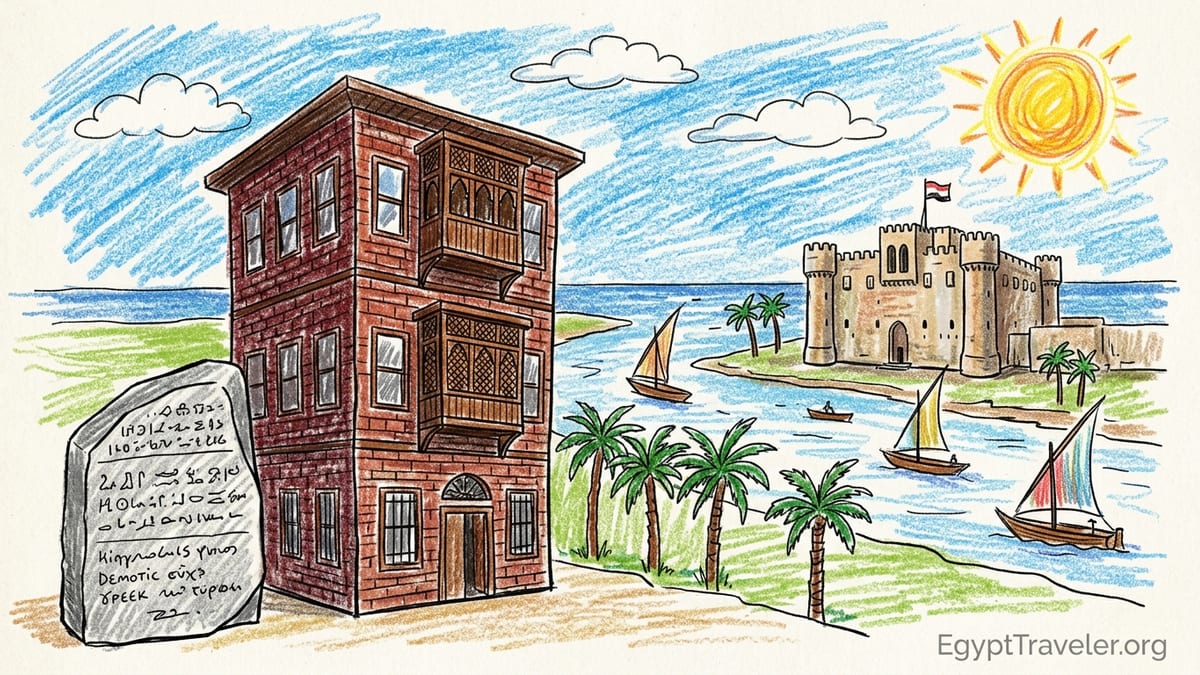
Understanding Rosetta and the Rosetta Stone Story
Rosetta sits about 65 kilometers east of Alexandria on the west bank of the Rosetta branch of the Nile, a few kilometers before the river meets the Mediterranean. Today it feels like a modest provincial town, but during the Ottoman period it was a thriving port that briefly eclipsed Alexandria. Its merchants grew rich moving spices and grain through the Delta, leaving behind tall brick mansions and ornate mosques that still define the historic core.
Most visitors arrive knowing Rosetta only as a name attached to the Rosetta Stone. The famous decree, carved in 196 BC, was not originally created here. Scholars believe it was first erected at a temple site elsewhere in the Delta, then later reused as building material at a coastal fort near Rashid. In July 1799, French soldiers strengthening the fortifications for Napoleon’s army unearthed the inscribed block and realized it might be important. That modest construction site became the starting point for the modern decipherment of hieroglyphs.
The fort where the stone was found is known today as Qaitbay Fort or Fort Julien, standing a few kilometers northwest of town where the Rosetta branch approaches the sea. After the French surrender, the stone passed to British control and was shipped to London in 1802. It remains on display in the British Museum. In Rosetta itself, you now see detailed replicas and interpretive exhibits rather than the original, but the town’s real draw is the broader Ottoman urban landscape that has survived when many other Delta ports were rebuilt or erased.
For travelers, this history matters less as a list of dates than as a framework for exploring the streets. Walking through central Rashid, you move from the governor’s mansion that now houses the Rashid National Museum to trading families’ homes, then out to the corniche and, if you have the time, to the riverside fort where the stone emerged from a wall of reused blocks. Understanding that the inscription’s journey passed through these very streets adds depth to what might otherwise be a simple architectural stroll.
Rashid National Museum: Gateway to the Town’s Story
Most visits start at the Rashid National Museum, a restored 18th century Ottoman house once owned by Arab Killy Hussein Bey, an Ottoman governor of the city. The tall, dark-brick façade with its projecting wooden mashrabiya balcony sets the tone for what you will see throughout town. Inside, rooms spread over several floors explain Rosetta’s role in the Ottoman spice trade, daily life in the Delta and the circumstances of the Rosetta Stone’s discovery, including a carefully made replica of the stone itself.
Displays are modest by big-city standards but atmospheric. You walk across polished wooden floors past panels about local battles, family life and traditional crafts. In one room, old flintlock rifles and sabers evoke Rosetta’s strategic position at the mouth of the Nile. Another presents domestic tools, brass coffee sets and embroidered textiles that make it easier to imagine the house when it was a bustling home. Labels are primarily in Arabic with some English, so carrying a translation app can help non-Arabic speakers get more from the exhibits.
Tickets are usually inexpensive by international standards, with prices historically in the range typical for small Egyptian regional museums. Expect to pay the local equivalent of just a few US dollars for entry and possibly a small additional fee if you plan to use a professional camera. Opening hours generally follow standard Egyptian museum schedules, roughly from morning to late afternoon, but times can shift seasonally and during Ramadan. It is worth checking current hours in Alexandria or Cairo before you come, or confirming by phone locally.
Even if you are mainly interested in the Ottoman houses, allow at least 45 minutes to an hour inside. The building itself is part of the collection: staircases zigzag up around a central light well, small inner courtyards cool the air, and high windows filter the strong Delta sun. From the upper floors you catch glimpses of neighboring roofs and minarets, a preview of the urban fabric you will explore on foot once you step back into the lanes.
Ottoman Merchant Houses and the Abu Shaheen Mill
The greatest surprise in Rosetta is how much Ottoman domestic architecture still survives. Current Delta guides often highlight the town’s two dozen or so preserved merchant houses, making Rosetta second only to Historic Cairo in Egypt for the concentration of Islamic-period monuments. These are tall, narrow, mud-brick mansions with intricate brick patterns, carved wooden ceilings and projecting mashrabiya balconies that allowed women to look out without being seen.
Among the most visited is the Al-Amasili House, a carefully restored residence on one of Rosetta’s main historic streets. Its cool stone floors, richly painted wooden ceilings and central reception halls illustrate how wealthy trading families lived during the 17th and 18th centuries. Visitors typically move through a series of high-ceilinged rooms that once hosted merchants who sailed in from Istanbul or the Levant, then out into courtyards where kitchen and service spaces were tucked against the walls. Guides, when available, point out subtle features such as built-in storage niches and wind-catching window placements that made these homes both practical and elegant in the Delta climate.
Right next door stands the Abu Shaheen Mill, a compact but evocative industrial space that once ground grain for Rosetta’s residents. The mill dates back many centuries and originally relied on donkeys walking in circles to turn the massive wooden grinding apparatus. Today the animals are gone, but the huge vertical wooden gears, stone grinding wheels and pointed arches still convey a sense of movement. Because the mill is usually included on combined tickets with one or more houses, budget conscious travelers can see several sites for little more than the cost of a coffee back in Alexandria.
Exploring these houses works best as a slow, loosely guided walk. In practice, many travelers hire a local guide near the Rashid National Museum or the main square to string the main houses together into an efficient route. Prices for a half-day private tour are often negotiable, commonly landing in the equivalent of 20 to 40 US dollars for a small group, which supports local guides and saves you time hunting down separate ticket offices. Alternatively, independent travelers can simply follow Arabic and English signs, paying small entry fees house by house.
Historic Mosques, Baths and Everyday Streets
Rosetta is famous not only for its houses but also for its concentration of historic mosques. The town has roughly a dozen significant mosques from the Mamluk and Ottoman periods, many built or renovated during Rosetta’s heyday as a port. As you walk the old quarters, you will frequently pass slender minarets, carved stone entrances and cool, shaded courtyards that provide a contrast to the surrounding brick façades.
Some mosques welcome visitors outside prayer times if you dress modestly and remove your shoes. Long trousers or a long skirt and covered shoulders are expected; women may be asked to cover their hair. Inside, you will find simple prayer halls, wooden beams and occasional carved stone mihrabs indicating the direction of Mecca. Unlike monumental Cairo mosques, Rosetta’s religious architecture feels intimately tied to daily life, with children playing in the courtyards and neighbors greeting each other in the lanes outside.
Beyond mosques, other Ottoman-era structures dot the historic streets. Travelers with an interest in social history may seek out the remains of old public baths, such as the Azuz Hammam complex, and relics of the old city gates like Abul-Rish Gate. These are not pristine tourist sites but fragments in a living town. You might pass a centuries-old doorway that now opens onto a modern barbershop, or see laundry strung across an alley framed by carved stone lintels. This blend of heritage and everyday life is part of Rosetta’s charm.
Because the historic center is relatively small, it is easy to wander without getting truly lost. Nonetheless, bringing an offline map can help you reconnect to main streets such as Dehliz Al-Malik or the corniche if you drift into purely residential lanes. Sidewalks are uneven and some alleys are poorly lit at night, so most visitors prefer to explore the historic quarter in daylight and use main roads after dark.
Qaitbay Fort and the Rosetta Branch by the Sea
Qaitbay Fort, also called Fort Julien, stands a few kilometers northwest of Rosetta where the Rosetta branch of the Nile approaches the Mediterranean. Built in the late 15th century by the Mamluk sultan Qaitbay to guard one of the Nile’s mouths, the fort later became a French stronghold during Napoleon’s campaign. It was while French engineers and soldiers were reinforcing these defenses in 1799 that they discovered the stone which would take Rosetta’s name and change the study of ancient Egypt.
Today, the fort is a squat rectangle of weathered masonry with rounded corner bastions and views over the last stretches of the river. Much of the stonework is reused from earlier ancient buildings, which is precisely how the Rosetta Stone ended up in its walls. Visitors can usually walk through vaulted chambers, climb outer ramparts and look back along the river or out toward the low coastal defenses that line this part of Egypt’s Mediterranean shore. The on-site displays about the Rosetta Stone are simple, but standing where it was found makes the story far more tangible than any museum label in Cairo or London.
Reaching Qaitbay Fort from central Rosetta generally requires either a taxi or prearranged transport, as it lies beyond comfortable walking distance for most visitors, especially in the heat. Shared microbuses sometimes run toward nearby villages, but for international travelers the most practical option is often to negotiate a round-trip ride with a local driver near the corniche or main square. Agree on the price and waiting time in advance. A typical fare for the short return journey may be only a few US dollars at local rates, but confirm the amount clearly to avoid misunderstandings.
If you have your own car, narrow rural roads lead north along the river to the fort and to stretches of modern coastal defenses beyond. Driving gives you flexibility to stop for photos of date palms, irrigation canals and fishing boats along the Rosetta branch. However, road surfaces can be uneven and signage minimal, so cautious driving is essential. Many visitors simply combine the fort with a broader guided tour of Rosetta’s historic core, timing the fort visit to avoid the harshest midday sun.
Walking the Corniche, Eating Local and Limited Overnights
Back in town, the riverfront corniche is Rosetta’s social spine. In late afternoon and early evening, families stroll along the promenade, children buy ice cream from street vendors and fishermen unload small catches from wooden boats. Simple riverside cafés serve sweet mint tea, Turkish-style coffee and shisha to clusters of locals and the occasional visitor. Watching the light soften over the Rosetta branch, with palms silhouetted against the water, is a relaxed way to end a day of house and museum visits.
Food options in Rosetta are straightforward and mostly geared to locals. Expect small grill shops turning out kofta, chicken and liver sandwiches, falafel stands and basic koshary joints. Being close to the river and sea, fresh fish and seafood are good bets when you can find a busy, well regarded restaurant. Prices are typically far lower than in Alexandria or Cairo: a satisfying local meal can often cost little more than the equivalent of a few US dollars. Because eateries change frequently, it is wise to ask your driver, guide or museum staff which places they currently recommend for fish or grilled meats.
Accommodation remains limited. Rosetta is not yet a major international tourist hub, so you will not find large beachfront resorts or international chains here. Instead, there are usually a handful of no-frills local hotels or guesthouses used mainly by domestic travelers and workers. Rooms tend to be simple, with varying levels of cleanliness and sporadic online visibility. Many foreign visitors therefore choose to base themselves in Alexandria, which offers a wide range of hotels from budget to luxury, and visit Rosetta as a long day trip.
Whether Rosetta is worth an overnight stay depends on your interests and tolerance for very simple lodgings. For most travelers, a full day is enough to visit the Rashid National Museum, two or three of the best Ottoman houses, the Abu Shaheen Mill, a mosque or two, a stroll along the corniche and a side trip to Qaitbay Fort. Those particularly fascinated by Ottoman domestic architecture or researching the Delta’s Islamic heritage might appreciate an extra half day to revisit quieter houses at different times of day, but most casual visitors find that returning to the greater dining and lodging choices in Alexandria makes the most practical sense.
Getting to Rosetta and Practical Logistics
Rosetta is most easily reached from Alexandria. The distance is only about 65 kilometers, but road traffic and local stops mean travel times can range from 1.5 to 2 hours each way. Public transport typically involves microbuses or local buses that depart from Alexandria’s major transport hubs and run toward Rashid. These services are inexpensive by international standards, often costing just a few US dollars equivalent, but they can be crowded and signage is mainly in Arabic.
For many international visitors, hiring a private taxi or arranging a car and driver from Alexandria is the most comfortable option. Hotels in central Alexandria or reputable local agencies can usually organize a day excursion that includes door-to-door transport, waiting time and sometimes a local guide in Rosetta. Prices vary depending on vehicle type and negotiation, but a full-day private car is often within reach for small groups splitting the cost. As always, agree clearly on total price, duration and whether fuel and tolls are included before setting off.
From Cairo, Rosetta is a considerably longer journey and less common as a standalone day trip. Travelers often visit Alexandria first, then continue to Rashid the next day. Self-driving is possible for confident drivers accustomed to Egyptian traffic, but you should prepare for busy multi-lane roads near Alexandria, variable lane discipline and frequent speed bumps when entering towns. For many visitors, hiring a driver remains the less stressful approach.
Within Rosetta, you can walk between most central sights. The Rashid National Museum, major Ottoman houses and several mosques sit within a compact historic area, though heat and humidity in summer can make even short walks tiring. Light clothing that covers shoulders and knees, a hat, sunscreen and ample water are essential in warmer months. Modest dress is also advisable out of respect for local norms. For longer hops or in the heat of the day, short taxi or tuk-tuk rides within town are inexpensive and easy to arrange through hotels, cafés or directly on the street.
The Takeaway
Rosetta is not a polished resort or a heavily curated open-air museum. It is a working Nile Delta town where muddy streets, laundry lines and satellite dishes mingle with 17th century mansions, carved mosque doors and the river that carried spices, soldiers and scholars for centuries. You will not see the original Rosetta Stone here; that resides in a London gallery far from the Delta mud where it was pulled from a fort wall. What you will see is the environment that produced the stone’s rediscovery and the architecture that prosperity left behind.
For travelers already heading to Alexandria or exploring Egypt’s Mediterranean coast, Rosetta rewards the extra effort. A well planned day trip can include a visit to the Rashid National Museum, several Ottoman merchant houses, the atmospheric Abu Shaheen Mill, a mosque or two, a quiet hour at Qaitbay Fort and sunset tea on the corniche. The experiences are local, unhurried and still largely free of crowds. While limited accommodation and modest dining options mean most visitors will prefer to sleep in Alexandria, Rosetta itself provides something increasingly rare: an intact Ottoman-era townscape that tells a layered story far beyond a single famous artifact.
If your interest in Egypt reaches beyond pharaohs and pyramids into the centuries when Arabic, Turkish and Mediterranean influences reshaped the Delta, Rosetta deserves a place on your itinerary. Come for the Rosetta Stone story, but stay long enough to appreciate the houses, mosques and riverfront that turn a name in a museum label into a real place with its own character and rhythm.
FAQ
Q1. Where exactly was the Rosetta Stone found?
The Rosetta Stone was discovered in 1799 by French soldiers rebuilding Qaitbay Fort, also called Fort Julien, a riverside fortress a few kilometers northwest of Rosetta.
Q2. Can I see the original Rosetta Stone in Rosetta?
No. The original Rosetta Stone was taken to Britain in the early 19th century and is displayed in the British Museum in London. In Rosetta you will see accurate replicas and interpretive exhibits.
Q3. Is Rosetta an easy day trip from Alexandria?
Yes. Rosetta lies about 65 kilometers east of Alexandria and can usually be reached in 1.5 to 2 hours each way by car, taxi or local bus, making it suitable for a full-day excursion.
Q4. What are the must-see sights in Rosetta?
Key sights include the Rashid National Museum, several restored Ottoman merchant houses such as Al-Amasili House, the Abu Shaheen Mill, selected historic mosques, the riverfront corniche and Qaitbay Fort.
Q5. Are there good hotels in Rosetta?
Accommodation in Rosetta is limited to simple local hotels and guesthouses. Most international visitors prefer to stay in Alexandria, which offers a much wider range of lodging, and visit Rosetta as a day trip.
Q6. How walkable is Rosetta’s historic center?
The historic core is compact and generally walkable, with the museum, main Ottoman houses and several mosques within short walking distance, although summer heat and uneven pavements can make strolls tiring.
Q7. Is it necessary to hire a guide in Rosetta?
A guide is not strictly necessary, but hiring a local guide can help connect the main houses and mosques efficiently, provide context in English and support the local economy for a relatively modest fee.
Q8. What should I wear when visiting Rosetta?
Modest, lightweight clothing that covers shoulders and knees is recommended, both for the sun and out of respect for local customs, especially when entering mosques and traditional houses.
Q9. Is Rosetta suitable for families with children?
Yes, families often enjoy climbing through Ottoman houses, exploring the fort and walking the corniche, but parents should be prepared for heat, limited formal facilities and the need to supervise children on uneven stairs and ramparts.
Q10. When is the best time of year to visit Rosetta?
The most comfortable months are typically from late autumn to early spring, when daytime temperatures in the Delta are milder and walking between sights is more pleasant than in the peak summer heat.