


East of Cairo, beyond the familiar pyramid belt, the Nile Delta flattens into a quiet landscape of fields, irrigation canals and small towns that hide some of Egypt’s most evocative ruins. A full-day excursion from Cairo to Bubastis (Tell Basta) and Tanis (San el-Hagar) takes you far from the crowds to explore temple precincts, toppled obelisks and royal tombs associated with the Bible and the later pharaohs. It is a rewarding, but logistically demanding, day out. This guide sets out how to do it in comfort, what you will actually see on the ground, and whether combining the eastern Delta sites with a Suez Canal stop makes sense in a single day.
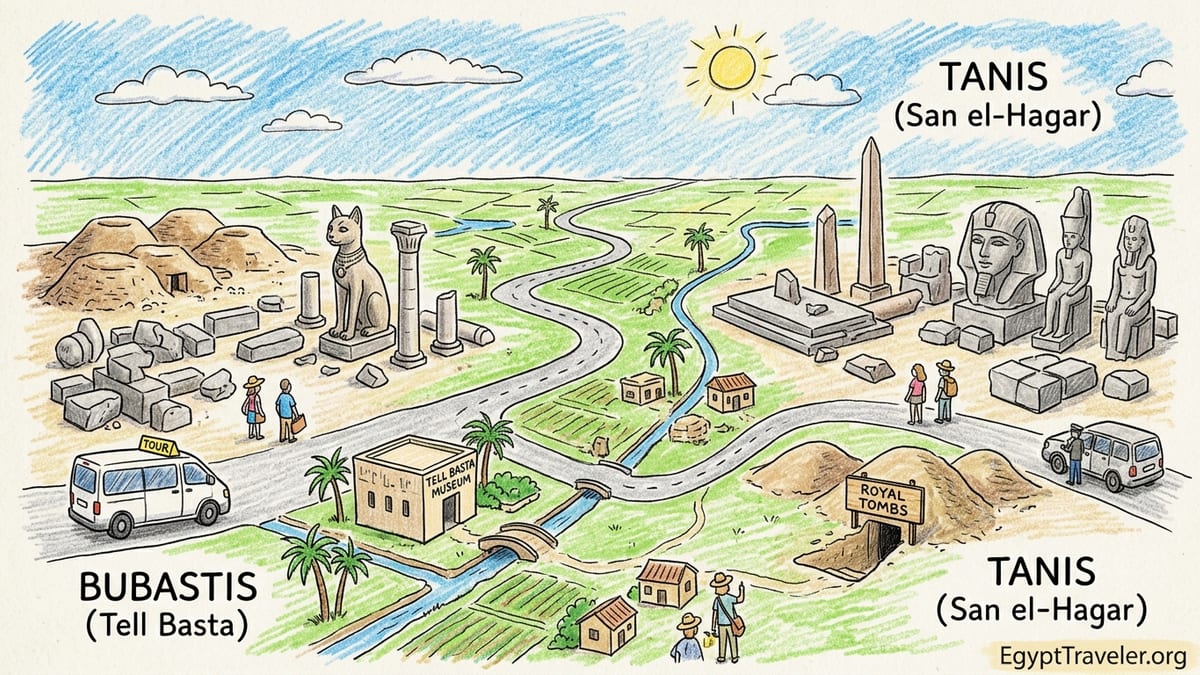
Understanding the Eastern Nile Delta Day Tour
Modern Cairo sits at the southern edge of the Nile Delta, but the main archaeological attractions for most visitors are clustered to the west and south at Giza, Saqqara and Dahshur. Bubastis and Tanis are different. Both lie to the northeast in the agricultural heart of the Delta, close to modern Zagazig and San el-Hagar. That means less monumental desert backdrops and more low mounds, excavation trenches and sprawling temple platforms interrupted by palms and irrigation ditches. For travelers interested in later pharaonic history, biblical connections or quieter ruins, this is exactly their appeal.
Bubastis, known in Egyptian as Per-Bastet, was the principal cult center of the cat goddess Bastet and became the capital during the Twenty-second Dynasty. Today it is embedded in the eastern edge of the city of Zagazig in Sharqiya governorate, about 80 to 100 kilometers by road from central Cairo depending on the route. The archaeological zone is officially called Tell Basta. It combines a compact museum with a largely open-air site of temple remains, statues and a famous colossal figure of princess-queen Merytamun. Visits here are usually the first stop on combined tours.
Tanis, modern San el-Hagar, lies deeper into the Delta, roughly another 70 to 90 kilometers beyond Bubastis. It was an important royal residence and religious center during the Third Intermediate Period, and its temple precinct of Amun is one of the largest in Egypt. Many big statues and obelisks were moved here from earlier sites such as Pi-Ramesses. The discovery in 1939 of intact royal tombs belonging to kings like Psusennes I made Tanis one of the twentieth century’s major Egyptian finds. In practical terms, though, it is remote and involves long road transfers.
Because both sites are quiet, ticketed government-run zones rather than commercial attractions, there are no crowds to absorb logistical mistakes. Getting the order of visits, the timing and the guiding right will determine whether your day feels like an immersive expedition or a long day of driving with brief stops among ruins.
Tell Basta / Bubastis: Temple of Bastet and On-Site Museum
Almost every organized Tanis and Bubastis tour begins at Tell Basta, usually leaving Cairo around 7:00 or 7:30 in the morning to reach the site close to opening time. The drive typically takes 1.5 to 2 hours depending on Cairo traffic. You leave the ring road to the northeast, pick up the desert highway then cross into Sharqiya’s greener belt toward Zagazig. The last stretch passes through busy local streets, which is one reason many visitors prefer not to self-drive.
At Bubastis the first impression is modest compared with the pyramids. Low mudbrick mounds and stone blocks spread around a shallow depression that marks the sacred precinct of Bastet. With a knowledgeable Egyptologist, the layers come to life. Guides point out the remains of the Old Kingdom temple of Pepi I, later additions from the New Kingdom and the Libyan dynasties, and reused granite blocks bearing cartouches of Ramses II. The colossal statue of Merytamun, a daughter-wife of Ramses II, lies partly buried but still powerful. Herodotus wrote of vast festivals here in honor of Bastet, with tens of thousands of pilgrims arriving by boat; standing amid the ruins with this story in mind gives the site a particular atmosphere.
The Tell Basta Museum, a small archaeological museum just outside the main excavation area, is worth at least 30 to 45 minutes. Its galleries hold more fragile or significant pieces excavated in the area, including relief fragments, statues of Bastet and domestic objects that help explain daily life in the Delta. Labels are mainly in Arabic and English, but their detail varies, so having a guide who can interpret the pieces and place them chronologically is helpful.
As of 2025 the Ministry of Tourism and Antiquities lists Tell Basta’s opening hours as roughly 9:00 to 17:00 in winter, extending to 18:00 in summer, with last entry about an hour before closing. Tickets for foreign adults are in the low hundreds of Egyptian pounds and less for students, with separate small fees for vehicles. Travelers report that payment is usually in cash at a booth by the gate and that the Cairo Pass covers entrance if you already hold one, though it is wise to confirm at the time of purchase. Facilities are basic: expect a simple restroom near the entrance, shaded areas at the museum and occasional small kiosks or vendors, but no full cafe.
On the Road Between Cairo, Bubastis and Tanis
The key trade-off on this excursion is archaeological depth versus driving fatigue. Over a standard 10 to 12 hour day you will spend around 5 to 7 hours on the road. From central Cairo to Bubastis allow 1.5 to 2 hours each way. From Bubastis to Tanis is another 1.5 to 2 hours on smaller regional roads, longer if you hit agricultural traffic or if there are checkpoints. The return from Tanis back to Cairo often takes 3 to 3.5 hours, especially when approaching the capital in late afternoon or early evening.
Most private tour operators use modern air-conditioned vans or minibuses with seat belts and bottled water on board. Reputable examples advertising this route in 2025 include Egypt-based mid-range companies that specialize in archaeological day tours and custom Delta itineraries. Their typical pick-up is from central Cairo or Giza hotel districts such as Zamalek, Downtown or near the pyramids. Departure is rarely later than 7:30 because leaving at 9:00 risks pushing the Tanis visit into the hottest part of the day and returning to Cairo well after dark.
Food planning matters because you will not find a cluster of tourist-focused restaurants at either site. Many tours include a set lunch in a simple local restaurant between Bubastis and Tanis, often on the outskirts of a mid-sized town where there is space for coaches to park. Expect grilled chicken or kofta, rice, salads and soft drinks rather than elaborate menus. Others opt for a late lunch or early dinner stop on the outskirts of Cairo on the way back. If you are arranging your own driver, it is wise to agree in advance whether you want to stop at a sit-down restaurant or rely on snacks brought from Cairo plus opportunistic coffee or tea stops at highway service stations.
Because of the long transfers, this itinerary is easiest in the cooler months between October and April. In summer heat, especially July and August, walking for 2 to 3 hours across open temple platforms with minimal shade can be very taxing. Air-conditioning in the vehicle helps during drives, but carrying water, wearing a hat and planning your heaviest exploring for the morning are still important.
Exploring Tanis: Temple Precincts, Royal Tombs and Delta Landscapes
Arriving at Tanis, you enter one of Egypt’s most atmospheric yet little-visited archaeological zones. The heart of the site is the vast temple precinct, dominated by the Temple of Amun. What makes Tanis visually striking is the concentration of colossal granite statues and broken obelisks scattered across the courtyard and beside the main temple platform. Many bear the names of earlier kings such as Ramses II and Merenptah, moved here from Pi-Ramesses when that older Delta capital lost importance. Walking through this forest of displaced monuments, a guide can show where inscriptions have been altered or reinscribed to suit new rulers.
To one side of the main precinct lie the royal tombs that made Tanis famous in modern times. In 1939 and the early 1940s, French archaeologist Pierre Montet uncovered intact burial chambers of kings like Psusennes I and Shoshenq II, finding gold masks, jewelry and coffin sets that rivaled Tutankhamun’s in craftsmanship, though on a smaller scale. The most important treasures are now in museums in Cairo, but the tomb chambers themselves remain in situ. With a guide and a torch you can descend into some of these spaces, where traces of reliefs and sarcophagus niches are still visible. Expect basic lighting and uneven steps rather than polished visitor infrastructure.
Beyond the central zone are additional temple remains, mudbrick town walls and scattered excavation areas that testify to Tanis’s long occupation. Much is only partially excavated or appears as low mounds, which can be underwhelming without context but fascinating if you have an interest in settlement archaeology. The surrounding landscape of fields and canals maintains a sense of isolation. Unlike Giza or Luxor, you are likely to share Tanis with only a handful of other visitors, often Egyptology students or specialist groups.
Entry procedures at Tanis are similar to Bubastis, with a small ticket office and posted prices in Egyptian pounds. Foreign adult tickets generally sit in a similar band to other non-iconic sites in Egypt, while student discounts are common. As with Bubastis, opening hours run roughly from mid-morning to late afternoon, with earlier closure during Ramadan. Services are minimal, so do not assume there will be a proper cafe or shop. A private vehicle with driver waiting at the entrance is effectively your base for water, snacks and a cool rest between sections of the site.
Ideal Itinerary, Entrance Logistics and Food Stops
For most travelers, the most efficient and comfortable visit sequence from Cairo is Bubastis first, then Tanis, then a late meal on the way back. A typical day might look like this: hotel pick-up in Cairo around 7:00, arrive Tell Basta around 9:00, spend 1.5 to 2 hours between the temple ruins and the museum, then depart at about 11:00. After a 1.5 to 2 hour drive you reach Tanis early afternoon, explore for 2 to 2.5 hours, and leave between 15:30 and 16:00 for the return to Cairo, arriving back around 19:00 to 20:00 depending on traffic and whether you stop for a sit-down meal.
Buying tickets on site is straightforward. Neither Bubastis nor Tanis requires advance reservations under normal conditions, and capacity limits have not been a concern. Carry small denominations of Egyptian pounds for tickets and for parking or photography fees if these are updated. Policymakers have adjusted prices for major sites in recent years, usually with modest increases, so treat any online price lists older than a season or two as approximate. If you have already purchased a Cairo Pass from a major museum or ticket office in the capital, ask your guide which components it covers in the Delta and bring your passport and pass card.
For lunch, many tour operators book a fixed-menu meal in a restaurant along the route between Bubastis and Tanis, sometimes near a junction town where main roads cross. These restaurants often serve grilled meats, rice, salads and soft drinks designed for groups, with prices typically built into the tour cost. Travelers arranging their own driver or taxi can instead bring a picnic from Cairo and eat in the shaded parking area at Bubastis after the visit, then push straight through to Tanis. This approach can save an hour and keep you ahead of any groups using the same timetable.
Snacks and bathrooms on the road are available at fuel stations and simple highway stops. Bring your own tissues, hand sanitizer and a refillable water bottle. During the hotter months, consider asking your driver to keep a cooler with extra bottled water in the car. Because both sites close in the late afternoon, building slack into your schedule at the start of the day is wiser than hoping guards will allow a late arrival.
Guides, Egyptologists and Whether to Add the Suez Canal
Current day-tour offerings from Cairo that combine Tanis and Bubastis generally operate as private excursions, not shared coach tours. They usually include hotel pick-up and drop-off, a private vehicle with driver, and a licensed Egyptologist guide who remains with you for the full day. Sample prices advertised in 2025 for a two-person private tour, excluding entrance fees, tend to fall somewhere in the range of a few hundred US dollars, with per-person costs dropping for larger groups. Inclusions sometimes extend to lunch and bottled water.
The main advantage of an organized tour is the combination of logistics and interpretation. Drivers familiar with the route know how to navigate Cairo’s morning traffic, manage police checkpoints in Sharqiya and Dakahlia, and find the often unsigned approach roads to the sites themselves. A knowledgeable guide adds the historical framework that is almost completely absent from on-site signage, particularly at Tanis where understanding the re-used monuments and the sequence of dynasties is crucial. For travelers arriving in Egypt for the first time, paying for that combination can make the difference between a tiring day of anonymous ruins and a coherent narrative of Egypt’s late pharaonic period.
Arranging a private driver and hiring an Egyptologist separately can be attractive if you already know trusted local contacts or are comfortable negotiating in Arabic. Cairo-based drivers with modern sedans or minibuses can often be booked on a daily rate, with fuel and tolls added. An independent Egyptologist may set a fixed fee for the day plus their expenses. In theory this can work out cheaper for small groups, especially if lunch and entrance fees are paid directly at local rates. In practice, it is essential to confirm that your driver’s insurance, vehicle condition and permits are in order and that your guide is licensed by the authorities, as unlicensed guiding at archaeological sites is not permitted.
Several tour companies now market an extended itinerary that adds a stop at the Suez Canal, often at Ismailia or the Canal Zone, to the same day as Tanis and Bubastis. On paper this is appealing: ancient Delta capitals and one of the world’s great feats of modern engineering in a single circuit. In reality, fitting all three elements into one day makes for a very long schedule, often 13 to 14 hours door to door. The detour from the Tanis area to Ismailia or another Canal city and then back to Cairo can add 2 to 3.5 hours of extra driving. For travelers keen on in-depth time at both archaeological sites, that usually means shorter walks in the ruins and a rushed Canal viewpoint.
If you are short on days in Egypt and have a strong interest in seeing the Suez Canal, it is technically possible to include a brief stop, such as a photo break at an overlook near Ismailia and a late lunch in the city, before the final return to Cairo. However, this leaves minimal margin for delays and will almost certainly involve returning to your hotel late in the evening. For most visitors, especially in the hot season or when traveling with children, it is more comfortable to keep Tanis and Bubastis as a focused archaeology day and plan a separate Canal excursion if time allows.
Organized Tours vs Private Arrangement: What Works Best
Choosing between a packaged day tour and a do-it-yourself combination of private driver and guide comes down to budget, risk tolerance and how familiar you already are with Egypt. Organized tours from known operators based in Cairo or Giza have the advantage of clear pricing in widely used currencies, published itineraries, and customer service contacts if something goes wrong. They handle permits, vehicle selection and route planning, and they typically offer flexible pick-up from major hotel areas.
On the other hand, packages bundle services together in ways that may not suit every traveler. If you prefer a more leisurely pace that lingers at Tanis and perhaps skips the museum at Bubastis, or if you want to add a brief family-history stop in the Delta, negotiating directly with a private driver and an Egyptologist may give you more control. This model is more common among frequent Egypt visitors, small academic groups and photographers who value timing their site visits for particular light.
In cost terms, a private driver plus separately hired guide can be competitive with mid-range tour-company prices, especially for three or more travelers sharing the vehicle. You will, however, be responsible for coordinating rendezvous points, covering meals and communicating any changes in timing between the driver and guide. Using messaging apps to share your live location and day plan can smooth this. If you are staying in a chain hotel in Cairo, the concierge can often connect you with vetted drivers familiar with longer runs into the Delta.
Whichever model you choose, it is worth confirming in advance how long you want to spend at each site and whether detours, such as a short Canal view or additional Delta stop, are realistic within daylight hours. Make sure everyone involved understands that the priority is unhurried exploration of Bubastis and Tanis, not ticking boxes on a too-ambitious route map.
The Takeaway
A combined day trip from Cairo to Bubastis and Tanis is not a casual half-day outing. It involves several hundred kilometers of driving, sparse on-site facilities and modest visitor infrastructure. Yet for travelers who already know the better-known sights around Cairo and Luxor, it offers a rare chance to walk through largely empty temple precincts, trace the outline of royal tombs that changed the course of twentieth-century Egyptology and imagine the long-vanished festival crowds of the Delta.
Starting at Tell Basta allows you to ease into the day with a manageable site and a small museum that sets the scene for later history. Pressing on to Tanis rewards the long transfers with some of Egypt’s most atmospheric ruins, where toppled obelisks lie scattered around a temple of Amun and the outlines of royal necropoleis emerge from the sand. A well-chosen guide and reliable driver turn the long day into a structured narrative rather than a succession of anonymous mounds.
Adding a Suez Canal stop is best treated as an optional extra for those with high energy levels and limited time, and even then it is wise to accept that something will have to give, often time on the ground at Tanis. For most visitors, keeping the focus on the archaeology, starting early and planning realistic breaks for food and rest is the surest recipe for a satisfying eastern Delta excursion.
FAQ
Q1. How long is the Tanis and Bubastis day tour from Cairo?
The standard day runs about 10 to 12 hours door to door, including roughly 5 to 7 hours of total driving and 4 to 5 hours on the sites themselves.
Q2. Is it safe to travel by road from Cairo to the eastern Nile Delta?
For most visitors traveling with licensed tour companies or vetted private drivers, the route is considered routine, with police checkpoints and agricultural traffic but no special security restrictions.
Q3. Do I need to book tickets for Bubastis and Tanis in advance?
No, under normal circumstances tickets are bought at the small on-site offices on the day, and there are usually no capacity limits or queues.
Q4. Can I visit Tanis and Bubastis without a guide?
Yes, independent visits are allowed, but on-site signage is limited, so hiring an Egyptologist guide adds significant value, especially at Tanis.
Q5. What should I wear for a Tanis and Bubastis tour?
Lightweight, breathable clothing, sturdy closed shoes, a hat and sunglasses are recommended, along with sunscreen and a light jacket in winter.
Q6. Are there good places to eat near the sites?
Dining options at the sites themselves are basic, so most visitors rely on pre-arranged meals in local restaurants along the route or bring snacks from Cairo.
Q7. Is adding a Suez Canal stop realistic on the same day?
It is possible but makes for a very long day, often 13 to 14 hours, and usually reduces the time you can spend exploring Tanis and Bubastis.
Q8. Can children handle this excursion?
Older children with an interest in history often enjoy the open spaces and ruins, but the long drives and limited facilities can be challenging for younger kids.
Q9. Are these sites covered by the Cairo Pass?
The Cairo Pass has historically included a broad range of sites run by the Ministry of Tourism and Antiquities, but coverage can change, so confirm at purchase time.
Q10. When is the best time of year to do the Tanis and Bubastis tour?
The cooler months from October to April offer the most comfortable conditions, as both sites have little shade and can be very hot in summer.