


In a stretch of desert between Cairo and Alexandria, Wadi El Natrun shelters four active Coptic monasteries that shaped Christian monasticism and still hum with prayer, agriculture and quiet hospitality. Visiting St. Macarius, St. Bishoy, the Syrian Monastery and Baramus is less like touring a monument and more like stepping into a living spiritual landscape, where fourth century traditions continue behind thick mudbrick walls and white domes. This guide explains why these monasteries matter, what you can actually see at each one, and how to visit respectfully in a way that leaves time for stillness as well as sightseeing.
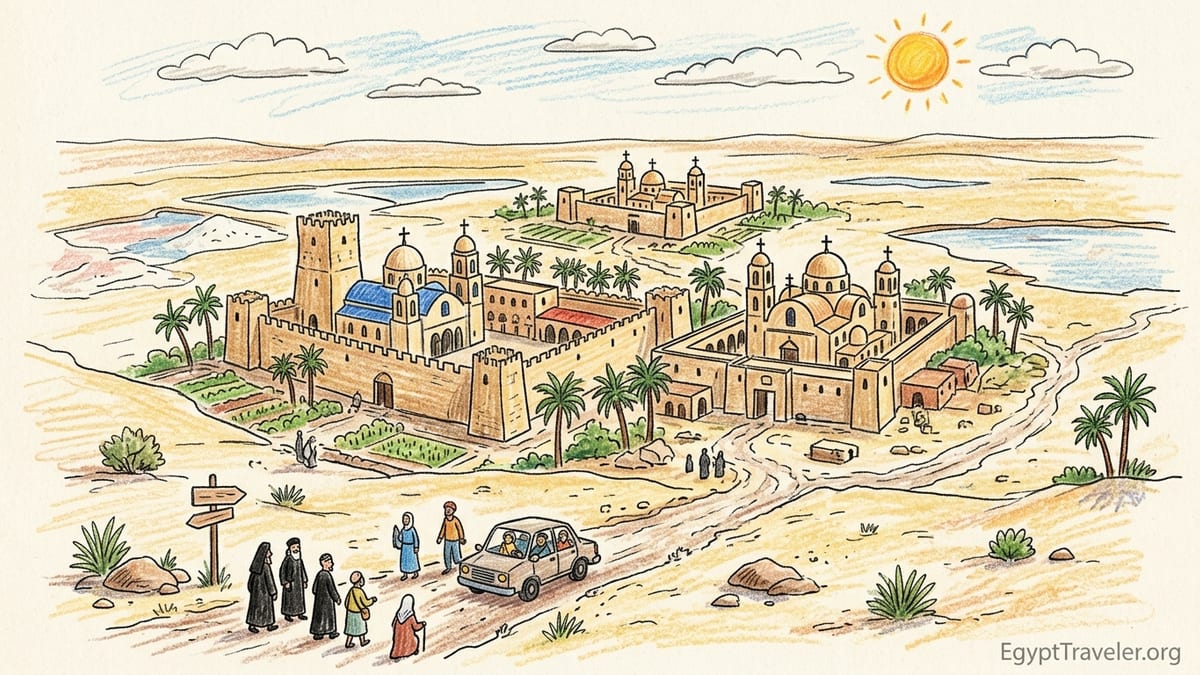
The Birthplace of Desert Monasticism
Wadi El Natrun lies about 100 kilometers northwest of Cairo along the modern desert highway to Alexandria, yet historically it felt like the end of the earth. From the fourth century, monks withdrew into this harsh valley to live in solitude, prayer and manual labor. Their way of life inspired what became Christian monasticism across the Mediterranean, including communities in Palestine, Syria and later Western Europe. St. Macarius the Great settled here around 360 AD, and over time dozens of monasteries rose among the salt lakes that gave the valley its name. Today only four monastic complexes remain active, but they represent an unbroken chain from those early centuries.
For travelers, this history is not abstract. When you enter a refectory where low stone benches line the wall, or climb a narrow stair inside a fortified tower, you are standing in the architecture that monks designed to survive raids, drought and long fasts. Many visitors come on a day trip from Cairo with a private driver or organized tour, spending six to eight hours between the four monasteries and the road. The atmosphere is very different from Cairo’s churches: quieter, more rural and often scented with bread baking or herbs drying in courtyards.
The four active monasteries are the Monastery of St. Macarius (Deir Abu Maqar), Monastery of St. Bishoy (Deir Anba Bishoy), the Syrian Monastery (Deir El Surian) and Baramus or Paromeos Monastery (Deir Baramus). They stand a short drive apart along a paved side road west of the main highway, close enough that pilgrims sometimes walk between them. Each has its own character. St. Bishoy is usually the busiest and most organized for visitors, St. Macarius feels more secluded and scholarly, the Syrian Monastery is renowned for its frescoes and library, while Baramus has the stark, fortress-like simplicity many travelers picture when they imagine a desert monastery.
Although Wadi El Natrun is a spiritual center for Coptic Christians, non-Copts and non-Christians are generally welcome to visit the main churches and compounds. The key condition is respect. This means dressing modestly, keeping voices low, and remembering that the monks you see in black robes and hoods are at home and at work, not part of a museum display. A good mindset is to treat the monastic zone as you would a small rural village where you are a guest rather than a tourist.
Planning Your Visit: Time, Access and Practicalities
Most travelers visit Wadi El Natrun as a day trip from Cairo. With normal traffic, the drive to the monastery turnoff near the town of Wadi El Natrun takes 1.5 to 2 hours each way by private car. Local operators and Cairo hotels frequently advertise day tours that include transport, a driver who waits between stops, and sometimes a guide familiar with Coptic history. As of mid 2026, typical prices for a private full day tour for two people in a standard sedan range from the equivalent of 80 to 150 US dollars, depending on whether an Egyptologist guide is included. Independent travelers often hire a Cairo taxi or ride-hailing service for a flat daily fee, agreeing in advance on a total price and fuel.
Access conditions can change during major fasts or feasts. For example, the official site of St. Macarius Monastery has announced that the ancient inner monastery is closed to visitors during fast periods, though the outer guest area remains open. In practice this means you might still see the churches and grounds from a distance, but not enter all historic spaces. It is wise to have your hotel or a local tour organizer call ahead to check whether any of the four monasteries are restricting visits on your chosen day, especially around Lent and major Coptic feasts such as Easter and Christmas.
To appreciate the four monasteries without turning the day into a race, allow at least 6 hours on the ground in Wadi El Natrun. A realistic, unhurried schedule for a private visit might begin at Baramus, continue to the Syrian Monastery, pause for a simple lunch at a roadside restaurant or monastery canteen, then finish at St. Bishoy and St. Macarius in the afternoon. This gives you roughly an hour to an hour and a half in each complex, enough time to visit the main church, climb a tower or walk the outer walls, and sit quietly in a courtyard before moving on.
There is no entrance ticket in the sense of a museum fee. Donations boxes are placed discreetly in churches and guest halls, and a modest contribution in local currency is appreciated. Simple refreshments such as tea, soft drinks and packaged snacks are often available from small kiosks or monastery shops, but do not rely on finding full restaurant service inside the compounds. Many day trippers bring bottled water and a few snacks from Cairo and then stop at a local roadside café near the highway for a more substantial meal on the way back.
Monastery of St. Macarius: Secluded Spiritual Powerhouse
The Monastery of St. Macarius stands slightly apart from the other three, further into the desert and reached by a paved side road marked by a sign on the Cairo–Alexandria highway. Traditionally it is considered one of the most important Coptic monasteries, both spiritually and historically, founded by St. Macarius the Great in the fourth century. Today it is a substantial complex that includes agricultural land, modern monastic buildings and the ancient core of churches and towers. Visitors usually enter through a gate that leads to a landscaped forecourt, then follow a monk or lay guide into the historic enclosure.
Inside, the heart of the monastery is the ancient Church of St. Macarius with its low domes and thick piers. The restored sanctuary contains a shrine where the monks venerate relics associated with St. Macarius and other early saints. Around this core stand additional churches, including one dedicated to the Holy Virgin and others associated with patriarchs and saints revered in Coptic tradition. Much of the decoration is in the simple Coptic style: carved wooden screens, oil lamps, and icons painted in warm earth tones rather than glossy modern styles. Even travelers without religious background often remark on the quiet, filtered light and the sense that these domes have seen prayer for more than 1,500 years.
Architecturally, St. Macarius also preserves fortified features that speak to centuries of attack and upheaval. A qasr, or fortified tower, rises above the old walls, its thick base once serving as a refuge during raids. In the past, monks would pull up wooden ladders or drawbridges to isolate themselves inside, surviving on well water and stored grain. Today, visitors may be shown the tower’s lower rooms and the well that made this possible, depending on current access and whether a monk is available to guide you. The contrast between the defensive brickwork and the delicate iconostasis in the churches is striking, a reminder that desert monasticism required both spiritual and practical resilience.
St. Macarius has a reputation for scholarship. The monastery library holds manuscripts and theological works, some of them in Coptic and Arabic, and the community has been active in publishing spiritual writings in modern languages. While casual visitors will not handle rare manuscripts, you may see book-lined rooms or modest display cases with printed material about Coptic spirituality available for sale. If you are particularly interested in theology, it is worth mentioning this politely to the guest master or monk who greets you; sometimes they can point you toward a small bookshop area with translations and introductory texts in English and French.
Monastery of St. Bishoy: Living Pilgrimage Center
Closer to the main road, the Monastery of St. Bishoy is often the first stop for group tours and one of the busiest sites in Wadi El Natrun. Founded by St. Bishoy in the fourth century, it evolved into a substantial walled compound with multiple churches, a refectory, gardens and a prominent keep. Most visitors enter through a modern gate, cross a courtyard shaded by palm trees, and are then met by a monk who offers a short orientation. On busy Fridays and during Coptic holidays, you may find local families arriving in minibuses, children in their best clothes, and the church courtyard filled with the sound of liturgical hymns.
The main attraction for many pilgrims is the Church of St. Bishoy, which contains the relics of St. Bishoy himself, traditionally believed to be incorrupt. Nearby are the relics of St. Paul of Tammah and other saints important in Coptic spirituality. The interior is more elaborate than some of the other monasteries, with richly carved wooden screens, hanging lamps and modern icons alongside older pieces. Guides often pause at the reliquary to allow Coptic visitors to venerate the saints, then explain to international guests the stories associated with St. Bishoy, such as his celebrated vision of Christ.
Beyond the main church, St. Bishoy preserves a notable fortified tower. Historically, monks retreated here during raids, pulling up a drawbridge from the courtyard below. Visitors today may climb narrow staircases to small chapels on the upper levels, including churches dedicated to the Archangel Michael and the Virgin Mary. From the roof, when access is allowed, the view extends over the monastery gardens and out to the desert, giving a clear sense of how isolated these communities once were. A refectory with stone benches and a barrel-vaulted ceiling offers another glimpse into monastic daily life; guides sometimes point out the spot where the abbot read spiritual texts aloud during meals.
For travelers, St. Bishoy is also where the modern and the ancient meet most visibly. A small shop near the guest entrance sells items such as simple wooden crosses, printed icons, bottles of holy oil and booklets in Arabic and sometimes English. Prices are modest, often just a few US dollars equivalent per item, and proceeds support the monastery. There may be posted notices about current visiting hours or restrictions during fasts. As of mid 2026, visitors report that St. Bishoy generally remains open to day trippers except during major liturgical services, when access to the main church can be limited to worshippers only for part of the day.
The Syrian Monastery: Frescoes, Manuscripts and Quiet Gardens
A short drive from St. Bishoy lies the Syrian Monastery, also known as Deir El Surian or the Monastery of the Syrians. Historically associated with Syrian and Mesopotamian monks who settled in Egypt in the early centuries, it is renowned for its artistic heritage. From the outside, the monastery looks similar to its neighbors, with thick mudbrick walls, a central tower and clusters of domes. Inside, however, the main Church of the Virgin Mary houses some of the region’s most important medieval wall paintings, including scenes of the Great Feasts and ranks of haloed saints rendered in soft, weathered colors.
Visitors commonly enter the main church with a monk or guide who points out key frescoes and explains that many were revealed during twentieth century restorations, when layers of later plaster were carefully removed. The painted decorations include depictions of Christ, the Virgin Mary and Old Testament prophets, as well as geometric and floral motifs that frame the arches and apses. Because these frescoes are fragile, photography may be restricted or completely forbidden inside the church. When allowed, it is typically without flash, so a modern smartphone in low-light mode is preferable to large flash units or tripods, which are almost always discouraged.
The Syrian Monastery is also famous for its library. Historically it housed an extraordinary collection of Syriac, Coptic and Arabic manuscripts, some of which were acquired by major museums and academic libraries in Europe in the nineteenth century. The remaining collection is still significant, and while it is not a walk-in reference room, visitors may see a dedicated library building or exhibitions of facsimiles and printed editions in a small museum-style space. Monks are usually reserved about granting access to workrooms, but if you are a researcher with institutional affiliation and advance permission, it can sometimes be arranged through church channels. Casual travelers should simply enjoy whatever is on display and respect any closed doors.
Outside the church and library, the Syrian Monastery feels particularly tranquil. Courtyards are planted with palm trees, olives and flowering shrubs, and narrow paths lead between whitewashed cells where monks live and pray. You may hear the sound of chanting drifting from a chapel or see a monk tending beehives or vegetable beds. Many visitors remark that despite receiving tour buses, the Syrian Monastery often feels less crowded than St. Bishoy, making it a good place to sit quietly on a bench and absorb the atmosphere before moving on to the final monastery of the valley.
Baramus Monastery: Fortress in the Desert
Baramus, also known as Paromeos Monastery, is traditionally considered the oldest of the surviving monasteries in Wadi El Natrun. The complex takes its name from a phrase meaning “that of the Romans,” linked in Coptic tradition to two Roman princes who embraced monasticism. Architecturally, Baramus has a more austere, fortress-like appearance than some of its neighbors. Thick outer walls with minimal openings and a prominent rectangular tower reflect the centuries when desert monasteries needed to defend themselves against raids from nomadic groups and bandits.
Inside the enclosure, the main churches are dedicated to the Virgin Mary and to saints venerated in the Coptic calendar. The interiors combine ancient elements such as domed sanctuaries and stone columns with later additions, including wooden screens and icons in the familiar Coptic style. Compared with the richly frescoed Syrian Monastery, Baramus feels more restrained, with plain plastered walls punctuated by small icon panels and hanging oil lamps. This simplicity can be particularly moving for visitors who associate monastic life with poverty and quiet.
Baramus also preserves classic defensive features. The qasr tower once offered refuge during attacks, with a well in the lower level and storage for food and manuscripts above. Today, depending on access rules and the presence of a guide, you may be able to explore the base of the tower and see the remains of the drawbridge mechanism or the shaft of the well. As in other monasteries, the refectory is a highlight: a long room with stone benches set against the walls where monks historically ate in silence while passages from scripture and spiritual writings were read aloud. Guides sometimes demonstrate where the abbot sat and how the food was passed, helping visitors imagine a typical meal.
Because it is slightly off the main tour bus circuit, Baramus can feel quieter and more contemplative than St. Bishoy. Independent travelers often choose to start here early in the morning, arriving shortly after the gates open, to walk around the outer walls and photograph the domes in the slanting light before the day warms up. In cooler months, the early hours can be surprisingly chilly, so bringing a light jacket or shawl is wise even if Cairo felt warm when you left. The lack of dense crowds at Baramus also makes it a good place to ask the monks gentle questions about monastic life, provided you accept that some topics are private and that not every monk speaks foreign languages.
Etiquette, Dress Code, Photography and Behavior
Visitors sometimes assume that because Egypt receives millions of tourists each year, standards of dress at religious sites are relaxed. Wadi El Natrun is more conservative than central Cairo churches. Men should wear long trousers and shirts that at least cover the upper arms. Women should choose skirts or trousers below the knee and tops that cover shoulders and chest; bringing a light scarf to cover hair in churches is appreciated, although not always strictly required. Sandals are acceptable, but avoid beachwear, shorts or sleeveless tops. If you arrive underdressed on a hot summer day, do not be surprised if a monk or steward quietly asks you to wrap a shawl or borrow a spare covering before entering the church.
Behavior inside the monasteries should reflect that they are living spiritual communities, not open-air museums. Keep your voice low, switch your phone to silent, and refrain from playing music or taking calls in courtyards or churches. Public displays of affection are out of place, and smoking is inappropriate anywhere inside the walls. When services are in progress, stand respectfully at the back of the church or outside the door unless you are invited to come closer. Non-Orthodox visitors are generally welcome to watch, but communion and certain rituals are reserved for Coptic faithful.
Photography rules vary between monasteries and sometimes change with restoration projects. As a rule of thumb, exterior photography in courtyards and around the walls is usually permitted, and many monks are used to visitors capturing the domes and towers on smartphones or small cameras. Inside churches, however, restrictions are tighter. In some places, like the frescoed interiors of the Syrian Monastery, photography may be entirely banned or limited to certain angles. Flash is almost always prohibited because it can damage old pigments. Before you raise a camera in a church, look for posted signs in Arabic and English or simply ask your guide, “Is photo okay here?” and respect the answer even if others seem more relaxed.
Monks have chosen a life of relative seclusion and should not be treated as tourist attractions. Avoid photographing individuals without permission, especially older monks or those engaged in prayer. If you would like a souvenir picture with a monk who has been guiding you, ask politely at the end of the visit. Some will agree, others will decline; either response should be accepted without pressure. For travelers accustomed to documenting everything, it can be an adjustment to set the camera down, but many find that the most lasting impression of Wadi El Natrun is not a photograph but the sensation of walking through quiet courtyards where chants echo off the domes.
Visiting With Intention: How Much Time You Really Need
In theory, it is possible to “do” all four monasteries in four or five hours, ticking off a church and a tower in each before rushing back to Cairo. In practice, travelers who approach Wadi El Natrun this way often remember little beyond a blur of domes. To appreciate the monasteries as more than architectural specimens, it helps to slow down. A well-structured day trip might involve leaving Cairo around 7:30 in the morning, reaching Baramus by 9:30, spending an unhurried hour there, then visiting the Syrian Monastery until noon. After a simple lunch, you could spend the early afternoon at St. Bishoy, allowing time for a quiet moment near the relics of St. Bishoy and a climb up the tower, and finish at St. Macarius, arriving when the light softens toward late afternoon.
If you are especially interested in monastic history or spirituality, consider focusing on two or three monasteries instead of all four. For instance, an art and manuscript enthusiast might prioritize the Syrian Monastery and St. Macarius, while a pilgrim interested in relics and modern Coptic life might give more time to St. Bishoy and Baramus. Some visitors arrange to stay overnight in simple guest accommodation at one of the monasteries, although this generally requires advance permission and is often limited to Coptic pilgrims or those on church-organized retreats. For most international travelers, a single long day is the most practical balance between depth and logistics.
Regardless of timing, build in space for unstructured moments. Allow yourself to sit under a palm tree in a monastery garden without an agenda, or to stand quietly inside a darkened church listening to the faint hum of air through the domes. Ask brief, respectful questions of your guide: how many monks live here, what time they rise for prayer, whether the monastery grows its own food. Concrete, human details like these bring the place to life far more than memorizing dates. By the time you drive back toward Cairo in the evening, the sight of the domes receding in your rearview mirror will feel less like a checklist completed and more like a glimpse into a world that goes on praying long after you leave.
The Takeaway
Wadi El Natrun is one of the most accessible windows into the early Christian monastic tradition anywhere in the world, yet it lies only a couple of hours from Cairo’s hotels. In a single day you can walk through fortified gateways built to withstand desert raids, stand before relics that shape Coptic devotion, and gaze up at frescoes painted when medieval caravans still crossed this valley. The four monasteries of St. Macarius, St. Bishoy, the Syrian Monastery and Baramus each offer a different angle on this story, from scholarly libraries to stark defensive towers.
What makes a visit truly memorable is not how many churches you see but how you see them. Dress modestly, move slowly, and treat the monks and pilgrims around you as hosts rather than background figures. Accept that some spaces, such as manuscript rooms or inner cloisters, are reserved for monastic life; what you are allowed to see is already a generous glimpse into a private world. If you travel with that humility, even a brief day trip can leave you with a sense of continuity that stretches from the desert fathers of the fourth century to the black-robed monks you pass in the courtyards today.
In an era when travel often means constant stimulation and endless images, Wadi El Natrun offers something rarer: silence, repetition and the feeling that time moves differently inside thick desert walls. Whether you come as a pilgrim, a history enthusiast or a curious traveler, these monasteries reward attention and respect. Leave room in your schedule, and in your mind, for the possibility that the most important part of the visit will be the moment you stop taking photographs and simply listen to the quiet.
FAQ
Q1. How long do I need to visit all four Wadi El Natrun monasteries?
Most travelers should plan a full day from Cairo, with at least six hours in the valley. This allows roughly one to one and a half hours at each monastery without rushing.
Q2. Can I visit the monasteries independently, or do I need a tour?
You can visit independently by hiring a private car or taxi and asking the driver to wait between monasteries. Organized day tours are convenient but not compulsory.
Q3. Is there an entrance fee for the monasteries?
There is usually no fixed ticket price. Entry is free, but donations in local currency placed discreetly in church or guesthouse boxes are appreciated.
Q4. What should I wear when visiting Wadi El Natrun?
Dress modestly. Men should wear long trousers and covered shoulders; women should have skirts or trousers below the knee, covered shoulders and a light scarf for churches.
Q5. Are non-Christians welcome at the monasteries?
Yes, non-Christians are generally welcome in main visitor areas and churches, provided they behave respectfully. Some liturgical rituals and inner spaces remain reserved for Coptic faithful.
Q6. Is photography allowed inside the churches?
Policies vary. Exterior photos are usually fine, but interior photography may be restricted or banned, especially near frescoes and relics. Flash is almost always prohibited.
Q7. Can I stay overnight in one of the monasteries?
Overnight stays are sometimes possible in simple guest facilities, mainly for Coptic pilgrims or church groups and usually require advance permission through church channels.
Q8. What is the best time of year to visit Wadi El Natrun?
October to April offers cooler temperatures and more comfortable walking. Summer visits are possible but can be very hot, especially in midday courtyards and on roofs.
Q9. Are there food and drink options at the monasteries?
Expect basic options such as bottled water, soft drinks and packaged snacks. For a full meal, most visitors stop at a roadside café near the highway before or after the visit.
Q10. Do I need to speak Arabic to visit the monasteries?
Not necessarily. Many monks and staff know some English, and tour guides are often bilingual. Learning a few Arabic greetings is appreciated and helps create a warmer interaction.