


On Egypt’s northern coast between the Mediterranean Sea and the green fields of the Nile Delta, Lake Burullus is emerging as one of North Africa’s most compelling birdwatching destinations. This shallow brackish lagoon, reed-fringed and dotted with low islands and fishing boats, is a protected area, a Ramsar Wetland of International Importance and an Important Bird and Biodiversity Area. For travelers, it offers a rare combination of authentic fishing culture, immense flocks of waterbirds and the chance to support fragile wetland conservation by choosing local, community-based guides.
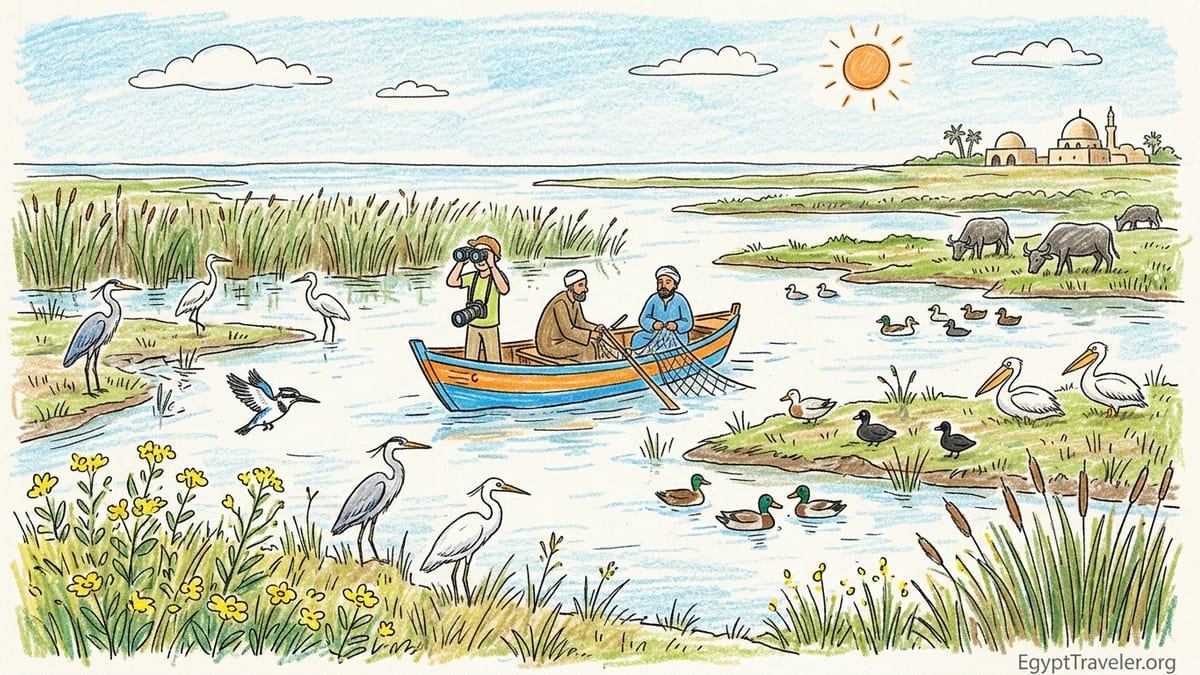
Understanding Lake Burullus and Its Wetlands
Lake Burullus lies in Kafr El Sheikh Governorate, roughly midway between Alexandria and Port Said, with the Mediterranean to the north and intensively cultivated farmland to the south. It is Egypt’s second-largest natural coastal lake, with an elongated shape of about 65 kilometers in length and a mosaic of open water, extensive reed beds and low-lying marshy islands. The lake connects to the sea at a narrow opening near the fishing town of Baltim, where brackish water mixes with freshwater drainage coming from the agricultural canals of the Nile Delta.
Since 1988 Burullus has been listed as a Ramsar site and later designated as a national protected area, recognizing its role as a critical wetland on the Mediterranean flyway for migratory birds. Conservation organizations and government agencies describe it as part of a network of northern delta lakes that together support enormous numbers of waterbirds, especially during winter. Nature Conservation Egypt and BirdLife International consider Burullus an Important Bird and Biodiversity Area, in part because it regularly holds more than 20,000 waterbirds under one of the qualifying criteria for such sites.
For visitors, the practical outcome of these designations is that birdwatching is not an abstract idea here. From the edges of Kafr El Sheikh’s roads to the wooden jetties where fishermen land their catch, you will see herons patrolling the shallows, terns hovering over small waves and rafts of ducks shifting on the wind. The protected status has encouraged low-key ecotourism planning, including pilot birding trips, youth bird camps and training for local boatmen in basic guiding and environmental awareness.
Despite its protection, Burullus is also very much a working landscape. Dozens of fishing hamlets are scattered along its southern and eastern shores, fleets of small open boats head out before dawn and water buffalo graze on the marsh edges. Any birdwatching experience here is inseparable from this local life, and understanding that dynamic will help you plan a more respectful and rewarding visit.
Seasons, Migration and Signature Waterbirds
Because Lake Burullus sits directly on one of the world’s major migration corridors between Eurasia and Africa, birdlife is highly seasonal. The most productive period for waterbirds typically runs from about late October through March, when wintering species arrive from northern breeding grounds. During this time you can expect large numbers of ducks, coots, cormorants and gulls, and the sheer biomass of birds can be astonishing on calm mornings.
Among the waterfowl, bird counters frequently report thousands of Eurasian coot and various dabbling ducks such as northern shoveler, Eurasian teal and mallard. Pygmy cormorant, a species of conservation concern in some parts of its range, is regularly seen in impressive numbers around Burullus and is one of the lagoon’s signature birds. Western marsh harriers quarter the reeds almost constantly, and on the open water you may pick out great crested and black-necked grebes in their less flamboyant winter plumage.
Spring and autumn migration periods bring a different focus. From roughly March to early May and again from late August to early November, many birders time trips to intercept flocks of waders and herons using the mudflats and shallow margins as refueling stations. Species such as black-winged stilt, ruff, wood sandpiper and little stint feed on exposed flats, while purple heron, squacco heron and little egret work the reed-fringed creeks. Swallows, wagtails and various warblers also pass through in large numbers, which can be noticeable even from village roads and causeways.
Resident species provide interest year-round, giving summer visits their own rewards despite heat and haze. Purple swamphen, little bittern in the denser reeds, moorhen, black-winged kite over nearby fields and pied kingfisher hovering along drainage canals are all realistic possibilities in any month, though visibility can be lower in the peak of summer. For many travelers, pairing a winter or migration-season visit to Burullus with cultural days in the Nile Delta or the cities of Alexandria and Cairo makes logistical and climatic sense.
Boat-Based Birding and Exploring Reed Beds
The defining experience at Lake Burullus is birding from a small local boat. The lake is shallow and much of the shoreline is hidden by dense Phragmites reed beds, so a boat allows you to reach the open water, tidal creeks and islets where birds congregate away from road noise. In practice, most visitors arrange a half-day or full-day trip using motorized wooden fishing skiffs adapted to carry a few guests, or traditional flat-bottomed boats powered by small outboard engines.
Typical departure points include small harbors near Kafr El Sheikh city on the southern shore, landing spots outside villages such as El Hamoul, and jetties closer to the sea inlet near Baltim. Costs vary but as of recent seasons a simple half-day charter with a local boatman might be in the region of what a mid-range hotel night in Alexandria would cost for two people, especially once fuel prices and guiding time are factored in. Because there is no fixed tariff, it is best to ask your guesthouse, tour operator or an organization involved in conservation to recommend trusted boat owners who understand that you are interested in wildlife, not fishing.
Once on the water, routes usually follow channels through the reeds towards more open expanses where rafts of ducks and coots gather. The boat can drift with the engine off to minimize disturbance, which greatly increases the chances of close views of species such as whiskered tern feeding over the shallows, or small flocks of glossy ibis and spoonbill commuting between feeding grounds. Around some of the low islands that punctuate the lake, you may notice mixed groups of gulls, terns and pelicans resting, with Dalmatian pelican occasionally recorded in winter alongside the more widespread great white pelican.
Safety and comfort are basic rather than luxurious. Lifejackets may not always be readily available, so asking in advance and carrying your own compact inflatable vest is wise. The boats are open to sun and wind, and there are no toilets or shelter once you leave the shore. Travelers should think of a Burullus boat trip in the same category as a rustic wetland excursion anywhere in the Mediterranean basin, where preparation and realistic expectations help transform a simple outing into a memorable immersion in a living landscape.
Local Communities, Fishing Culture and Emerging Ecotourism
Lake Burullus is ringed by tight-knit fishing communities whose livelihoods depend on healthy waters and intact reed beds. Wooden skiffs lined along the banks, nets stretched to dry on simple frames and small workshops fixing engines are part of the everyday visual fabric. Families often have multi-generational ties to the lake, and knowledge of water levels, fish movements and bird seasons has traditionally been passed down informally from parent to child.
In recent years, conservation organizations and local authorities have worked with some of these communities to diversify income sources and build basic ecotourism skills. Training workshops have introduced boat owners to bird identification, responsible wildlife viewing distances and simple interpretation in Arabic and basic English. Pilot birdwatching trips, often involving Egyptian nature clubs and university groups, have tested feasible routes, landing points and timings that fit around fishing schedules and local religious and cultural norms.
For international visitors, this means it is increasingly possible to arrange trips where your spending supports households actively engaged in conservation-friendly practices. For example, certain boatmen have agreed to minimize disturbance of roosting areas, avoid nesting islands in key months and switch from illegal bird hunting toward earning from guiding fees. Some households have started offering simple home-cooked lunches of lake fish and local vegetables to pre-arranged groups, providing a modest but meaningful additional income stream.
At the same time, it is important to recognize ongoing socio-economic pressures. Overfishing, fluctuating water quality and competition for space from fish farms and development affect local catches, which can push some people toward unsustainable practices such as illegal bird hunting. As a traveler, choosing operators who are connected to conservation initiatives and who speak openly about protecting the lake can help tip the balance toward long-term, nature-based livelihoods.
Conservation Challenges: Hunting, Habitat Loss and Pollution
Despite its protected status and international recognition, Lake Burullus faces serious environmental challenges that directly shape the birdwatching experience. The most visible issues for visitors tend to be habitat degradation, pollution and hunting pressure. Even a casual observer on a boat trip will notice plastic waste along reed edges, smoke from burning vegetation and occasional gunshots in the distance during peak hunting season.
Habitat loss has been a long-running concern. Over several decades, parts of the original marshes and shallow margins have been converted for agriculture, fish ponds or urban expansion, steadily shrinking and fragmenting the most bird-rich zones. A coastal road running along the northern shore and infrastructure projects in the delta have introduced disturbance and altered water flows, affecting the delicate balance between fresh and saline water. Scientific assessments point to increased nutrient loads from agricultural drainage and municipal effluents, contributing to eutrophication and episodes of poor water quality.
Illegal or poorly regulated bird hunting is another acute pressure, particularly during autumn and winter migration. Surveys coordinated by Nature Conservation Egypt around Burullus have documented the use of unsustainable techniques such as mist nets, electronic lures and night shooting targeting ducks, coots and other waterbirds. For some local families facing declining fish catches, hunting migratory birds has become a fallback income source, which complicates enforcement and highlights the need for realistic alternative livelihoods.
Thankfully, there are also promising conservation responses. National authorities have launched rehabilitation projects in Egypt’s northern lakes, including Burullus, aiming to improve water circulation, reduce pollution inputs and restore key habitats. Civil society groups run awareness campaigns with hunters and youth, encourage the use of legal and selective hunting methods where allowed, and promote ecotourism as a tangible economic incentive to keep birds alive. By aligning your trip with these initiatives, you help reinforce the message that living birds on the lake are worth more than a one‑time bag.
Planning Your Visit, Guides and Practical Arrangements
Reaching Lake Burullus typically involves traveling overland from major cities such as Cairo or Alexandria. From Cairo, many travelers arrange a private car and driver for the day through a local operator or hotel, making the roughly three to four hour journey to Kafr El Sheikh depending on traffic. From Alexandria, the drive is shorter, often around two hours to the southern shore of the lake. Public buses and microbuses connect these cities with Kafr El Sheikh and smaller delta towns, but using them requires more time, Arabic language skills and flexibility.
Accommodation options directly on the lake are limited and simple, usually small guesthouses or basic hotels in nearby towns rather than boutique eco-lodges. Many visiting birders choose to base themselves for one or two nights in Kafr El Sheikh city or in Baltim on the Mediterranean coast, then arrange day trips to the lake. In practice, this means working with a Cairo- or Alexandria-based nature tour operator, contacting an Egyptian birding club that organizes occasional field trips, or coordinating through a conservation organization that has on-the-ground partners.
Arranging a local guide or boat typically works best when done through an intermediary who knows both the communities and the birds. For example, Egyptian bird guides who regularly take clients to Fayoum, Wadi El Rayan or Lake Qarun often have contacts in Kafr El Sheikh and can pre-book a trusted boat owner at Burullus. Conservation-oriented operators may collaborate with Nature Conservation Egypt or similar groups to identify boatmen who have participated in awareness programs and agree to follow wildlife-friendly guidelines.
Costs for a private guided day trip from Cairo that includes transport, a boat excursion on Burullus, simple lunch and guiding can be comparable to or slightly higher than a full-day cultural tour in Cairo. Prices fluctuate with fuel costs and exchange rates, so it is prudent to request a detailed quotation in advance, ask how much is paid to local boat owners and clarify how any conservation contributions are used. Being transparent about expectations, group size and the importance of early-morning departures will help your guide and boat crew plan a smoother day on the lake.
Photography, Equipment and Fieldcraft on the Water
Lake Burullus is visually rich but also a challenging environment for photography, so planning your gear and fieldcraft will pay off. The combination of wide horizons, skittish waterbirds and boat movement favors relatively long lenses with good stabilization. Many visiting photographers find that a 100–400 mm zoom on a crop-sensor mirrorless or DSLR body strikes the right balance between reach and flexibility. If you are documenting broader scenes with fishing boats, reed beds and flocks in the distance, a 24–70 mm lens can capture the sense of place.
Light conditions are usually strongest just after sunrise and in the hour before sunset, when the low Mediterranean sun creates warm tones on plumage and soft reflections on the water. Midday light can be harsh, amplifying glare from the lake surface and haze from agricultural burning. A lens hood and polarized sunglasses are practical additions, and a dry bag or waterproof backpack liner will protect equipment from spray. Tripods are almost impossible to use effectively on the small, moving boats, so a monopod or simply bracing your elbows and using higher shutter speeds is more realistic.
Good fieldcraft matters as much as hardware. Let the boatman know when to cut the engine well before you reach a flock, and avoid standing suddenly or leaning over the gunwale, which can spook birds and destabilize the boat. Silent mode on modern cameras and limiting burst shooting help reduce stress on wary species such as ducks and large waders. Binoculars in the 8x32 or 8x42 range are ideal for scanning reed edges and identifying distant birds before deciding whether to approach closer for photography.
Respecting both birds and people is essential. Always ask permission before photographing individual fishermen at close range, especially women and children, and be prepared for some to prefer not to be photographed. From a conservation perspective, avoid sharing exact locations of sensitive nesting colonies or roosts on social media, and frame your images and captions in a way that highlights the beauty and value of a living wetland rather than just trophies of rare species.
Travel Responsibly and Support Community-Based Conservation
Responsible travel at Lake Burullus begins with simple behavior choices that reduce your footprint on a fragile ecosystem. Stick to existing tracks when walking near the shore to avoid trampling vegetation, take all rubbish back to town and avoid single-use plastic bottles where possible by refilling larger containers at your accommodation. On boats, ask the crew not to throw cigarette ends or food packaging into the water, and be prepared to gently model good practice by pocketing small items until they can be disposed of properly.
Consciously directing your spending can amplify the positive impact of your visit. Booking local boats that collaborate with conservation initiatives, eating in small family-run restaurants in Kafr El Sheikh or Baltim and buying modest handicrafts or preserved foods from community stalls all help to diversify livelihoods beyond fishing and hunting. When negotiating prices, aim for fair, not rock-bottom, rates and remember that seasonality, fuel costs and economic volatility in Egypt can make income unpredictable for lake-based households.
You can also use your presence to reinforce conservation messages. Ask your guide about local efforts to monitor waterbirds, reduce illegal hunting or improve waste management, and express interest in operators who contribute time or funds to such projects. Sharing your experience afterwards in trip reports, responsible travel blogs or talks to nature clubs back home can raise awareness of Burullus as a place where birdwatching and community well-being are tightly linked.
Finally, consider that your visit is part of a larger story. Lake Burullus sits at the intersection of global migration routes, national food security debates and local aspirations for a dignified future. By approaching the lake with humility, curiosity and a willingness to support those working to keep its waters alive with birds, you help tip the narrative from one of decline towards cautious hope.
The Takeaway
Lake Burullus is not a manicured bird reserve with hides and boardwalks. It is a sprawling working wetland, noisy with engines and egrets, beautiful and bruised at the same time. For travelers willing to accept its rough edges, it offers some of the most atmospheric waterbird encounters in Egypt, set against the rhythms of small fishing communities and the vast sky of the Nile Delta.
Planning a visit here means thinking beyond species lists. It invites you to choose local guides who are shifting from hunting to conservation, to learn a few Arabic phrases for greeting fishermen, to photograph not just rare birds but also the textures of nets, reeds and weathered boats. It also asks you to recognize the vulnerabilities of a lake squeezed by development, pollution and climate uncertainty, and to behave in ways that lighten rather than deepen those pressures.
For many birdwatchers, a morning boat trip at Burullus, watching marsh harriers glide over reed beds as pelicans rise in the distance and the call to prayer drifts from a village mosque, becomes a highlight of a longer Egyptian journey. Treated with care, Lake Burullus can continue to be both a sanctuary for birds and a source of pride and livelihood for the people who call its shores home.
FAQ
Q1. When is the best time of year to visit Lake Burullus for birdwatching?
The most rewarding months are usually from late October to March, when wintering ducks, coots and other waterbirds are present in large numbers and light and temperatures are generally comfortable.
Q2. Do I need a specialist bird guide to enjoy Lake Burullus?
A dedicated bird guide is not compulsory, but traveling with someone who knows the lake, the birds and the local communities will greatly improve your chances of seeing more species and moving around respectfully and safely.
Q3. How can I arrange a boat trip on the lake?
The most reliable approach is to arrange a trip in advance through a nature-focused tour operator, an Egyptian bird club or a conservation organization that works with trained local boatmen in Kafr El Sheikh or nearby villages.
Q4. Is bird hunting a problem at Lake Burullus?
Yes, unsustainable and sometimes illegal bird hunting remains a significant issue, particularly in autumn and winter, which is why choosing operators involved in conservation and community awareness is so important.
Q5. What kind of camera equipment is suitable for photographing birds on the lake?
A telephoto zoom in the 100–400 mm range with image stabilization on a camera body that performs well at higher ISO settings is ideal, paired with a wider zoom for landscapes and life on the boats.
Q6. Are there comfortable places to stay directly on the lakeshore?
Accommodation immediately on the lake is generally basic; most visitors stay in nearby towns such as Kafr El Sheikh or on the Mediterranean coast at Baltim and make day trips to the lake.
Q7. Can I visit Lake Burullus independently using public transport?
It is possible but more complicated, involving buses or microbuses to Kafr El Sheikh and then local connections; most foreign visitors find it easier and more time-efficient to hire a car with driver or join an organized trip.
Q8. What safety considerations should I keep in mind on the boats?
Boats are usually small and open, so ask about lifejackets, avoid standing suddenly, keep gear secure and be cautious in windy or rough conditions, particularly if traveling with children.
Q9. How can I ensure my visit benefits local communities and conservation?
Choose guides and boatmen connected with conservation initiatives, pay fair prices, avoid supporting operators who engage in illegal hunting and consider making a small donation to organizations monitoring birds and advocating for wetland protection.
Q10. Is Lake Burullus suitable for first-time birdwatchers?
Yes, the abundance of large, easily observed birds such as herons, egrets, pelicans and marsh harriers makes Burullus an excellent introduction to birdwatching, especially when accompanied by a patient guide who can help with identification.