


Wadi El Natrun is one of Egypt’s most important Coptic Christian sites, a quiet desert depression northwest of Cairo where four ancient monasteries still function as living communities. For many visitors it is an easy-to-underestimate dot on the map between Cairo and Alexandria, yet on the ground it becomes a full, immersive day of driving, walking between churches, and talking with monks. This guide focuses on the practicalities: how to reach the monasteries from Cairo, whether to book a private tour or travel independently, what to expect on site, and how Wadi El Natrun fits into a wider Nile Delta or Alexandria itinerary.
Understanding Wadi El Natrun and Its Monasteries
Wadi El Natrun lies roughly 100 kilometers northwest of Cairo, just off the Cairo–Alexandria Desert Road that many travelers already use when shuttling between the capital and the Mediterranean. The valley itself is a shallow depression west of the Nile Delta, historically known for its natron deposits that were used in mummification and glassmaking. Today it is better known as one of the cradles of Christian monasticism, sometimes called Scetis or the Nitrian Desert in older texts, with a monastic history that reaches back to the 4th century.
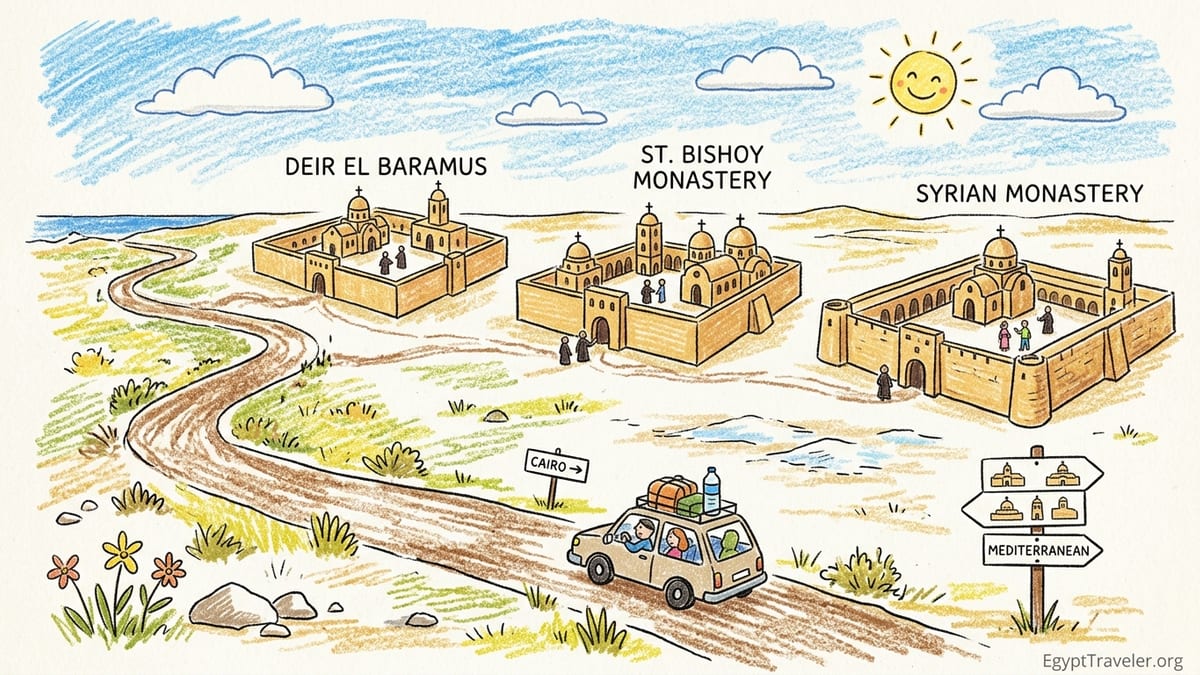
Four major monasteries receive visitors: the Monastery of Saint Bishoy (often spelled Pishoy), Deir El Baramus, the Syrian Monastery (Deir El Suryan), and the Monastery of Saint Macarius (Deir Abu Maqar). Each is surrounded by high walls and entered through a gate, with churches, refectories, small museums, and gardens inside. Most day trips from Cairo visit three of the four, either due to time or because one is temporarily closed to casual visitors. Typical itineraries focus on Saint Bishoy, Baramus and the Syrian Monastery, or substitute Saint Macarius when access arrangements allow.
The monasteries are about 10 to 15 kilometers off the main highway, spread along a side road that threads across the desert. This spacing makes them feel comfortably remote but also means you cannot simply walk between them. Having continuous transport, whether a private car with driver or a rental vehicle, is essential. The area is not a single walkable complex like a large temple; you will be hopping in and out of a vehicle multiple times during the day to cover the distance between monastic compounds.
Modern visitor infrastructure is modest. There are no large commercial visitor centers or ticket offices as you might find at the Pyramids of Giza or Karnak. Instead, you step directly into active religious spaces where monks go about their routines. Most monasteries have simple shops offering devotional items and sometimes basic snacks or bottled water, but you should not expect restaurants, cafés or formal tourist services inside the compounds. Planning for water, sun protection and snacks from Cairo is a good idea.
How Long a Wadi El Natrun Day Trip Really Takes
Commercial tours sold in 2026 typically advertise seven to eight hours for a private Wadi El Natrun trip from Cairo, but in practice you should plan on a full day. Driving time alone is usually 1.5 hours in each direction from central Cairo under light traffic, and closer to two hours if you are leaving from Giza or traveling at peak times. That gives you three to four hours just on the road, before you begin walking through monasteries and talking with monks.
Once at Wadi El Natrun, most visitors spend at least 45 to 60 minutes inside each monastery. Saint Bishoy and the Syrian Monastery have multiple churches, towers and courtyards that reward a slower pace, while Baramus and Saint Macarius can easily fill an hour if you are interested in their libraries or small museums. If you visit three monasteries and allow an hour apiece, plus short transfers and a break for a late lunch on the way back, the day quickly moves into the nine to ten hour range.
Private tour operators have adjusted their advertised durations upward to reflect this reality. It is now common to see Wadi El Natrun day trips marketed as nine or ten hours, with hotel pickup around 7:30 or 8:00 in the morning and return to Cairo early evening. Some budget operators still list seven hours, but in reviews guests often note that the experience felt rushed or that they had to skip one monastery to be back on time. When planning independently, it is wiser to assume a 10 to 11 hour door to door commitment and treat anything shorter as a pleasant bonus.
This longer time frame has practical consequences for energy and pacing. You will be walking on uneven stone and concrete surfaces, climbing a few staircases into towers or old churches, and spending many minutes standing during explanations given by guides or monks. The desert light can be strong even in winter, and it is difficult to find deep shade in courtyards at midday. Comfortable shoes, a hat, sunblock and regular water breaks are more important here than they might seem when you first glance at the map.
Opening Hours, Dress Code and On Site Etiquette
The monasteries at Wadi El Natrun are generally open daily, but they are working religious communities rather than tourist attractions, so visiting hours can shift around Coptic feast days and periods of fasting. As a broad rule, guest gates open mid morning and stay open through mid or late afternoon. Many recent tours structure their monastery visits between about 10:00 and 15:00, arriving after the earliest daily prayers and leaving before evening services begin. On major feast days such as Coptic Christmas or Easter, access for casual visitors is often restricted or paused altogether.
Dress codes are conservative and enforced. Both men and women should cover shoulders and knees, and women are expected to avoid low necklines or tight clothing. Long trousers or a below the knee skirt, closed shoes or sandals with straps, and a loose blouse or shirt with sleeves to the elbow are standard. Many female visitors bring a light scarf to cover their hair inside the churches, following local custom even where it is not strictly required. Those arriving in shorts or sleeveless tops can be turned away at the gate or asked to wait while the group obtains cover ups, which can waste valuable visit time.
Inside the monasteries, the rhythm is gentle but serious. Photography is usually allowed in courtyards and exterior areas but may be prohibited or limited inside certain churches, especially during liturgy. Monks often act as informal guides, explaining icons, relics and architectural features in Arabic or sometimes English. It is appropriate to keep voices low, avoid phone calls, and step aside discreetly if a procession or group of worshippers needs to pass. Even on a private tour it is worth remembering that you are in someone else’s home and prayer space, not in a museum.
Food options inside the monasteries are light. Some have small kiosks offering bottled drinks, prepackaged biscuits and simple sandwiches, principally for Egyptian pilgrims. Larger meals are usually taken at roadside restaurants on the Cairo–Alexandria Desert Road on the way back, or at service stations that have fast food counters and basic Egyptian grills. Travelers with dietary restrictions or who simply prefer not to rely on highway stops often bring a packed lunch from their Cairo hotel and eat it in the vehicle between monasteries, taking care not to snack conspicuously inside monastic courtyards.
Comparing Private Tours, Hired Drivers and Self Driving
There are three realistic ways to visit Wadi El Natrun from Cairo in a single day: a guided private tour, a private driver without guide, or self driving in a rental car. Public transport, while technically possible, is awkward enough that it rarely makes sense for a first time visitor. Each mode carries different trade offs in cost, flexibility and comfort, and your choice will shape not only the day’s logistics but how much you understand of what you are seeing.
Guided private tours are the most straightforward option. Established Cairo based operators offer door to door pickup in air conditioned sedans or minibuses, with an Egyptologist or Coptic specialist guide and a separate driver. Prices as of mid 2026 typically fall in the range of 90 to 150 US dollars per person for two travelers, trending lower for small groups, and often include bottled water and sometimes a simple lunch. These tours pre arrange monastery access, manage any changes if one monastery closes unexpectedly, and translate conversations with monks. For travelers who are new to Egypt, do not speak Arabic or prefer to avoid driving, this is the least stressful choice.
Hiring only a private driver from Cairo can reduce costs while preserving flexibility. Some travelers ask their Cairo hotel to arrange a car and driver for a day on the Cairo–Alexandria Desert Road, with rates typically quoted per vehicle rather than per person. Example midrange hotel concierges in central Cairo have recently quoted around 70 to 100 US dollars for a full day car with driver, petrol included, for up to three passengers. In this model you handle monastery introductions yourself and rely on information panels or informal conversations with English speaking monks. It is a good fit if you enjoy exploring at your own pace and have already read up on Coptic history.
Self driving gives the most control but requires comfort with Egyptian traffic and paperwork. Major international rental companies and local firms operate at Cairo International Airport and in some central districts, and daily rates for a compact car commonly range from 35 to 60 US dollars before insurance. From Cairo you would follow the Cairo–Alexandria Desert Road toward Alexandria, watch for the Wadi El Natrun turnoff, then drive the secondary road that passes the monasteries. Navigation apps work, but you should download maps offline and be prepared for police checkpoints. While the highway portion is straightforward, the combination of fast moving traffic, variable lane discipline and limited English signage makes this option better suited to experienced drivers who are already at ease on North African or Middle Eastern roads.
Why Public Transport Is Awkward for Monastery Hopping
On the map, Wadi El Natrun looks like a simple stop between Cairo and Alexandria, and some travelers consider using intercity buses or shared microbuses instead of private vehicles. In practice, public transport is awkward enough that it undercuts many of the benefits of a monastery day trip. Long distance buses on the Cairo–Alexandria route generally follow the desert highway and can let passengers off near the Wadi El Natrun service areas, but they do not divert to the monasteries themselves. From the highway you still face 10 kilometers or more of desert road, with no regular local bus linking the highway rest stop and the monastic complexes.
Shared microbuses that serve local towns around Wadi El Natrun rarely speak to tourists and can be difficult to identify without Arabic. They also do not operate on a fixed timetable in the way visitors from Europe or North America might expect. Waiting times can be long, and vehicles may be crowded when they arrive, especially on weekends when Egyptian pilgrims travel to the monasteries. Repeating this process multiple times in a single day to move between monasteries would be time consuming and unpredictable, and there is no guarantee of finding a ride back to the highway in late afternoon.
A few budget travelers attempt a hybrid model, taking a West Delta or Super Jet bus from Cairo’s main Turgoman station toward Alexandria, asking to be dropped at a Wadi El Natrun exit, and then negotiating with a local taxi or rideshare driver for a private circuit of the monasteries. While this can work, it requires more Arabic, bargaining and comfort with improvisation than most visitors possess on their first days in Egypt. For the majority of travelers, especially on a tight schedule, a private car in some form is the more efficient and less stressful solution.
Finally, public transport complicates timing. Monastery gates do not stay open late into the evening, and access can change without much notice around religious holidays. If you depend on irregular buses and microbuses, you have little control over arrival and departure times at each monastery. Arriving during a service when visitors are temporarily asked to wait, or missing the chance to speak with an English speaking monk because you must rush back to the highway for the last bus, can leave the day feeling fragmented. A private vehicle keeps you in charge of the schedule and lets you respond flexibly if a particular monastery draws you in for longer than expected.
A Logical Route Through the Monasteries
Most travelers arriving from Cairo encounter the monasteries in a sequence that follows the local access road. A common route begins with the Monastery of Saint Bishoy, continues to the Syrian Monastery nearby, and then either turns back toward Deir El Baramus or continues onward to the Monastery of Saint Macarius if it is open to casual visitors that day. This order balances practical driving distances with the desire to start at one of the valley’s best known communities and then move toward quieter, more contemplative spaces.
Beginning at Saint Bishoy makes sense for several reasons. It is one of the most visited monasteries, with established facilities for receiving pilgrims and tour groups, and it holds the relics of Saint Bishoy himself. Many private tours arrange for a monk to meet visitors here and give an introductory explanation of Wadi El Natrun’s history. The compound’s churches and towers give a clear sense of the blend of defensive architecture and spiritual life that characterized desert monasticism. Spending 60 to 90 minutes on site is typical, especially if you pause at the small bookshop or icon stand.
From Saint Bishoy it is a short drive to the Syrian Monastery. Smaller and quieter, this complex is well known for its rich wall paintings and more intimate courtyards. Travelers often describe it as the most atmospheric of the four monasteries, with beautifully preserved frescoes in its ancient church. Taking time here to sit in a side chapel or talk quietly with a monk guide can shift the day from sightseeing into something closer to retreat. Afterward, your driver can either return toward the highway, stopping at Beramus, or continue deeper into the valley.
Deir El Baramus is sometimes visited first on religious pilgrimage routes because of its reputation as one of the oldest monasteries in the area, but on a practical tourist day trip it often appears third, as it lies along the same access road in a way that avoids needless backtracking. The Monastery of Saint Macarius is farther along and may require prior arrangements through a tour operator, as visitor access shifts depending on internal community needs. When it is available, many travelers appreciate its more working farm atmosphere, with extensive cultivated land and a large resident monastic population. In all cases, your route should be checked with your guide or driver on the morning of departure, as local conditions and monastic schedules evolve.
Dedicated Cairo Excursion or Stop Between Cairo and Alexandria?
Because Wadi El Natrun lies roughly halfway between Cairo and Alexandria on the desert highway, it is natural to wonder whether to treat it as a standalone day trip from Cairo or as a stop when changing bases between the two cities. Both models work in theory, but in practice Wadi El Natrun functions more smoothly as a dedicated excursion from Cairo, with a return to the same hotel in the evening. This is the pattern used by most tour companies and the one that best handles uncertainties around monastery opening times, traffic and personal energy levels.
As a day trip from Cairo, you leave luggage in your hotel room, travel north in a private car or tour vehicle, and return along the same route. If a particular monastery is unexpectedly closed or if you find yourself spending longer at one site, you simply adjust your return time. Road conditions and checkpoints on the Cairo–Alexandria Desert Road are familiar territory to professional drivers based in Cairo, and mechanical or administrative issues can be resolved through established contacts. If you are traveling with children or older relatives, knowing you will be back in a familiar room that night is an added comfort.
Stopping at Wadi El Natrun while moving between Cairo and Alexandria introduces extra variables. You either need a private car and driver who is comfortable operating in both cities, or you must arrange a one way transfer with a long stop in the middle. In theory you could leave Cairo with your luggage, visit two or three monasteries, then continue to an Alexandria hotel in late afternoon. Yet if there is heavy traffic leaving Cairo, if a monastery is unexpectedly closed, or if there are delays at checkpoints, you risk arriving in Alexandria late and exhausted, still needing to check in and find dinner. For this reason, only travelers with generous time and a taste for complex logistics usually choose this option.
There is one scenario where combining Wadi El Natrun with a transfer makes sense. Independent travelers who have already spent several days in Cairo and plan to rent a car for a broader Nile Delta and North Coast loop sometimes build a route that runs Cairo to Wadi El Natrun to El Alamein and then east along the Mediterranean to Alexandria. In this case Wadi El Natrun becomes the first major stop on a multi day road trip rather than a mid transfer distraction. Even then, it is wise to stay flexible with accommodation bookings and avoid scheduling tightly timed train or flight connections on the evening of your monastery visit.
Booking and Transport Tips for 2026
When booking a Wadi El Natrun visit in 2026, timing and communication are key. For guided private tours, booking at least a few days in advance allows operators to confirm monastery access, especially around major religious dates on the Coptic calendar. Many reputable Cairo based companies now provide WhatsApp contact for rapid coordination, and it is common to receive your driver and guide details the evening before departure. Clarify in writing which monasteries the tour intends to visit, approximate departure and return times, and whether lunch or only bottled water is included.
If you opt to hire a driver only, through your hotel or a transport firm, confirm that the driver is familiar with the Wadi El Natrun turnoff and the internal monastery road. Ask explicitly whether the vehicle is air conditioned, whether fuel costs are included, and how long you will have the car at your disposal. Agree on a total price in Egyptian pounds and whether any highway tolls are extra. Since drivers may not speak much English, learning a few key Arabic words such as the monastery names or carrying them written in Arabic script can make the day smoother.
For self drivers, most of the preparation happens before you leave Cairo. Check your rental contract carefully for insurance coverage, authorization to drive outside Greater Cairo, and policies on roadside assistance. Inspect the vehicle, especially tires and air conditioning, and ensure you have a physical copy of your passport, driver’s license and rental agreement in the car. Fill your fuel tank before leaving Cairo; while there are service stations on the desert highway, they can be busy and queues may form at peak travel times. Download offline maps of the region in case of mobile data interruptions.
In all cases, start early. Leaving Cairo around 7:00 or 7:30 in the morning helps you clear the densest city traffic and arrive at the first monastery when the day is still relatively cool. It also builds in time for unforeseen delays without cutting your visit short. Bring small denomination Egyptian banknotes for donations at churches, purchasing candles or devotional items, and tipping restroom attendants at highway service areas. While credit cards are increasingly accepted in Cairo hotels and restaurants, monastery shops and many small vendors in and around Wadi El Natrun remain cash based.
The Takeaway
Wadi El Natrun rewards the traveler who treats it not as a quick roadside stop but as a full day’s engagement with Egypt’s Coptic Christian heritage. The monasteries here are living communities, not museum pieces, and the combination of desert light, thick defensive walls and quiet chapels creates an atmosphere that many visitors remember as one of the most spiritual experiences of their time in Egypt. Reaching them from Cairo requires deliberate planning, yet the logistics are manageable when approached in a structured way.
Choosing between a guided private tour, a private driver or self driving is less about right or wrong and more about your comfort with Egyptian roads and your desire for in depth interpretation. Public transport, although technically possible, is mismatched to the realities of moving between dispersed monasteries on a tight daily schedule. For most visitors, especially on a first trip, a private car based approach is the sensible baseline.
Whether you fold Wadi El Natrun into a broader Cairo stay or weave it into a longer route across northern Egypt, remember to protect time and energy for simply being there. Build a loose schedule that allows for conversation with monks, quiet minutes in frescoed chapels, and unhurried walks through sunlit courtyards. With practical details in order and expectations set for a true full day, Wadi El Natrun can become a powerful counterpoint to the busier pharaonic and Islamic sites that dominate many itineraries.
FAQ
Q1. How far is Wadi El Natrun from Cairo, and how long does the drive take?
The monasteries lie about 100 kilometers northwest of central Cairo along the Cairo–Alexandria Desert Road, and the drive usually takes 1.5 to 2 hours each way depending on traffic.
Q2. Is a guided private tour worth the extra cost compared to just hiring a driver?
For most first time visitors the added context, language support and logistical backup of a guided private tour justify the higher price, especially because so much of the visit’s value comes from understanding the monastic history and being able to interact with monks.
Q3. Can I visit all four monasteries in one day from Cairo?
It is possible in terms of distance and driving time, but most travelers find that visiting three monasteries at a relaxed pace makes for a richer day than rushing through all four with limited time at each.
Q4. What should I wear when visiting the monasteries of Wadi El Natrun?
Dress modestly, with shoulders and knees covered, loose fitting clothing and closed shoes or secure sandals; women often carry a light scarf to cover their hair inside churches in line with local custom.
Q5. Are there places to buy food and water near the monasteries?
Inside the monasteries you may find simple kiosks with bottled drinks and snacks, but it is wise to bring water and light food from Cairo and plan for a larger meal at a roadside restaurant on the highway during the return journey.
Q6. Is public transport a realistic way to visit Wadi El Natrun from Cairo?
Public buses can drop you near the highway exit, but the lack of reliable local transport along the monastery road makes it awkward and time consuming, so a private vehicle is strongly recommended.
Q7. Can Wadi El Natrun be combined with a transfer between Cairo and Alexandria?
It can, but doing so adds complexity, especially when traveling with luggage, and most visitors find that treating Wadi El Natrun as a standalone day trip from Cairo is more relaxed and predictable.
Q8. Do I need to book my Wadi El Natrun visit in advance?
For private tours, booking several days ahead allows operators to confirm access and arrange guides, while independent travelers should at least check expected opening patterns around major Coptic feast days.
Q9. Is it safe to drive the Cairo–Alexandria Desert Road to Wadi El Natrun?
The highway is the main route between Egypt’s two largest cities and is regularly used by tour and private vehicles, but traffic can be fast and assertive, so only confident drivers with experience on similar roads should consider self driving.
Q10. What is the best time of year and time of day to visit the monasteries?
The milder months from late autumn to early spring are most comfortable; within a day, starting from Cairo in the early morning lets you tour the monasteries before the strongest afternoon sun and return to the city by early evening.