


Rosetta, known locally as Rashid, is one of the most rewarding day trips in the Nile Delta for travelers based in Cairo or Alexandria. Ottoman-era mansions, historic mosques, the fort where the Rosetta Stone was found and the tranquil Nile riverfront near its Mediterranean mouth can all be seen without staying overnight, provided you plan the logistics carefully.
Why Rosetta Works as a Day Trip
Rosetta sits on the western bank of the Rosetta branch of the Nile, around 65 kilometers east of Alexandria and roughly 230 to 250 kilometers northwest of central Cairo by road, depending on your exact starting point. That makes it just within full-day reach if you have a private car and driver or join an organized excursion, but it is not a quick detour you can improvise on the spot.
The town’s attractions are compact but spread between the historic center, the riverside corniche and Fort Julien slightly out of town. Within a single visit you can walk cobbled streets lined with restored 18th century merchant houses, step into several major mosques, then drive out to the fort area and finish with a Nile viewpoint where the river widens on its way to the Mediterranean. Because public transport connections are slow and fragmented, most visitors with limited time choose a private driver or guided tour that handles the transfers between these clusters.
A realistic non-rushed day means 3 to 4 hours of sightseeing in Rosetta itself, plus 4.5 to 6 hours of road time depending on where you start. This is enough for the highlights without packing the schedule so tightly that you spend most of the day in a car. Trying to include multiple other Delta towns in the same itinerary often tips the balance toward too much driving and not enough exploration on foot.
If you enjoy Ottoman history, Islamic architecture and river landscapes but want a calmer experience than central Cairo, Rosetta delivers strong value: low entry fees at most sites, relaxed streets and a clear narrative that links the Rosetta Stone, Napoleon’s campaign and the Nile Delta’s trading heyday.
Driving Times and Best Ways to Reach Rosetta
From central Cairo, allow around 3 hours each way by private car in normal traffic, often more on Thursday evenings and Sundays when traffic out of and into the capital can be heavy. Drivers usually take the desert highway west toward Alexandria, then branch north and east toward Rashid through Beheira Governorate. Door to door from a hotel near Tahrir Square to the old town in Rosetta is typically 220 to 250 kilometers each way by the most commonly used routes.
From Alexandria, Rosetta is much closer in straight-line distance but still requires at least 75 to 90 minutes each way once you factor in city traffic, junctions and slower regional roads. Microbuses and shared taxis run from Alexandria to Rashid with frequent departures, and locals often quote “about an hour” for the run, but travelers should assume closer to 90 minutes in practice from central Alexandria to the Rosetta corniche and historic area.
Independent travelers can technically combine a train from Cairo to Alexandria with onward microbus or taxi to Rosetta, but this breaks the journey into several steps and eats up transfer time. A same-day round trip from Cairo that involves both trains and local buses can easily reach 8 or 9 hours of transport time, which leaves very little margin for delays or proper sightseeing. For a focused day trip from Cairo, a door to door car and driver or guided day tour is far more efficient.
From either city, most visitors start between 7:00 and 8:00 in the morning to arrive in Rosetta by late morning. This timing avoids the worst of Cairo’s early rush and maximizes cooler hours for walking the historic streets. Afternoon departure from Rosetta around 16:00 to 17:00 usually brings you back to Cairo by early evening and to Alexandria well before dark, although travel after sunset is common and accepted on the main roads.
Suggested Sightseeing Route for a One-Day Visit
The most efficient circuit keeps walking distances reasonable while stitching together Rosetta’s main themes: Nile Delta trade, Ottoman-era architecture, religious heritage and the Rosetta Stone. The order below works for both private drivers and guided tours that start from Cairo or Alexandria.
After arrival, begin in the historic center around the Rosetta museum cluster. Spend your first hour or so at the local museum complex, which introduces the town’s role as a Nile port, the French occupation and the discovery of the Rosetta Stone at nearby Fort Julien. Exhibits are modest compared to major national museums, but they provide context that makes the later visit to the fort more meaningful. Entry prices are usually low and tickets are bought in cash at the gate.
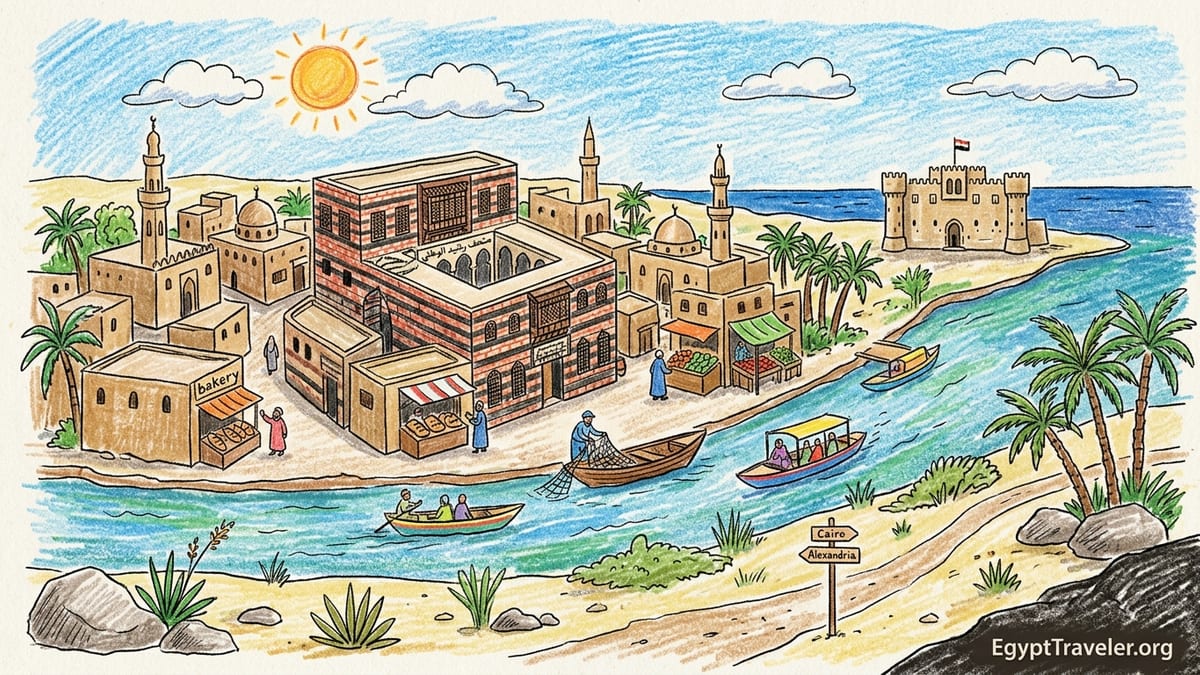
Next, explore several Ottoman mansions within walking distance of the museum. Restored merchant houses such as Amasyali House and Abu Shaheen House showcase black and red brick facades, mashrabiya wooden screens and interior courtyards typical of 18th century Delta architecture. With a guide, you can cover two or three houses and nearby lanes in about 60 to 90 minutes at a relaxed pace, pausing for photos on the narrow alleys and shaded doorways.
Late morning is an ideal time to step into at least one major mosque in the old town, such as Al Mahalli Mosque, Al Abbasi Mosque or the historically significant Zaghloul Mosque, which is associated with resistance against British forces in the early 19th century. Outside prayer times, non Muslim visitors are often welcomed into courtyards and sometimes prayer halls as long as they dress modestly and remove shoes where requested. This phase adds roughly 30 to 45 minutes of walking and short visits to your route.
Fort Julien and the Nile River Mouth
After lunch, turn your attention to the wider landscape that made Rosetta important. Fort Julien, sometimes called Fort Rashid, lies a short drive north or northwest of town on the left bank of the Rosetta branch of the Nile, about 5 kilometers away. This is where French soldiers found the basalt stele now known as the Rosetta Stone in 1799 during Napoleon’s campaign in Egypt. The original stone is in the British Museum, but the fort remains a key stop for travelers who want to stand close to the original findspot and see the defensive structure that guarded the river approach to Cairo.
The fort visit typically takes 45 to 60 minutes, including time for the short approach road and simple on site interpretation. The structure is more atmospheric than polished, with thick stone walls, internal courtyards and views across the broadening Nile toward the sandbars and fields of the Delta. Entry fees are usually modest and paid in cash to site staff. Because opening hours can vary during Ramadan and public holidays, it is sensible to confirm current times with your driver, hotel or tour operator the day before your trip and to aim to arrive at least an hour before closing.
From the fort, many drivers continue briefly north toward the areas where the river nears its Mediterranean outlet, or head back into Rosetta and follow the riverside corniche south toward the Abu Mandour Mosque area. While the exact meeting line of river and sea lies within a shifting coastal zone, you get a clear sense of the widening river mouth, flat Delta lands and the strategic importance of this branch as a historical entry route to Egypt.
Back in town, the corniche is a pleasant place for a final walk or short boat ride in late afternoon light. Small motorboats sometimes offer informal trips along the riverfront, often arranged on the spot with cash payment and basic lifejackets. If you plan a boat ride, keep it to 30 minutes or so to avoid rushing the drive back to your base city.
Ottoman Houses, Mosques and Walking Distances
Within the historic core of Rosetta, most sights are within a rough radius of 1 to 1.5 kilometers. Expect to walk a total of 3 to 5 kilometers over the day if you follow a typical itinerary that includes museum, houses, several mosques and the riverfront, plus a short wander for coffee or fresh juice. Streets can be uneven with some cobbles, broken pavements and occasional traffic, so closed shoes are strongly recommended.
The restored Ottoman houses are the most stair intensive elements of the visit. Many have steep wooden staircases, narrow landings and low beams that require some agility. Travelers with limited mobility can still enjoy the exteriors and ground floor courtyards, but may want to skip upper levels and rooftops. Mosques usually involve fewer steps but do require bending to remove shoes and sometimes using side entrances with thresholds or a few stairs.
If you add a visit to Abu Mandour Mosque on its low sandy hill south of town, plan for additional walking and some incline. The mosque sits on a raised ridge overlooking the Nile, historically reached by river boat but now also accessible by road. The approach involves either a modest uphill walk from the parking area or climbing steps from the riverside if you arrive by boat. Those who prefer flatter routes can limit themselves to the historic center, fort and accessible stretches of the corniche.
In hot months, plan your walking so that longer outdoor segments fall before 11:00 and after 15:30, using the middle of the day for indoor visits and lunch. Carry bottled water, as cafes and kiosks are available but not on every corner once you move away from the main market streets.
Private Driver versus Guided Tour
For travelers starting from Cairo, booking a full day private tour that includes a guide, car and driver is often the most straightforward option. Many Egypt based agencies offer customized Delta excursions on request, even if Rosetta is not always listed on standard brochures. These trips typically include hotel pickup around 7:00 to 7:30, the highway drive to Rosetta with one or two short coffee or restroom stops, 3 to 4 hours of guided walking and site visits in town, a stop at Fort Julien and a late afternoon return. Prices vary widely by operator and vehicle size, but it is reasonable to expect a per vehicle rate that reflects more driving time than a classic Giza or Saqqara day tour.
If cost control and flexibility matter more than commentary, hiring a private car and driver without full guiding can work well, especially from Alexandria where the distances are shorter. You might arrange this through your hotel, a local car service in Alexandria or a car and driver platform. In practice, many drivers know the basic locations of “Rashid museum,” “al buyut al athariyya” (the heritage houses) and “qalat Rashid” (Fort Julien), and can follow your preferred order while waiting nearby during your stops.
Travelers confident in basic Arabic or with offline maps can then explore on their own, hiring a local site guide at the museum complex or one of the houses if available. This arrangement often provides a more relaxed pace, though you will need to pay attention to opening hours and allow extra buffer time for finding entrances and ticket offices, as signage can be modest.
Independent public transport works best only for those based in Alexandria with strong tolerance for flexible schedules. A typical route involves taking a microbus from one of Alexandria’s Delta terminals to Rashid, then walking or using a local tuk tuk to reach the historic area. Committee style microbuses depart when full rather than on a fixed timetable, and return services can thin out in the evening. For a tight one day schedule or travelers anxious about return connections, a private car is far more reliable.
Lunch, Breaks and Practicalities on the Ground
Rosetta is a working Delta town with simple local eateries rather than a curated restaurant scene. Most visitors choose a straightforward lunch near the market streets or along the riverfront, focusing on grilled chicken, kofta, rice, salad and fresh bread, or ordering fried Nile fish when available. Prices are generally modest by big city standards, and you can expect to pay a fraction of what a sit down meal costs in central Cairo hotels.
Many guided tours include lunch at a pre selected local restaurant to simplify logistics and food safety. Independent travelers can scan for places that appear busy with local families, which is usually a good indicator of fresh turnover. Do not expect menus in multiple languages, but pointing to dishes or using basic phrases is normally enough to order. Bottled water, soft drinks and sweet teas are widely available.
For coffee breaks, traditional ahwa style cafes line several of the main streets and side alleys. These serve strong Egyptian coffee, tea and shisha and offer a window into daily life. Dress standards are moderately conservative, and travelers will feel most comfortable in lightweight long trousers or skirts and tops that cover shoulders and chest. Headscarves are optional for foreign women in public spaces but required in some mosque interiors.
Public restrooms are limited at standalone cafes, but major museums and some mosques have basic facilities. Carry small change for restroom attendants or informal service fees. Side streets are generally safe during daylight hours, with a friendly local atmosphere, but usual urban precautions apply: keep valuables zipped away, avoid flashing large amounts of cash and follow your guide or driver’s advice about where to meet after exploring on foot.
Cairo vs Alexandria Starting Points and When It Is Too Much Driving
For travelers already based in Cairo, Rosetta works best as a dedicated single destination day trip. The ratio of 6 or more hours of round trip driving to about 4 hours of sightseeing is reasonable if you are particularly interested in the Rosetta Stone story, Ottoman architecture or the Nile Delta, but it leaves little spare capacity for detours to other towns. Attempting to combine Rosetta with, for example, Tanta, Damanhur or an extended Alexandria stop on the same day often pushes total road time toward 8 or 9 hours.
This becomes especially tiring in summer heat or during high traffic days when entering or leaving Cairo can easily add an extra hour each way. In practical terms, if your driver suggests “just a quick Alexandria corniche stop” on the way back from Rosetta to Cairo, remember that city traffic and parking time can quickly turn that idea into a major extension. If you want to see both Alexandria and Rosetta thoroughly, it is usually better to overnight in Alexandria and dedicate separate days to each.
From Alexandria, a Rosetta day trip is easier to manage, with round trip driving closer to 3 hours. This makes it realistic to add a short additional stop in a nearby village or at a countryside café without feeling rushed. Some private tour operators offer combined itineraries like “Alexandria highlights plus Rosetta,” but these tend to deliver only a surface level look at each and require a very early start. If you are particularly interested in the Ottoman houses and fort, prioritize time in Rosetta rather than trying to see multiple Delta cities in one sweep.
As a rule of thumb, once your total planned road time climbs above 7 hours in one day, the quality of your on the ground experience in Rosetta starts to suffer. Use that threshold as a planning tool: calculate the realistic time between your hotel, Rosetta, any proposed side trips and back. If the sum approaches or exceeds 7 hours, simplify the plan by dropping the least important secondary destination and focusing on Rosetta itself.
The Takeaway
A day trip to Rosetta rewards travelers who value atmosphere and layered history over marquee monuments. With a clear route that starts at the museum and Ottoman houses, moves through key mosques and then reaches Fort Julien and the Nile river mouth, you can gain a deep feel for this Delta town without needing to stay overnight.
Starting from Cairo, commit the entire day to Rosetta and avoid stacking other far flung Delta cities onto the schedule. From Alexandria, use the shorter distance to your advantage by allowing unhurried time for walking, photography and quiet moments on the riverfront. In both cases, a private car and driver or an organized guided tour will protect your limited time far better than patching together trains and microbuses.
Rosetta’s compact center keeps walking distances manageable, though stairs in the old houses and optional detours to hilltop mosques or river viewpoints add some physical effort. Plan for a total of 3 to 5 kilometers on foot across the day, modest entry fees in cash and a simple, local lunch. With these practicalities in mind, Rosetta becomes a satisfying, logistics friendly excursion that adds depth and variety to a Cairo or Alexandria based itinerary.
FAQ
Q1. Can I visit Rosetta as a day trip from Cairo without feeling rushed?
Yes, if you dedicate the full day and use a private car or guided tour. Expect around 6 hours of round trip driving and 3 to 4 hours on the ground for the museum, houses, mosques and Fort Julien.
Q2. Is it easier to visit Rosetta from Cairo or from Alexandria?
It is logistically easier from Alexandria because the driving time is shorter, roughly 75 to 90 minutes each way, compared with about 3 hours each way from Cairo in typical traffic.
Q3. How much walking is involved during a typical Rosetta day trip?
Most travelers walk between 3 and 5 kilometers over the day, including streets between the museum, Ottoman houses, several mosques and the riverfront. There are also stairs inside historic houses.
Q4. Do I need a guide in Rosetta or is a driver enough?
A driver is enough for basic logistics, but a local or licensed guide adds valuable context about the Rosetta Stone, Ottoman architecture and mosque history. Many visitors combine a Cairo or Alexandria based guide with on site explanations from local staff.
Q5. Can I reach Rosetta by public transport from Alexandria?
Yes, microbuses and shared taxis run between Alexandria and Rashid, but they leave when full and can be crowded. For a tight day trip schedule and reliable timing, most travelers prefer a private car.
Q6. Is Fort Julien included in the same ticket as Rosetta’s town monuments?
Ticketing arrangements can change, but generally Fort Julien has a separate, modest entry fee paid in cash on arrival. Check current details with your tour operator or driver before departure.
Q7. Are there good places for lunch in Rosetta?
Rosetta has simple local restaurants and grills serving dishes like grilled chicken, kofta, rice and salads, plus fried fish when available. Most guided tours schedule a fixed local lunch stop.
Q8. What should I wear for visiting the mosques and historic streets?
Lightweight, modest clothing is best: long trousers or skirts, covered shoulders and closed shoes. Women may be asked to cover hair inside certain mosques, so carrying a scarf is useful.
Q9. Can I combine Rosetta with another Nile Delta city in one day?
From Cairo, combining Rosetta with another Delta destination usually leads to more than 7 hours of driving, which many travelers find too tiring. From Alexandria, a small additional stop is more realistic but still reduces time in Rosetta itself.
Q10. Is Rosetta safe to visit as an independent traveler?
During daylight hours, Rosetta feels like a typical Egyptian provincial town with a friendly local atmosphere. Normal precautions apply: keep valuables secure, respect local customs and follow current travel advisories and local guidance.