


The Nile Delta rarely features on first-time Egypt itineraries, yet this vast green fan between Cairo and the Mediterranean offers some of the country’s most atmospheric towns, important Coptic monasteries, under-visited archaeological sites and wetlands alive with birdlife. For travelers who have already seen the pyramids and temples along the Nile Valley, the Delta is where you begin to understand how most Egyptians actually live today, while still tracing layers of Pharaonic, Christian, Islamic and Ottoman history.
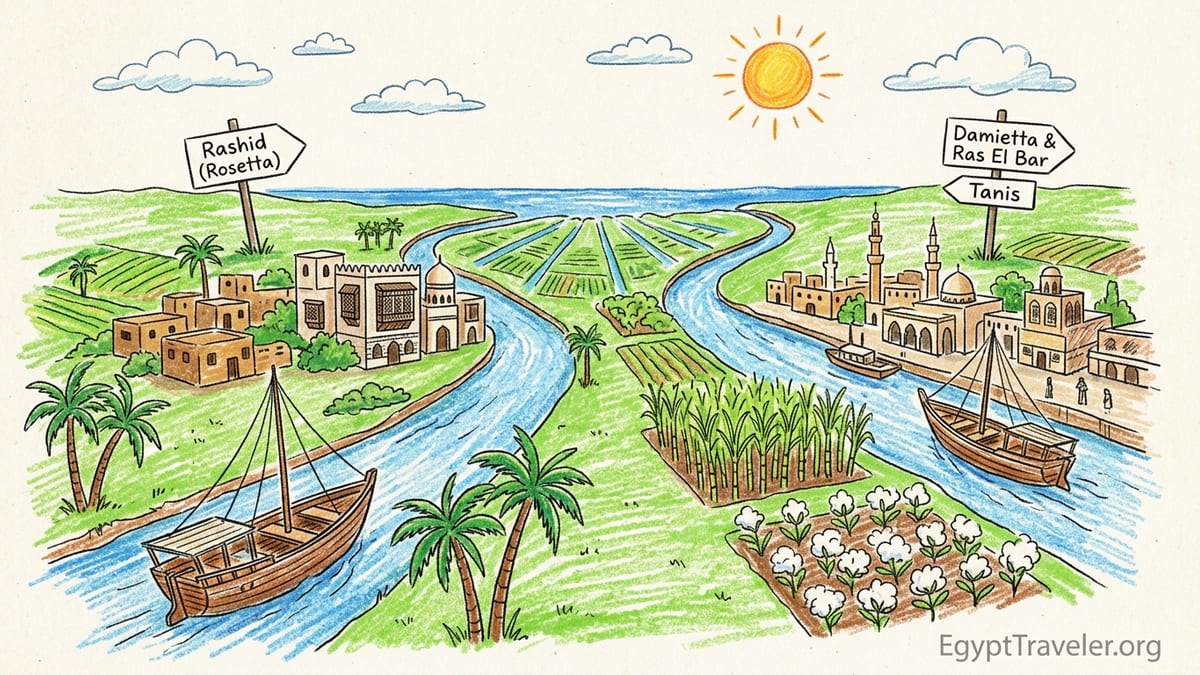
Understanding the Nile Delta and Its Two Great Branches
The Nile Delta begins roughly north of Cairo, where the river splits into multiple waterways that spread out like fingers toward the Mediterranean. For travelers, the two most important branches are the Rosetta branch to the west and the Damietta branch to the east. Historically, both were vital arteries for trade and agriculture, and the small cities that line their banks still depend on the river for irrigation, fishing and river transport. When you ride a local train from Cairo toward Tanta or Mansoura, you move through sugarcane, rice and cotton fields that are fed by this ancient irrigation network.
The Rosetta branch, also called the Rashid branch, runs northwest toward the sea, passing through fertile countryside before reaching the historic port town of Rosetta. It is along this branch that the famous Rosetta Stone was discovered at Fort Julien near the river’s mouth. The Damietta branch, to the east, flows through Mansoura and Damietta before fanning out into lagoons and sandbars around Ras El Bar. This side of the Delta feels more maritime, with stronger fishing traditions and easier access to Mediterranean beaches and seafood restaurants.
Most travelers base themselves either in Cairo and make day or overnight trips into the Delta, or use Alexandria as a jumping-off point for the western side. While it is technically possible to drive from Cairo right up through the Delta to the coast in a single long day, a more rewarding approach is to treat the Delta as a cluster of small regions. The western Delta around Wadi El Natrun and Kafr El‑Sheikh rewards those interested in Coptic monasteries and wetlands, the central belt around Tanta and Zagazig offers city markets and Tell Basta, and the eastern side delivers Mansoura’s Ottoman architecture, Damietta’s carpentry heritage and the relaxed resort feel of Ras El Bar.
For a first foray into the Delta, two or three days is enough to visit one region without rushing. A four or five day loop, using trains between major towns and hiring local drivers for remote sites such as Tanis, Wadi El Natrun or Lake Burullus, lets you sample the contrasts between the Rosetta and Damietta branches while keeping travel manageable.
Western Delta: Rosetta, Wadi El Natrun and Kafr El‑Sheikh
The western Delta curves between the Rosetta branch and the Cairo–Alexandria Desert Road, and it is a natural extension of an Alexandria stay. Rosetta, known locally as Rashid, lies just inland from the Mediterranean and is one of the most rewarding small towns in Egypt for travelers who enjoy Ottoman architecture. Its narrow streets are lined with tall brick mansions decorated with intricate wooden mashrabiya screens, many built during the town’s 16th to 18th century heyday as a port. A visit typically starts around the central square, where a small museum is housed in a restored merchant house and displays a replica of the Rosetta Stone along with coins, ceramics and models of historic homes.
Rosetta’s waterside setting is part of its charm. You can stroll the corniche along the Rosetta branch to watch fishing boats and river ferries, then hire a local taxi or tuk‑tuk for the short ride out to Fort Julien, the low stone fortress where French soldiers uncovered the Rosetta Stone at the end of the 18th century. Inside, simple exhibits and sweeping views toward the Nile mouth bring that moment of discovery to life. Back in town, several historic houses such as the Amasyali and Abu Shaheen residences are usually open to visitors, with ticket prices that remain modest by international standards. Ask at the museum or a local guide about current opening hours, which can change with restoration work.
Southwest of Rosetta, the desert corridor of Wadi El Natrun offers a completely different experience. Here, four ancient Coptic monasteries sit amid low hills and salt lakes just off the main highway between Cairo and Alexandria. The monasteries of Saint Macarius, Saint Bishoi, the Syrian Monastery and Al‑Baramus are among the earliest Christian monastic communities still active today. Visitors reach them most easily with a private driver from Cairo, usually in about an hour and a half, and can tour the fortified walls, ancient churches and small museums filled with icons and manuscripts. Dress modestly, expect a warm but serious atmosphere, and be prepared for informal tours given by resident monks who often speak some English or French.
East of Rosetta and south of Lake Burullus, the provincial center of Kafr El‑Sheikh is less about monuments and more about understanding contemporary Delta life. The town’s main appeal is its bustling everyday scene: crowded markets selling vegetables and Nile fish, cafes playing football matches, and streets filled with tuk‑tuks and microbuses. Travelers often use Kafr El‑Sheikh as a practical base for visiting Lake Burullus to the north, combining a taste of typical Delta urban life with excursions into the wetlands.
Lake Burullus and the Nile Delta Wetlands
Lake Burullus stretches in a long, shallow ribbon between the Rosetta branch and the Mediterranean, forming one of Egypt’s most important wetlands. Designated as a protected area and recognized under international wetland conventions, it is a crucial stopover and wintering ground for migratory birds that move between Europe and Africa. In practical terms, this means that from roughly autumn to early spring, visiting birdwatchers and nature‑minded travelers can expect to see large numbers of herons, egrets, terns, and various ducks and waders, alongside the reed beds and low islands that dot the lagoon.
Access to Lake Burullus is easiest from Kafr El‑Sheikh town or from small settlements such as Baltim on the Mediterranean side. Many visitors arrange boat trips by negotiating directly with local fishermen who operate simple wooden motorboats on the lake. A typical outing lasts one to two hours and may include stops on small islands used for fishing huts or reed harvesting. Prices are generally modest and best agreed in advance in Egyptian pounds, ideally after asking a hotel reception or local contact what the going rate should be to avoid misunderstandings.
The landscape around Lake Burullus contrasts strongly with the dense farmland of the inner Delta. Here, you move past salt‑tolerant vegetation, simple one‑room fishermen’s houses, and wooden bridges that cross narrow canals linking the lake to the fields behind it. Winters can be cool and windy, and fog is common in the early mornings, giving photographers soft, diffused light. Summer visits offer clearer skies but can be hot and hazy, with midday sun reflecting strongly off the water. Early morning or late afternoon are the most comfortable times to be out on the lake.
Facilities around the lagoon remain basic. While you may find small guesthouses in nearby coastal towns, most visitors sleep in Kafr El‑Sheikh, Alexandria or Cairo and treat Burullus as a day trip. Bring water, sun protection and snacks with you, and be prepared for simple, utilitarian boats rather than organized ecotourism operations. The experience is less about polished infrastructure and more about glimpsing the working life of the Delta’s fishing communities in one of Egypt’s most important natural habitats.
Central Delta Towns: Tanta, Zagazig and Everyday Egyptian Life
Further south, midway between Cairo and the Mediterranean, lie the big Delta towns that many Egyptians themselves call home. Tanta, a major rail hub roughly an hour by train from Cairo, is best known for its large mosque and for hosting one of Egypt’s biggest religious festivals honoring Sayyid Ahmad Al‑Badawi, a revered Sufi figure. Even outside festival days, the streets around the mosque are congested and lively, lined with sweets shops selling the nut and sesame confections that Tanta is famous for. For visitors, it offers a taste of everyday urban Delta life, with affordable hotels, plenty of local restaurants and easy onward train connections west to the Rosetta branch or east toward Zagazig and Mansoura.
Zagazig, southeast of Tanta, is the gateway to Tell Basta, one of the most accessible archaeological sites in the central Delta. A short taxi ride from town brings you to a scattering of ruins that once formed part of the ancient city of Bubastis, dedicated to the cat‑goddess Bastet. Today, visitors wander among fallen red‑granite blocks, reconstructed temple fragments and open trenches where excavations continue intermittently. The modest site museum displays statues and domestic objects uncovered nearby. Facilities are simple, but the chance to walk almost alone through a site that barely appears in mainstream itineraries can be a highlight for travelers who enjoy less visited ancient remains.
Both Tanta and Zagazig showcase why the Delta appeals so strongly to repeat visitors to Egypt. Unlike Luxor or Aswan, where tourism shapes entire neighborhoods, these towns function primarily for locals. You are more likely to share a table in a simple koshari restaurant with students and office workers than with tour groups. Trains between Cairo and these cities are frequent, and ticket prices remain low by international standards, especially in second class. Seats are usually unreserved on slower services, though express trains may require advance booking at the station counter.
For navigation inside town, expect to rely on white taxis, ride‑hailing apps where available, and older Peugeot or microbus services on set routes. English signage is limited once you leave the main train stations, so carrying hotel cards written in Arabic or screenshots of place names can help you direct drivers. As in the rest of Egypt, photographing busy markets or religious sites is generally fine, but it is polite to ask before photographing individuals or small family groups, especially women and children.
Eastern Delta: Mansoura, Damietta, Tanis and Ras El Bar
The eastern side of the Delta revolves around the Damietta branch of the Nile and has a noticeably different character from the west. Mansoura, whose name means “The Victorious,” sits on the eastern bank of the Damietta branch and is one of Egypt’s most pleasant medium‑sized cities. The central districts along the river feature early 20th‑century villas and Ottoman‑influenced apartment buildings with ornate balconies. The city’s museum recalls the 13th‑century Battle of Mansoura, when Egyptian forces captured France’s King Louis IX during the Crusades, and the riverside promenade fills each evening with families, students and street vendors selling corn, roasted sweet potatoes and fresh juice.
Further north, Damietta has long been known for carpentry and furniture production. Visitors who wander its markets will quickly see why; entire streets are devoted to workshops shaping wooden furniture that is sold across Egypt and exported abroad. The town also has a strong pastry tradition, and many Cairenes consider Damietta sweets worth carrying home in boxes after a visit. From Damietta, it is an easy drive out to Ras El Bar at the point where the Damietta branch meets the Mediterranean. This low‑rise resort has long been a summer escape for Egyptian families, with wide sandy beaches, simple seafront cafes and a breezy promenade at the so‑called meeting point where river and sea mingle.
For archaeology enthusiasts, the great prize in the eastern Delta is Tanis, near the modern village of San El‑Hagar to the northeast of Zagazig and Mansoura. Once a royal capital during the Third Intermediate Period, Tanis became famous in the 20th century after archaeologists uncovered intact royal tombs filled with gold and precious objects, many now housed in Cairo’s museums. The site itself consists of vast temple enclosures, scattered obelisks and colossal blocks reused from older monuments, spread across a wide sandy area. Reaching Tanis almost always requires a private car and driver arranged from Cairo or from a Delta city, as public transport connections are limited and signage is minimal. Conditions on the ground can change with ongoing excavations, so visitors are wise to check locally in Zagazig or Cairo about current access.
Ras El Bar offers a relaxing counterpoint to Tanis and the inland towns. In summer, its grid of low villas and hotels fills with Egyptian holidaymakers, and beachfront life is straightforward: renting umbrellas and loungers, eating grilled fish and shrimp caught locally, and strolling the breakwater that marks the river mouth. Outside of July and August, the resort is quieter, and hotel prices tend to drop, making it a comfortable place to pause for a night or two after archaeological or city visits in the interior. Evening temperatures are usually cooler here than in Cairo, thanks to the sea breeze, though winter winds can be surprisingly sharp.
Travel Logistics: Trains, Private Drivers and Practical Tips
Travel in the Nile Delta is shaped by two main factors: the dense population and the web of canals and branches that break the region into small islands. For long‑distance moves between major cities, trains are usually the most dependable choice. Egyptian National Railways runs regular services north from Cairo’s main stations to Tanta, Zagazig, Mansoura and Damietta, with journey times between one and three hours depending on the route and train category. Second‑class tickets are affordable for most travelers and offer basic but adequate comfort. Schedules change, so it is sensible to confirm departure times locally a day or two in advance and allow extra time for delays.
Once you leave the main rail lines, reaching historic towns, archaeological sites and monasteries often requires private transport. Many visitors arrange a car and driver through Cairo hotels or local travel agencies for day trips that might combine, for example, Wadi El Natrun monasteries with a stop in Tanta, or Zagazig with Tanis and Mansoura. Prices vary with fuel costs and demand, but full‑day vehicle hire remains comparatively good value compared with Western Europe or North America, especially if two or three travelers share costs. When negotiating directly with drivers, agree on the total price and rough route in advance, and clarify whether tolls, parking fees or waiting time are included.
For shorter hops within the Delta, white taxis, local cabs and microbuses fill the gaps between stations and town centers. In some cities, ride‑hailing apps operate alongside traditional taxis and can be helpful for visitors who prefer to avoid haggling in Arabic. Roads in the Delta are generally paved but often crowded with trucks, tractors, donkey carts and school traffic, so travel times can be longer than map distances suggest. Traveling outside peak commuting hours and avoiding major religious holidays can make journeys smoother.
Accommodation options range from simple business hotels in towns like Tanta, Zagazig and Mansoura to modest resorts at Ras El Bar or Baltim. International‑brand hotels are rare in the Delta, and most places are geared toward Egyptian business travelers or families rather than foreign tourists. Expect straightforward rooms with air‑conditioning and private bathrooms rather than boutique design. Food is a highlight: even basic restaurants serve fresh Nile or Mediterranean fish, ful medames and taameya for breakfast, and hearty stews and grilled meats at lunch and dinner. Vegetarian travelers can easily rely on koshari, salads and mezze‑style dishes, though it helps to learn a few menu words in Arabic.
Who the Nile Delta Appeals To and How to Plan Your Route
The Nile Delta is not for everyone. First‑time visitors with limited time may prefer to focus on Cairo, Luxor and Aswan, where world‑famous monuments are concentrated and tourism services are highly developed. The Delta, by contrast, offers subtler rewards: glimpses of daily Egyptian life along canals and in bustling markets, long conversations with curious locals on slow trains, and the sense of discovery that comes with visiting sites such as Tell Basta or Tanis where you may be the only foreigner that day. Travelers who enjoy independent exploration, speak some Arabic or are comfortable navigating with translation apps, and who have already seen the classic sights elsewhere in Egypt are likely to find the Delta especially compelling.
Archaeology enthusiasts are drawn by the chance to see under‑visited sites that fill in the northern half of Egypt’s ancient map. Tell Basta, Tanis and smaller mounds scattered across the Delta connect the better‑known monuments of the Nile Valley with the Mediterranean coast and ancient trade routes. Coptic heritage travelers focus on the monasteries of Wadi El Natrun and on lesser‑known churches in Delta towns, while those interested in Ottoman and late Islamic architecture will find Rosetta’s mansions, Mansoura’s riverside villas and Damietta’s traditional houses rewarding to explore.
Nature‑focused visitors use the Delta as a base for birdwatching and wetland photography at Lake Burullus and along the coast, particularly from late autumn through early spring when migratory species are most abundant. For photographers and writers interested in social history, the region offers unrivaled access to scenes of everyday Egyptian life: farmers tending irrigation ditches in the early morning, women carrying bread trays from communal ovens, and children fishing with simple lines from canal banks.
A simple first‑time itinerary might start with a day trip from Cairo to Wadi El Natrun, then continue by train to Tanta for a night, followed by a day in Zagazig and Tell Basta, and finally two nights in Mansoura with a side trip to Damietta and Ras El Bar. Travelers with more time could add Rosetta and Lake Burullus on the western side, using Alexandria as a base for that part of the loop. However you arrange your route, the key is to resist the temptation to pack in too many small stops in one day. Allowing time to sit in cafes, wander markets and talk with people is what transforms the Delta from a list of names on the map into a memorable part of your understanding of Egypt.
FAQ
Q1. Is the Nile Delta safe for independent travelers?
Safety conditions can change, but most Nile Delta towns that see occasional visitors, such as Tanta, Mansoura, Damietta and Rosetta, are used to outsiders and generally feel no more challenging than other Egyptian cities. As always, stay informed through current news, follow local advice, keep valuables secure and avoid political gatherings or large demonstrations.
Q2. How many days should I spend in the Nile Delta on a first visit?
Two to three days is enough for a first taste focused on one region, such as Wadi El Natrun and Tanta or Mansoura and Ras El Bar. Four to five days allows a more relaxed loop that also includes Rosetta, Lake Burullus or an excursion to Tanis.
Q3. Do I need to book a tour, or can I explore the Delta on my own?
Confident independent travelers can explore using trains and local taxis, especially between major towns. For remote sites like Wadi El Natrun, Lake Burullus and Tanis, many visitors find it easier to hire a private driver or join a small tour arranged through a Cairo or Alexandria agency to simplify access and language issues.
Q4. What is the best time of year to visit the Nile Delta?
The most comfortable months are typically from late autumn to early spring, when daytime temperatures are mild and birdlife around Lake Burullus is at its peak. Summers can be hot and humid, especially in inland towns, although coastal spots like Ras El Bar and Baltim benefit from sea breezes.
Q5. Can I visit the Wadi El Natrun monasteries without being Christian?
Yes, visitors of all backgrounds generally may enter the monasteries, provided they dress modestly, behave respectfully and follow any local guidance from monks or staff. It is wise to avoid major religious holidays if you prefer a quieter visit, as the monasteries can become crowded with pilgrims.
Q6. Is English widely spoken in Nile Delta towns?
Basic English is often spoken at hotel receptions, some restaurants and by younger Egyptians in university towns such as Mansoura and Tanta. In markets, taxis and small shops, Arabic dominates, so having key phrases written down or using a translation app can be helpful for smooth communication.
Q7. How easy is it to visit Tanis, and is it worth the effort?
Reaching Tanis usually requires arranging a private car from Cairo, Zagazig or Mansoura, and journey times can be several hours each way depending on road conditions. For travelers with a strong interest in archaeology and who have already seen the main Nile Valley sites, the scale and solitude of Tanis can make the effort worthwhile.
Q8. What should I wear when visiting Delta towns and monasteries?
Dress in light, breathable clothing that covers shoulders and knees, with a scarf or extra layer for visiting monasteries or mosques. Comfortable closed shoes are useful for uneven ground at archaeological sites and in older town quarters, and a hat and sun protection are important for long days outdoors.
Q9. Are there good accommodation options in the Delta, or should I stay in Cairo?
Most Delta cities have functional mid‑range hotels aimed at business travelers and Egyptian families, offering air‑conditioning and private bathrooms. They are rarely luxurious but adequate for a few nights. Some visitors base themselves in Cairo or Alexandria and make day trips, while others enjoy overnight stays in Tanta, Mansoura or Ras El Bar to reduce travel time.
Q10. Can I combine a Nile Delta trip with more classic Egypt sights?
Yes, the Delta fits naturally before or after time in Cairo and Alexandria. Many travelers spend a few days in Cairo for the pyramids and museums, add a night in Alexandria, and then dedicate several days to the Delta before continuing south to Luxor and Aswan by train or domestic flight.