


The Nile Delta has always been Egypt’s quiet powerhouse, a maze of canals, farm villages, shrines and trading towns that rarely make it onto first-time itineraries. For curious travelers, though, the Delta offers something hard to find elsewhere in Egypt: human-scale cities, living monastic communities, wetlands full of birdlife and archaeological fields where you may be one of only a handful of visitors that day. This guide compares the main Delta stops worth planning around, so you can build a route that matches your interests rather than follow a generic list.
How to Think About the Nile Delta as a Trip
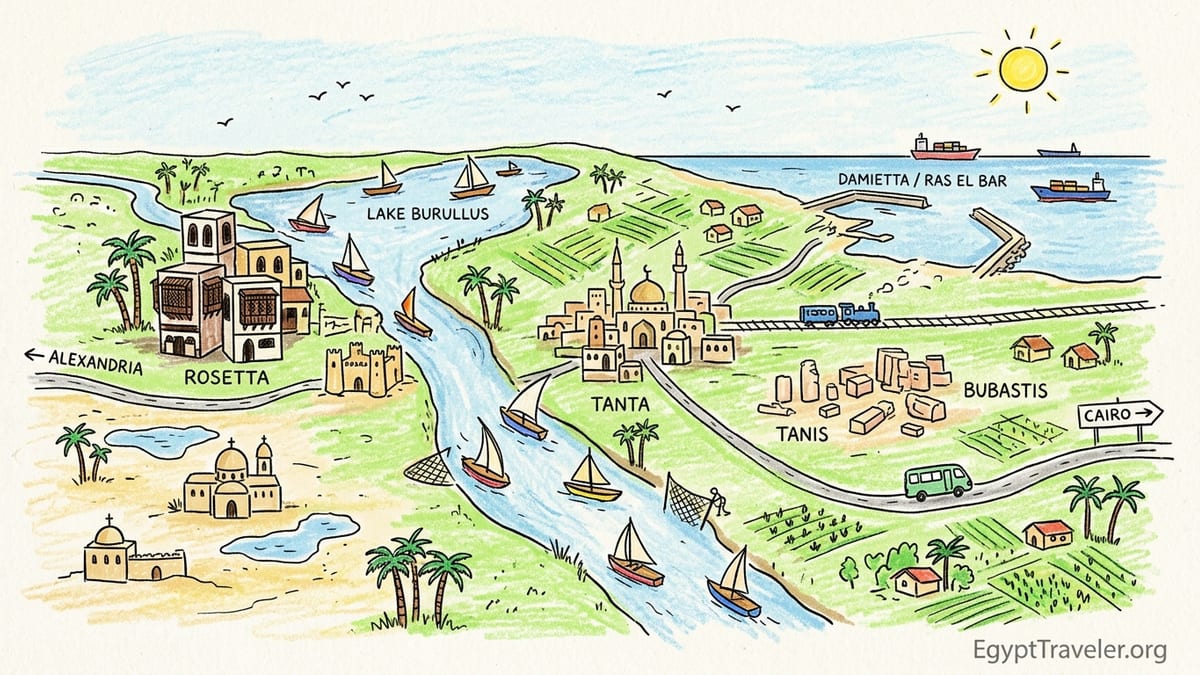
Instead of one central hub, the Nile Delta is a loose constellation of small cities and rural landscapes spread between Cairo and the Mediterranean. Distances are modest, and most of the places in this guide sit between 90 minutes and three hours from either Cairo or Alexandria by car. Train and bus links exist on most corridors, but the more remote sites and wetlands still reward travelers who are comfortable hiring a private car or taxi for a day.
For planning purposes, imagine three rough axes. West of the main Nile branches you have Wadi El Natrun, a desert valley of Coptic monasteries that works naturally as a stop between Cairo and Alexandria. To the central Delta you have Tanta and surrounding villages, an agricultural and Sufi heartland tied into Egypt’s rail network. To the northeast and along the Mediterranean rim you find Rosetta, Lake Burullus and Damietta / Ras El Bar, along with the inland archaeological sites of Tanis and Bubastis, all reachable by intercity road but requiring a bit more coordination.
Accommodation choices shape how you explore. Alexandria and Cairo remain the easiest bases, with large hotel inventories at a full range of prices. A traveler might, for example, stay three nights in Alexandria and devote one day to Rosetta and Lake Burullus, another to Wadi El Natrun, then move back toward Cairo for Tanta and Tanis. More intrepid visitors sometimes overnight in provincial cities such as Tanta or Damietta in simple two or three star local hotels to cut down on road time, but most of the stops in this article can be seen on long day trips.
Seasonality matters. The Delta is humid in summer and can feel hotter than Cairo despite similar temperatures, while winter is cooler, breezy and often misty near the coast. Autumn and early spring usually give the most comfortable mix of mild temperatures and green fields, and they coincide with some of Tanta’s Sufi festivals and peak bird migration on the northern lakes.
Rosetta: Ottoman Waterfronts and the Rosetta Stone
If you are drawn to Ottoman-era domestic architecture and Nile maritime history, Rosetta, also known as Rashid, should top your Delta list. The town grew into a key port after the Ottoman conquest in the 16th century and still preserves an unusually dense cluster of dark-brick townhouses with carved wooden mashrabiya projecting over narrow lanes. Several of these mansions have been restored as small museums, including the Rosetta National Museum housed in the former residence of an Ottoman governor, where you walk through creaking timber galleries and stone courtyards that once looked out on a thriving river port.
Rosetta is also where the Rosetta Stone was discovered in 1799 at nearby Fort Julien, giving the city a quiet but decisive role in how the world learned to read ancient Egyptian hieroglyphs. Today visitors can walk around the low, sand-colored fort that still guards the last kilometers of the Nile before it meets the Mediterranean. Inside, simple displays and replica inscriptions help situate the moment when French soldiers realized the significance of the trilingual slab they had unearthed.
From Alexandria, Rosetta is roughly 65 kilometers to the east and works very well as a day trip. By private car or taxi, the drive typically takes around ninety minutes each way, making it feasible to combine with a detour to the nearby Mediterranean shore or to Lake Burullus. Minibuses run from Alexandria’s intercity stations to Rosetta throughout the day and are inexpensive, though they can be crowded and require basic Arabic to navigate. From Cairo it is possible but less efficient as a day outing, with total driving time often exceeding three hours each way depending on traffic.
Rosetta combines naturally with Lake Burullus if you are interested in delta ecology and fishing culture as well as architecture. A common pattern is to spend the morning touring Rosetta’s old houses, the Rosetta National Museum and Fort Julien, then drive north to the lake in the afternoon to watch fishing boats and sunset over the reeds. Travelers based in Alexandria can comfortably fit both into a single, full day without feeling rushed if they set out soon after breakfast and return after dinner.
Tanis and Bubastis: Quiet Fields of Pharaohs
For travelers who want to step away from the crowded circuits of Giza and Luxor yet still feel the physical weight of ancient Egypt, Tanis and nearby Bubastis are compelling, if understated, stops. Tanis, now a low, wind-swept archaeological field known locally as San El Hagar, was once a royal capital during the Third Intermediate Period. The site is scattered with broken colossi, toppled obelisks and temple blocks reused from earlier cities. What makes it special is the atmosphere: you often share the ruins with only a few local families or a school group, allowing long, uninterrupted walks through mudbrick temple precincts and between storage pits lined with granite.
Bubastis, or Tell Basta near today’s Zagazig, was a major cult center of the feline goddess Bastet and later associated with the route of the Holy Family’s flight into Egypt. Excavations have uncovered the remains of a large temple complex and a palace from the Middle Kingdom period, though on the ground you see mainly fragments of columns, blocks and low walls placed between modern city neighborhoods. Many travelers find Bubastis more rewarding as a brief, interpretive stop combined with either Tanis or the modern city of Zagazig, where museums sometimes display finds from the site.
Logistically, Tanis and Bubastis are inland Delta destinations best reached from Cairo. Driving from Cairo to Bubastis takes roughly ninety minutes under normal traffic conditions, using the agricultural roads that thread through the eastern Delta. From there it is another hour or more by road to Tanis. Public transport is technically possible via trains to Zagazig and onward microbuses, but this approach can easily double travel times and complicate returns after dark. Most visitors who are serious about archaeology opt for a private car and driver for the day, either arranged through a Cairo travel agency or through their hotel.
These sites lend themselves to travelers who are willing to trade spectacle for context and quiet. You do not need a full day at each; instead, consider combining Bubastis and Tanis with a late lunch stop in Zagazig or a short detour to Tanta on your way back toward Cairo. Because signage in English can be sparse and guardians may not always be available to unlock side chapels, hiring a licensed Egyptologist guide who knows the Delta sites can significantly enrich the experience, even for travelers who have already visited the big temples in Upper Egypt.
Wadi El Natrun: Living Coptic Monasteries in the Desert
West of the Delta fields, Wadi El Natrun offers a completely different mood: a shallow desert valley dotted with lakes and four major Coptic Orthodox monasteries that have been active, with interruptions, since late antiquity. Monasteries such as Deir Anba Bishoy, Deir El Baramous, Deir El Surian and the Monastery of Saint Macarius are not museums but working religious communities, where monks in black robes move between chapels, gardens and refectories while visitors stand quietly beside medieval icons and painted domes.
The main reason to visit is to see monastic life woven into the contemporary Coptic church. At Deir Anba Bishoy, for example, you might be shown the ancient cave of Saint Bishoy, then step into a modern basilica where local pilgrims attend liturgy. Deir El Surian preserves a celebrated wooden door carved with biblical scenes, while the library at some monasteries houses manuscripts that scholars date back many centuries. Simple guest facilities exist within certain monasteries for retreatants, but most casual visitors come on day trips.
From Cairo, Wadi El Natrun is roughly a ninety minute drive on the Cairo–Alexandria Desert Road, and a similar distance from Alexandria. Many tour operators in both cities now offer half-day or full-day trips that leave in the morning and return by late afternoon, often visiting two or three monasteries. Independent travelers can take a bus or microbus toward Alexandria, ask the driver to stop near the Wadi El Natrun rest area, then hire a local taxi to cover the final several kilometers to the monasteries. Shared transport keeps costs low, but schedules are flexible and services can thin out in the evening, so arranging a return ride in advance is wise.
Wadi El Natrun combines easily with Alexandria or Cairo on multi-day itineraries. You might, for instance, leave Cairo in the morning, visit the monasteries, then continue on to overnight in Alexandria. Conversely, you can base in Alexandria and use Wadi El Natrun as a cultural counterpoint to a coastal stay, pairing old harbor corniches with desert monasteries. Because the monasteries are active religious sites, dress modestly, keep photography discreet, and avoid visits during major fasting periods or holy days unless your interest is primarily religious and you are comfortable with large crowds of pilgrims.
Tanta: Sufi Culture, Markets and Everyday Delta Life
Tanta sits almost exactly halfway between Cairo and Alexandria and is the Delta’s largest inland city, but it remains firmly outside most foreign itineraries. Travelers who do make the stop usually come either for its Sufi heritage centered on the mosque and shrine of Ahmad Al Badawi, or for a taste of a provincial Egyptian city that is not shaped primarily around tourism. The shrine complex fills with pilgrims year-round, especially during the annual moulid, or birthday festival, of Al Badawi, when devotional music, dhikr circles and informal street fairs spill across central Tanta.
Outside festival times, the atmosphere is gentler but still deeply local. The market streets around the shrine sell everything from bright textiles and children’s clothing to trays of sticky sweets and nuts. Cafes buzz with students from Tanta University. For many travelers, simply wandering these commercial streets, buying a serving of roasted chickpeas or a bag of sugared nuts from a street vendor and watching everyday life unfold, is as memorable as visiting any formal monument.
Reaching Tanta is straightforward. Fast trains from Cairo’s Ramses Station run multiple times a day and usually take around an hour, making Tanta one of the simplest Delta cities to turn into a day trip. Services from Alexandria along the coastal corridor typically take a similar amount of time or slightly longer, depending on the class of train. Tickets are inexpensive by international standards, often costing only a fraction of what visitors would pay for first class seats on the Cairo–Luxor line. On arrival, the main mosque, markets and most central hotels sit within walking or a short taxi distance of the train station.
Tanta combines well with more specialized stops. You can, for example, visit Tanta in the morning, have a late lunch in one of its busy grills or koshary restaurants, then continue by road toward Tanis or Bubastis for an overnight closer to the archaeological sites. Alternatively, travelers focusing on spiritual heritage might pair Tanta’s Sufi culture with Wadi El Natrun’s Coptic monasteries over two days, using Tanta as an overnight base between Cairo and Alexandria if they want to experience an Egyptian city evening beyond the big capitals.
Lake Burullus and the Northern Wetlands
Stretching along the Mediterranean coast between the Rosetta and Damietta branches of the Nile, Lake Burullus is a shallow brackish lagoon fringed with reeds, islets and low fishing villages. Birders and nature-minded travelers visit for the chance to see migratory species that pause here on routes between Eurasia and Africa, especially in autumn and winter when flocks of herons, ducks and waders feed in the shallows. Even if you are not a specialist, hiring a small fishing boat for an hour or two near one of the lakeside towns gives you a feel for the scale of the lagoon and the daily rhythms of local fishermen checking nets and fish traps.
On the human side, the lake shore offers glimpses of traditional fishing communities that still rely heavily on small-scale nets and wooden craft. In some villages, workshops build or repair fishing boats with hand tools, their hulls drying on the shore. Basic fish restaurants serve grilled mullet and other catch pulled from the lagoon that morning, often accompanied by simple salads and bread. Prices are modest by tourist-city standards, and while menus are usually only in Arabic, staff are used to domestic visitors from across the Delta and will typically point you toward their freshest options.
Lake Burullus is often combined with Rosetta or Damietta rather than visited on its own. From Alexandria, a common pattern is to drive first to Rosetta for a few hours of walking among Ottoman houses and along the Nile, then continue north to a lakeside village such as Baltim or Burullus town to catch the late afternoon light on the water before returning to Alexandria in the evening. Travelers with an interest in wetlands and coastal ecology can also link Burullus with Lake Manzala farther east, though this requires more driving and planning.
Access without a private vehicle remains challenging. There are local buses and microbuses from Delta cities like Kafr El Sheikh or Rosetta to villages along the lake, but they tend to be informal, crowded and oriented toward residents rather than tourists. If your time is limited or you are traveling with photography gear, consider hiring a car and driver for the day from Alexandria or Cairo and asking them to stay with you as you move between Rosetta, Lake Burullus and perhaps Damietta. This approach costs more but allows you to time boat outings around light and weather and to pivot toward another town if conditions on the lake appear too rough for comfortable small-boat travel.
Damietta and Ras El Bar: Where the Nile Meets the Mediterranean
At the eastern mouth of the Nile, Damietta and the nearby resort strip of Ras El Bar offer a different face of the Delta: seaside corniches, family beaches and a working river port where ocean-going ships share water with local fishing boats. Damietta itself is a medium-sized city known across Egypt for its furniture workshops, many of which produce carved wooden pieces for domestic and export markets. Traveling through its commercial districts, you will pass entire streets devoted to bed frames, salon sets and dining tables stacked in front of open-front workshops.
A short drive to the north, Ras El Bar sits on a low tongue of land between the Mediterranean and the Damietta branch of the Nile. The tip of this peninsula is where the river technically meets the sea, marked today by breakwaters and a simple lookout where local families stroll in the evening. The beaches along Ras El Bar are primarily domestic holiday territory, with seasonal rental apartments, simple hotels, cafes and beach clubs that come alive in summer. Outside the peak months, the area feels quiet, with long, mostly empty strands of sand and a mix of fishermen, joggers and bundled-up walkers on windy days.
Damietta and Ras El Bar work best for travelers who like the idea of combining a coastal stay with glimpses of everyday river trade. Sitting in a riverside café in Damietta, you watch barges and tugs navigate bends in the Nile while ferries shuttle people between banks. In Ras El Bar, you can walk from the river promenade to the sea in minutes, stopping at small seafood places that grill locally caught fish and shrimp. Prices are generally lower than in Alexandria’s more famous fish restaurants, though the setting at Ras El Bar is more casual and geared toward Egyptian families than international visitors.
Reaching Damietta from Cairo typically takes around three hours by car, depending on traffic leaving the capital, making it just feasible as a long day trip but more comfortable as an overnight or as part of a multi-stop Delta itinerary. Buses run from Cairo’s main stations to Damietta several times a day and are an economical, if slower, option. From Alexandria, the trip usually involves first heading eastward across the Delta and can take a similar three to four hours by road. Damietta and Ras El Bar link naturally with Lake Burullus and Rosetta to form a coastal loop, or with Tanis and Bubastis if you swing inland through the eastern Delta on your way back toward Cairo.
Choosing and Combining Delta Stops
Since most travelers will not have the time or energy to visit every site in the Delta, it helps to think in themes. If your main interest lies in architecture and the built environment, Rosetta’s Ottoman houses and Fort Julien give you a rare look at how wealthy river merchants and officials lived in the early modern period, while Damietta offers a sense of a contemporary workshop city where furniture-making still shapes daily life. For ancient history and low-key archaeology, Tanis and Bubastis are the clearest choices. For spiritual landscapes, Wadi El Natrun and Tanta present two very different but complementary traditions: Coptic monasticism in the desert and Sufi devotion in a bustling provincial city.
From a purely practical perspective, the most convenient day trip from Cairo for many visitors is Tanta, with fast trains and a compact center. Wadi El Natrun is almost as easy if you are comfortable arranging road transport. Rosetta and Lake Burullus work naturally from Alexandria as a combined day, while Damietta and Ras El Bar require more time and are better handled as an overnight or as part of a longer circuit. Archaeology-focused travelers may be willing to accept longer hours in the car to reach Tanis and Bubastis, especially if they have already ticked off the major Nile Valley temples and now want quiet sites for reflection and photography.
Budget also plays a role but usually in your choice of transport rather than entry fees, which remain modest at most of these sites. An independent traveler might, for instance, pay for a first class train ticket to Tanta, enjoy an inexpensive street-food lunch and spend little more than a handful of dollars all day. In contrast, hiring a private car for Wadi El Natrun or a Rosetta–Burullus loop might cost significantly more but buys flexibility and time. For many, a mixed approach works best: use trains where possible, then reserve private transport for rural or multi-stop days when you want to reach several sites that would be difficult or exhausting by public bus.
However you combine the Delta, try to leave space in your schedule for serendipity. Market towns such as Tanta or Damietta reward slow wandering, pausing at juice stands or pastry shops that catch your eye. On the wetlands, conditions change with light and wind, so a cloudy morning on Lake Burullus can give way to a glowing evening on the same water. And in Wadi El Natrun, what stays with many visitors is not a particular relic but a short conversation with a monk in a shady courtyard, or the sound of chanting drifting over the desert as the sun drops behind the monastery walls.
The Takeaway
Exploring the Nile Delta requires more planning than a straightforward Luxor–Aswan cruise, yet it returns that effort with an unusually intimate view of Egypt. In Rosetta, you walk through cool, timbered Ottoman houses that once watched over a thriving river port. At Tanis and Bubastis, you trace outlines of temples that have almost melted back into the fields, far from the tourist buses. Wadi El Natrun pulls you into the rhythms of living monasteries, while Tanta opens a window onto Sufi devotion and university-town energy. Along Lake Burullus and at Damietta and Ras El Bar, you see how the Nile finally gives itself to the sea, surrounded by fishermen, shipwrights and families on holiday.
If you are willing to accept some imperfect timetables, a few language gaps and the occasional delay, the Delta can be one of the most rewarding regions in Egypt to explore. It is where grand historical narratives intersect with the present in quiet, workaday ways: a monk checking his mobile phone under a thousand-year-old dome, a fisherman tying a new nylon net beside a reed canoe, a Sufi singer streaming devotional songs from a cheap loudspeaker beside a shrine that has anchored the city for centuries. Plan around your interests, string together the places that speak to you most strongly, and you will discover a side of Egypt that most visitors never see.
FAQ
Q1. Can I visit the main Nile Delta sites as day trips from Cairo?
Yes, several Delta destinations work as day trips from Cairo, including Tanta, Wadi El Natrun and, for determined travelers, Tanis and Bubastis with a long day by car.
Q2. Is Rosetta better visited from Cairo or Alexandria?
Rosetta is significantly easier from Alexandria, about ninety minutes by road, and can be combined with Lake Burullus or a short coastal stop on the same day.
Q3. Do I need a guide for Wadi El Natrun’s monasteries?
A guide is not required, but many visitors find that hiring a local guide or joining a small tour from Cairo or Alexandria helps with navigation and cultural etiquette.
Q4. When is the best time to see birdlife on Lake Burullus?
Autumn and winter are usually best for birdlife, when migratory species use the lagoon as a stopover, though you can see resident birds at other times of year.
Q5. Is Tanta’s Sufi festival suitable for first-time visitors to Egypt?
Yes, but expect dense crowds, loud music and late nights. Travelers comfortable with busy street scenes will find it vivid, while crowd-averse visitors may prefer quieter days.
Q6. Are there good accommodation options in Damietta and Ras El Bar?
Damietta and Ras El Bar offer simple local hotels and seasonal apartments rather than international chains. Many travelers still choose to overnight for the coastal atmosphere.
Q7. How difficult is it to reach Tanis and Bubastis by public transport?
It is possible but time consuming, involving trains and microbuses. Most travelers with limited time prefer hiring a private car and driver from Cairo for these sites.
Q8. Can I combine Rosetta, Lake Burullus and Damietta in one day?
It is technically possible with a private car on a very long summer day, but most visitors find it more enjoyable to focus on Rosetta and Lake Burullus or overnight near Damietta.
Q9. Is the Nile Delta safe for independent travelers?
Most Delta towns are accustomed to domestic tourism, and independent travelers are generally safe if they follow normal precautions, dress modestly and respect local norms.
Q10. Do I need to book tours in advance for Delta trips?
For popular day trips like Wadi El Natrun, advance booking is helpful but not always essential. For more remote sites like Tanis, prearranged transport is strongly recommended.