


For many travelers, “Nile Delta tour from Cairo” sounds like a single, interchangeable product. In reality, the Delta hides several very different day trips and short circuits, from quiet Coptic monasteries in Wadi El Natrun to the mud-brick ruins of Tanis and the Ottoman mansions of Rosetta. Picking the right excursion is less about ticking a box and more about matching your interests and energy levels to the geography of northern Egypt.
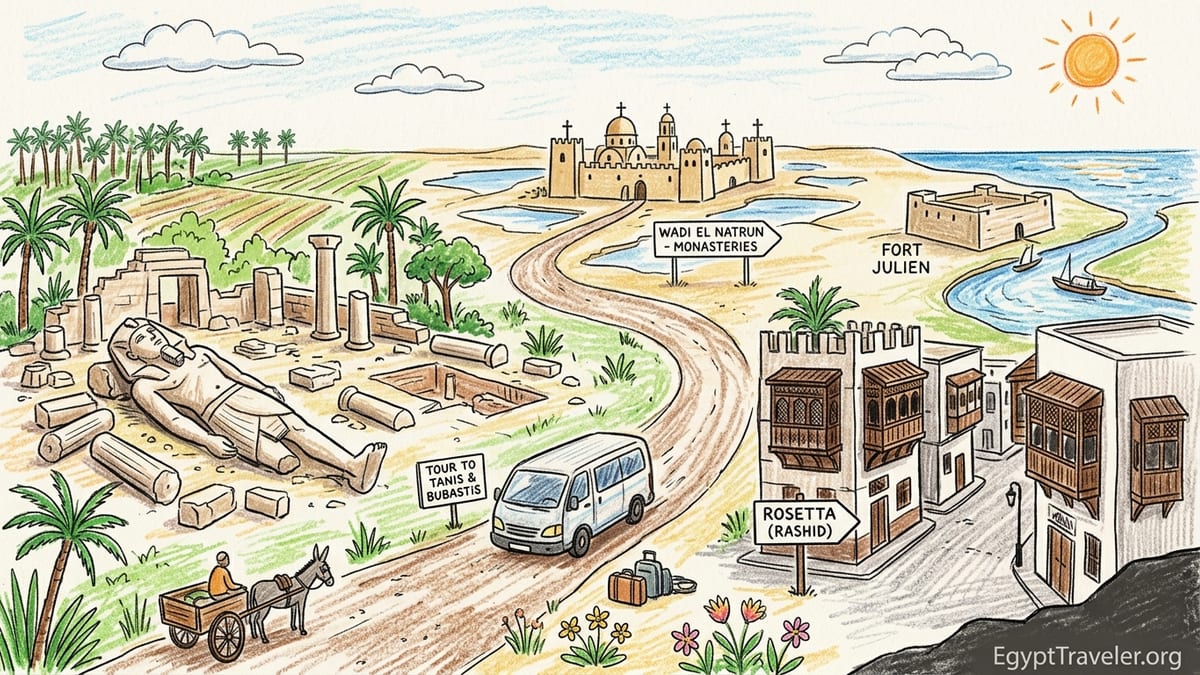
Understanding Nile Delta Day Trips from Cairo
Cairo sits just south of the Nile Delta, which fans out toward the Mediterranean in a wide triangle of farmland, canals and historic towns. Most tours marketed as “Nile Delta” operate as long day trips by road, leaving Cairo around 7.00–8.00 in the morning and returning by early evening. Each destination lies on a different spoke of the highway network, which explains why the tours rarely combine more than two major sites in a single day.
In practice, you can think of four main styles of Delta excursion from Cairo. Archaeology-focused trips concentrate on Tanis (San el Hagar) and sometimes Bubastis near Zagazig. Heritage-and-river tours follow the Rosetta branch of the Nile to the town of Rashid, better known to travelers as Rosetta. Coptic heritage excursions head west into the desert depression of Wadi El Natrun, a cradle of early Christian monasticism. Finally, Holy Family pilgrimage routes weave together Coptic Cairo and selected Delta or desert stops associated with traditional accounts of the flight of the Holy Family into Egypt.
Most operators sell these as private tours for two to six people in an air-conditioned car or minivan with hotel pickup in central Cairo or Giza. A smaller number of agencies also offer fixed-date group departures, especially for Wadi El Natrun and Rosetta during peak winter season. Prices, inclusions and the level of guiding vary strongly, so comparing the structure of each excursion before you book is more important here than for a standard half-day trip inside Cairo.
Drive Times and Practical Logistics from Cairo
Distance and road quality shape what is realistic as a day trip. Wadi El Natrun sits roughly halfway between Cairo and Alexandria along the desert highway, about 100–120 kilometers from central Cairo. Most tours quote a driving time of 1.5 hours each way in light traffic, and real-world experience usually matches that estimate outside rush hour. Rosetta, on the other hand, lies farther northwest near the Mediterranean coast. A typical Rosetta tour from Cairo plans on 2.5 to 3 hours each way, sometimes a little longer if the minibus crosses busy agricultural roads near the Delta villages.
Tanis and Bubastis lie to the northeast. To reach Tanis at San el Hagar, drivers usually follow the desert road past Bilbeis and Zagazig, then turn north across the Delta. Expect roughly 2.5 hours each way, which can stretch to 3 hours in the late afternoon when trucks and microbuses are heavier on the highway. Bubastis at Tell Basta, close to Zagazig, is a little closer; a combined Bubastis and Tanis day from Cairo typically involves 5 to 6 hours of total driving time across the day.
Holy Family pilgrimage excursions are the most varied logistically. Many operators offer short religious tours that stay in Greater Cairo, focusing on the churches of Old Cairo and the Holy Family Church in Maadi. Others extend north into the Delta or west to Wadi El Natrun. A full-day Holy Family itinerary that includes Old Cairo and Wadi El Natrun often clocks in at 3.5 to 4 hours of driving, which is about the limit for a comfortable one-day religious circuit for most visitors.
Travelers should also factor in season and daylight. In winter, when sunset can be before 5.30 pm, longer Delta runs to Rosetta or Tanis will finish some sightseeing in softer late-afternoon light, but with a dark drive back. In summer, high temperatures make air-conditioned vehicles essential, and many operators start earlier from Cairo to avoid arriving at exposed archaeological sites around midday.
Rosetta Tours: Ottoman Streets and Nile Heritage
Rosetta, known locally as Rashid, sits near the mouth of the western branch of the Nile where the river approaches the Mediterranean. A typical Rosetta day tour from Cairo combines multiple strands: Ottoman domestic architecture in the old town, riverside corniche views, a small museum that displays a replica of the Rosetta Stone, and sometimes a short felucca or motorboat ride on the Nile branch. Because of the distance from Cairo, most operators allow around 4 to 5 hours on site before the return journey.
Private Rosetta excursions marketed through mid-range Cairo agencies often start around 80 to 120 US dollars per person for a couple, including hotel pickup, an English-speaking guide and lunch at a local fish restaurant on the river. Larger day-tour companies may price shared bus departures slightly lower but with fixed dates and fewer inclusions. Entrance fees within Rosetta are modest compared with sites like the pyramids, and many historic houses are administered locally, so the most meaningful “ticket” expense is usually the combined museum and heritage house entrance, which operators often prepay and fold into the tour price.
Rosetta works well for travelers interested in Nile panoramas, cooler Delta breezes and the story of the Rosetta Stone without wanting a deep archaeological dig. Walking the narrow lanes between dark-brick Ottoman mansions and visiting the small fort where the stone was discovered gives a tangible sense of the Ottoman and early-modern period. However, visitors should not confuse Rosetta with large-scale temple ruins; it is a living town with heritage fragments, not an open-air museum on the scale of Luxor.
Tanis and Bubastis: Delta Archaeology for Serious History Fans
Tanis, at modern San el Hagar, is one of the more remote but most rewarding Delta sites for archaeology enthusiasts. Once a royal capital in the Third Intermediate Period, it offers sprawling fields of temples, broken obelisks and reused blocks. Modern tours from Cairo usually combine Tanis with a stop at nearby Bubastis, the ancient city of Bastet, near Zagazig. Because of the driving time and the relatively rough, sun-exposed nature of both sites, these excursions suit travelers who already have some background in ancient Egypt and are comfortable walking over uneven ground.
In practice, archaeology-focused day trips to Tanis and Bubastis are almost always run as private tours rather than shared buses. Sample itineraries marketed in 2025 and 2026 price a full-day circuit from central Cairo around 120 to 180 US dollars per person for two or three participants. That typically includes a licensed Egyptologist guide, air-conditioned vehicle with driver, bottled water and box lunch or a simple local restaurant stop, plus entrance fees for both sites. It is worth checking that Tanis is explicitly listed; some “Delta archaeology” outings only go as far as Bubastis and local museums.
Visitors who choose Tanis often do so after seeing Giza, Saqqara and the Egyptian Museum and wanting something less manicured and more exploratory. Expect largely unshaded ruins with minimal interpretive panels. The Egyptologist’s role is crucial here; a good guide will help you reconstruct temple layouts, highlight royal cartouches and explain why statues from earlier periods were reworked and re-erected at Tanis. Bubastis, by contrast, is more compact and heavily damaged, but its sacred cat associations and location near modern Zagazig make it a vivid glimpse into how ancient and modern Egypt intersect in the Delta.
Because Tanis and Bubastis lie in more conservative rural governorates, modest clothing is recommended even in hot weather, and travelers should be ready for basic facilities. Those who value comfort and structured narratives may be happier with Wadi El Natrun or Rosetta; those who enjoy climbing over broken temple blocks and imagining ancient processions will find Tanis the most atmospheric of the Delta archaeology options.
Wadi El Natrun Monasteries: Coptic Heritage in the Desert
Wadi El Natrun is not a Nile-side town at all but a desert depression west of the Delta, roughly midway between Cairo and Alexandria. It is one of the most important centers of early Christian monasticism, and today four major Coptic Orthodox monasteries remain active there. Most tours from Cairo visit at least three of these communities, commonly the Monastery of Saint Pishoy, the Syrian Monastery and the Paromeos Monastery. Travel time from central Cairo is typically around 1.5 hours each way by highway, which makes Wadi El Natrun one of the least tiring full-day excursions from the capital.
Unlike Tanis, Wadi El Natrun receives a steady flow of Egyptian pilgrims as well as foreign visitors. Standard itineraries marketed by reputable Cairo tour companies in 2026 run between about 70 and 120 US dollars per person for a private day trip for two, including hotel pickup, transport, an English-speaking guide familiar with Coptic heritage and sometimes lunch at a roadside restaurant. Shared departures arranged by larger agencies or church groups can cost less per person but may operate only on specific days. Entrance to the monasteries themselves is generally free, but many tours make a small donation to the community and include this in the package cost.
The experience at Wadi El Natrun is as much spiritual and cultural as it is historical. Within the fortified monastery walls you may meet resident monks who show visitors ancient churches, frescoes and relic shrines, and who explain the rhythm of monastic life. Dress codes are conservative, and women may be asked to cover shoulders and knees. Photography is usually permitted in outdoor areas but restricted inside certain chapels, and a respectful, quiet tone is strongly encouraged.
For travelers deciding between Wadi El Natrun and strictly archaeological sites, the key distinction is atmosphere. Wadi El Natrun is a living monastic landscape where services still take place daily. The focus is on early Christian history, icons and spiritual traditions rather than pharaonic ruins. Many visitors combine a Wadi El Natrun day with a separate half-day exploring the Coptic Museum and churches of Old Cairo to gain a fuller picture of Coptic heritage.
Holy Family Pilgrimage Routes and Religious Tours
Holy Family tours in Egypt follow Coptic tradition about the journey of Mary, Joseph and the infant Jesus through the country. While many sites on this trail lie in or near Greater Cairo and further south, some itineraries incorporate Delta or desert stops like Wadi El Natrun or churches north of the city. These excursions can range from short half-day visits to Old Cairo’s Hanging Church, Abu Serga and the Church of the Virgin in Maadi, to multi-day religious circuits that combine Cairo, Wadi El Natrun and monasteries in Middle Egypt.
From Cairo, a common one-day Holy Family itinerary might include morning liturgy or quiet visit time in Old Cairo, followed by a drive west to Wadi El Natrun to visit monasteries associated in tradition with the Holy Family’s passage. Another pattern focuses entirely on Cairo-area churches and shrines, which significantly reduces travel time and is easier for visitors with limited mobility. The presence of a guide with solid knowledge of Coptic tradition is essential, particularly for pilgrims who want liturgical context and translation of Arabic-language inscriptions and icons.
Pricing for Holy Family tours varies with the level of religious framing. Generalist tour companies often package them similarly to Coptic heritage excursions, in the 70 to 120 US dollars per person range for a private full day. Specialized Christian tour operators, particularly those arranging groups from overseas parishes, may charge more but include spiritual directors, set times for prayer and sometimes coordination with local clergy. In these cases, the guide is often more of a pilgrimage leader than a standard Egyptologist, though some tours use both a religious escort and a local licensed guide where regulations require.
Holy Family itineraries are especially attractive for repeat visitors who have already seen Egypt’s headline pharaonic sites and want an experience grounded in living faith communities. They also suit travelers who prefer churches and monasteries to large, sun-exposed ruins. Anyone interested primarily in biblical connections and Coptic spirituality will find these tours more rewarding than a generic “Delta sightseeing” circuit.
Group versus Private Tours, Guides, Fees and Inclusions
Because Delta sites are spread out and not linked by easy public transport, almost all travelers visit them on organized excursions rather than independently. The vast majority of offers from Cairo are private tours in a car or minivan. Private formats appeal to couples and small groups who want flexible pacing, hotel pickup and the ability to adjust the focus on the day. Prices are usually quoted per person based on a minimum of two participants, with discounts for larger private parties who share the vehicle.
Group departures exist but tend to be limited to popular or logistically straightforward routes such as Wadi El Natrun or Rosetta during the cooler months. In these cases, you might pay noticeably less per person, but at the cost of a fixed schedule, multiple hotel pickup stops and a larger group at sites that feel more contemplative when quiet. Archaeology-heavy runs to Tanis and Bubastis are less commonly sold as large-group bus tours because the market is smaller and the long drive makes it harder to fill a coach profitably on a regular schedule.
Guide types are another important differentiator. Tanis and Bubastis almost always involve a licensed Egyptologist, because they are primarily pharaonic sites where visitors expect deep historical explanation. Wadi El Natrun and Holy Family tours are more likely to be led by guides with a Coptic heritage or religious background, and in many monasteries resident priests or monks will take over part of the explanation. Rosetta tours commonly use generalist cultural guides familiar with Ottoman architecture and Nile history. When comparing offers, look carefully at whether the guide is an Egyptologist, a religious specialist or a general tour leader, and match that to your priorities.
Entrance fees and meals are usually consolidated into an “all-inclusive” day price, but there are exceptions. Archaeological sites like Tanis and Bubastis charge formal ticket fees that your operator should include and list clearly in the itinerary. Wadi El Natrun monasteries do not have standard entrance tickets, but guides often suggest or arrange small donations. Meals differ by destination: Rosetta tours frequently include a seated fish lunch on the river, Wadi El Natrun excursions may stop for a simple Egyptian meal near the highway, and archaeology-focused trips sometimes rely on box lunches due to limited restaurant options near the sites.
Longer Private Delta Circuits from Cairo
For travelers with more time and a strong interest in the less-visited north, several agencies now assemble longer private circuits that link multiple Delta and desert sites over two or three days. A common pattern is to drive from Cairo to Wadi El Natrun for monastery visits, then continue on to Alexandria for an overnight stay before looping through Rosetta and returning to Cairo. Another variation links Tanis and Bubastis with smaller Delta towns and rural landscapes, sometimes including a homestay or guesthouse on a farm.
These extended circuits almost always operate privately with a car and driver and an English-speaking guide, with per-person costs depending heavily on the chosen hotel standard in Alexandria or Delta towns. As a rough frame, adding an overnight and a second day of touring might increase the budget by 150 to 250 US dollars per person compared with a single day trip, mainly due to accommodation and guide time. The payoff is slower pacing and the chance to see village life, rural markets and Nile branch scenery that day trips skim past.
Travelers who choose multi-day Delta circuits are usually repeat visitors to Egypt or those who prefer quieter heritage landscapes to crowded classic circuits. Because these routes venture into less touristed areas, careful selection of operator and up-to-date safety and road condition advice are important. Reputable Cairo-based agencies will be transparent about which stretches are on highways and which use narrower local roads, and will suggest seasonal adjustments if heavy winter fog or summer agricultural burning affects visibility in the Delta.
If you are considering such a circuit, it is worth asking for a custom proposal that spells out driving times between each stop, planned rest breaks and the specific towns where you will sleep and dine. This helps distinguish a thoughtful Delta journey from a generic “Alexandria and surroundings” package that only briefly dips into the Nile branches.
Matching Tours to Your Interests
Choosing the right Nile Delta excursion from Cairo starts with an honest look at what fascinates you and how you like to travel. If your heart is set on temple alignments, royal cartouches and the feeling of discovery among broken obelisks, an archaeology-focused Tanis and Bubastis day is the clearest fit, even if it means a longer, less comfortable journey. Those who thrive on stories of early Christianity, monastic life and living faith communities usually find Wadi El Natrun or broader Holy Family itineraries more rewarding than a purely pharaonic outing.
Travelers who crave river views, historic houses and a slower urban rhythm will likely gravitate to Rosetta, where the Nile branch, Ottoman architecture and fish restaurants create a softer kind of heritage day. Visitors seeking a broader cross-section of northern Egypt or who have extra time may look beyond single-day trips to a two- or three-day Delta circuit, weaving together monasteries, rural villages, coastal lakes and perhaps a night in Alexandria.
Formats matter as much as themes. Private tours cost more per person but allow stops for photography in green fields or village markets and space to linger at a particular chapel or ruin. Group tours reduce costs and provide more social energy but work better in destinations with established facilities and shorter walks, such as Wadi El Natrun or Rosetta. Whatever you choose, reading the fine print on drive time, inclusions, meal arrangements and guide qualifications will help you avoid disappointment and ensure that your “Nile Delta tour from Cairo” truly matches your expectations.
Finally, remember that the Delta is a region of working farms, conservative rural communities and active religious sites. Modest clothing, patience with road conditions and a flexible mindset will transform long driving stretches into part of the experience, as you watch the green fan of the Nile open out between Cairo and the Mediterranean.
The Takeaway
Not all Nile Delta tours from Cairo are created equal. Rosetta offers riverside heritage and Ottoman houses, Tanis and Bubastis reward serious archaeology fans willing to travel further, Wadi El Natrun and Holy Family routes immerse visitors in living Coptic spirituality, and longer private circuits stitch these elements into slower journeys through Egypt’s northern landscapes. Understanding the character of each option, along with its drive time, guiding style and level of comfort, makes it much easier to choose the trip that fits your interests.
If you dream of deciphering hieroglyphs in a quiet temple field, prioritise Tanis and Bubastis with a knowledgeable Egyptologist. If silent cloisters and incense appeal more, look to Wadi El Natrun and Holy Family itineraries led by Coptic heritage guides. For relaxed river views and fish lunches in a historic town, Rosetta is the natural choice. And if you have the time and budget, consider a tailor-made multi-day circuit that lets you watch the Delta unfold slowly between Cairo, the monasteries and the sea.
Above all, avoid buying a “Nile Delta” label without reading what lies beneath. By matching destination, format and guiding style to your own curiosity, you will come back from northern Egypt with far more than a day-trip photo: you will have a concrete, textured sense of how the Nile fans out toward the Mediterranean, and how pharaonic, Christian and Ottoman histories still shape the Delta today.
FAQ
Q1. Can I visit Wadi El Natrun, Rosetta and Tanis in a single day from Cairo?
It is not realistic to combine those three in one day. Each lies in a different direction from Cairo, and even two of them would involve too much driving and not enough time on site.
Q2. Which Nile Delta tour from Cairo is best if I only have one spare day?
If you enjoy ancient temples and already know the basics of Egyptian history, Tanis and Bubastis offer the most distinctive pharaonic experience. If you prefer living religious sites and shorter drives, Wadi El Natrun is the better single-day choice.
Q3. Are Nile Delta tours from Cairo suitable for children?
Rosetta and Wadi El Natrun tend to work best for families, thanks to shorter walks, easier facilities and more varied scenery. Tanis and Bubastis can be demanding for younger children due to heat, rough ground and limited shade.
Q4. Do I need a licensed Egyptologist guide for Wadi El Natrun?
A full Egyptologist is not essential there, though some guides do hold that qualification. More important is a guide familiar with Coptic history and comfortable coordinating with monastery clergy.
Q5. How much should I budget for a private Nile Delta day trip from Cairo?
Most private full-day excursions to Rosetta, Wadi El Natrun, Tanis or Bubastis fall roughly in the 70 to 180 US dollar per person range, depending on distance, inclusions and group size.
Q6. Are meals usually included on Delta excursions?
Many operators include lunch, particularly on Rosetta tours where a fish meal on the river is part of the experience. On archaeology-focused runs, you may receive a box lunch instead of a restaurant stop, so check the details before booking.
Q7. What should I wear when visiting Wadi El Natrun and Holy Family sites?
Dress modestly, with shoulders and knees covered, and opt for light, breathable fabrics. Women may want to carry a scarf for use inside churches, and everyone should wear comfortable closed shoes.
Q8. Is it safe to travel into the Nile Delta from Cairo on a day trip?
Most visitors travel the main routes with reputable operators without issues, but conditions can change. It is sensible to book through established Cairo agencies, follow current local advice and avoid self-driving if you are unfamiliar with Egyptian roads.
Q9. Can I do any of these Nile Delta trips by public transport instead of a tour?
While some towns are reachable by train or bus, getting from stations to remote sites like Tanis or the monasteries is difficult without a car. For most travelers, an organized excursion is more practical and time efficient.
Q10. How far in advance should I book a Nile Delta tour from Cairo?
Booking a week or two ahead is usually sufficient outside major holidays, though specialist archaeology or religious trips may need more notice. Last-minute arrangements are sometimes possible through Cairo hotels, but choice may be limited.