

Leaving the manicured gates of my Marsa Alam resort in the late morning, I watched the palm-lined drive give way to a much older Red Sea reality. Within minutes the smooth internal road, edged with bougainvillea and low-slung villas, fed into the coastal highway. The tour buses turned south for more gated compounds. My driver turned north, toward El Quseir, a working port town whose story predates every modern resort billboard that lines this coast.
The Road From Resort Strip To Working Port
The drive from Marsa Alam City to El Quseir is about 135 to 140 kilometers, roughly an hour and a half on the coastal highway. The resorts thin out quickly once you leave the clusters around Port Ghalib and Abu Dabbab. The four-lane carriageway narrows in places, the asphalt patched but serviceable, and for long stretches there is nothing but rough desert to the west and a glint of the Red Sea to the east. Small blue signs point to individual hotels or dive bases, each one its own small world, self-contained and carefully landscaped.
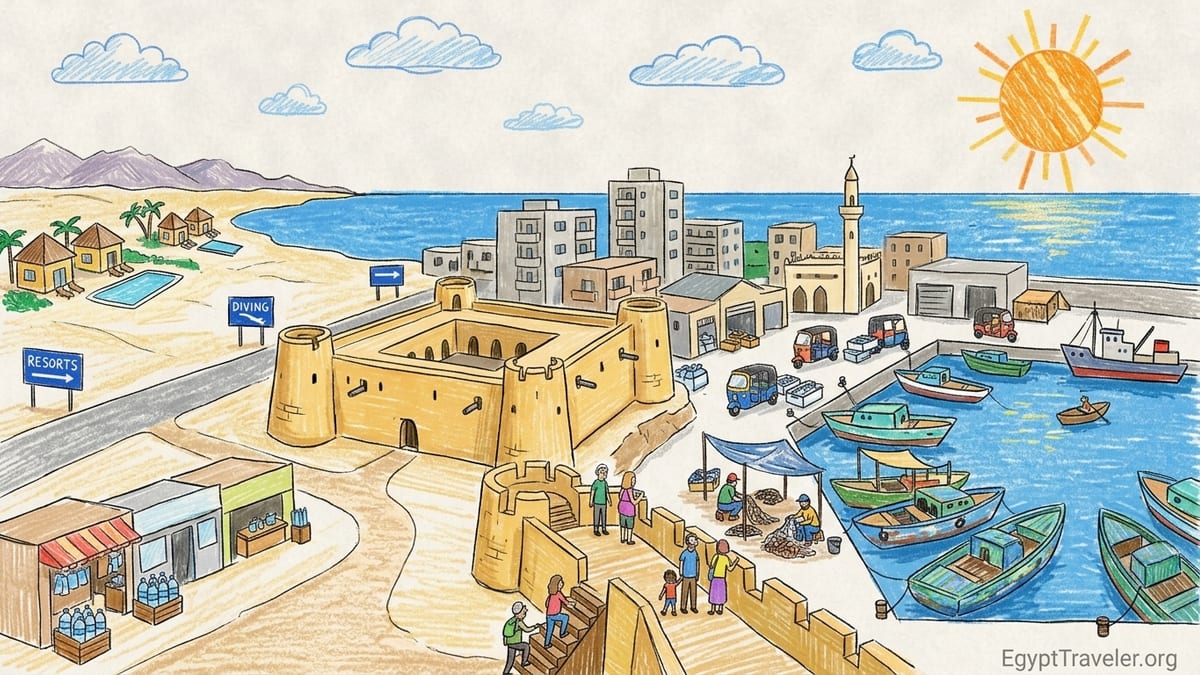
As we approached El Quseir from the south, the scenery shifted almost abruptly. Instead of a guarded gate and an ornamental lagoon, I saw concrete apartment blocks, low workshops and small grocery stores with crates of bottled water stacked out front. The road surface broke into patched sections, with speed bumps appearing without warning. There were more pick-up trucks than tour buses, and motorbikes threaded between them, often carrying two or three passengers at once. The Red Sea was still over my right shoulder, but here it framed a town, not a resort.
My driver dropped me near the Ottoman fort that anchors the old center. There was no grand visitor car park, only a sandy lot beside a row of shops selling phone cards, cold drinks and car parts. The heat pressed down hard even outside the peak summer months, and the mix of dust, sea air and exhaust fumes felt a world away from the controlled environment of an all-inclusive buffet. Yet this was precisely why I had come. El Quseir promised not a themed version of Egyptian history, but the layered reality of a port that had handled real cargo and real pilgrims for centuries.
First Impressions Of The Ottoman Fort
The fort of El Quseir stands on a low rise above the harbor, its thick sandstone and coral-limestone walls forming a squat rectangle against the sky. Historical research attributes its founding to the Ottoman sultan Selim II in 1571, built to secure the Red Sea route that connected the Nile Valley with Arabia and, by extension, the wider world of Indian Ocean trade. Today it looks solid and somewhat severe from the outside, but the closer I walked, the more I could read the story of its recent rescue.
Between 1996 and 2005, the fort underwent a substantial conservation and adaptive reuse project led in part by the American Research Center in Egypt and Egyptian heritage authorities. Their work stabilized the crumbling outer walls, rebuilt collapsed vaults, and inserted discreet modern elements like stair rails and display lighting. Inside the courtyard, the stone feels older, worn silky underfoot where generations of soldiers and customs officials once stood guard. Yet some of the parapets and internal walkways clearly show newer stone and mortar, slightly different in color and texture. The restoration did not try to disguise every intervention, and as a visitor you sense both survival and careful reconstruction.
Entry when I visited was inexpensive, charged in Egyptian pounds at a small kiosk by the gate. Prices had risen slightly compared with pre-2020 guidebooks, a result of currency fluctuations, but remained accessible enough that school groups, local families and a handful of foreign tourists were all climbing the same stairs. There was minimal signage in English, so I relied heavily on the fort’s physical cues and the few bilingual panels that summarized its function as a defensive outpost and customs checkpoint guarding trade and pilgrimage traffic to and from Jeddah and beyond.
Inside The Walls: Trade, Pilgrims And Restoration Details
From the central courtyard I walked into barrel-vaulted rooms that once stored grain and goods. Some of these spaces now house small exhibitions created during the 1996 to 2005 restoration, with maps of the Red Sea and panels that explain how El Quseir functioned within Ottoman trade networks. The town controlled one of the shortest practical routes between the Nile and the Red Sea. Caravans crossed the Eastern Desert from Qift on the river to reach this harbor, where goods and pilgrims transferred to ships bound for the Arabian Peninsula, East Africa and, via monsoon routes, the western coast of India.
The museum rooms contain fragments of imported ceramics, glass and metalwork that hint at this long-distance commerce, though most high-profile Roman and Islamic material actually comes from Quseir al-Qadim, the older port about eight kilometers to the north. Here in the Ottoman fort, the focus is late medieval and early modern: coral-stone architecture, gunports oriented toward the sea, and plans showing how the fort was modified when different powers controlled the coast. One panel notes Napoleonic use of the site during the French occupation of Egypt in the late 18th century, but there is little surviving French material on display. The history is present mainly through texts and diagrams rather than rooms full of artifacts.
The restoration work is most obvious in the upper levels. Wooden staircases now allow visitors to climb to the ramparts, something not safely possible before the conservation program. Up here, metal railings keep you away from the edge, a concession to visitor safety that slightly changes the historic feel but makes the fort far more accessible. The contrast between older coral blocks and newer infill is clear in the battlements. The work respected the fort’s original massing, yet it is honest about where walls have been rebuilt. For anyone interested in how living heritage sites survive into the 21st century, this blend of original and restored fabric is part of the story, not a distraction from it.
Harbor Views And The Living Port Below
From the ramparts, El Quseir’s modern harbor spreads out below in a working tangle of activity that no amount of heritage planning has managed to sanitize. To the east, the sea glints a flat, hard blue. Along the quayside, wooden fishing boats lie two and three deep, hulls painted in chipped blues and greens, most powered by outboard engines rather than sails. Some men were mending nets in the shade of simple awnings made from tarpaulin and scrap cloth. Others unloaded polystyrene crates of fish into three-wheeled tuk-tuks that would carry them into town.
There is no illusion here of an untouched or purely historical waterfront. The harbor hosts small freighters as well as fishing boats, and trucks rumble along the main quay, occasionally spewing dust and diesel fumes. The mix of chipped concrete, stray trash and patched asphalt is a reminder that El Quseir remains a modest but real commercial port, not an open-air museum. Yet if you look past the plastic crates and satellite dishes, the layout still reflects earlier centuries: a sheltered bay, a fort guarding the approach and a cluster of warehouses and shops facing the sea.
Walking down from the fort to the waterfront, I passed a simple mosque whose minaret cut a clean line against the bright sky, and a small Coptic church tucked into a side street, painted white and blue. Both speak to the diversity of communities that have lived from this sea trade. Closer to the water, shops sell engine parts, boat ropes and plastic fuel containers, catering more to skippers than to tourists. Street vendors offered plastic flip-flops and sunhats at prices noticeably lower than resort boutiques, though bargaining remains part of the transaction. The air smelled of frying fish, engine oil and the slightly metallic tang of the Red Sea.
Old Streets, Markets And Everyday Architecture
From the harbor I threaded inland into the older residential streets. Unlike the broad promenades of purpose-built resort towns, El Quseir’s lanes here are narrow and often uneven underfoot. Paving toggles between worn concrete and bare packed earth. Drainage channels sometimes cross the path without warning, and you need to watch your step, particularly in sandals. Shade is at a premium, provided mostly by the close spacing of two and three story houses.
The architecture is an unvarnished record of a town that has grown in bursts. Many facades use coral stone or rubble masonry at ground level, topped by later concrete additions with simple rebar balconies. Wooden mashrabiya-style window screens survive on a handful of buildings, though most upper windows now have aluminum frames. Paint peels from shutters in bands of turquoise, ochre and pale green. Satellite dishes bristle from almost every rooftop. Laundry lines hang across alleys at shoulder height. This is not a prettified heritage quarter, but a lived-in urban fabric that still reflects its maritime roots.
In one small market street I stopped at a fruit stall to buy two oranges and a bottle of water. The price in Egyptian pounds, once converted, came out significantly lower than anything inside a high-end hotel lobby, a reminder that El Quseir’s economy is not calibrated only to foreign wallets. Nearby, a baker slid rounds of flatbread into a gas-fired oven, while a barber worked in a tiny shop with a single chair, ceiling fan turning slowly above. For visitors used to resort malls lined with global brands, this is a different way to spend an afternoon: the commerce is modest, the products practical and the vibe firmly local.
Remembering Quseir al-Qadim And The Roman Indian Ocean
It is tempting, walking these streets, to imagine that Roman merchants once strolled here on their way to ships bound for India. The reality is more complex. The Roman and early Islamic port now known as Quseir al-Qadim lies around eight kilometers north of modern El Quseir, at a separate site that recent archaeological work has identified with the ancient port of Myos Hormos. Excavations there have uncovered Roman pottery from the Mediterranean and Indian Ocean, amphorae that once carried wine and garum, as well as Indian peppercorns, textiles and inscriptions that document trade with Arabia and the subcontinent.
Quseir al-Qadim is not currently a developed visitor attraction in the way an open archaeological park might be. Access can be restricted, and there are no extensive standing remains that resemble a Roman townscape. Much of what we know comes from careful excavation trenches and studies of harbors that have long since silted up. While some researchers emphasize its Roman phases, others document a later medieval Islamic reoccupation with its own trading networks. The key point for the traveler is this: when guides or brochures speak of ancient trade with India and Arabia, they are often referring to the wider region’s history, centered on Quseir al-Qadim as much as on modern El Quseir.
Standing in today’s Ottoman fort, I reminded myself not to fuse the two ports too casually. The fort dates from the 16th century and later, part of an era when Ottoman, local and European powers jockeyed for control of Red Sea routes. The Roman merchant ships that carried cargoes across the monsoon winds used an earlier harbor north of here, reached by its own desert road from the Nile. To honor both histories, it helps to keep the geography clear. El Quseir the lived-in town with its 19th and 20th century buildings is not a fossilized Roman city, even if it inherits the strategic advantages that drew traders to this section of coast two thousand years ago.
Ottoman, Napoleonic And Phosphate Echoes In The Urban Fabric
Back in the old center, traces of El Quseir’s later history appear in specific sites rather than sweeping vistas. Near the fort, low buildings that once stored goods now serve as shops or simple offices. Research into the town’s urban fabric highlights 19th century growth linked to pilgrimage traffic to Mecca and Medina and to modest regional trade. Some ground floor doorways still have heavy wooden lintels and carved details that speak to this era, though many interiors have been refitted for modern commercial use.
Napoleonic troops passed through this coast during the French campaign in Egypt, and historical sources mention the use of El Quseir as a landing point and logistical node. However, walking the streets today, there are few obvious French-era monuments or plaques. The memory of that occupation lives more in written history than in any accessible building that a visitor can enter. One small display in the fort mentions French use of the site, but it does so in a modest panel rather than through rooms full of uniforms or weapons.
More visible in the broader region is the legacy of the Red Sea phosphate industry that developed in the late 19th and 20th centuries. Along sections of coast north and south of town, disused loading jetties and rail spurs testify to a period when this mineral briefly tied the Eastern Desert to global fertilizer markets. From the fort’s ramparts you can sometimes pick out the faint lines of old infrastructure along the shore. Within El Quseir itself, however, much of this industrial heritage has been absorbed or demolished, leaving only scattered hints in storage yards and abandoned sheds near the edge of town.
Practical Realities: Heat, Traffic And Modest Comforts
As a walking destination, El Quseir rewards curiosity but demands realistic expectations. The coastal climate is hot for most of the year, with summer temperatures in particular making midday exploration uncomfortable. Shade is inconsistent away from the older alleys, and pavements are often uneven or absent entirely. Crossing main streets requires the same alertness as in any medium-sized Egyptian town: traffic lights are rare, and drivers rely more on eye contact and horn taps than on pedestrian crossings.
Signage for visitors remains limited. The Ottoman fort has basic informational panels, but wayfinding signs in the town center are sporadic. I navigated largely by sight lines, keeping the sea on one side and the fort as a landmark. Closed doors are common. Some historic-looking buildings now serve as private homes or storage spaces, and there is no program of regular guided interior visits. If you arrive expecting a choreographed heritage circuit with multilingual audio guides at every corner, you may feel underwhelmed. If you accept that this is a living town first and a secondary tourist destination second, the experience is more satisfying.
On the practical side, simple local cafes near the harbor serve tea, soft drinks and basic meals at prices aligned with the domestic market. Menus are often only in Arabic, but a combination of pointing and basic phrases goes a long way. I chose to limit food to bottled drinks on this visit, in part because I planned to snorkel later and preferred not to eat a heavy lunch in the heat. Public restrooms exist but are not abundant, mostly attached to cafes or the fort itself, so planning ahead is wise. For those used to resort standards, it is worth preparing mentally for more modest facilities and a rougher streetscape.
Heritage And Sea In One Day: A Half-Day Or Overnight Plan
For travelers based in Marsa Alam or Port Ghalib, El Quseir works well as a structured half-day excursion combined with snorkeling. A common pattern is to leave the resort in the late morning, arriving at the fort around midday. Spend one to one and a half hours exploring the fort and its small exhibits, including time on the ramparts to take in harbor views. Afterward, wander down to the harbor and old streets for another hour, stopping for a drink and perhaps some small-scale shopping in local groceries or clothing shops.
In the late afternoon, you can link the town’s history to the Red Sea itself by snorkeling at one of the nearby house reefs that have made this coastline quietly famous among divers. North and south of El Quseir, beach-based dive centers and small hotels provide access to shore entries where coral walls drop into clear water. Some dive clubs in the area, including those operating around El Quseir, advertise house reefs accessible directly from jetties or short walks across the beach, with rental masks, snorkels and fins available on site. From town, a pre-arranged transfer or taxi can take you to one of these bases for a late afternoon swim when the sun is lower and the heat slightly more forgiving.
Travelers with more time might choose to stay overnight in or near El Quseir. A small number of mid-range hotels and guesthouses operate along this stretch of coast, some focused primarily on divers. An overnight stay allows for a slower morning walk through the town, when light is softer and both shops and locals are starting their day, followed by a full day of snorkeling or diving. With civil dusk arriving early in winter months, it also avoids driving back to resort areas in the dark on a road where long-distance trucks share the lanes with tourist vans.
The Takeaway
El Quseir will not impress visitors looking for the polished grandeur of a major temple complex or a curated old town packed with restored mansions. Its strengths lie elsewhere. This is a place where you can still feel the practical logic of a historical port in the positioning of its fort, the orientation of its streets and the everyday bustle of a harbor that still sends boats out at dawn. The Ottoman fort, conserved through a decade-long effort in the late 1990s and early 2000s, gives tangible shape to stories of trade and pilgrimage that once linked the Nile Valley to Arabia and beyond. The separation between modern El Quseir and the older Roman-Islamic site of Quseir al-Qadim adds a layer of archaeological intrigue, but it is the lived-in character of the town that stays with you.
Compared with a standard resort shopping excursion, El Quseir offers more historical substance and less choreographed entertainment. There are no choreographed folkloric shows in the streets, no rows of identical souvenir shops calibrated to coach groups. Instead, there is heat, noise, dust, friendly curiosity from shopkeepers and children, and the satisfaction of tracing a coastline that has mattered for long-distance trade since long before the first dive resort laid out a poolside buffet. For travelers willing to trade a little comfort for a more grounded sense of place, a half-day or, better yet, an overnight that combines heritage walking with time on the Red Sea’s reefs offers a rich and balanced addition to any Red Sea itinerary.
FAQ
Q1. How far is El Quseir from Marsa Alam and Port Ghalib?
The driving distance from Marsa Alam City to El Quseir is roughly 135 to 140 kilometers, usually about one hour and thirty to forty minutes by car. From Port Ghalib, the distance is shorter, around 75 to 80 kilometers, often taking about an hour depending on traffic and road conditions.
Q2. Is El Quseir suitable for a half-day trip from a Red Sea resort?
Yes, many visitors comfortably fit El Quseir into a half-day, spending two to three hours between the Ottoman fort, harbor and old streets, then returning to their resort for evening meals. Those who want to add snorkeling often extend the outing to a full day to allow time at a nearby beach or house reef.
Q3. Can I easily visit the Roman-era site of Quseir al-Qadim?
Quseir al-Qadim lies about eight kilometers north of El Quseir, but it is not developed as a major tourist site. Access can be limited, there are few above-ground remains and there are no regular public tours, so most travelers engage with its history through publications and museum displays rather than a dedicated on-site visit.
Q4. What should I wear for walking around El Quseir?
Light, breathable clothing that covers shoulders and knees is advisable, both for sun protection and local cultural norms. Closed-toe shoes or sturdy sandals with good soles are important because pavements can be uneven, with sudden steps, drainage channels and patches of loose gravel.
Q5. Are there good snorkeling options close to El Quseir?
Yes, several dive clubs and small hotels along the coast north and south of El Quseir offer access to shore-entry reefs known for clear water and abundant marine life. Many have house reefs reachable from jetties or short walks, and they typically rent snorkel gear and provide shore guidance.
Q6. How much does it cost to visit the Ottoman fort?
Entry fees to the fort are set in Egyptian pounds and have changed over time with currency fluctuations. At the time of writing they remain relatively modest by international standards, but travelers should check current rates locally or through their hotel, and carry small denomination cash for tickets.
Q7. Is El Quseir child-friendly for families staying at nearby resorts?
Families can certainly visit, but parents should be prepared for heat, limited shade and traffic without many formal crossings. Inside the fort, staircases and ramparts require supervision of younger children. There are few playgrounds or child-focused attractions, so the appeal is strongest for children interested in history and boats.
Q8. What language is most useful when visiting El Quseir?
Arabic is the main language, and even a few basic phrases are appreciated. Shopkeepers and staff at the fort often have some English, especially those who interact with visitors from nearby resorts, but outside the immediate tourist-facing businesses, English may be limited.
Q9. Can I find alcohol or Western-style restaurants in El Quseir?
El Quseir is primarily a working Egyptian town, and most eateries are simple local cafes serving tea, soft drinks and straightforward meals. Some hotels along the coast may serve alcohol and more international menus, but inside the old town itself options are modest and oriented to local tastes.
Q10. Is it better to visit El Quseir independently or on an organized tour?
Confident travelers can visit independently using taxis or private transfers arranged through their hotel, which offers maximum flexibility for wandering. Organized tours provide easier logistics, often include a guide for the fort and may combine the town with snorkeling, but they operate on a fixed schedule and allow less unstructured exploration.