


Along Egypt’s Red Sea coast, warm, clear water and thriving coral make diving and snorkeling one of the country’s strongest draws. Egypt’s official tourism board notes that the Red Sea holds more than 300 coral species and over 1,000 fish species, with underwater experiences available from Hurghada and El Gouna down to Marsa Alam and across Sinai at Sharm el Sheikh and Dahab. This guide focuses less on town names and more on the types of underwater environments and experience levels you will find, from hotel house reefs for first‑time snorkelers to advanced wreck penetrations and blue‑water wall dives.
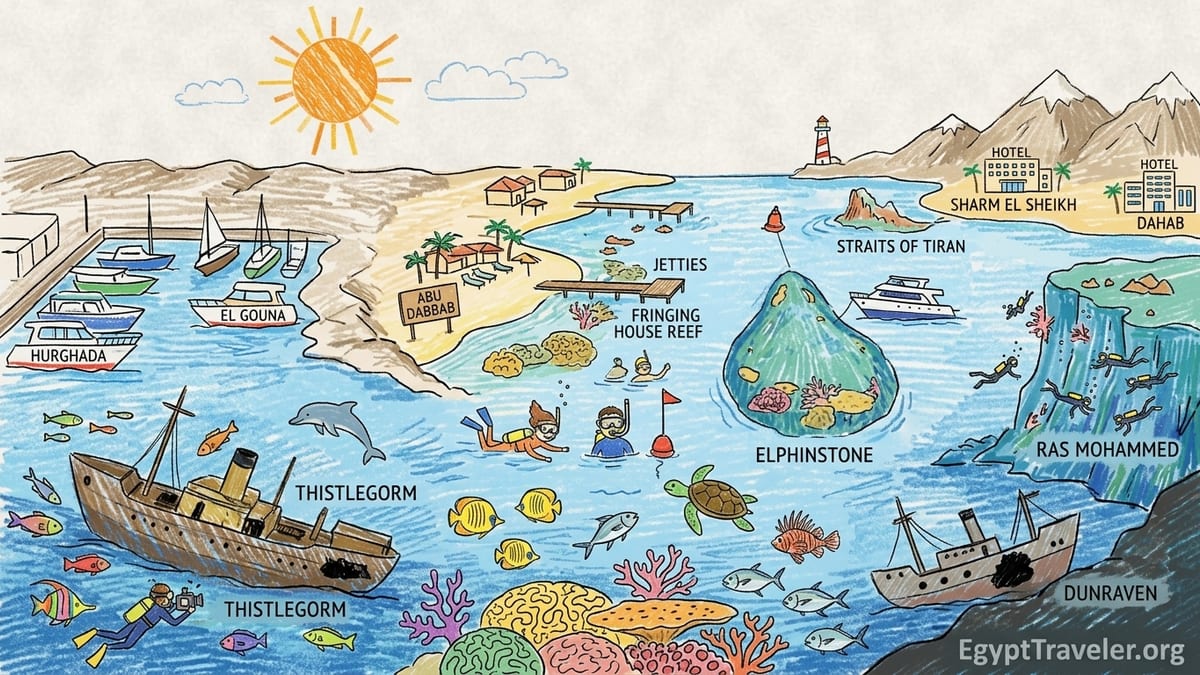
Understanding Egypt’s Red Sea Underwater Regions
Egypt’s Red Sea coast can be thought of in three broad regions for diving and snorkeling. In the north, the Gulf of Suez and the area off Hurghada and El Gouna mix fringing reefs, shallow coral gardens and famous wrecks such as the World War II freighter SS Thistlegorm, which lies at roughly 16 to 30 metres, reachable as a long day trip or on a liveaboard. To the south, between El Quseir and Marsa Alam, the shore turns into a string of bays and small resorts backed by extensive house reefs and offshore pinnacles like Elphinstone, a tear‑drop shaped reef that rises from deep water to just below the surface. Across the water in Sinai, Sharm el Sheikh and Dahab front some of the region’s most famous national park reef walls, including Ras Mohammed at the tip of the peninsula and the Straits of Tiran at the mouth of the Gulf of Aqaba.
Water temperatures in most popular areas usually sit around 22 to 24 degrees Celsius in winter and 27 to 29 degrees in summer, so standard 5 mm wetsuits work for most divers, with some preferring a thinner suit in August and September. Visibility often exceeds 20 metres, with clearer water on offshore reefs such as Fury Shoals or Daedalus, which lies about 90 kilometres offshore in the central Red Sea. Conditions are generally forgiving for beginners on leeward house reefs in Hurghada, El Gouna or Marsa Alam, while exposed offshore walls in the Brothers, Daedalus, Elphinstone triangle or the Straits of Tiran can bring strong currents, downwellings and choppier surface conditions more suitable for confident, experienced divers.
Travel logistics vary between regions and influence what kind of underwater days you will have. In Hurghada and Sharm, bustling marinas send out dozens of day boats each morning, typically returning after two or three dives. In Marsa Alam and quieter stretches such as El Quseir, shore‑based resorts often focus on unlimited house reef diving mixed with RIB shuttles to nearby reefs and occasional full‑day trips to marquee sites like Elphinstone or Fury Shoals. Dahab on the Gulf of Aqaba is unusual in that many of its most famous dive sites are true shore entries, reached by pickup truck and entered directly from rocky beaches, which lets divers skip long boat days entirely.
For planning, it helps to match your experience and goals to the right combination of region and format. First‑time snorkelers and Open Water students often gravitate toward Hurghada, El Gouna and the Marsa Alam house reef resorts, where shallow coral lies close to shore and daily conditions are relatively predictable. Divers who prioritise wrecks usually look to northern itineraries based around Hurghada or Sharm, which include Abu Nuhas, the Dunraven and SS Thistlegorm. Those chasing dramatic reef walls, blue water and more remote coral prefer southern liveaboards that reach Elphinstone, Fury Shoals and sometimes Daedalus, or Sinai itineraries focusing on Ras Mohammed and Tiran.
Easy House Reefs and Beginner Snorkeling Experiences
For travelers who want to float over coral straight from their hotel jetty, Egypt’s Red Sea delivers particularly well around Hurghada, El Gouna and the Marsa Alam region. Many mid‑range and upscale resorts in Hurghada advertise private jetties that reach across the tidal flat to drop‑offs festooned with hard coral heads and small fish, giving confident swimmers direct access to shallow gardens in five to eight metres of water. Several Hurghada hotels also partner with in‑house dive centres that station snorkel guides on the jetty during busy periods to brief guests on currents and safe entry and exit routes, which can be invaluable for first‑timers unused to waves and boat traffic.
Further south, Marsa Alam and the bays between Port Ghalib and Wadi Lahami are often described by returning divers as shore‑diving country. Resorts such as those around Marsa Shagra, Marsa Nakari and Abu Dabbab are built around gently sloping house reefs accessible from the beach or via short zodiac rides, with extensive coral tables and sandy patches ideal for both snorkelers and novice divers. Regular visitors note that areas like Abu Dabbab are praised for calm, protected conditions with little to no current on many days, which helps new snorkelers relax and focus on basic skills like breathing through a snorkel, clearing a mask and staying horizontal at the surface without kicking coral.
On the Sinai side, Nabq Bay and some sheltered stretches north of Sharm el Sheikh host shallow lagoons where hotel jetties open onto patch reefs in waist‑ to chest‑deep water. These areas see significant day‑boat traffic farther offshore, but the house reef sections remain accessible to new snorkelers accompanied by guides from on‑site centres. Dahab’s central Lighthouse and Mashraba area also serve as de facto beginner zones, with easy shore entries over sandy slopes before reaching coral blocks that start at three to five metres, giving new snorkelers room to retreat shallower if they feel uneasy.
Prices for introductory underwater experiences are relatively competitive across the main hubs. In Hurghada, for example, recent price lists from established dive centres show try‑dive or Discover Scuba sessions on a boat day commonly around 35 to 60 euros for one or two shallow, heavily supervised dives, including basic equipment. Guided snorkel boat trips, including hotel transfers, lunch and equipment, often fall in a similar band to a two‑dive day, roughly 55 to 75 US dollars per person as of 2026, depending on the operator and whether marine park fees are included. Travelers should confirm in advance exactly what is in the package and whether life jackets, shorty wetsuits and prescription masks are available for those who need extra comfort.
Reef Walls, Drop‑offs and Classic Boat Diving
Once snorkelers or new divers gain confidence, the natural next step in Egypt is a day on the boat diving or snorkeling fringing reefs and wall sites. From Sharm el Sheikh, boats head daily into Ras Mohammed National Park, where limestone headlands drop into deep blue and current‑swept walls such as Shark Reef and Yolanda Reef are famous for swirling schools of fish and densely covered coral slopes. The Straits of Tiran, reached on full‑day trips or liveaboards, feature four main reefs rising from deep water to just below the surface, Kormoran, Jackson, Woodhouse and Thomas, with plateaus and walls that can accommodate both intermediate and advanced divers depending on the route chosen and current strength.
Hurghada and El Gouna offer similar boat‑diving structures but in slightly more forgiving topography, with many local reefs such as Abu Ramada and Fanadir combining sandy plateaus at 10 to 15 metres with steeper drop‑offs. Visibility in this part of the northern Red Sea is generally very good, and the mix of depths means a boat can host Open Water divers completing training dives on the shallower tier while Advanced Open Water divers and more experienced guests explore deeper walls or drift sections. Typical two‑dive boat days from Hurghada as of 2026 are advertised in the 45 to 80 euro range for certified divers, with rental equipment, lunch and marine park fees either folded into the top end or charged separately at 5 to 15 euros per item or fee.
In the south, reef walls become more dramatic. Elphinstone, lying roughly 12 kilometres offshore from the Marsa Alam coast, rises from deep water to a narrow plateau. Boats from Port Ghalib, Marsa Alam and liveaboards on best‑of routes often schedule early morning dives here, both because conditions are calmer and because it is a natural first deep or drift dive of the day. The reef drops away quickly, so buoyancy control and depth awareness are critical, and many operators in the area recommend Advanced Open Water certification and a minimum number of logged dives before guests attempt Elphinstone, even if it is not always a strict legal requirement.
Farther south again, the Fury Shoals area spreads across a chain of reefs near the Sudanese border that combine sheltered coral gardens, labyrinthine swim‑throughs at sites like Sha’ab Claudia and more exposed outer walls. Liveaboards based from Marsa Alam or Port Ghalib frequently incorporate Fury Shoals into southern itineraries, sometimes pairing it with St John’s reefs. Shore‑based operators in Wadi Lahami and similar remote camps run high‑powered RIBs daily to individual Fury Shoals reefs, giving experienced snorkelers and divers access to some of the region’s most intricate hard coral structures without committing to a full week on a liveaboard.
Wreck Diving Highlights and Depth Considerations
Egypt’s Red Sea owes a significant part of its international reputation to wreck diving. For many visiting divers, the SS Thistlegorm, a British merchant ship sunk in 1941, is the main draw. The wreck lies upright at depths from roughly 16 metres at the shallower superstructure to around 30 metres at the deeper sections of the hull and cargo holds. It is reached on long day trips from Sharm el Sheikh or Hurghada or more comfortably on northern liveaboard itineraries that also include other wrecks like the Dunraven and the Abu Nuhas group. Because of Thistlegorm’s depth, frequent strong currents and the potential for overhead penetration, local regulations and operator policies now typically require divers to hold at least Advanced Open Water certification and to have around 20 or more logged dives before they are allowed on the site, with some boats insisting on a recent deep dive.
Around Hurghada and El Gouna, wrecks such as the Giannis D, Carnatic and Chrisoula K at Abu Nuhas cater to a range of experience levels. Some lie in around 15 to 25 metres of water, accessible to newly minted Advanced divers who remain outside or make only very short excursions into large, well‑lit sections. Others feature more complex penetration routes and stronger currents that demand greater familiarity with trim, gas management and wreck procedures. Dive guides in the region often split groups according to comfort and qualification, with introductory wreck tours staying on the outside and experienced wreck divers exploring interior passageways in small teams using reels, redundant lights and, in some cases, twinsets or sidemount configurations.
In Sinai, the Dunraven near Ras Mohammed offers a classic first wreck for many Sharm visitors. Resting inverted on a slope with depths from about 15 to 30 metres, it is often dived as a second or third dive of the day after a deeper wall. The site allows straightforward swim‑throughs of the hull that give divers a taste of overhead environments while still providing large exits and ambient light. Farther north in the Gulf of Aqaba, some operators in Dahab offer day trips to the wreck of the Million Hope, alongside the more famous Blue Hole and Canyon sites, though these often skew to more experienced divers and technical training.
Regardless of the specific wreck, depth and overhead considerations in the Red Sea call for realistic appraisal of skills. Many Egyptian operators now expect visiting divers to carry their own dive computers and to follow computer‑based depth and time limits rather than simple tables, especially on multi‑day packages and liveaboards where repetitive deep dives accumulate nitrogen quickly. Redundant lights are considered mandatory on night dives and any penetration, and several boats rent or include them as part of their wreck packages. Travelers should ask in advance how many guides will be in the water, how large groups are on wreck dives and whether they can opt out of penetration and stay on the exterior without pressure from staff or peers.
Shore Diving, Dahab’s Sites and Independent Exploration
Not every visitor to Egypt wants to spend full days on a boat. For those who prefer to enter the water from land, Dahab is the country’s best known shore‑diving hub, with several famous sites accessible directly from the beach or rocky shoreline. The Blue Hole, perhaps the most talked‑about, combines a shallow reef lip and vertical wall and is accompanied by memorials that underline its reputation as a site that demands respect, conservative depth limits and appropriate training, especially for technical divers who venture through the Arch. For recreational visitors, nearby Bells to Blue Hole drift routes and Lighthouse offer more relaxed profiles, with entries managed from shore via designated access points overseen by local dive centres.
South of Dahab, other Aqaba coast sites mix coral gardens and gentle walls with truck‑served shore entries. Dive centres load guests into pickup trucks with benches and tank racks, then drive along the coastal track to shaded beach cafes that serve as staging points. Shore divers walk a few metres across pebbles or sand and descend over sandy slopes that quickly give way to coral heads. This format appeals to independent travelers who enjoy the combination of social local cafes, one‑tank dives and flexible scheduling, and it often proves more economical than two‑ or three‑dive boat days in Sharm or Hurghada, particularly for repeat visitors staying a week or more.
Marsa Alam and the mid‑coast between Hurghada and the town itself provide a different style of shore diving. Many resorts maintain jetties that extend out over the shallow reef flat to house reefs dropping into 10 to 25 metres of water, allowing unguided buddy dives for certified guests after an initial orientation, subject to weather and current conditions. Some operations like those grouped around Marsa Shagra and Marsa Nakari run structured unlimited house‑reef programs, with early morning, late afternoon and night entries possible on the same reef. RIBs extend range to outer pinnacles, but many guests are content to explore the changing light and marine life of the house reef repeatedly, interspersing dives with surface intervals at on‑site cafes or chill‑out tents.
For shore divers, practicalities matter. Reef boots are strongly recommended for walking over hot sand and any broken coral near entries, and many Egyptian operators either rent them or include them in full‑equipment packages. Entry and exit points can be narrow channels cut through reef plate or natural sand tongues, with waves, surge and occasional current, so a detailed briefing and, for the first dive, accompanying guide are worth the modest extra fee. Shore divers who want to rent a car and explore independently should be cautious, as some access tracks require local knowledge, and unaccompanied diving outside recognised operations may be restricted or uninsured.
Liveaboard vs Day Boat vs Shore: Choosing Your Format
One of the defining choices in planning an Egyptian Red Sea trip is whether to dive from day boats, shore or a liveaboard. Day boats are the default in Hurghada, El Gouna and Sharm el Sheikh. They usually depart around 8:00 in the morning, offer two dives with optional third dive or night dive on request, and return by late afternoon. Prices in hubs like Hurghada typically sit between 45 and 80 euros for certified divers for a two‑dive day, excluding or including gear and marine fees depending on the operator. This format suits travelers wanting to mix diving with family activities on land, city evenings or visits to desert and cultural sites.
Shore‑based packages focus more tightly on diving but preserve flexibility about exact sites. In Dahab, for example, divers often book per‑dive or per‑day rates that bundle one or two guided shore dives, equipment and transport between the town and sites. In the Marsa Alam coast resorts, many packages offer a mix of unlimited house‑reef dives plus a set number of guided excursions by zodiac or minibus to nearby bays, with optional upgrades to marquee sites like Elphinstone or Abu Dabbab. This approach is attractive to guests who like the comfort of a resort stay, easier time adjusting non‑diving companions’ schedules and the ability to skip dives if tired without feeling they are wasting a full boat day.
Liveaboards are the most immersive option and provide access to the most remote reefs. Boats ranging from budget to luxury depart from ports such as Hurghada, Port Ghalib and Marsa Alam on one‑week itineraries, usually offering three to four dives per day. Northern routes focus on wrecks and classic reefs such as Abu Nuhas, Ras Mohammed, the Straits of Tiran and sometimes SS Thistlegorm. Southern routes concentrate on Elphinstone, Fury Shoals, St John’s and, on more ambitious itineraries, offshore sites like Daedalus and the Brothers. Many operators recommend divers have at least Advanced certification and 30 or more logged dives for the more challenging southern itineraries, given the potential for current, depth and variable sea conditions, although some beginner‑friendly boats cater to relatively new divers on gentler versions of these routes.
Cost comparisons depend heavily on exchange rates, boat standard and season, but a rough rule is that a week‑long Red Sea liveaboard with three to four dives a day can work out on a per‑dive basis comparable to or slightly cheaper than booking individual day boats, particularly once accommodation and meals are taken into account. However, liveaboards require committing your entire week to the boat schedule, with less ability to step back if you feel tired or want to sightsee on land. Travelers prone to seasickness should also consider that offshore sites such as Daedalus or the Brothers are fully exposed, and boats can experience significant motion at night. In all cases, reading recent reviews, checking safety standards and confirming included extras such as nitrox, rental gear and marine park surcharges is essential.
Certification, Conditions and Responsible Reef Behavior
Certification requirements in Egypt broadly follow international training agency norms but can be influenced by local regulations and operator policies, especially on protected sites. Open Water or equivalent certification is accepted for most local reef dives down to 18 metres, with Advanced Open Water or a recognised deep specialty requested or required once planned depths exceed that range or when multiple deep dives will be made in a day. For emblematic sites like SS Thistlegorm, many operators and some national park rules now insist on Advanced certification and a minimum experience count, reflecting the combination of depth, current and overhead environments.
Conditions can change quickly, particularly on exposed walls and offshore reefs. Even in summer, wind events in the Red Sea can push up short, steep waves and increase current, making negative entries or use of descent lines standard on some dives. Divers who qualified in lakes or quarries should be prepared for backroll or giant stride entries from boats and for maintaining position near mooring lines in current. Guides typically brief routes with an emphasis on staying slightly above the reef, avoiding kicking into the wall and watching no‑decompression limits carefully, especially on repetitive days when three or more dives are planned. Nitrox is widely available on boats and at many shore‑based operations for certified nitrox divers, often for a modest per‑tank surcharge or flat weekly fee.
Reef‑safe behaviour is not optional in Egypt’s high‑profile parks and protected areas. Many operators and national park rangers give explicit briefings on no‑touch policies, fin awareness, anti‑standing rules on coral and the importance of controlling buoyancy before approaching cleaning stations or schooling fish. Some liveaboards and shore‑based eco‑camps provide reef etiquette cards during check‑in and ask divers to sign acknowledgements. Snorkelers receive similar instructions, with strong recommendations to use a short‑blade fin and a snug mask and snorkel set to reduce the temptation to stand up or pull on coral to adjust gear mid‑water. Rash guards or thin wetsuits are suggested over heavy sunscreen use, and when sunscreen is necessary, reef‑friendly formulas are encouraged.
Medical forms and insurance are another practical point. Egypt has increasingly enforced requirements for dive centres to obtain medical declarations before allowing participants into the water, especially on multi‑day courses or trips. While many healthy travelers can complete a standard self‑declaration, those with pre‑existing conditions such as asthma, cardiovascular issues or recent surgeries may be asked to supply a doctor’s clearance letter. Travel insurance that explicitly covers scuba diving to your intended depth and format, including liveaboard stays if planned, is strongly recommended, as boat captains and dive centre managers increasingly ask to see policy confirmations during check‑in for more demanding itineraries.
The Takeaway
Egypt’s Red Sea is not a single uniform destination but a spectrum of underwater experiences that stretch from gentle house‑reef snorkels in front of family resorts to current‑swept reef walls far offshore. The best way to approach it is to be honest about your abilities and what kind of days you enjoy. If your idea of a perfect holiday is an hour of easy snorkeling before breakfast followed by pool time, coffee and perhaps a sunset glass‑bottom boat ride, a hotel with a good house reef around Hurghada, El Gouna or Marsa Alam will serve you well. If you are an Open Water or Advanced diver eager to log two or three dives a day without sacrificing evenings ashore, day boats from Hurghada or Sharm and shore‑based packages in Dahab or Marsa Alam offer a balanced compromise.
For wreck‑focused divers, northern routes from Hurghada or Sharm that include Abu Nuhas, Dunraven and SS Thistlegorm provide some of the world’s most accessible historic wrecks, provided you hold the right certifications and accept that currents and depth make these genuine advanced dives. Reef enthusiasts willing to spend most of a week at sea can choose southern or Sinai‑focused liveaboards that put Elphinstone, Fury Shoals, Ras Mohammed and the Straits of Tiran within easy reach. Across all of these options, the combination of accessible prices, well‑developed operator infrastructure and short flight times from Europe explains why so many divers return to Egypt year after year.
Whatever your path, the fundamentals remain the same. Choose reputable, safety‑conscious dive centres or liveaboard operators, verify your insurance and medical fitness, listen carefully to briefings and treat the reefs as living, fragile structures rather than underwater theme parks. Do this, and Egypt’s Red Sea will reward you with some of the most memorable underwater days you can experience within a relatively short haul of major hubs in Europe, the Middle East and beyond.
FAQ
Q1. Do I need to be a certified diver to enjoy Egypt’s Red Sea?
Many visitors enjoy the Red Sea with only snorkeling skills or through supervised introductory dives. However, to join standard boat dives beyond very shallow sites you will need at least an entry‑level scuba certification such as PADI Open Water or equivalent.
Q2. How much does a typical two‑dive day boat trip cost in 2026?
In major hubs like Hurghada and Sharm el Sheikh, recent price lists show two‑dive day trips for certified divers generally in the range of about 45 to 80 euros per person, with differences depending on whether rental equipment, lunch, transfers and marine park fees are included or charged separately.
Q3. What certification is recommended for SS Thistlegorm, Elphinstone and similar advanced sites?
Most operators require or strongly prefer Advanced Open Water or an equivalent rating, plus a minimum number of logged dives, for deeper and more demanding sites such as SS Thistlegorm, Elphinstone and offshore walls. These dives often involve depths approaching 30 metres, potential current and in some cases overhead environments.
Q4. Is a liveaboard necessary to see Egypt’s best reefs and wrecks?
A liveaboard is not strictly necessary but greatly increases your access to remote sites and allows more dives per day. Wrecks like SS Thistlegorm and reefs such as Fury Shoals and some sections of Daedalus are most comfortably visited by liveaboard, although certain itineraries also run long day trips from Hurghada, Sharm or Marsa Alam.
Q5. Can non‑swimmers or weak swimmers try snorkeling in the Red Sea?
Non‑swimmers can participate in some guided snorkeling programs that provide life jackets, flotation aids and close supervision, especially in sheltered lagoons or from hotel jetties. However, being able to float calmly and kick a short distance is important for safety, so nervous participants should start in shallow water and consider a private guide.
Q6. When is the best time of year to dive or snorkel in Egypt?
Diving and snorkeling take place year‑round, with water temperatures cooler from December to March and warmest from roughly June to September. Many divers favour spring and autumn for a balance of comfortable water and air temperatures, but each season offers good conditions in at least part of the Red Sea.
Q7. What equipment can I rent locally, and what should I bring from home?
Most established dive centres and liveaboards in Egypt rent full sets of scuba gear, including regulators, BCDs, wetsuits, fins and masks, as well as snorkel sets. Many divers still prefer to bring their own mask, computer and sometimes regulators for comfort and familiarity, while renting bulkier items like tanks and BCDs on site.
Q8. Do I need a guide for shore diving in places like Dahab or Marsa Alam?
Local regulations and insurance conditions usually require at least an initial guided orientation dive on new sites, especially on house reefs and more complex shore entries. Experienced buddy teams may be allowed to dive certain house reefs unguided after check‑outs, but shore entries at unstaffed locations should not be attempted without proper local support.
Q9. How can I minimise my impact on Red Sea coral reefs?
You can reduce your impact by refining buoyancy control, avoiding any physical contact with coral or the seabed, using a streamlined fin kick, keeping equipment secured, choosing reef‑friendly sunscreen or wearing a rash guard, and following all instructions from guides and park rangers regarding protected zones and no‑touch policies.
Q10. Is travel and dive insurance really necessary for Red Sea trips?
Comprehensive insurance that covers medical care, evacuation and scuba diving to your planned depths is strongly recommended. Offshore sites, liveaboards and remote shore‑based resorts are a significant distance from major hospitals, and having appropriate coverage provides peace of mind for both minor issues and serious emergencies.