


The Mediterranean coast of Egypt is no longer just a summer escape for Cairo’s weekend crowd. In the last decade it has evolved into a full-scale family playground, with shallow turquoise bays, purpose-built kids’ pools and a growing choice of resorts that understand exactly what parents with younger children actually need: easy logistics, flexible meal plans and rooms big enough for everyone to sleep. This guide looks at the most family-friendly stretches of Mediterranean Egypt and compares real resort options that work particularly well for babies, toddlers and primary-school kids.
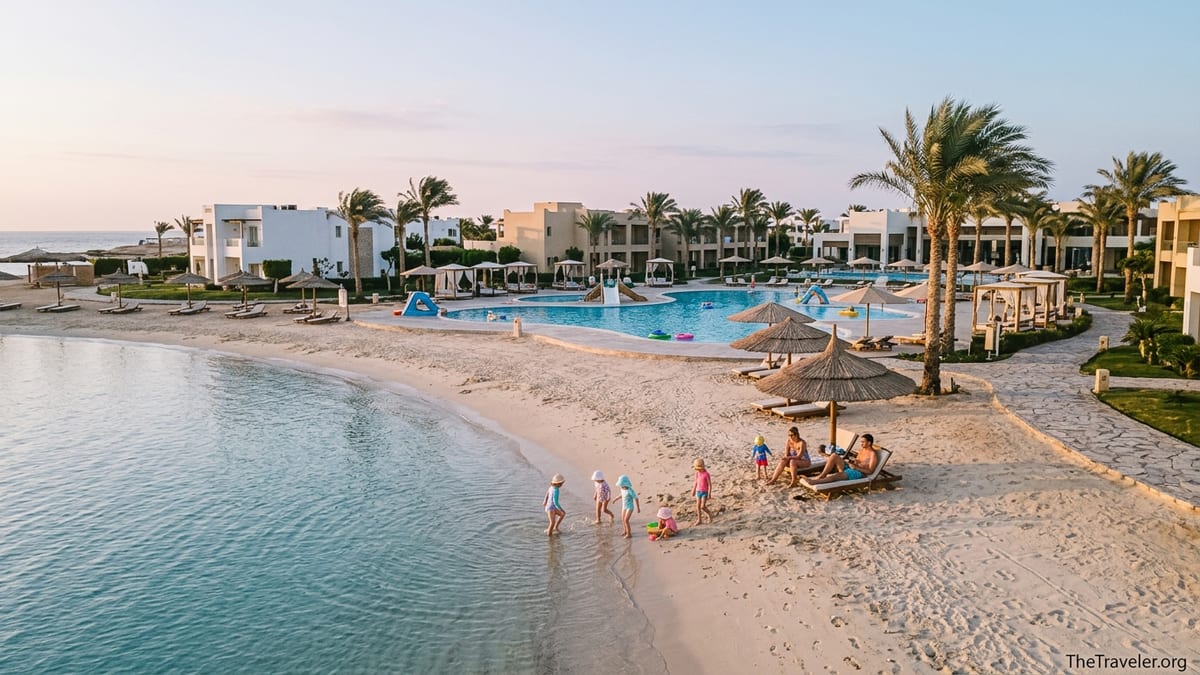
How the Mediterranean Coast of Egypt Works for Families
Egypt’s Mediterranean shoreline runs roughly 1,000 kilometres from Sallum near the Libyan border to Port Said on the edge of the Nile Delta, but most visiting families will focus on a few developed pockets. The main hubs are Alexandria and the nearby “Agamy” beaches, the expanding resorts between El Alamein and New Alamein, and the calmer bays of Marsa Matrouh and Almaza Bay further west. These areas combine soft sand, warm water and a high concentration of resorts where parents can realistically spend an entire week without needing a car.
Compared with the Red Sea, the Mediterranean side has gentler colors and a more classic holiday-town feel. Temperatures in peak summer are usually a few degrees cooler than Hurghada or Sharm, and some beaches here slope more gradually into the sea, which can suit nervous swimmers and toddlers. On the other hand, there is more wind on exposed days and waves can pick up, so the most family-friendly options tend to sit in natural coves where the water is sheltered.
From a practical point of view, the Mediterranean is easiest for families already in Egypt or combining Cairo with a few days at the beach. Drive times from the capital to parts of the North Coast can be around three hours in light traffic. For international visitors, new flights into Borg El Arab near Alexandria and Marsa Matrouh are opening the coast to more direct arrivals, although many long-haul families still route via Cairo, then take a transfer.
Prices are seasonally very sensitive. Mid-July to late August, when Egyptian schools are on holiday, sees rates spike sharply and availability of larger family rooms becomes tight. The shoulder months of June and early July or early September can be more comfortable both for temperatures and budgets, with family-friendly resorts on the Mediterranean often pricing below comparable Red Sea all-inclusive properties at those times.
Best Family Areas: From Alexandria to Almaza Bay
If you are traveling with younger children, the stretch you choose along the coast matters almost as much as the resort itself. Alexandria and the nearby beaches west of the city offer the shortest transfer from Cairo and a mix of simple local hotels and more modern complexes. However, the sandfront here can be narrow in parts and the city atmosphere may feel busy for those seeking a resort bubble. Families who like to mix beach time with museums and street life sometimes base themselves in Alexandria, then do day access to quieter private beaches outside town.
El Alamein and the surrounding North Coast compounds have become the most talked-about “Sahel” destination for domestic families in recent years. Master-planned communities such as Marassi and the emerging New Alamein area combine wide sweeps of pale sand with curated marinas, promenades and multiple hotel brands in one place. Here you can stay in a contemporary hotel, use several different beaches and pick from a cluster of cafes and restaurants without ever leaving the gated area, which many parents appreciate in high season.
Further west, Marsa Matrouh remains a classic domestic summer town but also serves as a gateway to Almaza Bay, a purpose-built resort area set in a calm horseshoe bay. Almaza Bay’s appeal for families lies in its combination of sheltered water and resort infrastructure. A small cluster of hotels sit side by side along a single cove, so you get a resort feel without the vast scale of some Red Sea destinations. For visiting families who want the gentlest sea conditions possible on this coastline, this is often the first place local travel agents mention.
For first-time visitors to Egypt with under-10s, the most straightforward options on the Mediterranean side usually come down to Marassi and neighboring North Coast resorts for those who like modern complexes, or Almaza Bay and Marsa Matrouh for those prioritizing a quiet bay and simple days on the sand.
Shallow-Water Beaches and Calm Bays for Small Kids
Shallow, predictable water is one of the main reasons families look at Mediterranean Egypt. Not every stretch of the coast is ideal for wobbly toddlers, so it helps to know where the geography works in your favor. Almaza Bay, for example, is built on a wide sandy arc where the seabed stays relatively shallow close to shore and the bay faces away from the strongest swells. Parents routinely comment that children can play at the edge of the water while adults remain within a few steps, though smaller kids still need close supervision.
In the North Coast compounds around El Alamein, beach conditions vary by exact location, but many of the better-known resort beaches are designed with families in mind. The marina-side beaches in Marassi are typically protected by breakwaters and jetties that reduce wave action. On a calm day, the water here can feel almost lagoon-like, with a clear gradient from ankle-deep paddling areas to deeper sections for older siblings who want to swim or try simple water sports such as kayaks.
Closer to Alexandria, some family-oriented resorts along the coastal highway offer broad, sandy fronts and designated swim zones where lifeguards mark shallower sections with buoys. Because the coast is more open here, wave conditions change more from day to day than in Almaza Bay, and parents with very young children may feel more comfortable during the early morning or late afternoon when winds tend to drop and the water is gentler.
Parents should note that while photos often show postcard-flat turquoise water, the Mediterranean is still an open sea. Red flags do appear on windy days and families should plan a few non-beach activities such as kids’ pools or indoor playrooms for those times. Choosing a resort that offers good facilities away from the shore becomes a kind of weather insurance, particularly for week-long stays.
Kids’ Clubs, Pools and Aqua Parks: What to Expect
Most mid-range and upscale Mediterranean resorts in Egypt now advertise kids’ clubs or at least indoor play spaces, but their quality and opening hours vary. In North Coast hubs such as Marassi, a number of branded hotels operate supervised clubs for children, sometimes with minimum age requirements around four years old for drop-off activities. Typical programs include crafts, simple games and occasional themed evenings, giving parents a few child-free hours around the pool or marina.
Dedicated kids’ pools are common and often separated from the main pools by a fence or shallow ledge. Depths are usually around half a meter to allow small children to stand. Some North Coast properties promote small aqua play zones or a handful of gentle slides rather than full-scale water parks, which can actually be an advantage for parents who want manageable spaces rather than sprawling attractions. At peak times, lifeguard coverage is fairly visible at larger resorts, though parents should not rely on this as a substitute for their own supervision.
In Almaza Bay, resort pools tend to be laid out close to the beach, which makes it easy to switch between sea and pool depending on conditions. Several hotels in the bay position a kids’ pool alongside the main family accommodation wings so that you can move between your room and the water quickly for naps and shade breaks. For families traveling with babies and toddlers, this proximity can be more valuable than high-drama slides or lazy rivers.
If an aqua park is a priority, some families continue to choose the Red Sea for its very large complexes, but the Mediterranean coast is gradually adding more slide-focused options each season. Before you book, check whether the advertised slides are suitable for younger children and whether height restrictions apply; some resorts’ splash areas are targeted more at pre-teens despite being marketed as “kids’ aqua parks.”
Room Types, Family Suites and How Much Space You Really Get
One of the most practical questions for parents is how to fit everyone into a room without turning bedtime into a nightly negotiation. Many Mediterranean resorts in Egypt officially describe their standard units as “family rooms” simply because they accept two adults and two children on existing beds or a fold-out sofa. The reality is that floor space in these standard rooms can feel tight once a baby cot and stroller are added.
In North Coast hotels aimed at couples and groups of friends, genuine two-bedroom family suites are less common than connected rooms. Connecting configurations usually link two adjacent standard rooms with an internal door, effectively providing four beds and two bathrooms. For a family of four or five, this can be significantly more comfortable, though it may price higher than a dedicated family room category. Some properties allow you to request interconnecting rooms at booking, but will not guarantee them until arrival, so it is worth following up by email directly with the hotel.
Purpose-built family resorts on quieter bays like Almaza generally offer more explicitly labeled “family” room types. These might include master bedrooms with a separate kids’ sleeping area curtained or walled off from the main space, or even small junior bunk rooms set back from the entrance. While the total square meters are often listed on booking engines, photographs and floor plans can be more revealing. Look for pictures that show both the main bed and the extra bedding to judge whether you will still have a bit of floor space for play during the hottest hours of the day.
Price-wise, families can expect significant seasonal swings. In peak August weeks, larger family units on the Mediterranean coast often command a noticeable premium, sometimes rivaling Red Sea all-inclusive rates. If your school calendar allows, the shoulder weeks immediately before or after these peak dates can deliver a better balance of space and cost, especially in areas like Almaza Bay where European charter flights may increase demand on certain weekends.
Meal Plans, All-Inclusive Options and Easy Daily Logistics
Unlike traditional Red Sea destinations that lean heavily into all-inclusive packages, the Mediterranean coast of Egypt offers a broader mix of meal-plan models. In upscale North Coast compounds such as Marassi, room-only or bed-and-breakfast stays are common, with families eating at promenade restaurants or marina cafes. This suits parents who prefer more flexibility and variety, but can also increase overall spend, especially with teenagers or kids who snack throughout the day.
Some North Coast resorts offer half-board, usually breakfast and dinner, which can be a practical compromise for families with predictable routines. You can spend the day at the beach or pool and then return to a relaxed buffet or set menu in the evening without needing to secure restaurant reservations at short notice. Be aware that drinks at dinner, including bottled water and soft drinks, are frequently charged separately, so daily costs may be higher than the room rate suggests.
In more self-contained bays such as Almaza, the range of board options is broader, with several properties offering all-inclusive packages that cover three main meals, snacks and local drinks. For parents who do not want to calculate every ice cream or juice, this can make budgeting easier and can also streamline days with young children who get hungry at unpredictable times. The trade-off is that you will likely eat in the same restaurants most days, though many resorts now rotate themed buffet nights to add variety.
Whichever meal plan you choose, look closely at how child pricing works. Some Mediterranean resorts allow younger children to share existing bedding and dine free up to a certain age, while others count them as paying guests at reduced rates. For larger families or multi-generational groups, this can materially change the total cost of the holiday and is worth confirming directly before you commit, particularly if you are looking at prime summer dates.
Real-World Resort Examples on Egypt’s Mediterranean
To move from theory to reality, it helps to look at how specific resorts on the Mediterranean coast of Egypt are positioning themselves for families. In the North Coast region, several mid-range properties highlight aqua facilities alongside classic beach-resort layouts. Some advertise compact on-site water play areas and supervised kids’ clubs, together with direct access to sandy beachfronts. These resorts tend to attract local families driving up from Cairo for a long weekend as well as international visitors combining a few days by the sea with city touring.
Within the broader El Alamein and Marassi area, a cluster of branded hotels stand out for their access to sheltered beaches, contemporary rooms and walkable family infrastructure. The marinaside setting offers a promenade with cafes and casual dining options that are easy with strollers, plus pedestrian zones where children can burn off energy in the evening without constant traffic worries. For parents who like the idea of a Mediterranean “village” feel with resort convenience, this type of setup can work well.
Over in Almaza Bay near Marsa Matrouh, several beach resorts share one wide bay, effectively creating a low-rise resort village focused on families and couples. Hotels here generally provide dedicated kids’ pools, simple playgrounds and beach clubs that transition smoothly from breakfast to sunset. Because the bay is relatively compact, walking from one end to the other with a stroller is feasible, and older children can easily go back to the room with an adult for a rest while siblings stay at the pool.
Prices across these resorts shift with demand. In high summer, nightly rates for a standard room often sit in the mid-range international bracket, with premiums for sea views and family suites. During shoulder periods outside local school holidays, international visitors can often secure more favorable deals, especially by booking mid-week nights. Travel agents specializing in Egypt frequently package flights, transfers and Mediterranean resort stays together, which may simplify logistics for families flying in from Europe or the Gulf.
Practical Tips for Parents Planning a Sahel or Almaza Stay
When traveling with younger children, the best Mediterranean resort in Egypt is usually the one that removes small frictions from every day. That means thinking about the distance from your room to both the pool and the beach, whether you can easily reach shade without packing up an entire camp, and how simple it is to find child-friendly snacks between formal meal times. Satellite photos and resort maps can be surprisingly revealing in this respect, showing whether buildings are stacked behind long lawns or whether accommodation wings sit close to the shoreline.
Packing for the Mediterranean coast in summer involves planning for intense sun rather than long walks. Many parents bring UV-protective swim shirts, wide-brim hats and basic beach shoes, as the upper layers of sand can get hot underfoot even along the gentler bays. Stroller-friendly paths are more common in newer developments such as Marassi and Almaza Bay, while older seaside areas around Alexandria can involve more steps and uneven pavement. For families with babies, confirming lift access to upper floors ahead of time can save awkward stair carries with sleeping toddlers.
Most resorts on the Mediterranean side of Egypt provide basic cots on request, though supplies can be limited in peak season. If a cot is crucial, ask the hotel to confirm in writing and consider arriving earlier in the day when housekeeping teams are more available to set up. Some parents also travel with compact inflatable toddler beds, particularly if they are unsure how comfortable sofa beds will be. As in many sunny destinations, blackout curtains and quiet air conditioning become key details for successful naps and early nights.
Finally, remember that local school holidays and public holidays can transform the atmosphere of a resort. Weekdays in June may feel mellow and international, while weekends in August may be lively and predominantly domestic. Neither is inherently better, but if you are hoping for quiet afternoons by the pool or easy restaurant reservations with small children, it is worth asking your chosen resort which weeks they expect to be busiest with local families.
The Takeaway
Mediterranean Egypt offers a different flavor of family beach holiday to the Red Sea, with softer light, town-backed beaches and resort communities that increasingly cater to parents traveling with young children. The most family-friendly areas cluster around El Alamein and the North Coast compounds, where sheltered marinas and modern promenades sit behind wide sandy strands, and around Almaza Bay near Marsa Matrouh, where a single calm bay anchors several low-rise resorts.
For families with babies and toddlers, shallow-water access, short walking distances and flexible meal plans tend to matter more than headline water parks or nightlife. Choosing a resort with a genuinely usable kids’ pool, a practical room layout and straightforward dining can turn a Mediterranean stay from a logistical juggling act into a genuinely relaxing break. Because conditions and offerings evolve each season, checking recent guest feedback and confirming details with the hotel directly remains important.
With a bit of planning and realistic expectations about summer crowds and pricing, the Mediterranean coast of Egypt can deliver exactly what many families are seeking: slow mornings by a calm bay, lazy afternoons at the pool and easy evenings where good food, a sea breeze and a short walk back to bed are the biggest items on the agenda.
FAQ
Q1. Is the Mediterranean coast of Egypt suitable for toddlers who cannot swim yet?
The calmer bays such as Almaza Bay and some sheltered North Coast beaches can work well for non-swimmers, thanks to gently sloping sand and designated shallow areas, but close supervision is still essential and parents should always check local flag warnings.
Q2. When is the best time of year to visit with young children?
Many families find June, early July and early September most comfortable, as the weather is warm enough for swimming but not at the absolute peak of heat and crowds that you see in late July and August.
Q3. Do Mediterranean Egypt resorts offer true all-inclusive plans like the Red Sea?
Some resorts, especially in more self-contained bays, do offer all-inclusive packages covering meals and local drinks, but North Coast properties near marinas more often provide bed-and-breakfast or half-board, relying on nearby restaurants for extra dining.
Q4. Are kids’ clubs generally free of charge?
At many mid-range and upscale resorts basic kids’ club access is included for registered guests, though certain activities, evening programs or babysitting-style services may cost extra, so it is worth asking for details in advance.
Q5. How long is the transfer from Cairo to the main Mediterranean resort areas?
In light traffic, driving from Cairo to parts of the North Coast around El Alamein can take around three hours, while reaching Marsa Matrouh or Almaza Bay typically involves a longer road transfer or a domestic flight combined with a shorter drive.
Q6. Can I rely on resort lifeguards for my children’s safety at the beach and pools?
Lifeguards are present at many larger resorts, particularly in kids’ pool areas, but they should be considered an additional safety layer rather than a replacement for parental supervision, especially with younger children.
Q7. What kind of food options are available for picky eaters?
Buffet restaurants at Mediterranean resorts in Egypt usually include familiar staples such as pasta, grilled chicken, rice, potatoes and simple salads, and many can prepare plain dishes on request, though parents of children with allergies should communicate requirements clearly.
Q8. Are strollers practical in Mediterranean resort areas?
Newer developments like Marassi and Almaza Bay are generally designed with flat, paved paths that suit strollers, whereas older seaside districts near Alexandria can have more steps and uneven pavements, so choosing a resort with lift access and smooth walkways helps.
Q9. How far in advance should I book for peak summer dates?
For stays during late July and August, families who need larger rooms or connecting units are usually advised to book several months ahead, as the most practical configurations for children tend to sell first.
Q10. Is it easy to combine a Mediterranean resort stay with sightseeing in Cairo?
Yes, many families spend a few nights in Cairo to visit the pyramids and museums, then transfer by road to the North Coast for four to seven days of beach time, which keeps travel legs manageable for younger children.