


My first all-inclusive stay on Egypt’s Red Sea coast was everything the brochure promised: a lagoon of turquoise water, palm-lined pools, and a colored wristband that supposedly meant I could forget my wallet for a week. It was only after a few days that I realised how much that same wristband also tied me to the resort gates. What I loved about the convenience was real. So were the drawbacks of being cut off from any real town life outside.
Where I Stayed and What “All-Inclusive” Actually Included
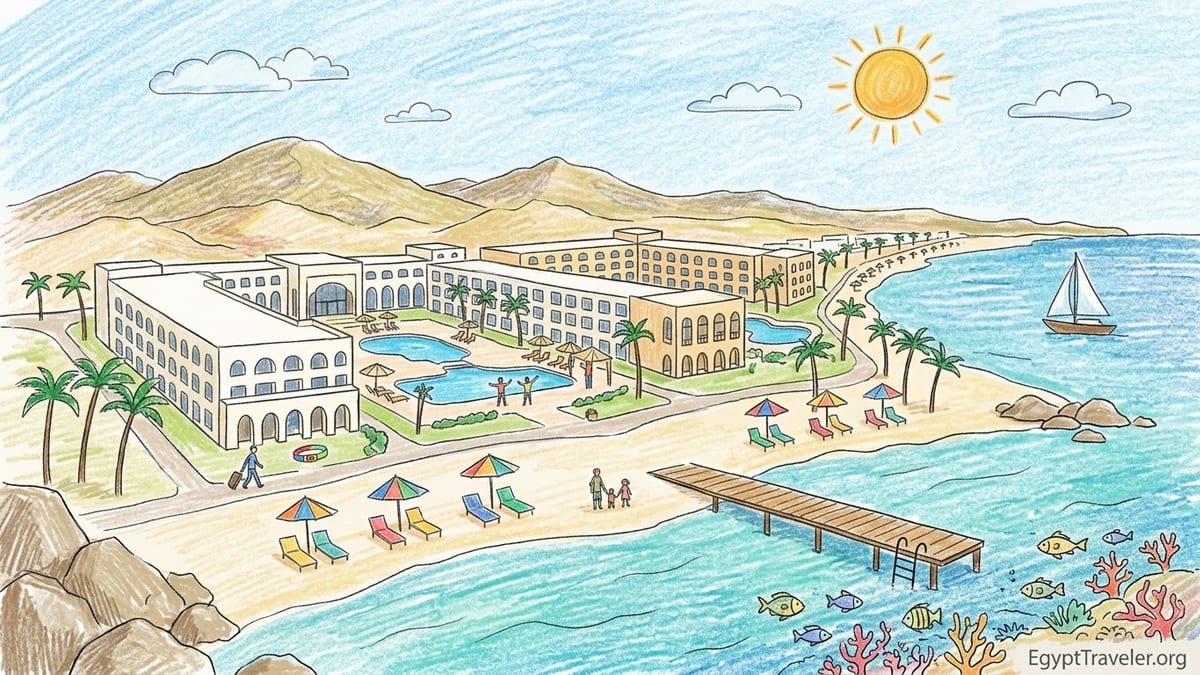
My base was a five-star all-inclusive resort south of Hurghada, of the same mould as large properties in Sahl Hasheesh and Soma Bay. Think long frontage on the Red Sea, several pools, a private beach, and a main building wrapped around a central courtyard. It followed the standard Red Sea model: a colored wristband at check-in, three buffet meals a day, snacks at set times, and local alcohol by the glass at designated bars. Spa treatments, a handful of specialty restaurants, branded imported drinks and excursions all lived in the “extra” column, with prices posted clearly at reception.
The room category matters more than I expected. I booked a mid-range “deluxe sea-view” room rather than the entry-level garden view. In practice, that meant a balcony looking sideways over the bay, a larger bathroom, and a slightly quieter wing away from the main pool. The rate included the main buffet restaurant, a snack bar by the beach, soft drinks, local beer and spirits, evening entertainment and use of the house reef jetty. It did not include à la carte seafood dinners, espresso-based coffees from the lobby bar machine after breakfast hours, or freshly squeezed juices, which were listed at prices comparable to mid-range European cafes.
On paper, it was generous. Breakfast, lunch and dinner operated in fixed windows, typically 07:00 to 10:00, 13:00 to 15:00 and 19:00 to 22:00, very similar to current schedules published by Red Sea resorts from Marsa Alam to Taba Heights. Snacks at the beach bar bridged the gaps with pizza slices, fries and small sandwiches. Alcoholic drinks flowed from late morning until around midnight, which mirrors the inclusions advertised at many Red Sea properties where all-inclusive beverages run roughly from 10:00 to 24:00. Once I had my wristband, I rarely needed to sign anything unless I ordered something clearly marked as premium.
For a family arriving from colder climates in winter, this is precisely the appeal. You step off the transfer bus and everything you absolutely need for a basic holiday is already prepaid: bed, three meals, snacks, basic drinks, a sun lounger, pools for the children and a section of warm, shallow sea. The clarity of what was and was not included removed a lot of anxiety. It is only when you want something beyond that tightly defined bubble that the trade-offs start to show.
Food Quality, Buffets and the “Day Four” Problem
Buffet food at my resort was better than some caricatures of mass all-inclusive dining, but the cracks appeared sooner than I hoped. The first night, the main restaurant felt like a feast. There were several live stations, trays of grilled fish, roast chicken, pasta cooked to order, large salad spreads and a dessert corner that seemed to have every possible cake in miniature. On night one and two, with jet lag and sea air sharpening the appetite, I could have happily declared the food “great” and left it at that.
By day four, repetition set in. The theme nights changed on paper, but the backbone of the buffet stayed almost identical: similar grilled meats, similar rice and potato dishes, the same mini pastries in different arrangements. This is not unique to my resort. Fact sheets from big Hurghada properties list a single main buffet as the core of the all-inclusive package, with specialty restaurants either at extra charge or only once per week. That structure almost guarantees heavy reliance on a single high-capacity kitchen and therefore a fairly stable menu cycle.
The quality itself was decent. I did not get sick and I always found something fresh. There were grilled vegetables, made-to-order omelettes, local bread, and at least one Egyptian dish each night like koshari or grilled kofta. But variety plateaued, and by mid-week I was timing my evenings around the chance to escape to an à la carte venue. At my resort, that meant reserving in advance and sometimes paying a supplement for seafood or imported steak. Other Red Sea properties advertise one free à la carte dinner per stay in Italian or Asian restaurants with advance booking. In practice, those limited slots book quickly, and guests who do not plan ahead end up back at the same buffet line night after night.
This repetition matters more if you are a curious eater. The resort made an effort to sprinkle in “local” touches, but I was very aware that the kitchen was cooking for several hundred people whose default expectation might be chicken nuggets and fries. If you want to wander into a backstreet koshari shop or a family-run fish place on the Corniche, a resort on a self-contained bay several kilometres from town makes that a lot less spontaneous.
Drinks, Beach and the House Reef: The Things All-Inclusive Does Well
Where the resort excelled was precisely where the Red Sea shines: easy access to shallow turquoise water and coral. My stay included free use of the sun loungers and umbrellas on the hotel’s private beach. Towels were issued via a card system, common along the coast, where you swap a plastic token for a beach towel and back again at the end of the day. From my lounger it was a two-minute walk to the waterline and a ten-minute stroll along a wooden jetty to reach swimmable depth beyond the seagrass.
The house reef access was one of the best arguments for staying put. Entry via the jetty ladder dropped me straight over coral heads with bright reef fish and, on one morning, a turtle crossing the sand channel. Masks and snorkels were not included in the package, but rental from the on-site dive center was straightforward, and daily guided snorkeling trips over nearby reefs were on sale alongside scuba courses. For a family that wants safe, supervised access to the underwater world, this system works very well and avoids the need to hire taxis into Hurghada or Sharm to find a local operator.
Drinks, while rarely matching a specialist cocktail bar, were adequate and sometimes better. The all-inclusive covered local beer on tap, local gin, vodka and rum by the glass, and simple mixed drinks. Lobby and pool bars were open from mid-morning until late evening, roughly in line with the 10:00 to midnight windows that many Red Sea resorts publish. Fresh juices, espresso drinks outside breakfast and branded imported spirits were clearly marked as extra. If I stuck to the house list, I never saw a bill.
For parents, this predictability is a major selling point. I watched families order round after round of ice creams and sodas for their children at the pool bar without mentally totting up a bill. Given that equivalent beachfront resorts on Mediterranean islands often charge significantly higher room-only rates before you add meals and drinks, the Red Sea’s value proposition is genuine. A week in a well-reviewed five-star all-inclusive on the Egyptian coast can undercut the cost of a much more modest half-board property in Western Europe, especially outside school holidays, even when you budget extra for a few outings.
Entertainment, Wristbands and the Subtle Pressure to Stay Inside
Evening entertainment followed a familiar pattern across Hurghada, Sahl Hasheesh and Sharm. My resort offered a mini-disco for children, a rotating schedule of shows in the amphitheater, and live music in the lobby on some nights. During the day there were water aerobics, pool games, beach volleyball and quizzes run by the animation team. All of this was technically included in the all-inclusive rate and promoted via noticeboards and announcements. It is lively, sociable and designed so that you never have to look outside for ways to fill your time.
The wristband culture underpins this bubble. On arrival, I was given a colored plastic band that identified my meal plan and allowed me to order drinks and access the beach without any room card checks. Some Red Sea resorts also distinguish between standard and “ultra” all-inclusive by band color if they sell premium tiers. The upside is speed and convenience at bars and towel stations. The downside is that you are clearly marked as “resort guest,” which matters more if you do want to step beyond the gates. Returning from town required passing security who checked bands and bags, a necessary measure for safety but also a mental reminder that you were crossing a boundary.
There was a more subtle pressure to stay inside in how information was presented. The resort had an in-house tour desk and a partner dive center kiosk just off the lobby. Their brochures covered all major activities: boat trips to Giftun Island, desert quad bike safaris, city tours, snorkeling safaris and visits to historical sites further afield. There was almost no information on independent transport into Hurghada or nearby villages, no walking maps, and limited details about local restaurants outside the resort zone. Staff could arrange a taxi into town but quoted fixed prices that were clearly higher than what I later negotiated with a street taxi at the Hurghada marina.
Over the week I met several guests who joked that they had not stepped outside the property since arrival and had no intention of doing so. With everything pre-paid and entertainment laid on from morning to night, it is easy to let the week pass without engaging with anything beyond the manicured grounds. The experience becomes less “Egypt by the Red Sea” and more “international resort that happens to be in Egypt.”
Taxis, Distance and the Real Cost of Being Far from Town
The biggest practical drawback of a remote Red Sea resort is the cost and effort of reaching any real town life. Properties in Soma Bay and Sahl Hasheesh, for example, sit 20 to 30 minutes’ drive from central Hurghada. My resort’s information sheet listed fixed taxi rates to Hurghada Marina and the old town that, converted to foreign currency, worked out noticeably higher than what locals pay for the same distance. Drivers waiting in the hotel car park knew that most guests were all-inclusive visitors unfamiliar with local prices.
I tested both options. Booking through reception gave me a clean, air-conditioned car, a driver who waited in town and a simple room charge, but the round trip cost was high enough that it discouraged casual evening outings just for dinner. Taking a street taxi from town back to the resort after haggling cut the price significantly but required more confidence and acceptance of an older vehicle and less formal arrangement. There was no public transport option visible between the self-contained resort area and Hurghada, a pattern repeated along much of the Red Sea coast where developments are physically separated from existing towns.
This distance affects food and social options. In a city like Hurghada or Sharm el Sheikh’s Naama Bay, you can walk the promenade, look at menus, and decide on a seafood place or a simple grill based on your mood and budget. At a bay-based resort, “going out for dinner” becomes a minor expedition involving taxis and pre-planning. Faced with the choice between a free buffet steps from the room and a taxi ride to a restaurant you have never seen in person, many people understandably shrug and head back to the main dining room.
Excursions are similarly influenced. The resort’s desk sold day trips to Giftun Island, desert safaris and snorkeling cruises at prices aligned with international tour operators. I booked one boat trip through them for the convenience of hotel pick-up and a familiar point of contact, but when I walked around Hurghada Marina later in the week I saw local operators advertising similar itineraries for noticeably less. The catch is that using those independent operators requires actually leaving the resort bubble in the first place.
Tipping, Paid Extras and How “All-Inclusive” It Feels in Practice
Tipping at Red Sea all-inclusive resorts is a subject all its own. Officially, many properties state that a service charge is included in the package price. In reality, resort staff from housekeeping to bartenders often rely heavily on tips, and visitors from countries with strong tipping cultures quickly spread the word that tipping brings faster service and friendlier attention. Guidance from Egyptian-focused travel advisories suggests that while additional tipping is not strictly mandatory, small cash tips in Egyptian pounds to cleaners, waiters and drivers are appreciated and can noticeably improve your experience.
Over my stay, I noticed that not tipping at all felt socially awkward, even though meals and drinks were prepaid. Housekeeping staff who received a small daily tip were more likely to restock complimentary water promptly and create towel art for children. At the bar, guests who tipped in small foreign notes often seemed to have their preferred drinks remembered. None of this was aggressively solicited, but tip jars were visible at several bars despite the all-inclusive model. For some visitors, this undermines the promise of “no wallet, no worries” and introduces an ongoing trickle of extra cost that is hard to track but significant over a week.
Paid extras existed in clearer form too. Spa menus, for example, were entirely outside the all-inclusive package. Massages and treatments were priced closer to international resort levels than local street prices. Motorized water sports such as jet skis, parasailing and banana boat rides were contracted out to independent operators with set tariffs per ten or fifteen minutes. While I was not constantly pressured, there was a steady background of offers: a staff member promoting a special spa package by the pool, a photographer suggesting an evening photo session on the jetty, the excursion desk advertising limited-time offers.
I rarely felt harassed, but the cumulative effect reminded me that the resort is both your temporary home and a sales environment. For travellers who deliberately seek a completely cashless, tip-free experience, this can be a mismatch with expectations. For others, especially those who factor in a realistic amount for tipping and a couple of paid excursions, it may still represent excellent value compared with paying à la carte elsewhere.
The Benefits That Are Hard to Ignore
For all the drawbacks, I came away convinced that Egypt’s all-inclusive Red Sea resorts deliver some very real advantages, particularly for certain types of travellers. Families with young children benefit enormously from food security and routine. Knowing that your child can always find pasta, grilled chicken or plain rice at the buffet reduces stress, especially if they have allergies or are hesitant eaters. Lifeguarded pools, kids’ clubs, shaded playgrounds and pushchair-friendly paths make life easier for parents who simply need a holiday that does not feel like a logistics exercise.
Couples and groups of friends who primarily want to relax in the sun and snorkel also get excellent value. The cost of individual boat trips, meals and beach club access adds up quickly in many parts of the world. On the Red Sea, a resort with a decent house reef lets you duck into the water for twenty minutes of fish-spotting before breakfast without booking anything or boarding a boat. Heated pools in winter, which several high-end Sahl Hasheesh and Soma Bay resorts now advertise, extend the comfortable swimming season well beyond what many European destinations can offer at similar prices.
There is also a safety and simplicity argument. Newer visitors to Egypt sometimes feel anxious about street touts, unfamiliar food or dealing with currency on arrival. A resort buffer gives them space to adjust, learn a few words of Arabic, and perhaps build confidence for simple independent outings later in the week. The controlled environment of a gated resort area, with security checks at entrances and restricted vehicle access, can be reassuring for those worried by headlines or travelling with elderly relatives.
The key point is that these benefits are not imaginary. When I compare my Red Sea stay to the cost of a week in a mid-range European beach town where every ice cream, sunbed and taxi ride would have been paid separately, the Egyptian all-inclusive still comes out ahead by a comfortable margin. The issue is not that the model is inherently bad, but that it easily crowds out the chance to experience anything beyond its own perimeter.
Who Should Go All-Inclusive, Who Shouldn’t, and How I Will Do It Next Time
After a week behind the resort gates, I would absolutely recommend an all-inclusive Red Sea stay for some travellers, with clear caveats for others. If you are travelling with children under about ten, especially on your first trip to Egypt, a decent all-inclusive resort in Hurghada, Sahl Hasheesh, Soma Bay or Sharm can be ideal. You gain predictable meals, safe swimming, entertainment, and you avoid daily decisions about where to eat and how to get there. People who simply want to decompress from stressful jobs, sit in the sun, read and snorkel will also likely be very happy within the resort bubble.
If, however, your primary interest is culture, food and local life, I would not book a full week of classic out-of-town all-inclusive on the Red Sea as your only experience of Egypt. In that case, a breakfast-only or half-board plan in a more walkable place such as Dahab or El Gouna makes more sense. In Dahab, for example, many small hotels and guesthouses line a seafront promenade where you can walk to independent cafes, dive shops and local restaurants in minutes. El Gouna, a purpose-built lagoon town north of Hurghada, at least offers a real marina, town square and network of tuk-tuks and taxis within the development itself, which lets you dine in different venues without long highway drives.
If I were planning a future trip, I would split my time. I would spend three or four nights at a Red Sea all-inclusive with a good house reef and strong family facilities, taking advantage of easy snorkeling, pools and the simplicity of having meals handled. I would then move for at least three nights to an independently walkable base. In my case, that might be Dahab, where I could join shore dives, eat grilled fish at local places along the waterfront, and walk through town in the evening without calling a taxi. Alternatively, El Gouna would offer a softer transition, with more cosmopolitan dining than a pure resort but still a controlled environment.
For some travellers, the reverse split might work better: start in a place like Cairo or Luxor for historical sites and urban life, then finish with four or five nights by the Red Sea to rest. The important thing is not to treat the resort as the only face of Egypt you will see. Thinking deliberately about your priorities before you book, rather than defaulting to the biggest “ultra all-inclusive” package available, will help you find a balance between convenience and connection.
The Takeaway
Staying at an all-inclusive resort on Egypt’s Red Sea showed me both sides of the equation. From inside the gates, it felt wonderfully simple. I woke to sun, walked barefoot to breakfast, spent hours between pool and sea, and never signed a bill for basic food and drink. I snorkelled a coral reef before lunch without leaving the property and watched my fellow guests relax in a way that would have been harder if every decision carried a separate price tag.
Yet the very design that made life so easy also insulated me from much of what I normally travel for. The cost and friction of taxis, the repetition of buffet meals after several days, the reliance on in-house excursion desks, and the subtle social pressure to tip even in an all-inclusive setting all encouraged me to remain in a carefully curated space. I had to work intentionally to see Hurghada’s marina, eat at a local restaurant, and compare the resort version of Egypt with even a small slice of the real thing.
All-inclusive on the Red Sea is not inherently good or bad. It is a tool. Used consciously, it can offer superb value, comfort and ease, particularly for families and those new to the country. Used unthinkingly, it can quietly turn a rich destination into an interchangeable backdrop. My advice is to decide honestly which kind of traveller you are, and then shape your itinerary accordingly, leaving at least a few days for life beyond the wristband.
FAQ
Q1: Are all-inclusive resorts on Egypt’s Red Sea really good value?
Yes, they generally offer strong value compared with equivalent beachfront resorts in many other regions, especially when you factor in three meals a day, basic drinks, pools and beach access. However, you should still budget for extras like tipping, spa treatments and any excursions you book outside the core package.
Q2: What is typically included in a Red Sea all-inclusive package?
Most Red Sea all-inclusive resorts include your room, three buffet meals daily, snacks at set times, soft drinks and local alcoholic drinks by the glass, access to pools, sun loungers and a section of beach, plus daily and evening entertainment. À la carte restaurants, spa services, premium imported drinks and motorized water sports are usually extra.
Q3: How repetitive is the buffet food after several days?
In my experience, the first few days feel abundant, but by day four or five patterns repeat, especially at resorts that rely on a single main buffet. Theme nights add some variation, but core dishes often stay similar. Booking occasional à la carte dinners or planning meals in town can help break the routine if variety is important to you.
Q4: Do I need to tip at an all-inclusive resort in Egypt?
Officially, service charges are often included, but many staff rely on tips, and small cash gratuities are appreciated for housekeeping, bar and restaurant service. You are unlikely to be openly pressured, but tipping in Egyptian pounds tends to bring more attentive service. If you dislike tipping altogether, this is worth considering before you book.
Q5: Are taxis from resorts to towns like Hurghada or Sharm expensive?
Taxi prices quoted through resorts are usually higher than what you might negotiate directly with street taxis in town. Because many resorts are 20 to 30 minutes from real urban centers, even a single evening out can feel costly or complicated. This distance is one of the main reasons guests end up spending their entire stay behind the resort gates.
Q6: Is it easy to snorkel without booking a separate trip?
Yes, that is one of the biggest advantages of Red Sea all-inclusive resorts. Many properties have a house reef accessible via a jetty, so you can snorkel directly from the hotel without booking a boat trip. You may need to rent or bring your own equipment, and guided excursions to outer reefs remain an extra cost.
Q7: Will I miss out on local culture if I stay all-inclusive?
If you spend your entire week inside a remote resort, you will experience limited local culture beyond staged entertainment and interactions with staff. To encounter real town life, markets and independent restaurants, you need to plan time in more walkable places like Dahab or El Gouna, or at least schedule a few evenings out in Hurghada or Sharm el Sheikh.
Q8: Who is best suited to a full all-inclusive stay?
Families with young children, travellers who mainly want sun, sea and rest, and people who feel anxious about independent travel are usually well matched to a full all-inclusive week. The predictability of meals, entertainment and costs makes it easier to relax, and the contained environment can feel reassuring.
Q9: Who should consider breakfast-only rather than all-inclusive?
Travellers focused on food, culture and flexibility should consider breakfast-only or half-board in a more central, walkable area. If you want to try local restaurants, explore evening promenades, or set your own schedule, having fewer meals tied to a specific resort will make it easier and more economical to eat out.
Q10: How would you personally split a future Red Sea trip?
I would spend three or four nights at a Red Sea all-inclusive resort with a good house reef to enjoy hassle-free snorkeling and pool time, then shift for at least three nights to a walkable base such as Dahab or El Gouna. That way I would get both the relaxation and value of the resort and the chance to eat in independent restaurants, stroll through town and experience a bit more of everyday Egyptian life.