


Traveling the Nile Valley by train is one of the most atmospheric ways to move between Luxor, Aswan and the rest of Upper Egypt. The railway runs close to the river for long stretches, linking ancient temple towns with modern cities and offering an overland alternative to the classic Nile cruise. This guide explains how the system really works today: what trains run, how to buy tickets as a foreign visitor, what to expect from each class, how to manage luggage and overnight trips, and how rail compares with sailing the Nile.
Understanding the Nile Valley Rail Corridor
The backbone of rail travel along the Nile is the main Egyptian National Railways line that runs south from Cairo through Beni Suef, Minya and Asyut before reaching Luxor and Aswan in Upper Egypt. For most travelers focused on antiquities, the key stretch is Luxor–Aswan, a journey of about 215 kilometers that typically takes around 3 to 3.5 hours on express day trains and up to 4 hours on slower services. Trains continue northwards to Cairo, where connections link with Alexandria and the Mediterranean coast.
For foreign visitors, the important distinction is between regular seated day trains operated directly by Egyptian National Railways and the separately managed Watania sleeper trains that run overnight between Cairo, Luxor and Aswan. Both use the same tracks through the Nile Valley, but they have different pricing, booking systems and rules for non-Egyptian passengers. In practice, you might combine a Cairo–Luxor overnight sleeper with a daytime Luxor–Aswan seated train, or ride the rails one way and take a cruise the other.
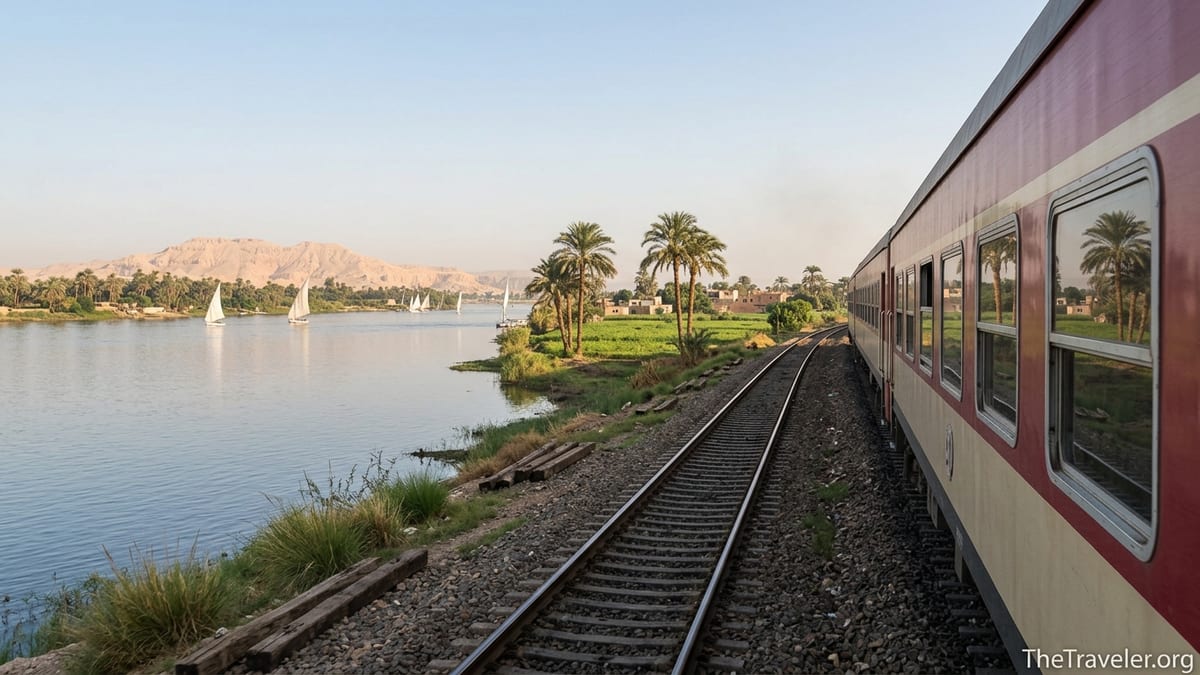
The route itself is not a wilderness scenic railway; much of the journey passes through agricultural land, small Nile-side towns and desert edges. Still, sunrise over sugarcane fields near Esna or late-afternoon light on the cliffs beyond Luxor can be memorable. Shorter hops, such as Luxor to Edfu or Kom Ombo to Aswan, allow you to use the train as a practical shuttle between major temple sites while keeping your feet on solid ground rather than on a ship.
Because schedules and rolling stock change, especially as new air-conditioned trains are introduced, it is wise to treat any timetable you see online as indicative rather than immutable. Use it to understand typical departure windows, then confirm exact times on arrival via station boards, the Egyptian National Railways app or by asking at the ticket counter a day or two before you plan to travel.
Classes, Comfort Levels and What They Actually Feel Like
On the Luxor–Aswan stretch, you will most commonly encounter air-conditioned first-class and second-class seated coaches, plus occasional third-class carriages that are primarily used by local travelers. In practical terms, first class usually means a 2+1 seating layout with more legroom, a quieter atmosphere and, on newer trains, comfortable reclining seats similar to short-haul economy on an airline. Second class is typically 2+2 across, still air-conditioned, and perfectly adequate for a three-hour ride, though seats are a bit narrower and the carriage can feel busier.
On some services, especially newer “VIP” or modern Spanish or Talgo sets, first-class interiors feature individual tray tables, power outlets at many seats and an onboard café trolley selling tea, coffee, soft drinks and snacks. Travelers in 2025 and 2026 have reported paying roughly the equivalent of a few US dollars for simple refreshments, such as a bottle of water, a can of soda or a packet of biscuits. While you should not expect gourmet dining, this is enough to keep you going between Luxor and Aswan, and many passengers also bring their own snacks from a bakery near the station.
Third-class and non-air-conditioned cars exist on some Upper Egypt trains, but foreign tourists rarely choose them. They are crowded, basic and inexpensive, designed for local commuters. If you buy tickets at the station as a visitor and ask for “first class to Aswan,” staff will generally steer you toward an air-conditioned coach on an express train. For a sense of local life or if higher classes are sold out, second class can be a comfortable compromise without feeling rough.
If you are traveling overnight between Cairo and Luxor or Aswan, Watania sleeper trains add another comfort tier altogether. Compartments are configured as either single or double berths, with two facing seats that convert into beds, clean sheets and a door that locks from the inside. Dinner and breakfast are usually included in the fare, served on trays in your compartment. Several recent travelers have described this as basic but filling: grilled chicken or kofta with rice and vegetables in the evening, then bread, cheese and jam with tea or coffee in the morning.
Buying Tickets: Stations, Apps and Agencies
Ticketing is where many Nile Valley train journeys become confusing. Egyptian National Railways has an official website and smartphone app that allow online booking of most air-conditioned trains. However, at the time of writing, these platforms are primarily designed for Egyptian ID holders and often reject foreign passport numbers or foreign-issued payment cards. The system may show options like “First AC” and “Second AC” for trains between Luxor and Aswan, but visitors frequently encounter error messages when they try to complete the purchase.
Because of this, many non-Egyptian travelers either buy tickets in person at the station or use international booking intermediaries. At Luxor station, there is a staffed ticket window where you can usually buy first- or second-class tickets to Aswan on the same day or a day in advance, except during major Egyptian holidays such as Eid when demand spikes. Travel agents and tour operators in Luxor’s East Bank hotel district also routinely book train tickets for their clients, adding a service fee that can be worthwhile if you prefer not to navigate queues and language barriers.
For those who want to secure seats before arriving in Egypt, several global online ticket platforms resell Egyptian train tickets to foreigners. These sites typically charge a noticeable mark-up over the local price but accept major international credit cards and e-mail you e-tickets or vouchers that you exchange at the station. For example, travelers in 2025 reported paying the equivalent of around 20 to 30 US dollars for a first-class Luxor–Aswan ticket sold via such platforms, slightly above the counter fare but still cheaper than a domestic flight.
Sleeper train tickets between Cairo and Luxor or Aswan are sold separately by Watania, the private company operating the service in cooperation with the railways. You can book online through Watania’s website or through an agent, or buy in person at dedicated sleeper train offices in Cairo and at major Upper Egypt stations. A typical recent price pattern has been in the range of about 80 to 120 US dollars per person in a twin cabin from Cairo to Luxor or Aswan, depending on season and whether you choose shared or single occupancy. As with day trains, booking a few days ahead is recommended, especially in peak winter months.
Key Stations in Luxor, Aswan and Along the Nile
Luxor railway station sits conveniently close to the city center on the East Bank of the Nile, roughly a five to ten minute walk from Luxor Temple and the Corniche where many mid-range hotels and tour offices cluster. The station itself is modest but busy, with separate areas for ticket sales and waiting, basic shops selling drinks and snacks, and informal porters who can help with luggage for a small tip. Taxis and rideshare drivers often wait just outside; agree a fare before you get in, as meters are not the norm.
Aswan station is also central, a short distance inland from the Nile Corniche and near many budget and mid-range hotels used by independent travelers. Its layout is straightforward: a main hall with ticket counters, kiosks and seating, and platforms reached at grade. Outside, you will find yellow city taxis, microbuses and sometimes hotel representatives meeting incoming trains. Nubian guesthouses on the islands upstream usually arrange private transfers from the station as part of their room rates or for a set fee.
Between Luxor and Aswan, smaller stations like Edfu and Kom Ombo serve as gateways to major temples but have more limited facilities. It is common for independent travelers to base themselves in Luxor or Aswan and visit these temples on day trips by road rather than by train, as coordinating local transport from the stations can be time-consuming. Still, if you are determined to arrive by rail, stations at these stops generally have basic ticket offices, waiting areas and vendors offering tea, coffee and packaged snacks.
In Cairo, it is important to know which station your Upper Egypt train uses. Traditional long-distance trains to Luxor and Aswan have historically departed from Ramses Station in central Cairo, connected to the metro network. In recent years, however, a new Upper Egypt station in the Bashteel district of Giza has taken over many southbound departures, especially for sleeper services. If your ticket lists “Upper Egypt Station” or “Bashteel,” factor in extra time and a taxi or ride-hail from downtown to reach it, as it sits several kilometers west of the historic city center.
Luggage, Security and Onboard Practicalities
For most travelers, luggage on Nile Valley trains is straightforward. There is no formal checked baggage system on regular day trains between Luxor and Aswan, so you keep your own bags with you, either placed on overhead racks or in the space between facing seats. A typical backpack or medium suitcase fits easily; very large cases can be more awkward but are still common, particularly for visitors coming directly from international flights. Aim to travel with baggage you can lift yourself up a short set of steps and along a carriage aisle.
Security checks are routine at major stations. When entering Luxor, Aswan or Cairo stations, you can expect to pass bags through an X-ray machine and walk through a metal detector gate, similar to airport-style screening but usually faster. On platforms, uniformed police and railway staff are visible, and other passengers are generally ready to help if you appear confused about your carriage or seat. As in any crowded transport hub, keep valuables close: a money belt or cross-body bag under your clothing is more secure than leaving items in an outer pocket or on a seat while you stretch your legs.
Onboard, toilets range from basic to acceptable, depending on the age of the train. Bring your own tissue, hand sanitizer and, if you are sensitive, a small bottle of soap. Trains do not usually offer Wi-Fi, so download maps, e-books and entertainment beforehand. Mobile signal is intermittent but often good enough near larger towns for messaging apps to work.
Food and drink are another practical consideration. On some express trains, a trolley sells hot drinks and snacks. On others, especially older sets, there may be no official catering at all. Many travelers pick up items from bakeries or small supermarkets near the station: flatbread sandwiches, falafel, fruit, water and soft drinks are widely available and inexpensive. Alcohol is not sold on board, and public consumption on trains is not common; if you carry alcohol, keep it discrete and respect local norms.
Overnight Services: Cairo to Luxor and Aswan by Sleeper
The classic overnight journey between Cairo and Upper Egypt is on the Watania sleeper train, which serves both Luxor and Aswan on its route. Typical departure times from Cairo are in the early evening, around 8 to 9.30 pm, with arrival in Luxor before dawn and in Aswan later in the morning. The reverse services leave Aswan in the late afternoon or evening and arrive in Cairo the following morning. Exact train numbers and times shift periodically, so confirm your schedule when booking.
Cabins on Watania trains are arranged along a narrow corridor, with single and double compartments opening off it. Each compartment has a large window, lockable door, sink with running water, fold-out table and two bunk-style beds that attendants convert from seats after departure. Bedding is clean if simple: a sheet, blanket and pillow per passenger. The atmosphere is closer to a classic European overnight train than to a luxury “Orient Express” experience, but for many travelers this is part of the charm.
The fare usually includes dinner shortly after departure and breakfast before arrival. In practical terms, dinner might consist of grilled chicken, rice, vegetables and a bread roll, served on a metal tray with juice or water. Breakfast is lighter: bread, processed cheese, jam, a boiled egg and hot tea or instant coffee. Portions are sufficient, though some passengers bring extra snacks such as fruit or chocolate. Alcohol is generally not served, and smoking is restricted to specific vestibule areas between carriages.
Sleeper trains are popular with tour groups as well as independent travelers, especially during the cooler months from October to March when many itineraries combine Cairo, Luxor and Aswan in quick succession. As a result, cabins can sell out days or weeks ahead around Christmas, New Year and key European and North American school holidays. If the sleeper is full on your dates, consider flying one leg of your trip or breaking the journey with a daytime train from Cairo to Luxor followed by an overnight stay, then a separate Luxor–Aswan train the next day.
Train vs Nile Cruise: How to Choose
For anyone planning a classic Egypt itinerary, the biggest question is often whether to travel between Luxor and Aswan by train or Nile cruise. Cruises typically run three or four nights, sailing between the two cities with stops at Edfu, Kom Ombo and sometimes Esna, and include full-board meals plus a sun deck with small pool. Prices vary widely, from budget-friendly vessels aimed at domestic tourists to high-end boats used by international tour operators. In contrast, the train makes the journey in a few hours and costs a fraction of even the cheapest cruise.
If your priority is flexibility and independent sightseeing, the train can be the better option. A first-class ticket from Luxor to Aswan often costs roughly what you might spend on a single lunch in a mid-range hotel, and you can decide to travel in the morning and still have much of the afternoon to explore Aswan’s souq or take a motorboat to Philae Temple. You also avoid the structured schedule of cruise excursions, which typically herd passengers to temples in groups at set times.
On the other hand, a Nile cruise offers something the train cannot: long, unhurried hours on deck watching the landscape drift by. Between Luxor and Aswan, many stretches of river retain a timeless feel, with farmers working date groves, children swimming and feluccas sailing under late-afternoon light. For some travelers, this slow, immersive experience is worth the higher cost and the relative lack of spontaneity; they are happy to let the boat dictate their daily rhythm.
A hybrid approach is increasingly common. For example, you might take the sleeper train from Cairo to Luxor, spend several days exploring temples and the West Bank sites, then board a cruise from Luxor to Aswan. After disembarking in Aswan and visiting Abu Simbel on a day trip, you could return north to Luxor or Cairo by day train. This arrangement gives you at least one long stretch on the river while still experiencing Egypt’s rail system and avoiding backtracking by boat.
Practical Itineraries and Realistic Timing
To see how all of this plays out on the ground, imagine a typical ten-day Upper Egypt itinerary starting and ending in Cairo. You might arrive in Cairo, spend two nights exploring the pyramids and the Egyptian Museum, then board a Watania sleeper train in the evening for Luxor. You would wake up near dawn, step off the train within walking distance of Luxor Temple, and check into a hotel on the East Bank for three nights, using taxis and organized tours to visit Karnak, the Valley of the Kings and Hatshepsut’s temple.
From Luxor, you could take a mid-morning first-class day train to Aswan, arriving around early afternoon. After checking into a riverside hotel or a Nubian guesthouse on one of the islands, you would have two or three nights to explore the High Dam area, Philae, the Nubian Museum and traditional villages. One full day could be devoted to a very early morning road trip or flight to Abu Simbel, returning by late afternoon.
On the final leg, you might choose to return to Cairo by air to save time, or take another overnight sleeper from Aswan. In peak season, many tour companies block-book sleeper cabins, so it is wise to secure your return rail ticket early in your trip, either through your hotel concierge, a reputable travel agency or directly at the station. If tickets are sold out, a fall-back plan could be an evening domestic flight from Aswan to Cairo, which typically takes about an hour and is offered several times a week.
Shorter itineraries are possible using only the day trains. For instance, if your main interest is Luxor and Aswan rather than Cairo, you could fly into one city, travel to the other by first-class train, and fly out from there, making use of open-jaw international tickets. This approach is often attractive to repeat visitors who have already seen the capital and want to focus on the Nile Valley monuments while minimizing time spent in transit.
The Takeaway
Traveling the Nile Valley by train is not just a way to get from one temple town to another; it is a window into everyday Egyptian life running parallel to the ancient river. Between Luxor and Aswan, modern air-conditioned trains make the journey efficient and affordable, while overnight sleepers between Cairo and Upper Egypt add a layer of classic rail romance. Understanding how tickets, classes, stations and luggage work in practice turns what could be a confusing system into a manageable and rewarding part of your trip.
When weighing train versus cruise, consider your priorities. If you value flexibility, budget and the freedom to design your own days of sightseeing, rail travel is hard to beat. If your dream is long evenings on deck watching the Nile slip by, a cruise may be the centerpiece, with trains handling the segments you do not want to sail. In many cases, a thoughtful combination of the two gives you the best of both experiences.
Whichever option you choose, build in a margin of time around rail departures and arrive at stations with realistic expectations. Trains can be late, routes can change and ticket systems may feel opaque to visitors. Yet with a bit of patience and preparation, the line between Luxor, Aswan and beyond becomes one of the most memorable journeys in Egypt, connecting not only ancient sites but also the living communities that still line the Nile today.
FAQ
Q1. Can foreign travelers use regular day trains between Luxor and Aswan?
Yes. Foreign visitors can usually buy first- or second-class tickets for day trains at the station ticket counters or through local agencies, even if online booking platforms aimed at Egyptians do not accept foreign passport numbers or cards.
Q2. How far in advance should I buy Luxor–Aswan train tickets?
Outside major holidays, you can often buy same-day tickets, but purchasing one or two days in advance at the station is safer. Around Christmas, New Year and Eid, trains can sell out, so book as early as your schedule allows.
Q3. Are the trains between Luxor and Aswan safe to ride at night?
Most travelers feel comfortable on evening services, and the route is heavily used by locals. As with any public transport, keep valuables close, avoid flashing expensive items and stay aware of your surroundings at stations and on board.
Q4. What is the typical price of a first-class Luxor–Aswan ticket?
Prices change with time and currency shifts, but in recent seasons a first-class ticket has generally cost the equivalent of a modest restaurant meal, often in the range of tens rather than hundreds of US dollars when bought locally.
Q5. Do sleeper trains stop in both Luxor and Aswan?
Yes. Cairo–Upper Egypt sleeper trains normally stop in Luxor in the early morning and continue to Aswan, arriving later in the morning. When booking, you choose either Cairo–Luxor, Cairo–Aswan or the reverse, depending on your itinerary.
Q6. Can I bring large suitcases on the train?
Yes. There is no strict checked baggage system on most services, so you keep your suitcases with you on racks or by your seat. Aim to travel with bags you can lift yourself up a short flight of steps and along the carriage aisle.
Q7. Is it better to go from Luxor to Aswan by train or Nile cruise?
Trains are faster, cheaper and more flexible, ideal if you want to control your schedule. Cruises are slower and more expensive but offer days of relaxed river scenery and include meals, making them attractive if you prefer an all-in-one package.
Q8. Do trains have Wi-Fi or power outlets?
Some newer first-class carriages and premium services have power outlets, but Wi-Fi is rarely available. Plan to rely on mobile data when there is coverage and bring a power bank if you need to keep devices charged.
Q9. How do I know which Cairo station my Upper Egypt train uses?
Check your ticket or booking confirmation. Traditional trains often use central Ramses Station, while many sleeper and long-distance services now depart from the newer Upper Egypt station in the Bashteel district of Giza. Allow extra time to reach the correct departure point.
Q10. Are there discounts for children or groups on Nile Valley trains?
Official policies change, but reduced fares for young children are common, especially on sleeper trains where small children sharing a parent’s berth may pay less. Group discounts are usually arranged through tour operators rather than at the public ticket window.