


The classic Nile cruise between Luxor and Aswan is one of the great river journeys of the world. Most travelers quickly discover there is not just one “Nile cruise,” but two main directions: Luxor to Aswan and Aswan to Luxor, usually over 3 or 4 nights. The temples are the same either way, yet direction has a big impact on your schedule, domestic flights, how Abu Simbel fits in, and how your wider Egypt itinerary flows. This guide breaks down the real-world pros and cons of each direction so you can match the cruise to your dates, budget and travel style.
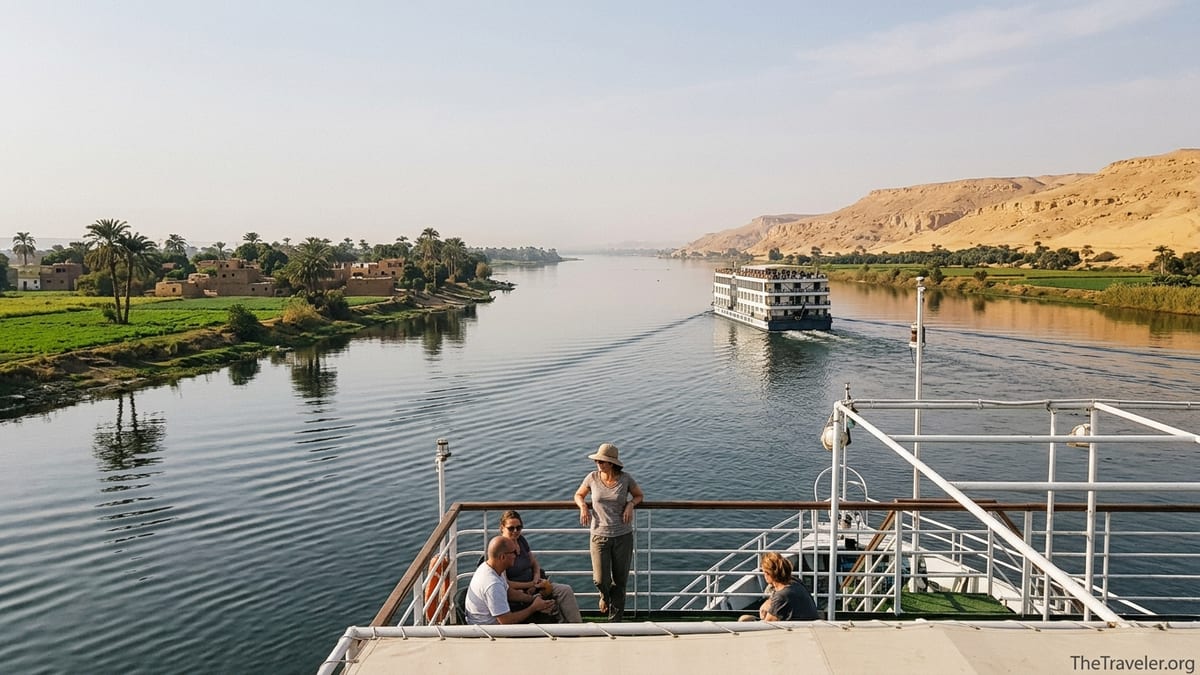
How Nile Cruise Directions and Durations Actually Work
Most mainstream Nile cruises run between Luxor and Aswan over 3 or 4 nights, with a handful of 7-night options that simply stitch two shorter sailings together. In practice, 4-night cruises most often sail Luxor to Aswan over 5 calendar days, while 3-night cruises more commonly sail Aswan to Luxor over 4 days. This pattern appears across many lines and boats, from affordable 4-star ships to boutique vessels and high-end brands.
For example, several widely sold 4-night itineraries start in Luxor on a Saturday or Monday, include a full West Bank day, visit Edfu and Kom Ombo on separate mornings, and arrive in Aswan on Day 4 with disembarkation on Day 5. By contrast, many 3-night programs board in Aswan midweek, visit Philae and Kom Ombo, then Edfu and onward to Luxor, disembarking on the fourth morning. The route is technically the same, but the pace and the way days are arranged differ.
Because boats do not usually depart every day, the direction you choose is often tied to which sailing actually matches your dates. A traveler landing in Cairo on a Wednesday, for instance, might find that flying to Aswan Thursday and joining a Friday 3-night Aswan to Luxor cruise fits far better than waiting until Saturday for the next 4-night Luxor departure. Direction is therefore partly a logistical choice and partly about travel style, which the rest of this article explores in detail.
Sightseeing Order: How Each Direction Feels on the Ground
Every standard Nile cruise covers the same core sites: on the Luxor side, Karnak, Luxor Temple and the West Bank tombs and temples; on the river, Edfu and Kom Ombo; and in Aswan, Philae Temple and the High Dam, often with optional felucca sails and village visits. The difference is the order in which you see them, and that has a surprisingly big impact on how the trip feels.
On a typical Luxor to Aswan 4-night cruise, you usually start with the heaviest sightseeing first. Day 1 is often Karnak and Luxor Temple, sometimes with an evening sound-and-light show. Day 2 tends to be a full West Bank day including the Valley of the Kings, Hatshepsut’s temple and the Colossi of Memnon. Only after this intense start do you sail toward Edfu and Kom Ombo, arriving in Aswan where the rhythm slows and you spend your last day exploring Philae and drifting on the river by felucca.
On an Aswan to Luxor cruise, the arc is reversed. Many travelers begin gently in Aswan, taking in Philae Temple and the granite quarries, perhaps adding a Nubian village visit. The ship then sails north via Kom Ombo and Edfu before finishing with Luxor’s headline sights. Travelers often report that this “saving the biggest for last” structure feels rewarding, especially if they have been building anticipation for the Valley of the Kings throughout their Egypt journey.
If you are worried about early start times in the heat, note that both directions rely on pre-dawn or early morning departures for some visits, especially West Bank tombs and Edfu by carriage. Luxor to Aswan simply front-loads more of the intensive touring, whereas Aswan to Luxor lets you warm up with lighter days before the big finale.
Weekly Schedules, Domestic Flights and Connection Logic
In reality, most travelers do not choose direction in a vacuum. They are trying to match a Cairo arrival, a return flight home, or fixed dates for work and school holidays. The three key moving parts are cruise departure days, domestic flights, and whether you want independent time in Luxor or Aswan before or after sailing.
Many ships follow a weekly rhythm. Four-night sailings from Luxor often start on Saturdays or Mondays, while three-night sailings from Aswan frequently begin on Wednesdays or Fridays. Actual days vary by boat, but if you look at several examples side by side, the pattern is consistent enough that travel planners use it as a starting template. If you only have a narrow window in Upper Egypt, this pattern tends to push you toward whichever direction aligns with your specific dates.
Domestic air connections also play a role. Cairo has frequent flights to both Luxor and Aswan on national and private carriers, but schedules change seasonally and are often more limited in the middle of the day. A common approach for a 9 or 10 day Egypt trip is to spend 2 or 3 nights in Cairo, then fly to Luxor to board a 4-night Luxor to Aswan cruise, and finally fly back to Cairo from Aswan. Others prefer to fly Cairo to Aswan first, spend a night or two and visit Abu Simbel by road or air, then board a 3-night Aswan to Luxor cruise and exit via Luxor airport.
Direction can also affect how much “dead time” you accumulate. For instance, a traveler arriving in Cairo late on a Monday night with exactly one week in Egypt might find that Tuesday flights line up well with an Aswan embarkation on Wednesday, but would require two spare nights in Luxor before the next workable Luxor departure. In that case, Aswan to Luxor simply avoids wasting a day or paying for extra hotels.
Abu Simbel and How Direction Shapes Your Plan
Abu Simbel is the single biggest side trip linked to Nile cruises, and it is much easier to integrate from Aswan than from Luxor. The famous rock-cut temples lie far to the south near the Sudanese border, and standard day trips from Aswan follow an early morning road convoy or short domestic flight. Because almost all visitors start from Aswan, direction makes a major difference if Abu Simbel is a priority.
For many travelers, the most efficient pattern is to fly from Cairo to Aswan, spend a day or two based there, take the Abu Simbel excursion by road or air, and then board an Aswan to Luxor cruise. This sequence means you are not trying to combine a long Abu Simbel day with same-day embarkation, and you can recover on the boat as it sails north. Travelers who have done this often describe enjoying a relaxed first afternoon on board after returning from the temples, rather than rushing downstream from Luxor beforehand.
By contrast, if you choose a Luxor to Aswan direction and still want Abu Simbel, you typically disembark in Aswan and either take a very early road convoy the next morning or fly out for a day trip. That works well if you can spare an extra night in Aswan at the end. Some itineraries even place Abu Simbel after the cruise, followed by a domestic flight back to Cairo or another stop within Egypt. The key point is that Abu Simbel sits naturally on the Aswan “side” of the puzzle, so an Aswan to Luxor cruise meshes better when the temples are non-negotiable.
There are exceptions. A traveler on a longer 12 to 14 day Egypt itinerary might do a 4-night Luxor to Aswan cruise first, spend two nights in Aswan including Abu Simbel, then continue by air or road elsewhere. In that case, direction matters less because there is slack in the schedule. For most people on tighter trips, however, the Abu Simbel question pushes them toward starting in Aswan and cruising north.
Which Direction Fits Different Egypt Itineraries
The “better” direction often depends less on taste and more on how the cruise fits into the rest of your Egypt plan. Several common patterns repeat in real itineraries sold by tour operators and booked independently by travelers, and each pattern nudges you toward one direction.
If you are combining a short Nile cruise with a classic Cairo stay and flying in and out of Egypt on fixed international dates, Luxor to Aswan over 4 nights often makes sense. A frequent structure is 3 nights in Cairo for the Giza pyramids, the Grand Egyptian Museum and Islamic Cairo, followed by a flight to Luxor, a 4-night cruise to Aswan, and a final domestic hop from Aswan back to Cairo. This pattern works particularly well if your Cairo arrival aligns with a standard Luxor departure day, so you avoid long gaps before embarking.
Travelers who prioritize Abu Simbel and Upper Egypt culture sometimes reverse the sequence: Cairo to Aswan, a night or two there for the temples and Nubian heritage, then a 3-night Aswan to Luxor cruise, finishing with Luxor and the West Bank and flying out from there. This configuration is popular with visitors who enjoy building toward the Valley of the Kings as the “grand finale” of their ancient Egypt experience.
For those including the Red Sea or desert oases, direction can help avoid backtracking. Someone spending several days in Hurghada or Marsa Alam might transfer by road to Luxor, sail Luxor to Aswan, then fly or take a sleeper train north. Alternatively, a traveler starting in Aswan after a Lake Nasser cruise or Nubian homestay may prefer to cruise Aswan to Luxor, then connect onward by road to Hurghada. Here, the Nile cruise direction simply knits together two very different parts of the trip.
Onboard Pace, River Feel and Practical Comfort
Beyond logistics, direction subtly affects the onboard atmosphere. Luxor to Aswan itineraries, especially the 4-night versions, tend to feel like they “decelerate” over the course of the cruise. You hit the major monuments around Luxor first, which means early mornings and long touring days, and then enjoy more time on deck as the boat sails against the current toward Aswan. Many travelers who like to front-load sightseeing and then rest find this progression satisfying.
Aswan to Luxor cruises, particularly in the 3-night format, often feel more compact. You may begin with a quiet afternoon visiting Philae and strolling the embankment, then quickly tick off Kom Ombo and Edfu as the ship heads north, followed by an intense final day in Luxor. People who prefer to acclimatize gently and do their heaviest touring at the end tend to favor this layout, though they have slightly less total time on the river if they choose a 3-night program.
From a comfort standpoint, both directions involve similar early starts, security checkpoints, and transfers by minivan or carriage at temple stops. Heat is a factor on either route, especially from late spring through early autumn. Because Luxor’s West Bank can feel particularly hot and exposed by late morning, some travelers prefer to tackle it as early as possible in the trip, which is easier to arrange on a Luxor to Aswan cruise. Others like the psychological boost of “saving the best for last” in Luxor, even if that means keeping energy in reserve for the final days.
If river scenery is your main priority, direction makes little difference. The Nile’s cultivated banks, desert escarpments and small riverside villages are visible both upstream and downstream. Weather, time of year and the amount of daytime sailing your specific itinerary includes are far more important than whether you are heading north or south.
Costs, Availability and Real-World Booking Examples
From a pricing perspective, direction by itself rarely changes the base cruise rate. What matters more is duration, ship category, time of year and how close to departure you book. Four-night Luxor to Aswan cruises are often described as the “standard” product, so they can be heavily represented across mid-range and upscale fleets. Three-night Aswan to Luxor cruises sometimes function as shorter, budget-friendly options or as one half of a longer back-to-back sailing.
In practice, your wallet feels direction mainly through availability and the add-ons needed to make dates work. During high season around late October to April and peak holiday periods, certain days and directions sell out faster. Travelers may find that the Aswan to Luxor direction has better last-minute space at certain times, especially on 3-night sailings, while the most in-demand 4-night Luxor to Aswan departures require committing weeks or months ahead.
Another cost consideration is how Abu Simbel fits into each direction. A well sequenced Aswan-first itinerary that includes Abu Simbel before you sail might require only one additional hotel night and a straightforward shared road trip or small-group flight. A more awkwardly arranged Luxor-first schedule could add an extra hotel night in Aswan and potentially pricier private arrangements if shared services fall on the wrong days. When comparing quotes, it is worth asking agencies to present both directions with all transfers and Abu Simbel logistics priced transparently so you can see which version truly fits your budget.
Independent travelers who prefer to arrange pieces separately often end up letting direction be dictated by opportunity. For instance, if you find a particularly good-value 4-star ship with a confirmed Saturday Luxor to Aswan departure, you can then build the rest of your plan around flying into Luxor at the right time. Conversely, if a small boutique vessel you like only has space on a Wednesday Aswan to Luxor run, that may become the anchor for your dates, with Cairo and desert segments adjusted accordingly.
The Takeaway
There is no universally superior direction for a Nile cruise between Luxor and Aswan. Both routes show you the same legendary temples and offer long, quiet stretches of river. The best direction is the one that ties cleanly into your flights, makes Abu Simbel either easy or optional according to your priorities, and matches how you like your trips to flow.
As a rule of thumb, choose Luxor to Aswan if you want a 4-night “classic” cruise, prefer to tackle the biggest archeological sites early and then wind down in Aswan, and your dates align with one of the common Luxor departure days. Opt for Aswan to Luxor if Abu Simbel is a must, you like the idea of easing into Upper Egypt with quieter days in Aswan first, or you need the flexibility of a shorter 3-night sailing.
When comparing real offers from cruise operators or tour companies, always look at the fine print around embarkation days, included sightseeing, Abu Simbel options and domestic flight timings, not just the direction label. With those elements aligned, either direction can deliver exactly what draws travelers to the Nile in the first place: the slow rhythm of the river, the glow of temples at sunrise, and the sense of moving through the heart of ancient Egypt rather than just visiting it.
FAQ
Q1. Is Luxor to Aswan or Aswan to Luxor better for a first-time visitor?
For most first-time visitors with a week to ten days in Egypt, Luxor to Aswan on a 4-night cruise is the easiest fit, because many ships operate this as their primary itinerary and it allows you to start with Luxor’s big-name sites then wind down in Aswan. However, if Abu Simbel is a must-do and your dates match an Aswan sailing better, starting in Aswan and cruising north to Luxor can be just as rewarding.
Q2. Which direction works best if I want to visit Abu Simbel?
Starting in Aswan and sailing Aswan to Luxor usually works best if Abu Simbel is central to your trip. You can base yourself in Aswan, take a day trip or overnight to Abu Simbel by road or plane, and then board your cruise afterward without rushing. With a Luxor to Aswan cruise you can still visit Abu Simbel at the end, but you will typically need at least one extra night in Aswan.
Q3. Do 3-night and 4-night cruises run in both directions?
In theory they can, but in practice 4-night cruises are more commonly scheduled Luxor to Aswan, while 3-night cruises more often run Aswan to Luxor. Some lines offer both durations in both directions, especially higher-end or boutique boats, yet availability is often better if you follow the usual pattern of 4 nights from Luxor and 3 nights from Aswan.
Q4. How does direction affect domestic flight planning from Cairo?
Direction influences whether you fly to Luxor or Aswan first and which city you depart from at the end. A typical Luxor to Aswan plan is Cairo to Luxor, cruise, then Aswan to Cairo. An Aswan to Luxor plan flips that: Cairo to Aswan, cruise to Luxor, then Luxor back to Cairo. Checking flight times on your precise travel dates often makes one of these sequences clearly smoother than the other.
Q5. Is the river scenery different depending on which way I sail?
The core scenery is essentially the same in both directions: green fields, palm groves, desert cliffs and small riverside villages along the Nile between Luxor and Aswan. The differences you notice are more about time of day, season and how much daytime sailing your itinerary includes, rather than whether you are traveling upstream or downstream.
Q6. Does one direction feel less rushed than the other?
A 4-night Luxor to Aswan cruise usually feels more relaxed because it spreads the sightseeing over an extra day and allows a full West Bank program in Luxor. Three-night Aswan to Luxor cruises can feel more condensed, especially around Luxor, though starting gently in Aswan helps balance that. If pace is your priority, choose the longer itinerary first, then decide direction.
Q7. Which direction is better if I am also visiting Hurghada or the Red Sea?
If you are coming from Hurghada or Marsa Alam, it often makes sense to transfer by road to Luxor and sail Luxor to Aswan, then fly or take a train north toward Cairo. If you are heading to the Red Sea after Upper Egypt, the reverse can work: start in Aswan, cruise to Luxor, then continue by road to the coast. In both cases, you are trying to avoid unnecessary backtracking.
Q8. Are prices different for Luxor to Aswan versus Aswan to Luxor?
Base cabin prices are usually similar in both directions for the same ship, cabin type and season. Differences arise from duration, inclusions and how many extra hotel nights and transfers you need to make the schedule work. For example, a direction that forces an extra night in Aswan before Abu Simbel can make the overall package a little more expensive even if the cruise rate itself is identical.
Q9. Can I book the cruise direction first and sort out flights later?
You can, but it is safer to check at least a sample of domestic flight options before committing to a non-refundable cruise. Schedules between Cairo, Luxor and Aswan can be limited outside peak times, and occasional timetable changes do happen. Confirm that you can realistically reach your embarkation city on time and still connect comfortably with your international flights home.
Q10. What direction is better if I get tired easily in the heat?
If you tire easily in hot weather, you may prefer Luxor to Aswan on a 4-night cruise, because it gives you more time to spread out the most demanding days in Luxor and then relax in Aswan at the end. Booking during the cooler months from roughly late October to early April will make a bigger difference than direction alone, but having an extra day on the river and a calmer finish generally helps manage energy levels.