


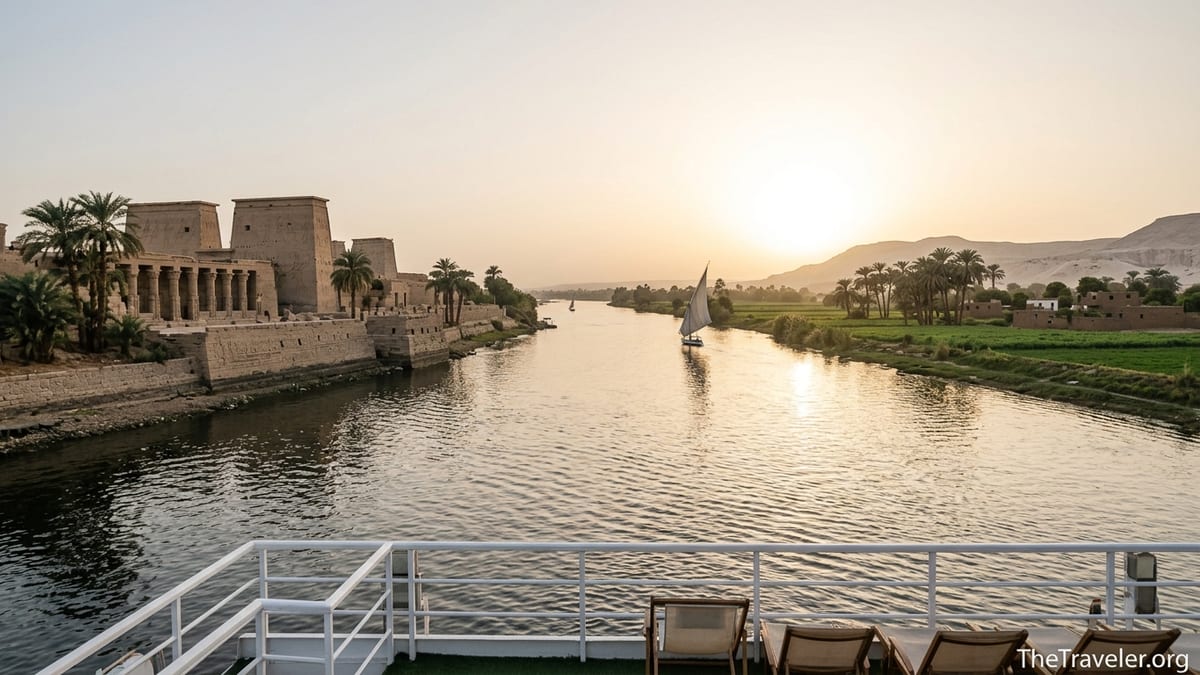
Between Luxor and Aswan, the Nile squeezes past green fields, desert cliffs, ancient temples and small river towns that still live by the rhythms of the water. For many travelers, this short stretch of Upper Egypt is the highlight of a trip to the country, but choosing where to base yourself and how to travel between Luxor, Aswan, Edfu, Kom Ombo and Esna can be confusing. This guide compares the main stops so you can decide where to linger, where a quick temple visit is enough, and whether a cruise, dahabiya or independent overland trip suits you best.
Understanding the Luxor to Aswan Nile Corridor
The classic Upper Egypt itinerary runs roughly 215 kilometers between Luxor and Aswan, with most visitors combining both cities plus key temple stops at Edfu, Kom Ombo and sometimes Esna. Almost all 3 and 4 night Nile cruises follow some version of this route, adding guided visits to major sites like Karnak and Luxor Temple, the Valley of the Kings, Philae Temple and either an optional or included side trip to Abu Simbel. Cruises typically sail Luxor to Aswan over 4 nights or Aswan to Luxor over 3 nights, while independent travelers use trains, taxis and day boats to link the same sights.
Prices for a standard 5 star cruise in 2026 usually fall somewhere between about 700 and 1200 US dollars per person for 3 or 4 nights, depending on season, cabin type and how many guided tours are bundled into the fare. Some travelers report finding simpler boats for closer to 400 to 600 dollars, while luxury brands and boutique dahabiyas can cost several thousand dollars per cabin during peak dates. These figures make it important to know where you most want to spend time so you can allocate nights and budget to the places that matter most to you.
In broad terms, Luxor is the archaeological heavyweight, with huge temples and world class tombs that can easily fill three full days. Aswan is quieter and more relaxed, with Nubian culture, islands, the famous dam and access to Abu Simbel. Edfu and Kom Ombo are primarily temple stops that almost everyone visits by cruise ship or private car, and Esna is both a lock on the river and a compact temple town that is just starting to see more independent tourism. Thinking of the route as a chain of very different experiences, rather than one generic cruise, will help you design a trip that feels balanced instead of rushed.
Luxor: Open-air Museum and Tomb Capital
Luxor sits roughly in the middle of Egypt and functions as the northwestern anchor of most Nile itineraries. Often described as an open air museum, the city brings together the monumental East Bank temples of Karnak and Luxor with the tomb complexes on the West Bank, including the Valley of the Kings, the Valley of the Queens and Deir el Bahari. A typical first day might start at Karnak in the early morning to walk through its forest of columns before the tour buses arrive, continue to Luxor Temple in late afternoon, and finish on the corniche as the sandstone glows orange at sunset.
The West Bank rewards slow travel. Many visitors now plan two separate days here, one focused on the Valley of the Kings and another on the wider mortuary landscape. Standard tickets to the Valley of the Kings cover a rotating selection of tombs, with the option to pay extra for famous burials like Tutankhamun or the deeply carved tomb of Seti I. Independent travelers usually hire a local driver for the day at a fixed rate and buy all tomb tickets at the official visitor center, where updated lists explain which tombs are open. Another full day might link the Temple of Hatshepsut, the Colossi of Memnon and the superbly painted tomb of Nefertari in the Valley of the Queens, often cited by recent visitors as one of the most vivid experiences in Egypt.
Luxor offers the widest choice of accommodation on this stretch of the Nile. You can sleep in a historic riverfront property with views of Luxor Temple, choose a mid range hotel with a rooftop pool and sunset bar, or stay in a guesthouse among palm groves on the West Bank, crossing the river each morning by small public ferry or private motorboat. For travelers who do not want to take a cruise at all, a common strategy is to base in Luxor for four or five nights, organize day trips by car to Edfu, Kom Ombo and Aswan, and then return to Luxor by train or domestic flight.
Aswan: Nubian Culture, Islands and Gateway to Abu Simbel
At the southern end of most itineraries, Aswan is smaller and more easygoing than Luxor, with granite outcrops, palm fringed islands and soft pink light in late afternoon. It is the best base for exploring Nubian culture, walking the riverfront souq and visiting the modern engineering of the High Dam. Many travelers say that if Luxor is the place to work through a checklist of temples and tombs, Aswan is where they finally slow down and enjoy the river itself.
The star attraction is the Philae Temple complex, relocated to Agilkia Island after the building of the dams. Visitors typically take a short motorboat ride from the marina to reach the island, where pylons and courtyards dedicated largely to the goddess Isis rise above the water. Most tours time the visit for early morning or late afternoon to avoid the midday heat and crowds. Nearby, the Unfinished Obelisk quarry gives context to how ancient builders extracted and shaped the massive monoliths that now frame temples from Luxor to Paris.
Aswan is also the jumping off point for Abu Simbel, a pair of rock cut temples on the western bank of Lake Nasser. Travelers usually join a pre arranged road convoy leaving around 3 or 4 in the morning, arriving at the site soon after sunrise, or they book a short domestic flight departing Aswan Airport. A typical small group road excursion, including transport and guiding, often costs in the region of 80 to 150 US dollars per person, depending on season and how many people share the vehicle. Many cruise itineraries offer Abu Simbel as an optional add on, while some higher end dahabiya trips include it in the base price.
Edfu and Kom Ombo: Essential Temple Stops on the River
Edfu and Kom Ombo almost always appear together on Nile cruise itineraries, partly because they fit neatly into the sailing schedule and partly because each offers something quite different from Luxor’s sprawling religious complexes. Edfu, located about halfway between Luxor and Aswan, houses one of the best preserved major temples in Egypt, dedicated to the falcon god Horus. Because the temple walls and roof survived almost intact, visitors can experience the full sequence of pylon, courtyard, hypostyle halls and inner sanctuaries in a way that feels more enclosed and atmospheric than at many other sites.
On cruise days, groups typically disembark at Edfu in the morning and transfer to the temple by local carriage or minibus, spend an hour or two exploring, then return to the ship in time for lunch. Independent travelers sometimes hire a private car and licensed guide from Luxor or Aswan, combining Edfu with Kom Ombo or Esna in a long day on the road. Simple ticket offices at the gate sell entrance tickets at official prices, and it is worth checking opening hours the evening before, as they can shift seasonally, especially during the hottest months.
Kom Ombo, about 60 kilometers north of Aswan, stands dramatically on a bend in the river and is unique for its double dedication to the crocodile god Sobek and the falcon headed Haroeris. Much of the stonework here is more weathered than at Edfu, but the appeal lies in its riverside setting and details such as carved medical instruments and mummified crocodiles displayed in the small on site museum. Cruises generally tie up directly beside the temple at sunset or early evening, creating one of the most atmospheric stops on the route as the stone glows in floodlights and the river laps quietly beyond the colonnades.
Esna and Smaller River Towns: Locks, Temples and Quieter Scenery
Esna sits south of Luxor and is best known to cruise passengers for its lock, which raises and lowers ships as they pass through a section of the river. For years many boats called only briefly here, focusing on the mechanical novelty of the lock, but that is starting to change as more independent travelers and smaller vessels schedule time to explore the town and its restored temple. The Temple of Khnum, partially sunk below street level, features finely carved zodiac ceilings and colorful reliefs that have emerged after recent cleaning work.
In practical terms, Esna is a useful stop for those who prefer flexible itineraries. Travelers staying in Luxor will sometimes arrange a half day car trip to Esna to see the temple, watch the lock in action and wander through local markets, then return to Luxor in time for dinner. A handful of boutique dahabiyas and small cruise boats now start or end itineraries at Esna instead of Luxor, using private road transfers to avoid sections of the river with heavy traffic while still including all the classic temple stops farther south.
Smaller villages and farming islands between the main towns provide some of the most memorable scenery on the Nile. Even on large ships, many guests spend entire afternoons on the sun deck watching feluccas, water buffalo and farmers at work in green fields backed by desert cliffs. Travelers who want more contact with local life may prefer a dahabiya or felucca charter that spends nights moored at quiet riverbanks instead of in city ports, trading some onboard amenities for star filled skies and early morning walks through palm groves.
Cruises vs Independent Travel: How to Experience the Nile
Choosing between a cruise and independent travel along the Nile depends largely on your priorities and comfort level. A standard 3 or 4 night cruise packages transport, accommodation, most meals and guided temple visits into one product, which can feel reassuring if it is your first time in Egypt or if you prefer not to negotiate daily logistics. Group sizes vary widely, from ships carrying more than one hundred passengers to small boutique boats with fewer than twenty cabins, and this has a big impact on how rushed or relaxed each stop feels.
Independent travelers often report that they enjoy having more control over timing, especially at headline sites like the Valley of the Kings or Philae, where cruise groups tend to arrive in predictable waves. It is relatively straightforward to book domestic flights between Cairo, Luxor and Aswan, and daytime trains or private drivers connect Luxor, Esna, Edfu, Kom Ombo and Aswan along the river. In this model, you might spend four nights in Luxor, then travel by train to Aswan for two or three nights, arranging day trips by road to Edfu and Kom Ombo. Some travelers even reverse the usual pattern by staying in Aswan first, then working north to Luxor where they spend the bulk of their time.
Cost comparisons depend heavily on the style of accommodation you choose. A mid range hotel in Luxor or Aswan can cost significantly less per night than a 5 star cruise cabin, especially outside holiday periods. On the other hand, when you factor in meals, guided tours and transport, a fairly priced cruise can still represent good value. One common hybrid strategy is to book a three night cruise between Luxor and Aswan, then add extra hotel nights at either end so you have both the moving river experience and unhurried time in at least one city.
How Long to Spend in Each Destination
For travelers with a week focused on Upper Egypt, a balanced schedule often allocates three full days in Luxor, one or two in Aswan and the remaining time in transit or on the river. A sample plan might include two nights in Luxor, followed by a three night cruise to Aswan that stops at Edfu and Kom Ombo, then two free nights in Aswan to visit Philae at your own pace and take a day trip to Abu Simbel. Another popular pattern is to spend three or four nights in Luxor first, then join a shorter three night cruise from Aswan back to Luxor, using the ship more as a moving hotel than a sightseeing package.
If your main interest is archaeology, it makes sense to weight your time heavily toward Luxor, where you can easily fill additional days visiting lesser known tombs and temples. Travelers often add sites like Medinet Habu, the Ramesseum or the tombs of the nobles once they realize how much there is beyond the Valley of the Kings. In this case, Esna becomes a natural half day excursion from Luxor, while Edfu and Kom Ombo can still fit into a one day private car trip or a short cruise.
Those who care more about scenery and a slower pace might spend only two days focused on Luxor’s major monuments before shifting south. In Aswan, it is easy to design days around felucca sailing, tea in riverfront cafes, walks through Nubian villages and relaxed visits to Philae or the Nubia Museum. A four night cruise that builds in long stretches of daytime sailing, rather than packing every hour with bus excursions, can also serve this style of traveler well.
The Takeaway
When you look beyond the brochures, the Luxor to Aswan stretch of the Nile is not a single product but a set of distinct places, each rewarding in slightly different ways. Luxor is where to stand inside vast hypostyle halls, descend into painted tombs and feel the full weight of New Kingdom history. Aswan is quieter and more intimate, with islands, Nubian culture and the option to extend your journey to Abu Simbel. Edfu, Kom Ombo and Esna, meanwhile, are focused stops that round out your understanding of how the ancient Egyptians lived with the river.
The choice between a cruise and independent travel is less about which is better and more about what kind of experience you want day to day. Cruises simplify logistics and string the classic sights into a comfortable package, while independent itineraries let you linger, backtrack and shape each day around your energy level and interests. If your budget and schedule allow, a hybrid approach that combines hotel nights at one end with a modest length cruise in the middle often delivers the best of both worlds.
Whatever you choose, factor in the heat and light of Upper Egypt. Early starts and long midday breaks will make temple visits far more enjoyable, and building at least one unscheduled day into either Luxor or Aswan gives you space to absorb what you have seen. The Nile will still be there the next morning, flowing past fields and cliffs as it has for thousands of years, ready to carry you from one chapter of the journey to the next.
FAQ
Q1. Is it better to start my Nile trip in Luxor or Aswan?
Both directions work, but many travelers prefer starting in Luxor because the concentration of major temples and tombs justifies arriving fresh with more time. Beginning in Aswan can feel more relaxed, letting you ease into the pace of the river before tackling Luxor’s dense archaeological sites.
Q2. How many days do I need in Luxor to see the main sights?
Plan on at least two full days, which allows one day for Karnak and Luxor Temple and another for the Valley of the Kings and a few West Bank highlights. Three days or more is ideal if you want to add the Valley of the Queens, Medinet Habu or lesser known tombs.
Q3. Is Aswan worth visiting if I am mainly interested in temples?
Yes. Aswan gives access to the island temple of Philae and the monumental rock temples of Abu Simbel, both very different in mood from Luxor’s sites. Combined with the Unfinished Obelisk and nearby Nubian villages, it offers a distinct layer of history and culture along the Nile.
Q4. Do I need a cruise to visit Edfu and Kom Ombo?
No. While most visitors see Edfu and Kom Ombo as part of a cruise, you can reach both by road with a private car and licensed guide from either Luxor or Aswan. This option suits travelers who prefer to stay in hotels but still want to see the key river temples.
Q5. What is the difference between a large cruise ship and a dahabiya?
Large cruise ships are like floating hotels with dozens of cabins, buffets and structured sightseeing schedules. Dahabiyas are much smaller, usually sail with the wind rather than motors, and stop at quieter riverbanks, offering a more intimate and flexible experience at a higher per night cost.
Q6. Is it safe to travel independently between Luxor, Esna, Edfu, Kom Ombo and Aswan?
Most independent travelers report that the route feels manageable, with regular trains, shared minibuses and private drivers available. As with any trip, it is wise to book reputable transport, follow local guidance and keep valuables secure in crowded stations and markets.
Q7. When is the best time of year to cruise the Nile?
The most comfortable months are typically from late October to early April, when daytime temperatures are warm but not extreme. Prices are usually higher around Christmas, New Year and major holidays, while the hottest summer months see fewer visitors and lower rates but more challenging midday heat.
Q8. Can I visit Abu Simbel as a day trip from a Nile cruise?
Yes. Many cruise itineraries from Aswan offer an optional early morning excursion to Abu Simbel by road or domestic flight. You leave the ship before dawn, tour the temples soon after arrival and return to Aswan in the afternoon to rejoin the cruise.
Q9. Do I need a guide for the temples and tombs along the Nile?
Guides are not mandatory, but a knowledgeable, licensed guide can add considerable depth to sites such as Karnak, the Valley of the Kings, Edfu and Kom Ombo. Many cruises include guiding in the fare, while independent travelers can hire guides at official offices or through their accommodation for specific days.
Q10. How should I budget for a Nile trip that includes Luxor, Aswan and key temples?
Costs vary widely, but a mid range traveler might combine a three or four night cruise with several hotel nights at each end, plus entrance fees and guided tours. It is sensible to allow extra for optional experiences such as hot air ballooning over Luxor, the Abu Simbel excursion from Aswan and tipping for ship staff, drivers and guides.