


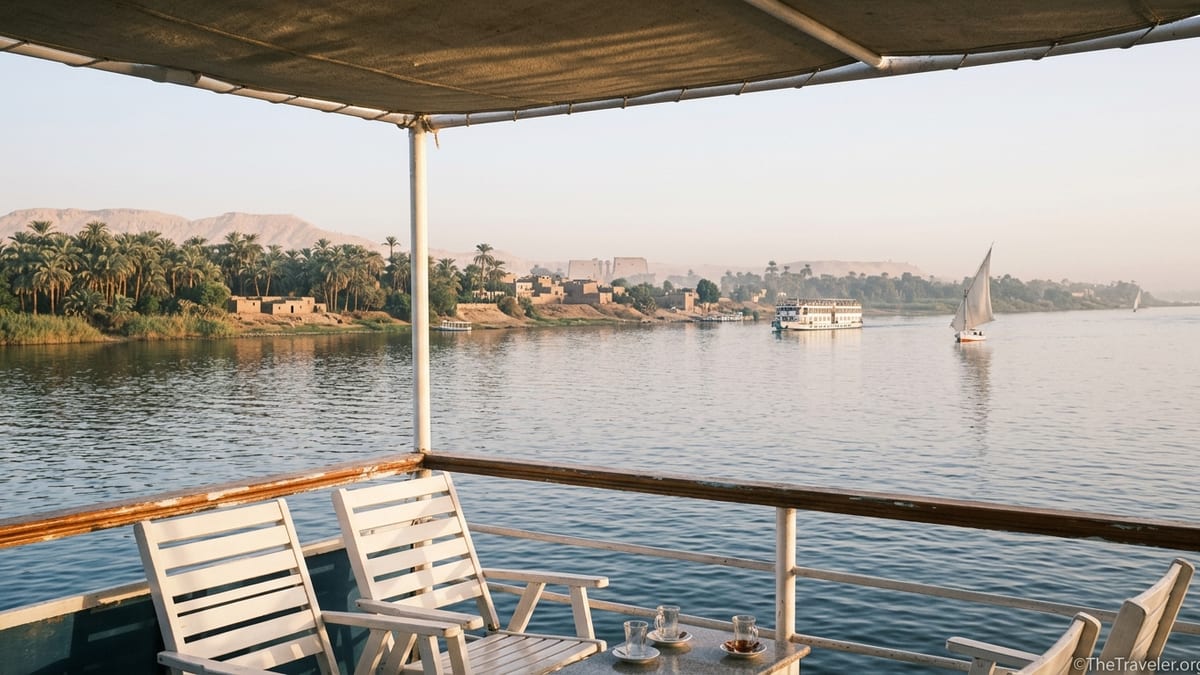
Between Luxor and Aswan, the Nile is less a river and more a moving museum. Temples rise from the banks, date palms frame quiet villages, and cruise boats glide past fields that look unchanged since pharaonic times. For first-time visitors, this stretch of southern Egypt is where the country’s ancient history, daily life, and modern tourism all meet. This guide focuses on the classic Nile corridor – Luxor, Esna, Edfu, Kom Ombo, Aswan and Abu Simbel – and explains how to choose between big-ship cruises, boutique dahabeyas and traditional feluccas, where to stay, what things really cost, and how to plan a smooth first trip.
Understanding the Nile Corridor: Luxor to Aswan
Most first-time Nile itineraries focus on the 220 kilometer stretch between Luxor and Aswan. This is where you find many of Egypt’s most famous temples and tombs in a relatively compact area. A typical 4 night cruise from Luxor to Aswan or 3 night cruise from Aswan to Luxor will include stops at Esna, Edfu and Kom Ombo, along with shore excursions in Luxor and Aswan. Several reputable operators publish these standard routes, and in 2026 the majority of big-ship itineraries still follow this pattern.
Luxor is usually the starting or ending point. On the east bank sit Luxor Temple and the vast Karnak complex, while the west bank holds the Valley of the Kings, Valley of the Queens and mortuary temples such as Hatshepsut’s Deir el Bahri. Aswan, at the southern end, is a more relaxed river city known for its Nubian culture, granite quarries and the Temple of Philae. Many travelers add a separate day trip or overnight excursion from Aswan to the temples of Abu Simbel near the Sudanese border.
Esna, Edfu and Kom Ombo are smaller towns strung along the river between Luxor and Aswan. Esna is known for its lock, where cruise ships line up to pass through, and its Temple of Khnum. Edfu has one of the best preserved Ptolemaic temples in Egypt, dedicated to Horus, while Kom Ombo is famous for its riverside double temple dedicated to Sobek and Haroeris. On most cruises, you visit these places in quick shore excursions of one to three hours before sailing on.
For a first-time visitor, it is helpful to think of the Nile corridor as a linear route anchored by two major hubs: Luxor and Aswan. You can travel entirely by cruise boat, combine a cruise with a few nights in hotels at either end, or base yourself in one city and visit some sites by road and felucca. The right choice depends on how much time you have, your budget and how structured you want your trip to feel.
Nile Cruise Boats, Dahabeyas and Feluccas
The most common way to experience the Nile between Luxor and Aswan is on a multi-day cruise ship. These modern riverboats usually carry 80 to 150 passengers, with air conditioned cabins, a restaurant, bar, and sundeck with a small pool. In 2026, realistic prices for a standard 5 star cruise on this route typically range from about 550 to 800 US dollars per person for a 3 or 4 night itinerary in a double cabin, including full board meals and standard sightseeing with a guide. High season from roughly October to April can push prices higher, especially around Christmas and New Year.
Dahabeyas are much smaller sailing boats, usually with only 6 to 12 cabins and a maximum of 12 to 20 guests. They move under sail when conditions allow, assisted by a tug when the wind drops. A dahabeya itinerary between Aswan and Luxor usually takes 4 to 5 nights and is slower and quieter than a big-ship cruise, with more random stops in small villages or at lesser known ruins. Current published rates for quality dahabeya operators often sit in the range of 700 to 1,200 US dollars per person for 3 to 4 nights, and higher for ultra-luxury vessels launched in the last few years. That price generally includes all meals and guided sightseeing but not tips or alcoholic drinks.
Feluccas are traditional open sailing boats without cabins or private bathrooms. They are ideal for short sunset sails around Aswan, where a one hour private felucca ride for two or three people might cost the equivalent of 15 to 25 US dollars, depending on your bargaining skills and season. Multi-day felucca trips still exist between Aswan and near Kom Ombo, but they are very basic. Travelers sleep on deck under blankets, use simple shore facilities, and eat meals cooked by the crew. For a first-time visitor who values comfort, a sunset or half-day felucca sail around Aswan is usually a better choice than a multi-night felucca trip.
When choosing between these options, consider your tolerance for structure and group touring. Big-ship cruises are highly scheduled: you sail on fixed days, follow set meal times, and join group excursions with other passengers. Dahabeyas feel more like being on a large houseboat with friends. You still have a guide and a rough schedule, but there is more flexibility to linger in quiet stretches of river or stop at a village where children wave from the shore. Feluccas offer pure atmosphere for short sails but lack the comfort most first-time visitors expect overnight.
Key Destinations: Luxor, Aswan, Esna, Edfu, Kom Ombo and Abu Simbel
Luxor remains the single most important stop on any Nile trip. Many travelers fly directly from Cairo to Luxor to start or end their cruise. Once there, budget at least one full day for the west bank alone, including the Valley of the Kings, where a standard ticket lets you enter several royal tombs, and optional add-ons like the tomb of Tutankhamun if you wish to pay extra. Another half or full day is easily filled with Karnak and Luxor temples on the east bank, especially if you visit in the late afternoon and stay after dark when Luxor Temple is beautifully lit.
Aswan has a very different rhythm. The city straddles the river, with islands, granite boulders and palms giving this section of the Nile a more dramatic, broken-up feel compared with Luxor’s wide floodplain. Typical first-time highlights include the Temple of Philae on an island reached by motorboat, the unfinished obelisk in the granite quarries, and a walk or boat trip around Elephantine Island. Many travelers also visit a Nubian village on nearby islands to see brightly painted houses and learn about Nubian culture. Aswan is also the main gateway for trips to Abu Simbel, which can be reached by early morning flight or four to five hour road journey each way.
Esna, Edfu and Kom Ombo are usually visited as part of a cruise, but you can also reach them by road from Luxor or Aswan if you are traveling independently. In Esna, the Temple of Khnum lies sunken below street level, giving you a sense of how Nile silt and modern town life have risen around the ancient site. Edfu’s Temple of Horus is one of the best preserved in Egypt, with towering pylons and detailed reliefs. Kom Ombo’s riverside setting is especially atmospheric at sunset when many cruise groups visit. There you can also see a small museum displaying mummified crocodiles related to the cult of Sobek.
Abu Simbel demands an early start but rewards those who make the trip. The twin temples of Ramses II and Nefertari were cut from the rock and moved in the 1960s to save them from the rising waters of Lake Nasser. Many travelers choose a group bus excursion from Aswan that leaves around 4 am and returns by early afternoon. Others pay more for a short flight which turns the visit into a half day outing. Given the long travel times and heat, most first-time visitors find that a single visit of two to three hours at the site is enough, especially if combined with a guide who can explain the reliefs and the story of the temple’s relocation.
Practicalities: Tickets, Transport and Accommodation
Entrance fees to major temples and sites along the Nile are set by Egypt’s Ministry of Tourism and Antiquities and are periodically updated. As of the latest published schedules, adult foreign visitors typically pay the equivalent of around 15 to 25 US dollars per major site such as Edfu, Kom Ombo or Philae when paying in local currency at the official ticket booths. Combination tickets and add-on fees for special tombs, photography permissions or sound and light shows can increase that total, so it is wise to allocate a flexible amount in your daily budget for admissions.
Transport along the Nile depends on whether you are cruising or traveling independently. If you are not taking a cruise, trains run between Luxor and Aswan several times a day, with journey times of roughly three hours on faster services and up to four on slower ones. Tickets are modestly priced compared with European standards, though foreigners often pay slightly higher fares than Egyptian citizens. Private car transfers arranged through hotels or local agencies are another common choice and can be surprisingly affordable when shared between two or three travelers, typically costing the equivalent of 60 to 120 US dollars for the full Luxor to Aswan journey, depending on vehicle type and season.
Within Luxor and Aswan, taxis and ride-hailing apps fill in the gaps, though prices are not always metered. A short taxi ride from central Luxor to the east bank temples may cost just a few dollars, while a private car to the west bank sites for a full morning or day, including waiting time, is usually negotiated as a flat fee. In Aswan, short taxi rides between the station, corniche and hotels are also inexpensive, and boatmen along the river offer crossings to islands for small negotiated fees. In both cities, agree on prices before you get in the car or boat, and keep small bills handy.
Accommodation options cover everything from simple guesthouses to historic luxury hotels. In Luxor, budget travelers often choose small hotels or family-run guesthouses on the west bank, where rooms can cost the equivalent of 25 to 60 US dollars per night with breakfast. Midrange business hotels and boutique properties on the east bank typically range from 60 to 150 US dollars per night. In Aswan, riverfront hotels with views of the islands and desert hills command higher rates, while more modest accommodations a few streets back from the corniche are more budget friendly. Booking one or two nights in a well-reviewed hotel at either end of your cruise gives you time to explore at your own pace and recover from long journeys.
Costs and Budgeting for a First Nile Trip
For a realistic first-time budget in 2026, many visitors find that around 150 to 250 US dollars per person per day is a comfortable middle ground for the Nile region if you combine a midrange hotel or standard 5 star cruise, meals in local restaurants, private airport or station transfers, and guided sightseeing. This figure can drop closer to 80 to 120 US dollars per person per day if you stay in budget guesthouses, eat in simple local places and travel by train, or rise significantly if you opt for luxury dahabeyas, five star hotels and private Egyptologist guides for all visits.
As a concrete example, a couple might book a 4 night standard 5 star cruise between Luxor and Aswan for about 650 US dollars per person in a double cabin, including full board and a shared guide for the main temples. If they add two nights in a midrange Luxor hotel at around 100 US dollars per night, two nights in a similar Aswan hotel, entrance fees to a dozen sites, a day trip by bus to Abu Simbel at around 150 to 200 US dollars per person, plus airport transfers and incidental costs, their total outlay for ten days along the Nile could easily reach between 2,500 and 3,000 US dollars for two people, excluding international flights.
On the other hand, a traveler choosing a smaller dahabeya might pay around 900 to 1,200 US dollars per person for a 4 night sailing with all meals and guided excursions. Paired with simpler guesthouses in Luxor and Aswan and local transport rather than private cars, the total outlay for a similar ten day stay could still end up comparable to or slightly higher than the big-ship example, but with a more intimate on-river experience. These ranges are approximate, but they help show that the Nile is not necessarily a rock-bottom budget destination once you factor in cruises and multiple entrance fees.
Tips and additional charges deserve special attention in your budget. Many cruise companies collect a recommended tip for the crew at the end of the voyage, often suggested as a fixed per person amount for the whole sailing. Guides, drivers and boatmen also expect gratuities. While the individual amounts may be modest, over several days they add up. It is wise to keep a separate envelope of small bills in local currency and note typical tip levels mentioned in up-to-date guidebooks or by your tour operator so you are not constantly guessing.
Planning Your First Nile Itinerary
For first-time visitors with about a week to ten days in Egypt, a classic structure is to combine a few days in Cairo with several days on or along the Nile between Luxor and Aswan. A popular option is to fly from Cairo to Luxor, spend one night in a hotel there, then embark on a 3 or 4 night cruise to Aswan, followed by an extra night or two in Aswan for a more relaxed finish and a side trip to Abu Simbel. From Aswan, you can fly back to Cairo. This sequence spreads out travel days and gives you time in both major Nile cities instead of treating them only as boarding points.
If you prefer more flexibility and less time in groups, consider building your trip around hotels and day trips rather than a cruise. You could, for instance, base yourself in Luxor for four nights, using private guides and drivers to see the west bank, east bank and a day trip by road to Dendera and Abydos if you have a strong interest in temples. After Luxor, take the train or a private car to Aswan, spend three nights there, visit Philae and the quarries, sail on a felucca at sunset, and take a day or overnight excursion to Abu Simbel. This style works well for travelers who enjoy setting their own pace or who are prone to motion sickness on boats.
Seasonality matters too. The main Nile cruising season runs roughly from October to April, when daytime temperatures are more comfortable for temple visits and nights on the river are cool rather than cold. December and early January are busy and more expensive, as are some Easter and spring break periods for European and North American travelers. May and September can be shoulder months with fewer crowds but increasingly intense heat in the middle of the day. June through August are extremely hot in Upper Egypt, and while cruises still operate, you will need to plan sightseeing at dawn and late afternoon and spend the hottest hours indoors.
When planning, also think about how early starts and long days will feel. Many Nile excursions begin around 7 or 8 am to avoid the worst heat, and Abu Simbel bus trips may start in the pre-dawn hours. If you are sensitive to early mornings or traveling with children, build in buffer days with lighter schedules. Booking one extra night at the end of your cruise in Aswan or Luxor gives you time to revisit a favorite site independently, shop at a more relaxed pace, or simply watch the river traffic from a café instead of rushing straight to an airport transfer.
On-the-Ground Tips for First-Time Visitors
Walking around temples and tombs involves a lot of uneven surfaces, stairs and sloping ramps. Pack comfortable closed-toe walking shoes with good grip rather than thin sandals, and bring a hat, sunscreen and a refillable water bottle. Many visitors underestimate how tiring it can be to stand in the sun listening to explanations or to walk through deep-cut tomb corridors in the Valley of the Kings. Building in short breaks in the shade and drinking plenty of water will help you enjoy more of what you see.
Dress codes along the Nile are relatively relaxed but still influenced by local norms. Lightweight long trousers or skirts and breathable shirts that cover shoulders are ideal during the day. On cruise ships and in upscale hotels, many travelers switch to slightly dressier but still modest outfits for dinner. In village stops and local markets, avoid very revealing clothing to be respectful and to attract less attention. Carrying a light scarf can be useful both for sun protection and for extra coverage if you feel uncomfortable.
Cash and payments are another practical consideration. ATMs are available in Luxor and Aswan and in some towns along the river, but it is wise to withdraw enough local currency for entrance fees, tips and small purchases before boarding a cruise or heading to outlying sites. Larger hotels and cruise companies usually accept major credit cards for room bills or cruise balances, but small guesthouses, local guides and boatmen will expect cash. Keep your most important documents and larger sums of money in a hotel safe or money belt and carry only what you need for each excursion.
Finally, be prepared for a certain level of sales pressure in tourist areas. Vendors in markets around Luxor Temple, near the Kom Ombo and Edfu docks, and at viewpoint stops along the road may call out, approach you with souvenirs or try to negotiate quickly. A firm but friendly “no, thank you” usually suffices if you are not interested. If you do want to buy something, assume that bargaining is expected, take your time and agree on a price you feel comfortable with rather than focusing on winning the lowest possible deal.
FAQ
Q1. How many days do I need on the Nile between Luxor and Aswan?
Most first-time visitors find that 3 to 5 days on the river itself is enough, either as a cruise or split between the two cities. Adding extra hotel nights in Luxor or Aswan lets you explore key temples and tombs at a more relaxed pace and fit in a side trip to Abu Simbel.
Q2. Is it better to cruise from Luxor to Aswan or from Aswan to Luxor?
From a sightseeing perspective the experience is very similar in both directions, since you stop at the same main temples. Some travelers prefer starting in Luxor, where there is more to see, then ending with a slower pace in Aswan. Others like to start in Aswan so they can visit Abu Simbel first. Availability and cruise schedules often decide the direction.
Q3. What is the difference between a Nile cruise ship and a dahabeya?
A cruise ship is a larger, mostly motor-powered vessel with dozens of cabins, multiple decks and hotel-style facilities. A dahabeya is a smaller sailing boat with far fewer guests, more use of wind power and a quieter, slower atmosphere. Dahabeyas tend to be more expensive per night but offer a more intimate experience with flexible stops.
Q4. Can I visit the main temples without taking a cruise?
Yes. You can base yourself in Luxor and Aswan and visit most temples by road or by arranging local boats. Trains and private cars connect Luxor and Aswan, and day trips from either city can reach Esna, Edfu and Kom Ombo. This approach suits travelers who prefer independent pacing over an all-inclusive cruise.
Q5. How much should I budget for a Nile cruise in 2026?
As a broad guide, expect to pay around 550 to 800 US dollars per person for a standard 3 to 4 night 5 star cruise in a double cabin, including full board and group excursions. Dahabeya sailings typically cost more. Prices vary with season, cabin type and what is included, so always check the latest inclusions and any extra charges for tips or optional tours.
Q6. Is Abu Simbel worth the long trip from Aswan?
Many travelers consider Abu Simbel a highlight of their time in Egypt, thanks to the scale of the statues and the story of how the temples were relocated. However the journey is long, especially by road. If your schedule allows and you are prepared for an early start, it is usually worth including once, particularly on a first trip.
Q7. When is the best time of year to cruise the Nile?
The most comfortable months are generally from October to April, when daytime temperatures are milder and evenings are cool. Crowds and prices peak around late December, early January and some spring holidays. May and September can be hot but manageable with early starts, while June to August are very hot and better suited to travelers who can handle high heat.
Q8. Do I need to book my Nile cruise in advance?
For peak season dates and for smaller dahabeyas, it is wise to book several months ahead to secure your preferred dates and cabin type. In lower season, it may be possible to book closer to your travel dates or even on arrival through local agencies, but first-time visitors usually find advance booking less stressful.
Q9. Are meals and excursions included in cruise prices?
Most multi-day Nile cruises include full board meals and a standard set of guided excursions to main temples and sites in the base price. Drinks, some entrance fees, optional evening shows and tips are often extra. Always read the inclusion list carefully so you know which costs will still be paid on the spot.
Q10. Is the Nile region suitable for families and older travelers?
Yes, the Nile corridor works well for a wide range of ages, but you should factor in heat, early start times and lots of walking on uneven ground. Families may appreciate having a cabin on a ship to retreat to between excursions, while older travelers might prefer shorter daily programs, private guides and occasional rest days in comfortable hotels.