


Few travel decisions feel as momentous as choosing how to see the Nile. For many visitors to Egypt, the question quickly becomes: should you sail between Luxor and Aswan on a large, hotel-style cruise ship or on a much smaller, traditional-style sailing vessel known as a dahabeya? Both trace the same legendary river, but the experiences differ sharply in scale, atmosphere, flexibility and price. This guide breaks down the trade-offs in practical detail so you can decide which is right for your trip, budget and travel style.
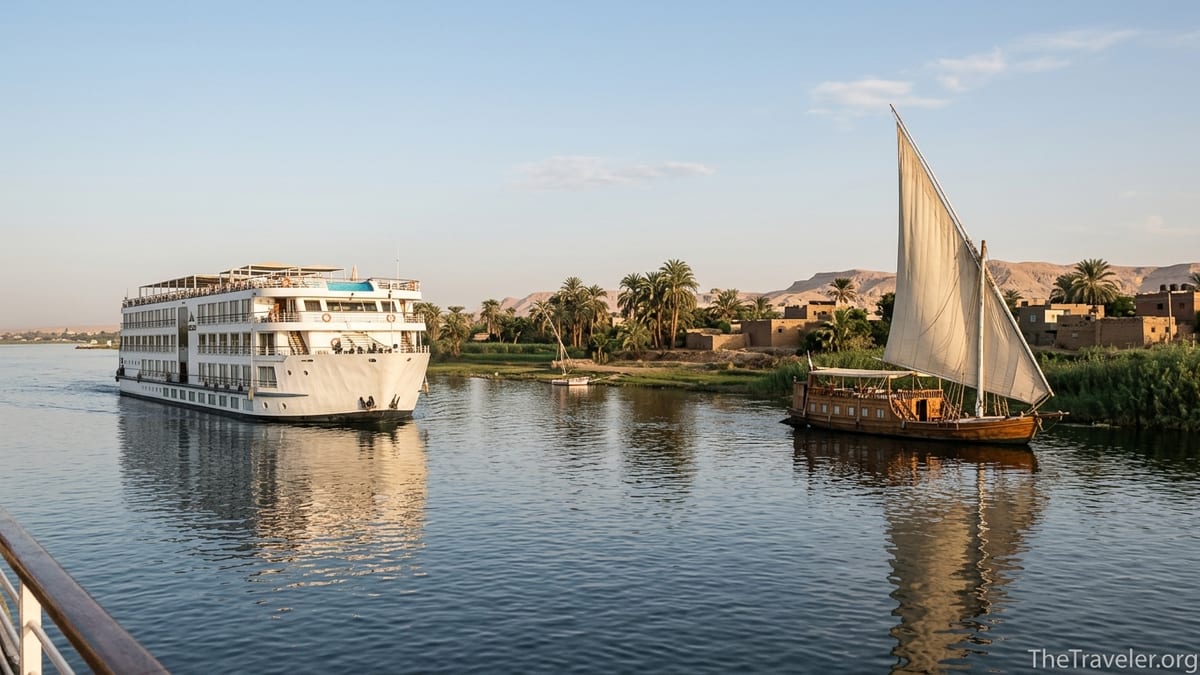
What Exactly Is a Nile Cruise vs a Dahabeya?
When most travelers talk about a “Nile cruise,” they mean the larger river ships that run fixed itineraries between Luxor and Aswan. Boats such as Amwaj Livingstone or Farah Nile Cruises typically carry anywhere from 80 to 150 passengers, with several decks, a small pool, restaurant, lounge and bar, and rows of outside cabins along a hotel-style corridor. These ships operate almost like floating resorts, with regular weekly departure dates and set 3, 4 or 7-night programs visiting the main temples and tombs along the river.
A dahabeya (you will see it written in several ways: dahabiya, dahabeah, etc.) is a very different proposition. Historically, these were elegant two-masted sailing boats used by Egyptian elites and 19th-century travelers. Modern versions keep the long, low wooden hull and shallow draft, usually with just 6 to 12 cabins. Companies such as Djed Egypt Travel, Nile Dahabeya Cruise Company and Nour El Nil operate fleets of these intimate vessels that are towed by a small tug when the wind is not cooperating, but still feel closer to traditional Nile sailing than a motor ship.
In practical terms, a standard Nile cruise is a mass-market product: predictable, widely available, and relatively easy to book on short notice. A dahabeya is a niche, small-ship choice: fewer sailings, fewer cabins, and a much more limited supply. That scarcity is part of the appeal for many travelers, but it also means you need to plan earlier, especially for peak months between October and April.
Both options normally include full board and guided sightseeing, but the way you move through the river landscape and how you experience the archaeological sites feels very different once you are on board.
Cabins, Comfort and Onboard Atmosphere
On a large Nile cruise ship, cabins tend to follow a predictable pattern. A typical deluxe cabin on a contemporary ship such as Amwaj Livingstone is around 18 to 20 square meters, with a large window or French balcony, en-suite bathroom, air conditioning, small desk and wardrobe. Suites are larger, often with a sitting area and sometimes a full balcony. Public spaces include a main restaurant, a lounge bar where evening entertainment happens, and a sun deck with plunge pool and row of loungers.
The feel on board is that of a compact resort. On a 7-night Luxor to Aswan run, you might share the ship with 120 other passengers of all ages. There can be live music, folkloric shows, sometimes even galabeya dress-up nights. For sociable travelers, couples keen to meet others, or families who like some buzz around them, this environment can be a positive. For others, particularly those who are sensitive to noise or crowding, the constant activity and background music can feel overwhelming.
Dahabeya cabins are usually smaller in number but surprisingly comfortable. Boats like Princess Donia, Amoura or Sonesta Amirat Dahabiya often have between 8 and 12 cabins, each with en-suite bathroom and opening windows right onto the Nile. Dimensions are often closer to 12 to 16 square meters for standard cabins, though some luxury dahabeyas offer one or two larger suites at the stern with private terraces. The decor tends toward wood, textiles and classic brass fixtures rather than contemporary hotel style.
The atmosphere on a dahabeya is intimate and low-key. With perhaps 14 to 20 guests on board, you get to know fellow passengers and the crew by name. Meals are usually served at a single long table. Evenings often involve quiet conversation on deck under the stars rather than scheduled shows. If your idea of a river cruise leans more toward reading a book in a shaded deck chair while the riverbank drifts past, the dahabeya environment will likely feel closer to your ideal.
Itineraries, Flexibility and Archaeological Stops
Large Nile cruise ships follow tightly regulated schedules, partly because they are queuing through locks and assigned mooring slots alongside other vessels. A standard 3 or 4-night Aswan to Luxor cruise will almost always include Philae Temple, Kom Ombo, Edfu, Esna Lock and the main Luxor sites such as Karnak and the Valley of the Kings. Guides work to a timetable designed to keep shore excursions synchronized with meal times and navigation hours.
This rigidity has advantages. First-time visitors who simply want to be sure they see the headline monuments will find that virtually any mainstream cruise product delivers them. Several university alumni trips and group tours use these ships because they know exactly how long each day will be and how many hours they can allocate to lectures or free time. The trade-off is that you are rarely alone at the temples. Coaches from several ships may arrive at once, and even early-morning visits can feel crowded in peak season.
Dahabeyas, because they carry fewer people and can moor in more places along the riverbank, have much more flexibility. Operators often build in extra stops at lesser-known sites or quiet villages between the major temples. On some itineraries, guests visit small riverside communities, walk through date palm groves, or explore archaeological sites such as El Kab that larger ships skip entirely. Daily schedules can be adjusted by an hour or two if the group wishes to linger at a particular temple or take a swim stop in a calm stretch of the river.
One common pattern is that dahabeyas leave temples such as Kom Ombo just as the last big coaches pull away, or they arrive after the morning rush has passed. Travelers who have recently sailed from Aswan to Luxor on small boats often report visiting Edfu Temple with only a handful of other people in late afternoon, compared to the shoulder-to-shoulder crowds that big ships see mid-morning. If unhurried exploration and the feeling of stepping slightly off the beaten path are priorities, the dahabeya’s slower, more flexible rhythm is hard to beat.
Privacy, Noise and Overall Pace of Travel
Privacy on a large Nile ship is a mixed picture. In your own cabin, you can close the door and feel entirely separate, with decent sound insulation and your own bathroom. On deck or in the restaurant, though, you are very much part of a crowd. During peak weeks, most sun loungers can be occupied, and finding a quiet corner can take some patience. In popular mooring spots, several large ships tie up side by side, so your cabin window may end up facing directly into another ship’s corridor.
Noise levels on big ships vary by operator and time of year, but you can expect engine vibration during navigation hours, music in the lounge, and a general hum of activity. If you are a light sleeper or sensitive to sound, it is worth requesting a cabin away from the engine and nightclub area. The upside is that you have more options for entertainment: bars, sometimes a small spa, and often a boutique or two.
Dahabeyas tend to be much quieter. Without a large engine running constantly and with far fewer people on board, the main sounds are the river, the flapping of the sail canvas when the wind is up, and occasional activity from the small tug when needed. In the evenings, you often moor along a quiet stretch of riverbank rather than in busy ports, which means you hear crickets rather than city traffic or neighboring ship generators.
The overall pace on a dahabeya is deliberately slow. Instead of racing from one major temple to the next, you might sail for a couple of hours in the morning, stop for a village walk or a dip in the river shallows where it is safe, then continue in the late afternoon. For some travelers, especially those short on time or who want to pack in as many sites as possible, this can feel too leisurely. For others, particularly repeat visitors to Egypt or travelers coming off busy tours in Cairo, it is precisely the restorative pause they are looking for.
Food, Service and Cultural Experience
Food on large Nile cruise ships is generally safe, plentiful and geared toward international palates. Buffets at breakfast, lunch and dinner typically offer grilled meats, stews, salads and desserts, with some Egyptian dishes mixed in. On mid-range ships, cuisine can feel functional rather than memorable, similar to a decent all-inclusive resort. Luxury ships run by international brands or long-established local operators tend to raise the bar, plating multi-course menus in an à la carte setting.
Service on big ships depends heavily on the operator and the training of the crew. On reputable lines, you can expect professional, if somewhat impersonal, hospitality. With 100-plus passengers to look after, staff do not always have time to learn everyone’s preferences, though repeat cruisers sometimes report small touches, such as a favorite drink remembering itself at dinner on day three or four.
On dahabeyas, food is one of the highlights for many travelers. With far fewer guests to cook for, chefs can prepare family-style meals using fresh produce from local markets. Menus often lean more heavily into regional dishes: slow-cooked lamb, okra stews, grilled river fish, mezze plates, and homemade breads. Meals are served at a communal table on deck when weather allows, which encourages conversation and fosters a house-party feeling. Dietary needs can also be handled more personally, simply because the team is cooking for 15 people rather than 150.
The cultural experience tends to feel more immediate on a dahabeya. You are closer to the waterline, closer to the riverbank, and more likely to stop in small communities that see only a handful of visitors. On an 8-day sailing between Esna and Aswan, it is not uncommon to anchor beside a crop field and watch farmers bring their animals down to drink at sunset. Guides have more time to sit and talk, rather than delivering commentary into a microphone for a large group before hurrying everyone back to the bus.
Trip Length, Scheduling and Practical Logistics
Most mainstream Nile cruise ships operate short, repeatable itineraries that fit easily into a wider Egypt trip. The most common patterns are 3 nights Aswan to Luxor, 4 nights Luxor to Aswan, or 7 nights round trip. Because many ships run multiple departures each week in high season, you can usually match a sailing to your flights even if you only finalize your plans a couple of months ahead. This regularity also makes big ships the backbone of package tours that combine Cairo, Luxor, Aswan and sometimes Abu Simbel in 8 to 12 days.
Dahabeya trips are usually a bit longer and less frequent. A typical itinerary runs 5 to 7 nights between Esna and Aswan or vice versa, with fixed departure days that may not align perfectly with every international arrival. Some specialist operators offer even longer sailings or combine Nile and Lake Nasser segments, but these remain a niche product. Because each boat has so few cabins, departures can sell out months in advance over peak travel windows such as late October or early November, Christmas and New Year.
If your vacation time is tight and you need exact dates, a large cruise ship gives you more flexibility. If you have more room in your schedule and can build your route around the dahabeya departure, you will likely be rewarded with a more personalized experience. For families traveling over school holidays, it often comes down to availability: by the time you are ready to book, many dahabeyas may already be full, while large ships still have multiple cabin categories open.
Arrival and departure logistics are similar for both options. Most itineraries start or end in Aswan or Luxor, both of which have domestic flight connections from Cairo and, in peak season, some direct international flights. Transfer from airport or hotel to embarkation point is usually handled by the cruise operator or your tour agency, whether you choose a big ship or a small sailing boat.
Prices and Value for Money
Price is one of the clearest areas of difference between large Nile cruises and dahabeyas. On the mainstream market, a good quality four or five-star Nile cruise ship selling cabins from operators that work with university travel offices and established agencies might cost in the region of 180 to 250 US dollars per person per night in shoulder season for a standard cabin on full board, not including sightseeing supplements. In high-demand weeks, prices for similar cabins can rise above 275 dollars per person per night, especially if sightseeing and guiding are bundled into a package.
Dahabeyas, by contrast, often price their limited cabins at a significant premium. For example, mid-range small-boat trips marketed through tour operators and travel agencies frequently come out at 900 to 1,000 dollars per person for 4 nights, while some higher-end options on luxury dahabeyas or packages sold through international brands can run into the several thousands for a 10-day Egypt itinerary that includes a 4 or 5-night dahabeya segment. The per-night cost can easily be double that of a solid mainstream large-ship cruise.
Whether that premium represents good value depends on what you want from the trip. If your goal is simply to see the classic sites in relative comfort and you are watching your budget, a reputable large ship is hard to beat on cost per room-night. If, however, you place a high value on intimacy, quiet, flexible timing at key temples and a slower, more immersive feel for the river, many travelers who have tried both report that the extra outlay for a dahabeya felt justified.
One subtle factor is what is included. On both big ships and dahabeyas, cruise-only prices sometimes exclude entrance fees to monuments and tipping pools for crew and guides. Package tours sold through agencies may bundle these together. When comparing, look carefully at whether quoted rates cover sightseeing, private guiding, drinks with meals and transfers, and adjust your cost expectations accordingly.
Which Experience Suits Which Type of Traveler?
If you are a first-time visitor to Egypt wanting a classic highlight reel in a week or less, traveling with older relatives or children, or simply prefer a fully serviced, hotel-like environment, a large Nile cruise ship is likely the better fit. The routine is predictable, there is always someone at reception to answer questions, and you have more facilities to fall back on if anyone in the group needs downtime. Couples who enjoy socializing at the bar or pool and solo travelers who like meeting a wider mix of people also tend to appreciate the energy on board.
Dahabeyas are a stronger match for travelers who value quiet, open space and depth of experience over facilities. They particularly appeal to well-traveled couples, small groups of friends, and families with older children or teens who enjoy being outdoors and do not need structured entertainment. Because there are so few cabins, they also work well for multigenerational groups who want to charter an entire boat for a milestone birthday or family reunion, turning the dahabeya into a private home on the river for a week.
Mobility and comfort preferences matter too. While both large ships and dahabeyas involve climbing on and off gangways and walking across uneven ground at archaeological sites, large ships usually have more spacious stairs, lifts on some vessels, and more railings. Dahabeyas, being smaller and sometimes more rustic in design, may not be ideal for travelers with significant mobility issues or those who need wheelchair access inside the cabin corridors.
Think too about your tolerance for unpredictability. Large ships adhere closely to schedule; if you prefer knowing exactly what time you will be at each temple and when you will be back on board for lunch, that structure can feel reassuring. On a dahabeya, wind, current and the group’s interests all play a role. You might decide on the day to stop for a swim or to linger at a little-visited site. For some, that is the charm. For others, especially those who like to plan every hour, it can feel a touch too free-form.
The Takeaway
Choosing between a large Nile cruise ship and a dahabeya is less about which is objectively “better” and more about which aligns with the way you like to travel. The big ships deliver comfort, predictability and strong value, placing Egypt’s blockbuster temples within easy reach for hundreds of passengers each week. Dahabeyas, with their small size, slower pace and more flexible itineraries, trade facilities and capacity for atmosphere, silence and a stronger sense of connection to the river itself.
If your priority is to keep costs manageable, fit a cruise into a tight vacation window and tick off the classic sites with minimal logistical effort, book a well-reviewed mainstream Nile ship. Choose a cabin away from the engine, be ready for some crowding at popular stops, and enjoy the ease of having a floating hotel carry you from Luxor to Aswan. If, on the other hand, you dream of drifting past palm groves in near silence, anchoring under star-filled skies and stepping ashore in small groups before or after the tour-bus crush, start looking into dahabeya departures as early as you can and be prepared to pay more for the privilege.
Either way, the Nile itself is the real star. Whether viewed from a sun deck lined with loungers or a low wooden rail a few meters above the water, watching the river’s slow coils and the green ribbon of life along its banks is one of the most enduring experiences Egypt offers. Choosing the right vessel simply shapes the way you remember it.
FAQ
Q1. Is a dahabeya safer or riskier than a large Nile cruise ship?
The safety record for both is generally good when you sail with licensed operators. Large ships feel more substantial and are less dependent on wind, while dahabeyas are towed by a support boat when needed and must comply with Egyptian maritime regulations. For most travelers, seasickness and river conditions are non-issues on the calm Nile.
Q2. How far in advance should I book a dahabeya compared with a regular Nile cruise?
Because dahabeyas have so few cabins, they often sell out months ahead for peak periods such as late October, November and the Christmas holidays. Large cruise ships may still have cabins available closer to departure, sometimes even a few weeks out. If you have your heart set on a specific dahabeya, aim to book at least six to nine months in advance.
Q3. Are children welcome on dahabeyas?
Policies vary by operator. Some dahabeyas welcome families with children, especially if a family books several cabins or the whole boat, while others prefer to limit sailings to adults or teens to preserve a quiet atmosphere. Large cruise ships are generally more flexible and offer a livelier environment that many children enjoy.
Q4. Will I see the same major temples on a dahabeya as on a big cruise ship?
Yes, most dahabeya itineraries include the headline sites between Esna and Aswan, such as Edfu and Kom Ombo, but they often reach them at quieter times of day and add lesser-known stops. Large ships focus on the main attractions and follow fixed time slots, which can mean more crowds but a very reliable schedule.
Q5. Do dahabeyas have air conditioning and private bathrooms?
Most modern dahabeyas aimed at international travelers have air-conditioned cabins with en-suite bathrooms, though equipment can be simpler than on large ships. If climate control is important to you, check the specifications of your chosen boat before you book rather than assuming all vessels are the same.
Q6. Is the food better on a dahabeya or a large Nile cruise ship?
Quality varies, but many travelers find food on dahabeyas more personal and flavorful, with home-style Egyptian dishes and fresh ingredients. Large ships offer more standardized buffets with wide choice but less character. Luxury big ships can match or exceed dahabeya standards, though usually at higher overall trip cost.
Q7. Can I get reliable Wi-Fi on the Nile?
Connectivity on both large ships and dahabeyas is improving but still inconsistent. Some big ships offer paid Wi-Fi packages that work reasonably well near towns, while dahabeyas often rely on mobile hotspots. If staying connected is critical, consider buying a local SIM card with data and treat onboard Wi-Fi as a useful extra rather than a guarantee.
Q8. What is the dress code on board?
Dress is casual on both types of vessels. Lightweight, modest clothing is appropriate for the climate and cultural context, with layers for cooler evenings from November to February. Some large ships host optional Egyptian-themed nights where guests wear local-style garments, while dahabeyas tend to keep things low-key without formal events.
Q9. How do tipping and service charges work?
Many cruise packages, both on large ships and dahabeyas, suggest a pooled tip for crew and guides at the end of the sailing. Some operators include service charges in the fare, while others give recommended amounts per passenger per day to be paid in cash. Clarify this before departure so you can budget and carry suitable currency.
Q10. If I get easily bored, which option is better?
Sociable travelers who like varied evening entertainment and more people around generally fare better on large ships, which have bars, music and more structured activities. Dahabeyas suit those who are happy with quieter nights, conversation, reading under the stars and watching the river, and who see the slower pace as part of the experience.