


Egypt’s Red Sea coast is one of the easiest places in the world to combine warm-water snorkeling and diving with comfortable resorts and relatively friendly prices. From the big resort cities of Hurghada and Sharm El Sheikh to quieter stretches around Marsa Alam, El Gouna, Soma Bay and Dahab, first-time visitors have plenty of choice. This guide focuses on what new visitors actually need to know: where to land, how to get to your hotel, what different areas feel like on the ground, rough costs, and how to plan snorkeling and diving without feeling overwhelmed.
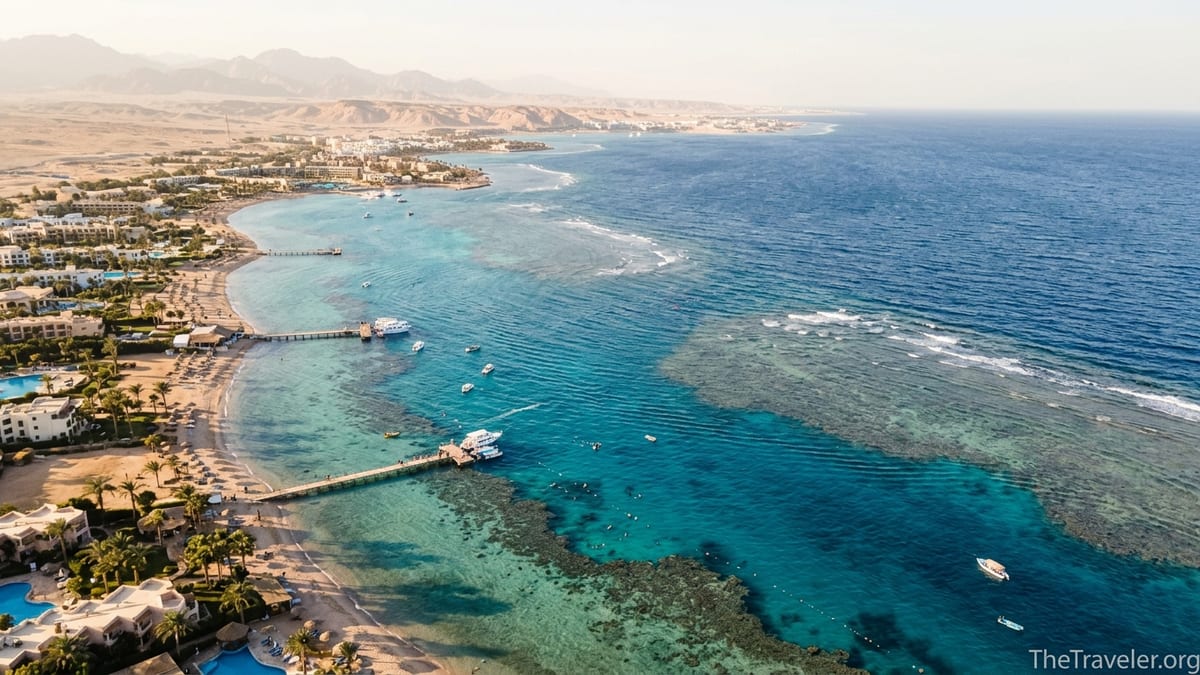
Red Sea Regions at a Glance
The Red Sea coast is long, but most visitors cluster around a few hubs. Hurghada and Sharm El Sheikh are the largest and busiest, each with an international airport, big resort strips and city-style services. Hurghada anchors the western mainland coast and is the jumping-off point for nearby resort enclaves like El Gouna to the north and Soma Bay to the south. Sharm El Sheikh sits on the tip of the Sinai Peninsula and has direct access to the famous reefs of Ras Mohammed National Park and the Straits of Tiran.
Further south on the mainland, Marsa Alam is quieter and more spread out, known for turtles, dugongs and long house reefs. Many resorts here sit on otherwise undeveloped shoreline, which makes the sea feel wild but also means you rely more on your hotel facilities. Dahab, north of Sharm El Sheikh on the Gulf of Aqaba, is the most relaxed of the main hubs. Once a backpacker town, it still feels low-rise and laid-back, with simple guesthouses and shore-diving just a few minutes from town.
For a first visit, it helps to think in terms of mood and convenience. If you want a classic all-inclusive resort with kids’ clubs and waterparks plus easy flights, Hurghada and Sharm El Sheikh are the usual choices. If you prefer quieter beaches and are happy to stay mostly in one resort, Marsa Alam or Soma Bay can work well. For a more independent feel with cafes and dive centers woven through town streets, Dahab and El Gouna are appealing bases.
Distances between these hubs are significant. Driving from Hurghada to Marsa Alam typically takes three to four hours. Hurghada to El Gouna is closer to 30 to 40 minutes, while Hurghada to Soma Bay is roughly one hour. Sharm El Sheikh to Dahab is usually around 1.5 hours by road. These times matter when you are weighing whether to combine areas in a single trip or focus on one base.
Airports, Entry and Getting Around
Most international visitors land at Hurghada International Airport or Sharm El Sheikh International Airport. There is also a smaller airport at Marsa Alam with some direct charter flights from Europe in peak seasons. For a first trip, it is usually simplest to fly directly into the region where you plan to stay instead of routing through Cairo and taking an internal connection, unless flight times or prices are significantly better via the capital.
On arrival, many package holidaymakers are met by their tour operator and taken straight to a coach or private minibus. Independent travelers typically either pre-book a transfer, ask their hotel to arrange a car, or negotiate with airport taxis. In Hurghada, for example, recent guides and local operators quote around 15 to 20 US dollars per car for a pre-booked private transfer to central hotels, with slightly higher prices for El Gouna or Soma Bay. In Sharm El Sheikh, similar pre-booked private rides to Naama Bay or the main resort strip often fall in the 15 to 25 dollar per car range, depending on distance and vehicle.
Public transport in these resorts is limited, although Hurghada and Sharm El Sheikh have local minibuses and plenty of regular taxis. In Hurghada, many visitors end up using ride apps or hotel cars because prices are clearer upfront than flagging a taxi in the street. In El Gouna, you typically get around using internal tuk-tuks and hotel shuttles rather than standard city taxis. Marsa Alam resorts are often isolated, so most day trips and transfers are arranged through on-site travel desks or dive centers, with fixed prices posted in euros or US dollars.
If you plan to move between hubs, private cars are the most common option. A one-way taxi between Sharm El Sheikh and Dahab is often quoted in the 30 to 40 US dollar range for the car, while Hurghada to El Gouna or Soma Bay is usually cheaper due to the shorter distance. Organizing these legs via your hotel reception or a trusted local agent is usually safer than bargaining blindly at a taxi rank, especially late at night or after a long flight.
Resort Areas: Hurghada, El Gouna and Soma Bay
Hurghada has grown from a small fishing village into a city-sized resort strip, with a long coastal highway lined with hotels. Areas like the modern Marina and Sheraton Road have restaurant promenades, bars, and nightlife. If you stay at a larger all-inclusive property south of town, such as around Makadi Bay, you will likely spend most of your time within the resort and join organized excursions for boat trips or city visits. Prices vary widely, but it is common to find mid-range all-inclusive resorts quoting around 80 to 150 US dollars per night for a double room outside peak New Year and Easter weeks.
El Gouna, about 25 kilometers north of Hurghada, feels more like a self-contained upscale town. Built around a network of lagoons and small marinas, it offers boutique hotels, an 18-hole golf course, kite-surfing centers, and a range of cafes and restaurants clustered around Abu Tig Marina and the Downtown area. Many visitors choose El Gouna for its tidier, more planned feel compared with Hurghada city. Hotel rates here can be a little higher, with mid-range lagoon hotels often in the 120 to 200 US dollars per night range in busy winter months, though shoulder seasons see lower deals.
Soma Bay, around 45 kilometers south of Hurghada, is another purpose-built resort peninsula with a handful of large properties and a golf course. It is popular with windsurfers and kitesurfers, thanks to steady winds on the outer reef, and with divers who appreciate the quieter atmosphere compared with Hurghada’s main strip. Visitors typically stay at all-inclusive or half-board resorts, then book boat trips out to local reefs or the nearby house reefs attached to each hotel. Because there is no real town, evening entertainment mostly centers on hotel bars, beach clubs and occasional resort-run shuttles between properties.
For first-timers debating between these three, Hurghada suits those who want maximum choice of budget to upscale hotels, bars and excursions, while El Gouna and Soma Bay appeal if you prefer a more contained, upmarket setting and are happy to pay slightly more for a polished environment and quieter beaches.
Sharm El Sheikh and Dahab: Sinai’s Big-Hitter and Its Laid-Back Neighbor
Sharm El Sheikh sits at the southern tip of the Sinai Peninsula and has long been one of the world’s best-known dive destinations. The resort area stretches along a series of bays, including Naama Bay, Shark’s Bay and Nabq. Naama Bay is the historic center, with a pedestrian promenade lined with restaurants, shisha cafes and shops. Sharm offers a full spectrum of accommodation, from large international-brand all-inclusives to smaller dive lodges. Pricing can range from budget hotels around 40 to 60 US dollars per night in low season to high-end beachfront resorts well above 250 dollars per night during winter peaks.
For divers, Sharm’s main attractions are the reefs of Ras Mohammed National Park and the Straits of Tiran. Day boats head out early, often around 8 am, for two or three dives, returning late afternoon. Visibility is usually very good, often 25 meters or more, and many sites have significant current that makes for exciting drift dives. First-time visitors commonly book a three to five day dive package with a local center, which spreads costs and logistics over several days and can include famous sites like Shark and Yolanda Reef when conditions and experience levels allow.
Dahab, roughly 80 kilometers north of Sharm El Sheikh, offers a very different feel. The waterfront promenade is low-rise, lined with simple cafes where divers rinse kit on the beach and plan shore dives at sites like Lighthouse and Eel Garden. Many hotels are small guesthouses or apartment-style properties, and prices reflect that. It is still possible to find basic but well-reviewed rooms from around 25 to 50 US dollars per night, while mid-range boutique hotels and beach camps cost more. Shore diving in Dahab means much of the action is just a short walk or pickup ride from your accommodation, with famous sites like the Blue Hole and Canyon drawing visitors from around the world.
For a first trip with limited time, it can make sense to base yourself either in Sharm El Sheikh or Dahab rather than trying to split a short stay between them. Sharm is better for classic resort comfort, organized excursions to St Catherine’s Monastery and desert experiences, plus easy access to Ras Mohammed by boat. Dahab is better if your priority is a more relaxed, backpacker-like atmosphere and you are comfortable foregoing big-resort facilities in favor of beachfront cafes and independent dive shops.
Marsa Alam and the Southern Coast
Marsa Alam, several hours south of Hurghada by road, is known for its quieter atmosphere and rich marine life. Instead of one dense resort town, the area consists of a string of medium to large resorts along an undeveloped shoreline, plus a marina at Port Ghalib and several well-known dive lodges. The coastline here is famous for turtle and dugong encounters at bays such as Abu Dabbab and for offshore sites like Elphinstone Reef, where experienced divers may see oceanic whitetip sharks in season.
Many Marsa Alam resorts operate on an all-inclusive basis because there are relatively few independent restaurants nearby. A typical mid-range all-inclusive hotel night might fall in the 80 to 140 US dollar range for a double, depending on season and how far you are from the airport. Because distances are longer and there is little public transport, travelers often budget for hotel-arranged transfers and excursions. Dive centers commonly post prices in euros; a guided shore dive can be in the same ballpark as other Red Sea regions, while boat trips to special sites like Dolphin House or Elphinstone carry supplements to cover fuel and marine park fees.
Marsa Alam particularly suits visitors who are happy to make the resort their base and spend most days snorkeling or diving on nearby house reefs, with the occasional full-day boat trip. Non-divers still have plenty to see from the surface: many hotel jetties lead straight to drop-offs where you can snorkel along coral walls, and several bays are known for resident green turtles feeding in the seagrass. It is important to follow local guidelines on not touching or chasing wildlife, as authorities and operators increasingly enforce rules to protect these populations.
If you are arriving at Hurghada but staying in Marsa Alam, consider overnighting near Hurghada after a late flight before taking the three to four hour road transfer south. For families with young children, that break can make the journey more manageable. Conversely, if your priority is to minimize road time, look for seasonal flights that land directly at Marsa Alam airport, especially in the main European winter season when charter schedules are busiest.
Diving, Snorkeling and the Reefs
The Red Sea’s appeal lies in warm water, high visibility and healthy coral. Water temperatures along the Egyptian coast tend to be warmest from June to September, when they can reach around 28 to 30 degrees Celsius at the surface, and coolest in February, when they may drop closer to 21 to 23 degrees Celsius. Many divers are comfortable in a 5 mm wetsuit for much of the year, while snorkelers often use thinner shorties or rash vests in summer and thicker suits during winter. Holding the rail of a boat in January without a windproof layer can feel surprisingly cold despite the sunshine.
For first-time visitors, house reef snorkeling is often the easiest starting point. In Hurghada, Makadi Bay and many Marsa Alam resorts, you walk down a jetty past the shallow coral and enter the water near the drop-off, where fish life is abundant within a few fin kicks of the ladder. Typical half-day boat trips from Hurghada to nearby reefs or islands might include two snorkeling stops, lunch on board and hotel transfers, with prices often quoted per person in euros or US dollars. Children’s lifejackets and basic equipment are usually included, but it is wise to bring your own well-fitting mask and snorkel.
For diving, prices vary slightly by region and operator but are broadly comparable. Many centers offer packages that bring the price per dive down for multi-day bookings. A newly certified diver might, for example, book a four-day package in Sharm El Sheikh including eight to ten boat dives, equipment rental and marine park fees, and expect the total to reflect the added costs of fuel and permits for Ras Mohammed or Tiran days. In Dahab, where many sites are shore dives, individual dive prices can be a little lower, although transport and entrance fees for special sites such as the Blue Hole still apply.
Marine protection rules are important to respect. In Ras Mohammed and other protected areas, boats follow designated mooring policies and divers are briefed strictly on not touching coral or feeding fish. Many Marsa Alam dolphin and turtle excursions limit time in the water, require life jackets, and enforce minimum distances from animals. As a visitor, choosing operators who emphasize conservation in their briefings is one of the most practical ways to help the reefs you have come to see.
Typical Costs and First-Time Budgeting
Overall, the Red Sea is still relatively good value compared with many tropical destinations, although prices have nudged upward in recent years. For accommodation, a realistic starting range for a clean, mid-range double room in Hurghada, Sharm El Sheikh, or Marsa Alam is often around 70 to 150 US dollars per night, depending on board basis and season. In Dahab and parts of Hurghada city, budget options can dip below this, especially outside peak winter months, while upmarket resorts in El Gouna, Soma Bay or Sharm’s prime beachfront areas can push daily room rates well above 200 dollars.
For food and drink, all-inclusive resorts keep daily spending predictable. In Hurghada or Sharm town centers, a simple local meal of grilled chicken, rice and salad can be modestly priced, while international restaurants and hotel bars charge more, closer to big-city European or Gulf prices for cocktails and imported wine. Bottled water is inexpensive in supermarkets but can be significantly marked up in hotel minibars. Most visitors budget some extra for snacks, coffee and occasional dinners outside their resort, even on all-inclusive stays.
Excursions are where daily costs can add up. Snorkel boat trips generally cost less than dedicated dive days, and private speedboat charters are higher again. Desert quad bike or 4x4 safaris from Hurghada or Sharm, day tours to Luxor from Hurghada, and cultural trips to St Catherine’s Monastery from Sharm all sit in different price brackets and depend heavily on group size and whether you book through a tour operator or negotiate locally. As a rough planning tool, many first-time visitors set aside a similar amount for excursions over a week as they do for one or two nights of accommodation.
Certain small charges are easy to overlook. Airport departure days tend to involve buying extra drinks or snacks airside, and many hotels charge extra for late check-out. Some Red Sea resorts also add small daily environmental or service fees to final bills, which may not be obvious in the headline room rate. When comparing deals online, it helps to check whether quoted prices include taxes and service charges and whether airport transfers are bundled in.
Practical Planning Tips for First-Time Visitors
Timing your trip can make a big difference to comfort. Winter months, roughly November through March, bring cooler air and water temperatures but also clearer skies and fewer crowds outside the New Year and school holiday peaks. Summer, from June to early September, is hotter and more humid, especially in Hurghada and Sharm El Sheikh, but sea temperatures are at their most inviting. Many experienced divers favor spring and autumn shoulder seasons, when water is still warm enough for comfortable multi-dive days and air temperatures are less intense.
For a first visit focused mainly on relaxing and snorkeling, a week in one base is often enough. A typical itinerary might be seven nights in a Hurghada or Sharm resort, including two or three days of boat trips and several days enjoying the house beach. If you have 10 to 14 days and want more variety, combining Hurghada with El Gouna or Soma Bay, or Sharm with Dahab, is a common pattern. Combining Hurghada and Marsa Alam, or Marsa Alam and Sharm, is also possible but involves more long road journeys.
Travel documents and health basics deserve some attention. Entry requirements and visa rules can change, so you should check with official consular or government sources before you travel. Travel insurance that explicitly covers snorkeling and scuba diving is strongly recommended, especially if you plan to dive deeper than recreational training limits or join trips far offshore. Many dive centers ask to see proof of certification and may request a recent medical statement if you have underlying conditions.
On the ground, small habits improve comfort and safety. The sun is strong, so high-factor reef-safe sunscreen, hats and cover-ups are worthwhile. Tap water is generally not drunk; most visitors use bottled water, including for brushing teeth in more cautious cases. Reputable hotels and restaurants maintain high food hygiene, but it still makes sense to be conservative with very rich buffet combinations in the first day or two until your stomach adjusts. If you are prone to seasickness, consider medication or sea bands for longer boat days to distant reefs.
FAQ
Q1. Is Hurghada or Sharm El Sheikh better for a first-time Red Sea trip?
Hurghada and Sharm El Sheikh both work well for first-timers. Hurghada gives easier access to El Gouna and Soma Bay on the mainland, while Sharm has direct boat access to Ras Mohammed and a more compact resort layout around several main bays. Your choice usually depends on flight availability, whether you want city-style nightlife, and how important specific dive sites are to you.
Q2. Do I need to be an experienced diver to enjoy the Red Sea?
No. Many visitors never dive and have a great time snorkeling on house reefs or joining easy boat trips. For scuba, there are beginner-friendly sites in all main hubs and plenty of dive centers that offer entry-level courses. More advanced sites with strong currents or depth requirements are reserved for certified divers with relevant experience.
Q3. How many days should I stay for my first Red Sea holiday?
Seven nights is a common first-time stay, giving enough time to settle in, enjoy several boat or snorkeling trips and still have full beach days. If you are combining two regions, such as Sharm and Dahab or Hurghada and Soma Bay, 10 to 14 nights allows for travel days and some flexibility for weather or rest days between dives.
Q4. Is it expensive to eat and drink outside all-inclusive resorts?
Prices vary, but everyday costs in resort towns are generally moderate by European standards. Simple local meals in Hurghada, Sharm or Dahab can be quite affordable, while imported drinks and international restaurant menus are higher. Many travelers mix resort meals with the occasional dinner at a marina restaurant or seaside cafe to control costs.
Q5. What is the best time of year for diving and snorkeling in Egypt’s Red Sea?
You can dive and snorkel year-round, but conditions and comfort vary. Winter has cooler water and air but can be very pleasant, especially for sightseeing on land. Summer brings warmer seas but hotter, sometimes humid days. Many divers favor spring and autumn for a balance of warm water, good visibility and manageable air temperatures.
Q6. Are there strong currents or challenging conditions for beginners?
Some famous sites, particularly in Ras Mohammed and the Straits of Tiran, can have strong currents and are better suited to divers with drift experience. Beginners typically start on more sheltered reefs and house reefs where conditions are calmer. During snorkel briefings, guides will usually indicate whether any current is expected and adapt entry and exit points accordingly.
Q7. Is Marsa Alam too remote for a first-time visitor?
Marsa Alam is quieter and more spread out than Hurghada or Sharm, but many first-time visitors appreciate its relaxed feel and rich marine life. It suits those who are happy to spend most of their time around their resort and on the water rather than exploring city streets or nightlife. If you prefer having many restaurants and shops within walking distance, Hurghada, Sharm or Dahab may feel more convenient.
Q8. Can non-swimmers enjoy a Red Sea resort holiday?
Yes, although options are more limited. Many resorts have shallow, calm lagoons and good pool complexes where non-swimmers can still enjoy the water. Some boat trips offer glass-bottom viewing or flotation aids, but deep-water snorkeling may not be comfortable for total non-swimmers. For such travelers, choosing a resort with attractive pools, spa facilities and easy beach access becomes more important.
Q9. Do I need to bring my own snorkeling or diving equipment?
It is not essential, as most dive centers and excursion boats provide or rent equipment. Many regular visitors do bring their own mask, snorkel and sometimes fins to ensure a good fit and avoid daily rental charges. For scuba, bringing personal regulators, computers and wetsuits is common among experienced divers, but airlines’ luggage allowances and your own comfort carrying gear will influence your decision.
Q10. Is it easy to combine a Red Sea beach stay with a visit to Cairo or Luxor?
Combining a Red Sea resort with Cairo or Luxor is common, but it adds internal travel. Many visitors fly into Cairo for a few days of sightseeing, then take a domestic flight to Hurghada or Sharm El Sheikh. Others base in Hurghada and join long day or overnight road trips to Luxor. When planning, factor in travel time and the need for rest days between intensive sightseeing and diving activities.