


Abydos does not appear on most Nile cruise itineraries, yet for many archaeologists and serious Egyptophiles the Temple of Seti I here is the most beautiful in the country. With low crowds, exquisitely preserved reliefs and one of the finest historical documents ever carved in stone, Abydos rewards anyone willing to make the long but straightforward journey from Luxor. This guide focuses on visiting the Temple of Seti I and its surrounding remains, with practical detail on how to fit Abydos into a Luxor stay, either alone or paired with Dendera.
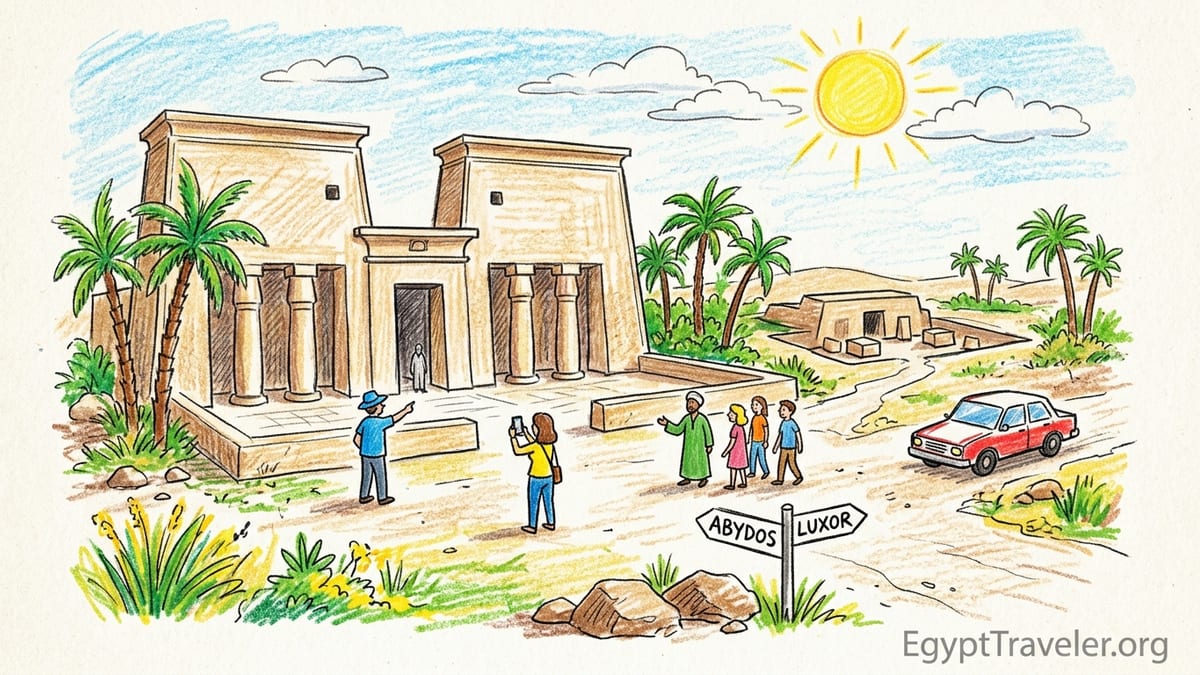
Why Abydos Belongs On a Luxor Itinerary
Set on the west bank of the Nile near the modern town of El Balyana, about 160 kilometers north of Luxor, Abydos was one of ancient Egypt’s most sacred pilgrimage centers. Today, the main draw for visitors is the Temple of Seti I, a New Kingdom masterpiece that many Egyptologists quietly rank above even Karnak and Luxor Temple for the quality of its reliefs. Where other sites dazzle with scale, Abydos captivates with intimacy and astonishing detail.
Unlike Luxor’s sprawling complexes, Abydos feels compact and contemplative. When you walk into the first hypostyle hall at Seti I’s temple, often with just a handful of other visitors, the silence and soft light make it easy to imagine priests moving through incense haze more than 3,000 years ago. This quieter, more focused atmosphere is exactly why many repeat visitors to Egypt prioritize Abydos once they have seen the “greatest hits” in Luxor.
Reaching Abydos does require effort. A private car drive from Luxor typically takes around 2.5 to 3 hours each way, and a combined Abydos and Dendera day can easily run 11 to 12 hours door to door. Travelers with only two or three nights in Luxor will probably not have enough time. For those with four or more nights or a deep interest in pharaonic art and religion, though, Abydos can be the highlight of an Upper Egypt trip.
The site is especially rewarding for anyone who has already visited several temples around Luxor and wants to go deeper rather than simply see more of the same. The seven parallel sanctuaries, the subtle change from Seti I’s delicate raised reliefs to the bolder sunk reliefs added by Ramesses II, and the mysterious Osirion behind the main temple all offer layers of nuance that reward a patient eye.
Inside the Temple of Seti I: Reliefs, Color and Seven Sanctuaries
The Temple of Seti I at Abydos looks modest from the outside, but its interior is among the most refined spaces in all of ancient Egyptian architecture. Two hypostyle halls lead you into the heart of the temple, their stone roofs intact, which means the reliefs have been sheltered from the worst of the sun and wind. As a result, you will see more original paint here than at most sites in Luxor, with soft creams, blues and reds still clinging to gods’ headdresses and offering tables.
Seti I favored low raised relief, a style where figures stand out crisply from the background rather than being carved inward. At Abydos, this technique reaches its peak. Look closely at the feathers in Ma’at’s wings, or the pleats of the king’s kilt; the carving is so fine that it almost resembles line drawing. In several chapels, you can still pick out tiny details such as individual grains of incense or the texture of animal fur. Even travelers who felt “templed out” after days in Luxor often find themselves pausing here, suddenly alert again to the artistry in front of them.
The temple’s most distinctive feature is its seven parallel sanctuaries aligned side by side, each dedicated to a different deity (and to Seti himself as a deified king). Moving from left to right, you pass chapels for Ptah, Re-Horakhty, Amun, Osiris, Isis, Horus and Seti. In antiquity, priests would carry portable barques holding the gods’ images along these seven axes in ritual processions; today, you can walk that same route, stepping from one shadowy sanctuary to the next, each with its own iconography and mood.
Because much of the roof remains in place, lighting inside the temple can be dim. A small pocket flashlight or the torch on your phone will help you appreciate fine lines and color, especially in the rear sanctuaries and side rooms. Photography is generally allowed for personal use without flash, but check current rules when you buy your ticket, as Egypt’s Ministry of Tourism occasionally adjusts photography fees and regulations.
The Abydos King List and the Osiris Cult in Practice
For many visitors, the single most memorable room in Seti I’s temple is a long side corridor often called the “Gallery of the Ancestors.” Here, in what looks at first glance like a decorative frieze, Seti I and his son Ramesses II are shown presenting incense to a procession of 76 earlier pharaohs. This is the Abydos King List, one of Egypt’s most important historical documents carved into stone.
The list does more than simply name rulers. It reflects how Seti I wanted to present the royal past, omitting controversial figures such as Hatshepsut and Akhenaten while honoring others from the early dynasties through the New Kingdom. Guides often use the relief to explain how modern Egyptologists reconstructed the country’s chronology, and to point out how history can be rewritten even in stone. Standing in front of the King List, you can trace cartouches with your eyes and realize that some entire reigns have been erased from official memory.
Abydos was also the heartland of the cult of Osiris, god of the dead and of resurrection. For centuries, Egyptians believed that the head or another relic of Osiris was buried here, and pilgrims from all over the Nile Valley came to participate in festivals reenacting his death and rebirth. In Seti I’s temple, scenes of Osiris dominate the rear chambers, showing the god on his throne, receiving offerings and presiding over judgment in the afterlife.
These reliefs make the mythology feel tangible. When a guide describes how ordinary Egyptians might have saved for years to travel to Abydos and have a stela set up here, believing it ensured their participation in Osiris’s resurrection, the temple’s religious significance comes into focus. Modern travelers often compare this experience to visiting places like Santiago de Compostela or Varanasi: a sense of being in a landscape shaped by centuries of pilgrimage, not just an isolated monument.
Exploring the Osirion and Other Remains at Abydos
Directly behind the rear wall of Seti I’s temple lies one of Abydos’s most intriguing structures: the Osirion (often spelled Osireion). Partly sunken and ringed by massive granite pillars, it looks very different from the elegant limestone halls in front of it. Most scholars consider it a symbolic tomb or cenotaph for Osiris, aligned with the temple but set at a lower level to evoke the watery underworld.
Access to the Osirion varies with water levels and conservation work, but even when direct entry is restricted you can usually view it from above via walkways or a viewing platform. In winter and early spring, the central basin is often filled with water, turning the stone pillars into reflections in a pool. In the hotter months, when it is drier, you may see more of the floor plan, including the central island where the symbolic burial of Osiris was envisioned.
Beyond the Osirion, Abydos includes other remains that are accessible with a short walk or quick drive. Just north of Seti I’s temple stand the ruins of a separate temple built by Ramesses II, whose more vigorous sunk reliefs contrast strongly with his father’s delicacy. Although the decoration is far less complete, visiting allows you to see how royal style evolved even within a single generation.
Archaeological work continues in the wider Abydos area, and ongoing digs sometimes limit access to minor structures. In practice, most day trippers from Luxor focus on the main Seti I temple, the King List corridor, the Osirion and, time allowing, Ramesses II’s temple. If you are particularly archaeology-focused and staying overnight at a nearby guesthouse, local guides can help you arrange walks to lesser-known tombs or earlier dynastic cemeteries, but these are typically beyond the scope of a standard visit.
Getting to Abydos from Luxor and Why It Pairs With Dendera
The practical starting point for most travelers is Luxor. Abydos lies roughly 160 kilometers to the north by road, and the most straightforward way to reach it is by private car with driver, typically arranged through your hotel, a local travel agency or an Egyptologist guide. In 2026, a return trip from Luxor to Abydos by private car generally costs in the ballpark of 70 to 100 US dollars for Abydos alone, or around 90 to 120 US dollars when combined with Dendera, with prices depending on vehicle size, fuel costs and whether an accredited guide is included.
Driving time from Luxor to Abydos is usually 2.5 to 3 hours each way, using the modern agricultural road north through Qena and then west across the fields toward El Balyana. Security checkpoints are routine along the route. They can add a few minutes to the journey but are rarely disruptive, and most private drivers are accustomed to the formalities. Police convoys, which were once mandatory for this route, are no longer consistently required, but local regulations can change, so it is wise to confirm current procedures with your hotel a day or two before travel.
Abydos is often paired with Dendera Temple, dedicated to Hathor, because the two sites lie in the same general direction from Luxor and complement each other well. A common itinerary is to leave Luxor early, drive around three hours to Abydos, spend 1.5 to 2 hours exploring Seti I’s temple and the Osirion, then return south and stop at Dendera for 1.5 to 2 hours on the way back. With driving plus rest and lunch stops, this usually makes for an 11 to 12 hour day.
There are theoretical alternatives, such as taking a morning train from Luxor to El Balyana or Qena and then hiring a local taxi, but the time lost arranging onward transport and the need to negotiate independently make this less practical for short stays. For most visitors, a prearranged private day tour with a driver and, ideally, a trained Egyptologist guide strikes the best balance between cost, comfort and time efficiency.
Is Abydos Worth It If You Have Seen Luxor’s Major Temples?
Travelers often wonder whether Abydos adds enough to justify the long day if they have already spent several days exploring Luxor’s rich temple landscape. The short answer is that for anyone with a serious interest in ancient Egypt’s art, religion or history, the answer is almost always yes. Abydos offers depth rather than breadth. Instead of another vast columned court, you get intact roofs and shadowed sanctuaries where subtle colors and fine lines have survived.
Visually, the comparison that most impresses visitors is between the partially restored reliefs at Karnak and the almost “fresh” carving at Abydos. In the chapels of Osiris and Isis, figures of Seti I and the gods stand out with a three-dimensional crispness that photographs barely capture. If you enjoyed the painted tombs in the Valley of the Kings or Queens, Abydos gives you that same thrill of seeing color and craft preserved against the odds, but in a temple context.
Intellectually, the Abydos King List and the Osiris-themed relief cycles also offer a narrative that is different from what you encounter at Luxor Temple or Hatshepsut’s Deir el-Bahri. Here the focus is on continuity of kingship and on the promise of resurrection through Osiris. Travelers who love connecting dots between sites often report that visiting Abydos helps them understand funerary scenes elsewhere on the Nile, because they have seen the “home base” of the Osiris cult.
That said, Abydos may feel less essential if you are on a whirlwind itinerary and primarily interested in iconic postcard views. For a first-time visitor with only two days in Luxor, sticking to the West Bank tombs and the big local temples is usually more realistic. Abydos comes into its own when you have an extra day to go deeper, or when you are on a repeat trip to Egypt and ready to move beyond the standard circuit.
Guides, Time on Site and How to Structure Your Visit
Abydos is one of the sites in Egypt where a knowledgeable guide can make an enormous difference. Many of the most important scenes are subtle: a small line of hieroglyphs that turns an offering scene into a historical record, or a series of panels that together tell the story of Osiris. An Egyptologist guide who knows the temple can walk you systematically through the hypostyle halls, the seven sanctuaries, the King List corridor and the Osirion, tying motifs together and pointing out contrasts between Seti I’s and Ramesses II’s styles.
If you are archaeology focused, plan a minimum of 1.5 to 2 hours at the Temple of Seti I and the Osirion, not counting travel. That allows time for a slow walk through each sanctuary, a careful look at the King List, and at least 15 to 20 minutes at the rear of the temple to study the Osirion from above. Visitors with a strong background in Egyptian history or art may want closer to 2.5 hours, especially if photographing details or sketching.
For a combined Abydos and Dendera day trip from Luxor, a realistic outline for an archaeology enthusiast might look like this: depart Luxor around 6:30 a.m., reach Abydos by 9:30 a.m., tour until about 11:30 a.m., then drive back toward Qena, stopping for a simple lunch at a roadside restaurant or in Dendera village. Arrive at Dendera Temple around 2:00 p.m., explore until roughly 4:00 p.m., and return to Luxor between 5:30 and 6:00 p.m., depending on traffic.
Independent travelers sometimes consider visiting Abydos without a guide to save money. Entry signage on site is limited, and most explanatory material is brief. If budget is tight, a compromise is to hire a driver only but invest in a good guidebook to Seti I’s temple, or to download a detailed site plan and carry printed notes that highlight key scenes. However, for a once-in-a-lifetime visit, especially on a tight schedule, a guide’s ability to orient you quickly and answer questions is often worth the extra cost.
Practical Tips: Tickets, Transport Choices and When to Go
Tickets for Abydos are purchased at the entrance gate, typically through a central ticket office that covers Seti I’s temple and the Osirion. As of late 2025, combined entry for foreign adults to major Upper Egypt sites of this type often sits in the range of several hundred Egyptian pounds, with student discounts around 50 percent for those holding valid international student IDs. Exact prices change periodically with currency fluctuations and government decisions, so confirm the current rate with your hotel or guide shortly before your visit.
Transport wise, a private car with driver remains the most practical choice. Many midrange and higher-end hotels in Luxor can arrange this directly, typically including hotel pickup, air-conditioned sedan or minivan, bottled water and a driver experienced with the checkpoints. Group bus tours are less common for Abydos alone but are offered by some tour operators for the combined Abydos and Dendera circuit, usually including a guide and lunch.
The route passes through rural areas, and rest stops are basic but adequate. Plan to use facilities at larger fuel stations or cafes recommended by your driver. Dress as you would for other temple visits in Egypt: light, breathable clothing that covers shoulders and knees, comfortable closed shoes, a sun hat and sunscreen. Even though parts of the temple are roofed and shaded, the walk between the parking area, ticket office, temple and Osirion exposes you to strong sun, especially from March through October.
The best seasons to visit Abydos are the cooler months from roughly November to March, when daytime highs are more comfortable and the long hours in the car feel less draining. If you are traveling in summer and still want to include Abydos, consider starting very early from Luxor, so that you tour the temple before midday heat and spend the hottest hours in the air-conditioned vehicle en route back toward Dendera or Luxor.
The Takeaway
Abydos is not the easiest temple to fit into an Upper Egypt itinerary, but for travelers willing to devote a full day to it, the rewards are exceptional. The Temple of Seti I offers some of the best-preserved relief carving in Egypt, with enough remaining color, intact roofing and intimate chapels to give a rare sense of how a functioning New Kingdom cult temple felt.
For visitors who have already explored the monumental complexes of Karnak and Luxor, Abydos shifts the emphasis from sheer size to nuance and meaning. The Abydos King List, the Osirion and the Osiris-focused iconography all deepen your understanding of how the ancient Egyptians thought about kingship, death and rebirth. When combined with Dendera’s radiant Hathor temple on a thoughtfully planned day trip from Luxor, Abydos often becomes not just another check mark on a list of sites, but the place where Egypt’s long story suddenly clicks into focus.
FAQ
Q1. How long does a day trip from Luxor to Abydos actually take? Most visitors should expect 2.5 to 3 hours of driving each way between Luxor and Abydos, plus 1.5 to 2 hours on site. If you include Dendera on the return, the entire excursion typically runs 11 to 12 hours door to door.
Q2. Is it safe to travel by road from Luxor to Abydos? The road between Luxor and Abydos is routinely used by tour operators, with security checkpoints along the route. Regulations can change, but as of 2026 most travelers visit by private car without incident. It is sensible to book through a reputable hotel or agency and reconfirm current guidance a day or two before your trip.
Q3. Can I visit Abydos independently without a tour? Yes. You can hire a private car with driver through your hotel or negotiate directly in Luxor and visit on your own. However, signage on site is limited, so if you skip a guide it helps to bring a detailed guidebook or notes about key scenes, especially for the King List and Osiris-related reliefs.
Q4. Do I need an Egyptologist guide at Abydos? A guide is not mandatory, but a knowledgeable Egyptologist can greatly enrich the experience by explaining the Abydos King List, the function of the seven sanctuaries and the meaning of specific scenes. For visitors particularly interested in archaeology or art history, hiring a guide is highly recommended.
Q5. Is Abydos still worth visiting if I have already seen Karnak and Luxor Temple? For most travelers interested in ancient Egypt, yes. Abydos does not compete on size but on quality and preservation of its reliefs, the unique layout of seven sanctuaries, and its deep association with the cult of Osiris, all of which offer a different perspective from the main Luxor temples.
Q6. How much does it cost to visit Abydos? Entry fees change periodically, but expect to pay the equivalent of a few US dollars in Egyptian pounds for the temple ticket, with possible student discounts about half the adult rate. Private car and driver from Luxor usually add 70 to 100 US dollars for Abydos alone or slightly more if combined with Dendera, depending on vehicle and inclusions.
Q7. What should I wear and bring for a visit to Abydos? Wear light, modest clothing that covers shoulders and knees, along with comfortable walking shoes. Bring a sun hat, sunglasses, sunscreen, water and a small flashlight or phone torch to better see reliefs in shadowed chapels. A camera without flash is usually allowed, but confirm current rules at the ticket office.
Q8. When is the best time of year to go to Abydos? The most comfortable period is from roughly November to March, when daytime temperatures are milder. In hotter months you can still visit, but plan an early departure from Luxor so that you tour the temple before midday heat and spend the hottest hours on the road in an air-conditioned vehicle.
Q9. Can I stay overnight near Abydos instead of doing a day trip? A few simple guesthouses and small hotels exist in the broader Abydos and El Balyana area, mostly used by archaeologists or very independent travelers. Facilities are basic compared with Luxor. Most visitors still find it more convenient to base in Luxor and visit Abydos on a long day trip with a private car and guide.
Q10. Is Abydos suitable for children or casual sightseers? Children who enjoy stories and mythology may respond well to the Osiris legends and the dramatic reliefs, but the long drive can be tiring. Casual sightseers without a strong interest in ancient history may prefer to focus on closer Luxor sites. Abydos is best appreciated by travelers willing to invest time and attention in its details.