


The Temple of Hathor at Dendera is one of Egypt’s best preserved and most atmospheric ancient sites, famous for its blue astronomical ceilings, Hathor-headed columns and mysterious underground crypts. Recent restoration work has revealed vivid colors that give a rare glimpse of how temples once looked, making Dendera an increasingly popular side trip from Luxor or Qena for travelers who want to go beyond the classic Nile circuit.
Why Dendera Matters: An Overview of the Temple of Hathor
Dendera lies on the west bank of the Nile near the modern city of Qena, about 60 kilometers north of Luxor. The main Temple of Hathor dates largely to the Ptolemaic and early Roman periods, roughly between the 1st century BCE and the 1st century CE, built over much older sacred structures. Dedicated to Hathor, goddess of love, music and joy, it served as the cult center for one of ancient Egypt’s most beloved deities.
The Egyptian Ministry of Tourism and Antiquities highlights Dendera as one of the country’s best preserved temples, and a walk through its hypostyle hall, side chapels and rooftop shrines makes that claim easy to understand. Wall reliefs are crisp, colors have survived in sheltered areas, and architectural details such as staircases, crypt entrances and shrines are intact in a way that many travelers find more legible than at more ruined sites.
For modern visitors, Dendera combines the grandeur of a major state temple with the intimacy of hidden spaces. You can stand beneath a ceiling filled with marching stars and constellations, then moments later duck into a low, inscribed crypt that once stored sacred cult objects. This mix of open monumentality and enclosed mystery sets Dendera apart from many other famous temples on a standard Nile itinerary.
Because the temple complex is more compact than Karnak or Medinet Habu, it is also easier for non-specialists to read. You can trace a fairly clear path from the monumental facade through the main sanctuary and out onto the roof, with enough time to pause and absorb key scenes without feeling overwhelmed.
Hathor-Headed Columns and the Restored Astronomical Ceilings
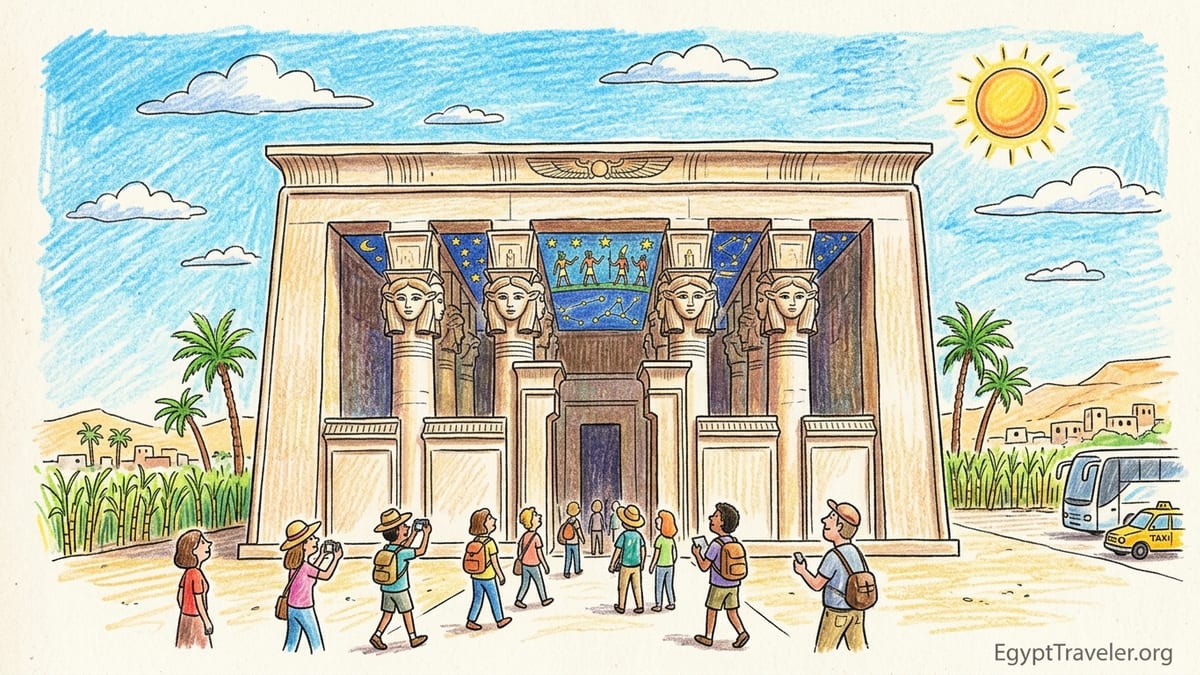
The first impression most visitors take away from Dendera is the great hypostyle hall with its rows of massive columns capped by four-faced Hathor capitals. Each capital shows the goddess with cow ears and a heavy wig, gazing out toward the four cardinal directions. Years of soot and grime once obscured these faces, but cleaning campaigns have brought back soft blues and greens around the wigs and crowns, transforming the atmosphere of the hall.
Look up from the columns and you see why Dendera has become famous among photography enthusiasts and Egyptologists alike. The ceiling of the great hall is covered in astronomical scenes, including marching deities carrying solar boats, constellations represented as animals and human figures, and bands of stars and hieroglyphs. Before cleaning, many guidebooks described the ceiling as almost black. Today, visitors report clearly visible pale blue backgrounds, golden-yellow figures and white stars, which show through vividly in smartphone photos taken without flash.
The restoration work has been done carefully, focusing primarily on removing layers of soot and bird droppings rather than repainting. This means that the colors you see are largely original pigments exposed again after centuries of smoke from oil lamps and later human activity. Travelers who have recently visited both Dendera and Edfu or Kom Ombo often comment that, while those temples are impressive architecturally, it is Dendera’s color that sticks in their memory.
If you have limited time on site, plan to spend at least 15 to 20 minutes just standing in different parts of the hypostyle hall looking upward. Move toward the center to take in the overall composition, then walk to the side aisles where you can get closer to individual astronomical motifs. Many independent visitors use a basic telephoto or the zoom function on a phone to isolate details such as star-goddesses, the vulture-winged sky, or processions of deities.
The Famous Zodiac and Other Astronomical Imagery
Dendera is closely associated with the so-called Dendera Zodiac, a circular astronomical relief that originally formed part of a ceiling in a rooftop chapel dedicated to Osiris. The original sandstone slab was removed in the 19th century and is now in the Egyptian collection of the Louvre Museum in Paris. On site at Dendera today, visitors see a modern replica installed in its original architectural position, surrounded by other astronomical scenes.
Even though the zodiac disk in the temple is a copy, the surrounding decoration is authentic and offers rich material for anyone interested in ancient sky lore. The ceiling of the Osiris chapel shows the sky goddess Nut arching over the world, with registers of decans, planetary symbols and hour deities. Some tour guides like to point out constellations that roughly correspond to Taurus or Libra, helping visitors connect the imagery with familiar Western zodiac signs.
Elsewhere in the temple, especially in the outer hypostyle hall, you can find additional zodiac-related figures and calendar scenes. A black bull representing Taurus, rows of star-goddesses and processions of solar boats all contribute to an environment that feels like a three-dimensional star atlas. Travelers who have visited planetariums in their home countries often note that Dendera’s ceilings give a more tactile sense of how the Egyptians embedded the sky into sacred architecture.
For many visitors, knowing that the actual zodiac disk is in Paris does not diminish the experience. The combination of original astronomical ceilings and the in-situ replica allows you to understand both the architectural context and the global story of how this piece traveled, inspired early 19th-century debates about the age of the world, and eventually became a museum centerpiece far away from the Nile.
Crypts, Rooftop Chapels and the Birth Houses
Beyond its ceilings, Dendera is especially loved for its maze of crypts and upper-level chapels. Small, steep staircases lead down into narrow, low-roofed crypts cut within the thickness of the temple walls. These spaces once sheltered cult statues, ritual instruments and possibly precious metals associated with Hathor’s festivals. Today they are empty, but their walls are covered in intricate reliefs, including the often-cited scenes of so-called “Dendera light bulbs,” which most scholars interpret as symbolic imagery related to lotus flowers and creation myths rather than actual technology.
Some crypts are periodically closed or require an additional ticket referred to locally as a serdab or crypt ticket. When open, these areas are among the most atmospheric parts of the complex, especially for travelers interested in the behind-the-scenes functioning of a temple. Because the ceilings are low and surfaces are fragile, flash photography is typically discouraged, and visitors should be prepared to walk carefully in dim light.
From the rear of the main temple, staircases lead up to the roof where a series of chapels dedicated to Osiris and other deities overlook the surrounding plain. The rooftop area offers good views over the Nile valley and the village of Dendera, and many guides time their visit so that guests reach the top when the light is soft in the late afternoon. The replica zodiac and important astronomical reliefs are located in this rooftop zone, so it is worth the climb even in warmer months.
Outside the main Hathor temple there are also birth houses, or mammisis, small chapels associated with divine birth and festival processions. The best preserved of these structures shows reliefs of Ptolemaic rulers presenting offerings to deities and scenes of the divine child. Travelers who have seen the birth house at Philae often comment that Dendera’s versions, though smaller, feel more intact and easier to explore without crowds.
Tickets, Opening Hours and Optional Areas
According to the Ministry of Tourism and Antiquities, the Temple of Dendera is generally open daily from around 7:00 in the morning until 17:00 in the afternoon, although closing time can vary slightly with the season. Many tour operators from Luxor aim to arrive between 8:30 and 10:00, which means independent travelers who come right at opening or mid-afternoon often enjoy quieter conditions.
Recent official pricing for foreign visitors lists a standard adult ticket around 300 Egyptian pounds and a reduced student ticket at roughly half that rate. Additional optional tickets are available for specific areas such as a “panorama” access and a “serdab” or crypt ticket, each typically priced around 100 Egyptian pounds for foreigners. These add-ons are modest compared with overall trip costs and can be worthwhile for travelers who want rooftop viewpoints or access to particular enclosed spaces when open.
Tickets are purchased at the main gate, and Dendera is among the sites included in Egypt’s gradual roll-out of e-ticketing. In practice, many visitors still simply pay cash or by card at the kiosk on arrival, while some group tours have tickets pre-arranged by their operator. A small parking fee is charged per vehicle, with separate rates for taxis, minibuses and large tour buses, usually collected as you enter the complex.
When considering optional areas, ask at the ticket office or check with your guide which zones are currently open. Rooftop access is almost always worth the small supplement, particularly if you are interested in the zodiac replica and Osiris chapels. Crypt access is more subjective: travelers who are claustrophobic or unsteady on stairs may prefer to skip it, while those fascinated by the “backstage” of temple ritual often say these tight passageways were among their most memorable experiences in Upper Egypt.
How to Reach Dendera from Luxor or Qena
Dendera combines well with a Luxor stay, particularly as a half-day or three-quarter-day trip. The distance from Luxor to Dendera is about 60 kilometers by road, and the drive usually takes 1.5 to 2 hours each way, depending on traffic and checkpoints. Many travelers book a private car through their Luxor hotel or a local travel agency, often packaged with an English-speaking guide and including pick-up and drop-off at their hotel or cruise boat.
In practical terms, a typical private excursion from a mid-range Luxor hotel might involve a 7:00 or 8:00 departure, arrival at Dendera around 9:30 or 10:00, a two-hour visit, and an optional stop at the nearby temple of Abydos on a full-day circuit before returning to Luxor in the early evening. Some agencies advertise combined Abydos and Dendera tours that share transport costs among a small group, which can be more economical than hiring a car alone.
If you are already in Qena, either on a Nile cruise that stops at the city or during overland travel, Dendera is only a short drive away, roughly 15 to 20 minutes by taxi. Many Qena hotels and river cruise reception desks can arrange a local car for a fixed fee, often including waiting time at the site. Because Dendera is on the west bank opposite Qena, you simply cross the Nile bridge and follow signs to the temple, passing sugar-cane fields and small villages on the way.
Public transport options are limited for foreign travelers because of security procedures and the need to coordinate with local authorities. While some experienced backpackers have used microbuses and then hired a tuk-tuk for the last stretch, most visitors find it simpler and still relatively affordable to book a private driver through an agency, especially if they want a predictable schedule and help navigating ticketing on arrival.
How Much Time to Allow and Do You Need a Guide?
For most travelers, a focused visit to the main Temple of Hathor and its immediate surroundings takes around two hours. This allows time to explore the hypostyle hall, sanctuary, roof, at least one crypt if open, and a quick circuit of the exterior and birth houses. Serious photography enthusiasts, history buffs or those wanting a slower pace often plan for three hours on site and still feel engaged throughout.
Whether you need an Egyptologist guide depends on your interests and travel style. The site itself has only limited explanatory signage, and even when panels are present they can be quite brief. A licensed guide can help decode the astronomical ceilings, identify key scenes of Cleopatra VII and Caesarion offering to the gods, and point out small but significant details such as sound holes for sistrum instruments in reliefs or formulaic offering texts.
Many visitors traveling on a tight budget choose to come with only a driver, relying on general Egypt guidebooks and offline resources to interpret what they see. In that case, it is helpful to prepare in advance by reading about Dendera’s plan and printing or saving a simple diagram of the temple layout. On arrival, some independent travelers also arrange for an on-site local guide at the gate, negotiating a fee in Egyptian pounds for a one- or two-hour walkthrough.
For travelers who already have a dedicated Egyptologist with them in Luxor, adding Dendera as a side excursion with the same guide often gives the best balance of context and flexibility. Because the temple is relatively compact, a good guide can structure the visit efficiently, for example starting with the exterior facade and Hathor columns, then the hypostyle hall and astronomical ceiling, then moving through side chapels, crypts and roof in a logical sequence without backtracking.
Planning Your Visit: Best Time of Day, Practical Tips and Safety
Dendera can be visited year-round, but weather and light strongly influence the experience. From October to April, temperatures in Upper Egypt are usually mild, and morning visits between 8:00 and 11:00 offer comfortable conditions with soft side light for photographing column capitals and reliefs. In the hotter months from May to September, many travelers prefer to arrive as close to opening as possible to explore the exposed rooftop chapels before midday heat builds.
Inside the temple, much of the space is shaded and relatively cool, but the rooftop and approach to the complex are in full sun. Carry water, wear a hat and sunscreen, and consider light layers if visiting in winter mornings, when breezes across the fields can feel surprisingly cool. Footwear with decent grip is useful for navigating worn stone staircases, especially those leading to crypts and rooftop chapels.
Photography is usually allowed throughout the complex, and many visitors make extensive use of phone cameras to capture the restored ceilings. Policies on tripods and professional gear can vary and may require additional permits, so it is wise to check ahead with your tour operator if you plan serious photographic work. Inside confined spaces, be courteous to other visitors by avoiding bright video lights or repeated flash use.
Security around Dendera is similar to other major Upper Egyptian sites, with a checkpoint on the access road and standard bag screening at the entrance. Most travelers report feeling comfortable on site, and the atmosphere is generally relaxed, with vendors clustered near the parking area rather than inside the temple itself. As always, keep valuables secure, agree taxi fares in advance if arranging transport on the spot, and carry small-denomination Egyptian notes for tips and minor purchases such as drinks at the parking lot kiosks.
The Takeaway
For travelers who love ancient Egypt, Dendera offers a rare combination of outstanding preservation, newly revealed color and a visitor-friendly scale. The Hathor-headed columns and blue astronomical ceilings deliver some of the most striking interior scenes anywhere along the Nile, while the crypts and rooftop chapels invite you into spaces that feel intimate and almost backstage.
Access from both Luxor and Qena is straightforward with a private car or organized excursion, and the relatively modest ticket and optional area fees make Dendera an excellent value in time and budget. Whether you visit as part of a full-day circuit with Abydos or on a dedicated half-day trip, allowing two to three hours on site gives enough time to appreciate both the big picture and the details.
Travelers who come prepared, either with a knowledgeable guide or with some pre-reading and a simple plan, consistently rank Dendera among their favorite experiences in Upper Egypt. The temple’s restored colors, famous zodiac imagery and sense of completeness turn what might seem like an optional side trip into a highlight that deepens your understanding of how ancient Egyptians linked sky, stone and ritual life.
FAQ
Q1. How long does a typical visit to the Temple of Hathor at Dendera take?
A standard visit usually takes about two hours, covering the hypostyle hall, sanctuary, rooftop chapels and at least one crypt if open. Travelers who enjoy photography or detailed exploration often plan for three hours.
Q2. What are the current opening hours for Dendera Temple?
The temple is generally open daily from around 7:00 in the morning until approximately 17:00 in the afternoon. Hours can vary slightly with the season and local decisions, so it is wise to double-check with your hotel or tour operator the day before your visit.
Q3. How much does it cost to visit Dendera Temple?
Recent official prices list the main entrance ticket for foreign adults at around 300 Egyptian pounds, with student tickets at roughly half that rate. Optional tickets for areas such as the rooftop panorama or crypts are usually about 100 Egyptian pounds each for foreigners, but you should confirm current rates on site.
Q4. Can I visit Dendera as a day trip from Luxor?
Yes. Dendera is about 60 kilometers from Luxor, with a drive of 1.5 to 2 hours each way. Many travelers book a private car or join a small-group tour that includes hotel pick-up in Luxor, a two- to three-hour visit at Dendera, and sometimes a combined excursion with Abydos.
Q5. Is the famous Dendera Zodiac still in the temple?
The original circular Dendera Zodiac relief was removed in the 19th century and is now in the Egyptian collection of the Louvre Museum in Paris. At the temple you will see a modern replica installed in its original rooftop chapel, surrounded by authentic astronomical ceilings and other reliefs.
Q6. Do I need an Egyptologist guide to enjoy Dendera?
A guide is not mandatory but is highly recommended if you are interested in understanding the astronomical imagery, ritual scenes and historical context. Without a guide, you can still appreciate the architecture and colors, but you may miss many details. Independent travelers often hire a licensed guide in Luxor or arrange for a local guide at the Dendera gate.
Q7. Are the crypts and rooftop areas included in the standard ticket?
Access policies can change, but generally the main temple, hypostyle hall and standard rooftop routes are included in the basic ticket, while certain viewpoints or specific crypts may require an additional ticket. These optional tickets are moderately priced, and it is best to ask at the ticket office which special areas are open on the day of your visit.
Q8. What is the best time of day to see the restored ceiling colors?
The colors are visible throughout the day, but many visitors find that late morning or mid-afternoon provides a good balance of ambient light inside the hall and manageable heat outside. Early morning visits are cooler and quieter, while late afternoon on the roof can offer soft, warm light over the surrounding fields.
Q9. How do I get to Dendera from Qena?
If you are in Qena, the temple is a short drive away on the opposite bank of the Nile. Most travelers hire a taxi or arrange a car through their hotel or cruise reception, with the driver waiting during the visit. The ride typically takes 15 to 20 minutes each way.
Q10. Is Dendera Temple suitable for travelers with mobility concerns?
The main courtyard and hypostyle hall are on relatively level ground, though surfaces are uneven in places. Access to crypts and rooftop chapels involves steep, narrow staircases with worn steps and no lifts, which can be challenging. Visitors with limited mobility can still enjoy the columns, main ceilings and many wall scenes at ground level, but should discuss specific needs with their tour operator in advance.