


The Temple of Horus at Edfu is often described by Egyptologists as the closest you can get to walking through a complete ancient Egyptian temple. Its soaring pylons, shadowed hypostyle halls and almost intact sanctuary survived relatively untouched for centuries because the complex lay buried under sand and later houses. Today it is a highlight of Nile cruises between Luxor and Aswan, but it is also reachable by train and road for independent travelers who want to experience it at quieter times. This guide explains what makes Edfu unique, walks you through its main features, and sets out clear, real-world advice on how to get there and avoid the worst of the crowds.
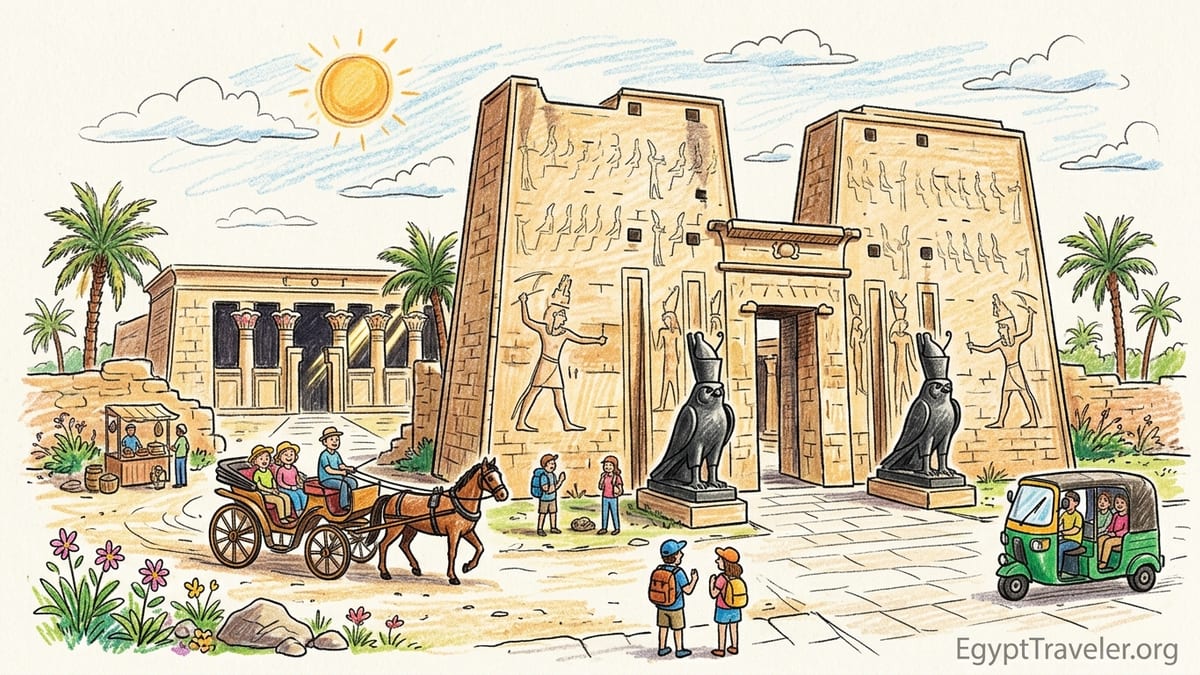
Why Edfu’s Temple of Horus Is So Remarkably Complete
The Temple of Horus at Edfu sits on the west bank of the Nile in Aswan Governorate, roughly halfway between Luxor and Aswan. Built during the Ptolemaic period between 237 and 57 BCE, it is dedicated to Horus, the falcon god associated with kingship and protection. What makes Edfu exceptional is not just its size, but how fully the original layout survives. Unlike many sites where only columns and fragmentary walls remain, at Edfu you still move through a coherent sequence of spaces from the monumental gateway all the way into the sanctuary.
The Egyptian Ministry of Tourism and Antiquities specifically highlights that Edfu is one of the most complete ancient temples in the country and that it retained its architectural and decorative elements because it was buried for a long period beneath sand and later structures. In practice this burial acted as a protective blanket, shielding delicate reliefs and architectural details from weathering, iconoclasm and stone-robbing that affected temples like Luxor and Karnak. The temple was gradually cleared in the 19th century under the French archaeologist Auguste Mariette, revealing façades, hypostyle halls and a sanctuary that looked astonishingly close to how they appeared in antiquity.
For visitors, this unusual state of preservation means that Edfu is one of the few places in Egypt where you can get a near-complete sense of how worship unfolded: where processions entered, how incense and offerings were presented, where the cult statue rested at night, and how side chapels linked to wider temple rituals. When you walk the axis from the forecourt to the dark heart of the building, you are following a route that ancient priests would immediately recognize.
Another advantage of Edfu’s preservation is the clarity of its inscriptions. Many of the walls are densely covered in hieroglyphic texts and ritual scenes that remain sharp enough for specialists to study in detail. Recent conservation work has even revealed traces of original color and gilding, giving a glimpse of how bright and elaborate the temple once looked. While most travelers will not read the hieroglyphs, the crispness of the carving is obvious to the naked eye and adds to the sense of immersion.
Walking the Temple: From Pylons to Open Courtyard
Your visit begins at the massive twin-towered pylon that forms the ceremonial gateway. As you approach across the open forecourt, the facade looms above you, rising over 30 meters, with carved scenes of the pharaoh smiting enemies before Horus. Standing in front of this pylon and looking up is often when visitors realize just how complete Edfu is: the doorway still has its deep recesses, the towers rise intact, and carved flagstaff grooves frame the entrance where banners once flew in the desert wind.
Flanking the base of the pylon are two famous black granite statues of Horus as a falcon, each wearing the double crown of Upper and Lower Egypt. Travelers commonly pause here for photographs, and early-arriving visitors often have a few moments when one statue seems to stand guard over them alone before tour groups arrive. Touching the cold stone and tracing the outline of Horus’s beak or claws drives home how tangible the cult of this god once was.
Passing through the pylon, you emerge into a large open courtyard surrounded by a colonnade. This forecourt would have been the transition space where ordinary worshippers could gather, while only priests processed deeper into the temple. Today, many guides from Nile cruises start their explanations here, using the courtyard’s broad perspective to point out the main features of the temple and outline the myth of Horus and his conflict with Seth. If you arrive independently by train or private car before the big cruise groups, you may find the courtyard relatively empty, with just a few independent travelers and local guides offering their services in a low-key way.
The colonnade around the courtyard is worth a slow circuit. Each column has a different floral capital, and the walls behind them carry reliefs of the king presenting offerings to Horus and other deities. Because the temple’s roof and upper walls survive, this area remains shaded for much of the day, making it a comfortable place to pause even under intense Upper Egyptian sun.
Hypostyle Halls, Side Chambers and the Dark Sanctuary
Beyond the open courtyard you step into the first hypostyle hall. Here the atmosphere changes dramatically: the light dims, the air cools and tall columns crowd the space, their capitals just visible in the gloom above. Rays of sun filter in through stone grilles, creating sharp-lit slashes that fall across carved walls. The effect is deliberate, designed to mark the shift from the communal outer court to the more sacred interior. Many visitors describe this moment as one of the most evocative in the entire temple.
The first hypostyle hall still retains its roof, complete with decorative ceilings and well-preserved reliefs. Look up to spot astronomical motifs and down to see offering scenes carved along the base of the walls. This hall also holds inscriptions that describe the founding ceremonies of the temple, including the ritual drawing of its ground plan. A second, slightly smaller hypostyle hall lies deeper in, functioning as an inner vestibule that only initiated priests would have entered in antiquity.
Radiating off these halls are numerous side chapels and storage rooms. Some were used to prepare offerings like bread, beer and incense; others stored sacred vessels and ritual equipment. Today most are empty, but their carved walls still illustrate their former functions. In one side chamber you may see priests carrying trays of loaves, in another they pour libations or burn incense before Horus. Many guides illustrate how these scenes correspond to the daily liturgy, turning the temple into a three-dimensional manual of religious practice.
At the heart of the complex lies the sanctuary, one of the most intact in Egypt. This compact, dimly lit chamber once housed the cult statue of Horus within a naos, or shrine. The granite naos that stands there today dates to the earlier reign of Nectanebo II and was reused in the Ptolemaic structure. Around the sanctuary are an ambulatory and multiple chapels dedicated to associated deities. Walking the narrow passage around the sanctuary gives an almost physical sense of how tightly choreographed the priests’ movements would have been during festivals and daily rituals.
Key Reliefs, Mythology and Details Not to Miss
Because Edfu is so complete, it is also dense with narrative reliefs that recount myths and ritual dramas. One of the most striking themes is the story of Horus avenging his father Osiris by battling his uncle Seth. Along the walls you will find scenes that illustrate episodes of this cosmic conflict, including Horus hunting Seth in the form of a hippopotamus. Guides often point out these reliefs as examples of how Egyptian theology was visualized for temple visitors.
On the outer rear wall, there are large processional scenes depicting the annual festival when the goddess Hathor traveled from her temple at Dendera to visit Horus at Edfu. Although most travelers do not walk all the way around the outside, making the effort can be rewarding. Here you see boats carrying statues of the gods, priests marching in rows and musicians playing sistrums and drums. These scenes tie the temple into a wider sacred landscape along the Nile, underscoring that Edfu was part of a network of cult centers linked by river and ritual.
Inside, look for smaller but telling details. In some chambers, you can still see faint patches of original blue or red paint picked out between the carved lines. In others, visitor graffiti from Greek, Roman and even later periods is scratched into the stone, evidence that ancient travelers were drawn to Edfu much as modern ones are. Several recent conservation projects have gently cleaned soot and mineral deposits from selected reliefs, revealing sharp outlines and the occasional gleam of gold that make it easier to read the scenes even without a guidebook.
If you are particularly interested in iconography, consider pausing with a local guide for ten or fifteen minutes in one of the quieter side chapels. Many guides carry laminated sheets illustrating key deities and scenes from Edfu and other temples. Seeing the same god or symbol recur from wall to wall, while the guide links it back to the broader story of Horus and the king, can be far more illuminating than trying to decode dozens of scenes alone.
Getting to Edfu: Train, Road and Nile Cruise Options
Edfu lies on the main railway line and road between Luxor and Aswan, which gives travelers multiple options for visiting. The most common is as part of a multi-day Nile cruise: nearly all standard four-night Luxor to Aswan itineraries stop at Edfu, usually on the second or third day. In that case, temple visits are normally bundled into the cruise price and logistics are handled by your tour operator. Expect early morning wake-up calls and a short transfer by horse-drawn carriage or minibus from the riverbank to the temple.
Independent travelers can reach Edfu by train from either Luxor or Aswan. Regional services typically take around two to three hours depending on the train and intermediate stops. While exact fares change over time, second-class seats are often priced in a range that makes day trips viable for budget travelers. Tickets can be bought at the station ticket window; some travelers also report success purchasing through local travel agencies in Luxor or Aswan that handle seat reservations and provide schedules in English.
Arriving by road is another practical option, particularly for small groups or families who want more control over timing. Private drivers commonly offer day trips that combine Edfu with Kom Ombo, or stops at Esna and Edfu while transferring between Luxor and Aswan. In this scenario, a driver picks you up from your hotel early in the morning, waits while you visit the temple and continues on, with the cost agreed in advance. Prices vary widely based on vehicle type and season, but in practice you can often negotiate a full-day transfer plus temple stopovers for less than the per-person cost of some organized group tours.
When comparing options, factor in not just cost, but also your tolerance for crowds and interest in flexible timing. Nile cruises offer seamless logistics but limited control over when you see the temple. Trains and private cars require more planning but let you aim for off-peak hours, which can completely change the feel of your visit.
Distances on the Ground: From Station and River to the Temple Gate
One of the most practical questions travelers ask is how far Edfu Temple sits from modern transport points. From Edfu railway station to the temple the distance is roughly 2 kilometers. Many visitors choose a quick transfer by tuk-tuk or local taxi, which usually takes around five minutes. Fares are negotiated on the spot, and as a rough guide travelers in recent seasons have reported paying modest sums for a one-way ride, slightly more if you ask the driver to wait and bring you back to the station after your visit.
Walking from the station to the temple is also possible if you are traveling light and comfortable in the heat. The route takes about 20 to 25 minutes at an easy pace, passing through ordinary neighborhood streets where you see local shops, schoolchildren, and the everyday life of Edfu. However, in the hotter months between May and September, most visitors prefer motorized transport, especially for mid-day arrivals.
Nile cruise boats dock on the riverbank near the town, and from the moorings to the temple is a similar distance of roughly 2 kilometers. Many cruise lines have a set arrangement with horse-drawn carriages, known locally as calesh. Groups often disembark together and climb into a line of carriages that whisk them to the temple in about ten minutes. Independent cruisers or those on smaller boats sometimes opt for a private calesh or a taxi instead. In every case, it is wise to confirm the total price for a round trip, including waiting time, before you step aboard to avoid awkward haggling later.
The ticket office is located close to the main approach to the temple, near where vehicles drop passengers. From there it is a short walk through the outer compound and security checks before you reach the pylon and Horus statues. Allow a few extra minutes if several busloads have arrived together, as queues can form at the x-ray machines. Once inside the temple enclosure, you have freedom to set your own pace regardless of how you arrived.
Timing Your Visit, Dealing With Cruise Crowds and How Long to Stay
Because Edfu is an almost guaranteed stop on standard Nile cruise itineraries, crowd patterns are quite predictable. Cruise ships usually aim to have passengers at the temple between roughly 7:00 and 10:00 in the morning, with the busiest window often around 8:00 to 9:30. At these times you may see long lines of calesh outside, guides holding flags or colored signs, and groups moving through the halls in clusters of twenty or thirty people. The main courtyard and first hypostyle hall can feel congested, and photography may require patience.
If you visit independently, the best strategy is to work either ahead of or behind the cruise schedule. Very early arrivals, around opening time, can enjoy the temple before most groups arrive. On certain days the site opens as early as 6:00 in the morning, which creates a golden hour of soft light and relative quiet. Late-morning or early-afternoon visits can also be calmer once the cruise passengers have reboarded and boats have continued south or north. In the hottest months, consider balancing cooler, quieter hours against the midday sun by carrying water, a hat and sun protection.
In terms of duration, most organized cruise groups spend about 60 to 90 minutes inside the temple, enough time for a brisk guided tour that covers the main axis and a few key chapels. Independent travelers who are particularly interested in photography, architecture or religious history often stay two to three hours. A practical minimum if you are coming all the way from Luxor or Aswan by train is 90 minutes inside the site, which allows you to absorb the main spaces without feeling rushed.
When planning a day trip, remember to include transfer times to and from the station or river moorings and to check the latest opening hours shortly before you travel. In recent years, official schedules have generally listed opening around 6:00 or 7:00 in the morning with closing between 5:00 and 6:00 in the evening, but these can shift slightly by season. As a rule, last entry is about one hour before closing, and arriving earlier gives you more margin for delays and more flexibility to linger in quiet corners if you find a favorite spot.
Tickets, Practicalities and On-the-Ground Tips
Ticket prices at Edfu are set by the Ministry of Tourism and Antiquities and are periodically adjusted. At the time of writing, foreign adult tickets are priced in the upper hundreds of Egyptian pounds, with a reduced rate for accredited students who can show valid identification. Egyptian nationals and residents pay lower local rates. Tickets can usually be purchased directly at the onsite ticket office, and at many periods card payments have been accepted alongside cash, though it is wise to carry enough local currency in case of technical issues.
Security procedures are similar to other major archaeological sites in Egypt. Expect to pass through a metal detector, have bags screened and possibly show your passport or a copy. Small backpacks, cameras and water bottles are generally allowed, but larger items may be checked or discouraged. There are basic facilities near the entrance, including restrooms and a few kiosks or stalls selling bottled drinks and simple snacks. For more substantial meals, most travelers return to their cruise boats or eat in town.
Dress codes are practical rather than formal. Lightweight, breathable clothing that covers shoulders and knees works well and is respectful in a conservative area. Closed shoes or sturdy sandals make it easier to navigate uneven stone floors and steps, especially in the dim inner halls. Bringing a small flashlight or using your phone’s light function can help you appreciate reliefs in darker corners, though be mindful not to shine bright beams directly into other visitors’ eyes.
Hiring a local guide at the gate can greatly enhance your visit. Licensed guides often wait near the entrance and will quote a price for a one- to two-hour tour. Negotiation is standard, so agree both the fee and the approximate duration before starting. Some travelers also arrange guides in Luxor or Aswan who accompany them on the train or in a private car. While guide quality varies, a knowledgeable one can unpack the symbolism on the walls, point out features you might otherwise miss and help you move around peak crowds more efficiently.
The Takeaway
Edfu’s Temple of Horus stands out in Egypt because it feels like a living blueprint of a complete ancient sanctuary rather than a scattered ruin. Its towering pylons, intact colonnades and remarkably preserved sanctuary all owe their survival to centuries of burial under sand and later settlement, a stroke of luck that now allows modern visitors to step into spaces that ancient priests would recognize. Whether you come as part of a Nile cruise convoy or make the extra effort to arrive by train or private car at a quieter hour, the temple rewards an unhurried, observant visit.
For travelers willing to plan around cruise schedules, Edfu can offer moments of surprising calm, especially in the early morning or later in the day when the crowds thin. Standing almost alone before the granite falcons or in the shadowed hypostyle hall, listening to the faint echoes of other visitors while shafts of light pick out carved hieroglyphs, you gain a sense of continuity across millennia that is hard to find elsewhere. With realistic expectations about transport, timing and on-the-ground logistics, Edfu is not just a stop between Luxor and Aswan, but a destination that can anchor an entire Upper Egypt itinerary.
FAQ
Q1. Why is the Temple of Horus at Edfu considered so well preserved?
The temple remained buried under sand and later buildings for centuries, which protected its walls, reliefs and overall layout from weathering and deliberate damage.
Q2. How long should I plan to spend at Edfu Temple?
Most cruise groups spend about 60 to 90 minutes, but independent travelers interested in photography or history often stay two to three hours for a more relaxed visit.
Q3. How far is Edfu Temple from the train station?
The temple is roughly 2 kilometers from Edfu railway station, about a five-minute ride by tuk-tuk or taxi, or a 20 to 25 minute walk if the weather is reasonable.
Q4. How far is the temple from Nile cruise docking points?
Cruise boats generally dock on the nearby riverbank, also around 2 kilometers from the temple. Transfers by horse-drawn carriage or minibus usually take about ten minutes each way.
Q5. When is Edfu Temple most crowded with Nile cruise groups?
The busiest period is typically between about 7:00 and 10:00 in the morning, with a peak around 8:00 to 9:30 when several cruise groups often arrive at once.
Q6. What is the best time of day to visit for fewer crowds?
Arriving at opening time in the early morning or visiting later in the morning or early afternoon after cruise groups have departed usually offers a calmer experience.
Q7. Can I visit Edfu independently by train from Luxor or Aswan?
Yes. Regional trains connect Edfu with both Luxor and Aswan in around two to three hours. From the station you can walk or take local transport to the temple.
Q8. Are there additional fees besides the main entry ticket?
The standard ticket covers admission to the temple. Extra costs typically involve local transport, guiding services and optional tips rather than separate site fees.
Q9. Is hiring a guide at Edfu worthwhile?
Many travelers find a licensed guide worthwhile because the temple is dense with symbolism and narrative reliefs that are easier to understand with expert explanation.
Q10. Is Edfu suitable for travelers with limited mobility?
Access to the outer court and some halls is relatively level, but there are uneven stones, thresholds and dim interiors, so travelers with limited mobility should plan carefully and may need assistance.