


Between Qena and Aswan, the Nile bends through a corridor of palm groves, sugarcane fields and desert cliffs that has concentrated over 3,000 years of Egyptian history into a single stretch of river. For a first trip to Egypt, this part of Upper Egypt can feel like a vast open-air museum, where everyday villages sit beside some of the world’s most important temples and tombs. This guide explains why the region around Qena, Luxor and Aswan became so significant, and how to use Luxor and Aswan as practical bases for exploring Dendera, Abydos, Esna, Edfu and Kom Ombo by train, road, tour and, if you choose, by cruise.
Understanding Upper Egypt’s Nile Valley
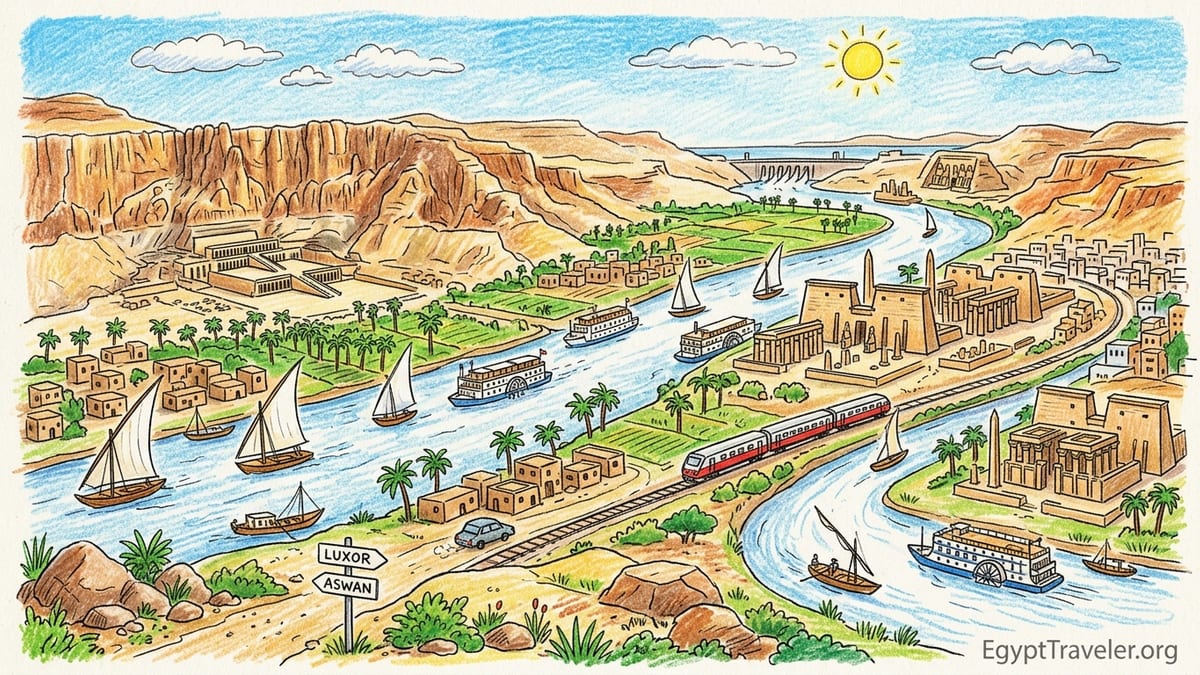
Upper Egypt refers to the southern stretch of the Nile Valley, running from around modern Qena down to Aswan and beyond. Here the Nile is tightly framed by cliffs and desert on both sides, with only a narrow band of fertile land that has supported human life for millennia. Today, modern towns such as Qena, Luxor and Aswan line this corridor, but the basic geography is the same one that shaped the ancient pharaonic state.
This geography explains why the region holds such a dense concentration of temples and archaeological sites. With cultivable land restricted to a thin ribbon, settlements clustered close to the river, and religious centers grew where land and trade routes intersected. Luxor stands where the river’s east bank offered space for monumental complexes such as Karnak and Luxor Temple, while the west bank’s desert cliffs provided natural gateways to the Valley of the Kings and Queens. Further north, Dendera and Abydos mark older cult centers that predate many of the better-known New Kingdom sites.
The Nile itself also played a crucial role. For most of Egyptian history it was the country’s main highway, and the stretch between Qena and Aswan functioned as a kind of ceremonial spine. Temples such as Esna, Edfu and Kom Ombo were placed at points where provincial religious life, agricultural estates and long-distance river traffic met. Today, the result is a travel corridor where major temples appear every few hours along the river, and where it is practical to see several world-class sites in a single day’s journey.
For first-time visitors, this means that staying in one or two main bases and exploring out on day trips is usually more efficient than constantly checking in and out of hotels. Luxor and Aswan, with their established tourism infrastructure, transport options and range of accommodations, are the obvious hubs for turning this dense archaeological landscape into a manageable itinerary.
Why This Stretch Is So Temple-Rich
The area between Qena and Aswan brings together several historical factors that help explain the unusual concentration of temples. First, this was the heartland of Upper Egypt long before the country was unified. Abydos, north-west of Qena, developed as an early royal cemetery and cult center linked with Osiris, while Dendera on the opposite bank became associated with Hathor. Later dynasties respected these older sites, restoring and expanding them rather than shifting the sacred focus elsewhere.
Second, the valley’s shape channeled traffic and power. Any movement between Nubia and northern Egypt had to pass through this bottleneck. Rulers who controlled Luxor and Aswan effectively controlled the flow of gold, stone and soldiers between Africa to the south and the Mediterranean world to the north. Temples like Edfu and Kom Ombo doubled as religious complexes and as statements of authority at strategic points along this corridor.
Third, the desert’s proximity created ideal conditions for tombs and mortuary cults. On Luxor’s west bank, the cliffs behind Deir el-Bahari and the Valley of the Kings provided dry, stable bedrock for tomb carving. Just a short distance away, floodplain fields and villages could support the priests, artisans and farmers who serviced these necropolises. That close pairing of desert necropolis and riverbank town is rare elsewhere, and it allowed religious and everyday life to sit side by side in ways that still define the landscape.
Finally, the Ptolemaic and Roman eras added new layers instead of erasing the old. The famous zodiac ceiling at Dendera, the reliefs of Cleopatra and Caesarion, and the well-preserved pylons at Edfu and Kom Ombo all date to this later period of building. These rulers had every reason to invest in visible reminders of legitimacy in Upper Egypt, which helped preserve and enhance the temple network that modern travelers see today.
Luxor: The Main Base for Temples and Tombs
Luxor, roughly halfway between Qena and Aswan, is the natural base for first-time visitors focusing on temples, tombs and classic Nile scenery. The city is compact enough that most visitors stay either on the east bank near Luxor Temple and the modern corniche, or on the quieter west bank near the fields and villages behind the Ramesseum and Medinet Habu. Both sides have hotels and guesthouses, from basic family-run options to international brands with riverfront pools.
Luxor works well as a base because day trips radiate easily from it. A typical first visit might include one full day on the west bank for the Valley of the Kings, the Mortuary Temple of Hatshepsut and the Colossi of Memnon, and another day on the east bank for Karnak and Luxor Temple, perhaps combined with the Luxor Museum. With early starts in the cooler hours, these sites are reachable by taxi or private driver in short hops of 15 to 30 minutes.
From Luxor you can also reach more distant sites. Abydos and Dendera are practical as a long day trip, either by private car or by a combination of train and local transport. Expect around 2.5 to 3 hours each way to Abydos from Luxor, which is why many operators package both temples into an early departure, returning by late afternoon. This sort of excursion is easier when you can leave luggage safely at a Luxor hotel rather than moving accommodations for a single night.
Transport into and out of Luxor is straightforward. There are multiple daily trains from Cairo, including daytime air-conditioned services and overnight options with reclining seats and sleeper berths. As of 2026, a first-class seat on a standard air-conditioned train between Cairo and Luxor is typically priced in the range many travelers expect for a medium-distance intercity route, while a berth in the tourist sleeper can cost significantly more per person but includes a bed and basic dinner. Flights from Cairo and Red Sea hubs like Hurghada also operate regularly, which can save a full day of overland travel if your time is limited.
Aswan: Gateway to Nubia and Southern Temples
Aswan sits near the First Cataract, the traditional boundary between Egypt and Nubia. It is smaller and more relaxed than Luxor, with a strong Nubian presence, granite outcrops rising from the river, and wide views over the islands. Where Luxor feels like a museum district, Aswan feels more like a lived-in Nile town, and many travelers appreciate splitting their time between both for a change of pace.
Aswan is the optimal base for exploring temples and sights further south and around Lake Nasser. The relocated temples of Abu Simbel, usually reached on an early-morning road convoy or by short flight, are most commonly visited as a long half-day trip from Aswan. Closer at hand are Philae Temple, moved to Agilkia Island after the construction of the High Dam, as well as the Unfinished Obelisk quarry, the High Dam itself and several Nubian villages reachable by boat.
North of Aswan, Kom Ombo is about an hour and a half by road, and Edfu another hour or so beyond that. Many visitors see these temples on the way between Luxor and Aswan, but it is also possible to stay in Aswan and arrange private road trips or join group tours that run up the valley for the day. These routes follow the main Nile-side highway, so distances are predictable; delays are more about police checkpoints and photo stops than about poor road quality.
Aswan is well connected to Luxor and Cairo by train, including daytime and sleeper services that also stop at Kom Ombo and Edfu. Flights link Aswan to Cairo, and in high season there are often services onward to Abu Simbel. Using Aswan as a base at the start or end of a trip can make it easier to fit Abu Simbel into an itinerary without backtracking unnecessarily through Luxor.
Getting Around: Trains, Road Transfers and Private Drivers
For travel along the spine of the Nile Valley, Egypt’s train network remains the most straightforward option for many independent travelers. There are multiple daytime trains daily between Cairo, Qena, Luxor and Aswan. As of 2026, premium air-conditioned services offer reserved first and second class seating, with journey times of around 9 to 10 hours between Cairo and Luxor, and roughly 3 more hours on to Aswan. Overnight tourist sleeper trains typically leave Cairo in the evening and arrive in Luxor around dawn and Aswan mid-morning, which can efficiently combine transport and a night’s accommodation if you are comfortable with modest on-board facilities.
Between Luxor and Aswan, trains are an option, but many travelers prefer private cars or shared minivans because these allow stops at Edfu and Kom Ombo. A direct road transfer between Luxor and Aswan normally takes about 3.5 to 4 hours without lengthy stops. With extended visits at both Edfu and Kom Ombo temples, the total travel day often stretches to 7 or 8 hours door to door. Prices vary with demand and negotiation, but as a rough indication, small groups commonly report paying the equivalent of a modest day tour in other parts of the world for a private car including both temple stops.
Within Luxor and Aswan themselves, short journeys are usually by taxi, arranged either through your hotel or negotiated on the street. Many west bank accommodations in Luxor work with regular drivers who can be hired for a half or full day at rates that are broadly comparable with private day tours in other major destinations. In practice this might mean paying a reasonable flat fee for a full-day circuit of the west bank’s main sites, with the driver waiting while you explore each one at your own pace.
For longer excursions such as Dendera and Abydos from Luxor, or Abu Simbel from Aswan, most travelers join organized tours or arrange a private car with a licensed driver through a local agency or hotel. These trips often require permits and coordination with local police checkpoints, which reputable operators handle routinely. When comparing offers, pay attention to whether entrance fees, guiding at the sites and meals are included, and confirm realistic departure and return times so you can plan around the midday heat.
Weather, Seasons and Realistic Sightseeing Plans
The climate in Upper Egypt is hot desert, with extremely low rainfall and a sharp contrast between pleasantly warm winters and scorching summers. In Luxor and Aswan, daytime highs from late October through March typically sit in the mid-20s Celsius, with cool evenings and very occasional chilly nights. From May to September, afternoon temperatures regularly climb above 40 degrees Celsius, particularly in July and August, and the sun can feel intense even in short exposures.
For first-time visitors focused on temples and tombs, the most comfortable months are usually November through February, with March and early April, and late October also workable if you are prepared for warmer afternoons. In these cooler periods it is realistic to plan three to four substantial sites in a day, such as a morning in the Valley of the Kings and Deir el-Bahari, followed by Karnak in the late afternoon when the light softens. In summer, by contrast, many travelers wisely limit themselves to two major sites in the early morning, then rest by a pool or indoors during the midday heat, resuming sightseeing around sunset.
Heat also affects travel logistics. Train carriages and most modern tour vehicles are air conditioned, but platforms, car parks and temple courtyards are often exposed. Even in winter, the sun feels strong when reflecting off pale stone. Plan for water, a hat and sun protection as seriously as you would for a desert hike. Timetables matter too: a train that arrives in Luxor at 6 am in January lets you be at the valley by opening time, while an arrival at 11 am in August may mean waiting until late afternoon before your first major visit.
Wind and sand can be factors in spring, when occasional dusty days reduce visibility and make rooftop terraces less appealing. However, even then, conditions in the Nile Valley are usually calmer than in exposed desert areas. Overall, the predictability of Upper Egypt’s climate makes it comparatively easy to plan, provided you treat sunrise and sunset as anchors of your daily schedule rather than trying to pack everything into the middle of the day.
Nile Cruises and How They Fit Into Your Plan
Nile cruises between Luxor and Aswan are one of the iconic ways to experience Upper Egypt, and many first-time visitors choose to include a short cruise segment alongside hotel stays. A typical three-night cruise from Aswan to Luxor or four-night cruise from Luxor to Aswan will usually include guided visits to Kom Ombo and Edfu, and sometimes additional stops such as Esna. Daily life on board revolves around sailing in the cooler hours, sightseeing at key temples, and spending the hottest part of the day under shade on deck or in air-conditioned cabins.
For planning, it helps to decide whether the cruise or the land stays in Luxor and Aswan are the backbone of your itinerary. If the cruise is central, you might fly directly into Aswan, cruise north to Luxor while visiting Kom Ombo and Edfu en route, then spend several nights in Luxor for the valley sites before flying or taking the train to Cairo. Alternatively, if you prefer more flexibility on land, you might base yourself in hotels in Luxor and Aswan and treat the cruise as an optional add-on, or even skip it entirely in favor of day trips and road transfers.
Because cruise offerings, sailing schedules and boat quality change frequently, it is best to treat cruise-specific choices as a separate planning task. Specialized resources and agencies focus on current boat lineups, seasonal sailing patterns and price bands. For the purposes of this regional guide, it is enough to understand that cruises can conveniently bundle transport between Luxor and Aswan with guided visits to Edfu and Kom Ombo, but they are not essential for seeing the main temples if you are comfortable organizing trains and private drivers.
Whichever way you travel, remember that the Nile itself is part of the experience. In Luxor and Aswan, you can arrange short felucca sails at sunset, hire small motorboats to cross between banks, or simply walk along the corniche to watch local ferries and working boats. These small encounters with the river’s daily life can be as memorable as the formal cruise segment, and they fit easily around any itinerary based on the main hubs of Luxor and Aswan.
Suggested Routes for First-Time Visitors
For most first-time visitors focusing on Upper Egypt, a practical approach is to anchor your trip with stays in Luxor and Aswan, adding day trips along the valley according to your interests and the season. One common pattern is to fly or take the train from Cairo to Luxor, spend three or four nights exploring the east and west banks plus a day trip to Dendera and Abydos, then travel onward to Aswan by road with stops at Edfu and Kom Ombo. In Aswan, two or three nights allow time for Philae, a half-day visit to a Nubian village, and either an early-morning excursion to Abu Simbel or a rest day by the river.
Another option is to start in Aswan, especially if onward flights work better that way, then travel north to Luxor. In this case, you might begin with Abu Simbel and local Aswan sights, then join a cruise or hire a private car to Luxor that stops at Kom Ombo and Edfu. Once in Luxor, you could choose between an intensive temple schedule or a slower pace with long evenings on the corniche and selective visits to fewer sites. This south-to-north pattern has the advantage of ending with Luxor’s larger range of dining and shopping options, which some travelers enjoy before returning to Cairo or heading to the Red Sea.
If you have more time, including Qena in your plan gives context to the northern edge of this Upper Egyptian corridor. From Luxor, an early-morning train or private car can take you to Qena and on to Dendera in time to see Hathor’s temple in soft morning light, with its famous astronomical ceiling panels and rooftop chapels. With careful planning, the same day can include Abydos, returning to Luxor by evening. Travelers with a strong archaeological focus sometimes add an overnight stay near Abydos to explore at a quieter pace, but for most first-time visitors a well-structured day trip is sufficient.
Whichever route you choose, build in open time for rest and unplanned discoveries. An extra evening in Luxor might become a chance conversation with a west bank café owner, while a free morning in Aswan could turn into an impromptu felucca sail or a walk through the spice market. In a region where the past is so visible, leaving space for the present-day Nile Valley is often what makes the trip feel complete.
The Takeaway
The Nile Valley between Qena and Aswan offers one of the most concentrated runs of ancient sites anywhere in the world, and using Luxor and Aswan as your main bases is the simplest way to make sense of it. Geography, history and modern transport all line up here: the narrow river corridor that once channeled pharaonic power now helps visitors move easily between temples, tombs and villages.
For a first-time trip, focus on getting the fundamentals right. Choose your season with care, aim for early starts and shaded breaks, and decide whether you prefer the structure of a cruise or the flexibility of trains and private drivers. From that foundation, add the elements that matter most to you, whether that is standing beneath Dendera’s painted ceilings, tracing hieroglyphs at Abydos, or watching the sun set behind Luxor’s west bank from a small sailing boat.
Above all, treat this part of Upper Egypt not only as a series of famous monuments, but as a living landscape. The same river that carried blocks for Karnak’s pylons still irrigates the sugarcane fields around Esna and Edfu, and the people you meet in modern Qena, Luxor and Aswan are part of a story that continues well beyond the walls of any temple.
FAQ
Q1. How many days do I need in Upper Egypt for a first visit?
Most first-time visitors find that five to seven full days in Upper Egypt works well, typically split between Luxor and Aswan with time for key day trips.
Q2. Is it better to start in Luxor or Aswan?
It depends on flight and train connections, but many travelers start in Luxor for the big-name sites, then continue to Aswan for a calmer pace and Abu Simbel.
Q3. Can I visit Dendera and Abydos in one day from Luxor?
Yes, but it is a long outing. Expect roughly 2.5 to 3 hours each way by road with early departure and a late afternoon return if visiting both temples.
Q4. Do I need a guide at every temple?
No, but a good guide can add context at complex sites like Karnak, Abydos or Philae. Many travelers mix guided days with independent visits using guidebooks or audio guides.
Q5. How hot is it in Luxor and Aswan in summer?
In June to August, afternoon temperatures often exceed 40 degrees Celsius, so most sightseeing is done very early in the morning and again near sunset.
Q6. Are trains between Luxor and Aswan reliable?
Trains generally run, but schedules can shift and delays are common. For flexibility and temple stops en route, many travelers prefer private cars or organized transfers.
Q7. Is a Nile cruise essential for seeing Upper Egypt?
No. A cruise is a pleasant way to travel between Luxor and Aswan, but you can see all major sites using trains, road transfers and local day tours.
Q8. Can I arrange private drivers locally or should I book in advance?
You can do either. Hotels and guesthouses in Luxor and Aswan routinely arrange reliable drivers, though in peak months it can be wise to pre-book popular day trips.
Q9. Is it safe to travel independently in Upper Egypt?
Independent travel on established routes between Qena, Luxor and Aswan is common. As with any destination, staying informed locally and using licensed operators is advisable.
Q10. What should I wear when visiting temples and villages?
Lightweight, breathable clothing that covers shoulders and knees is practical for sun protection and respectful in conservative areas, paired with a hat and sturdy walking shoes.