


Half-buried below the modern streets of a Nile-side town, the Temple of Khnum at Esna has quietly become one of Upper Egypt’s most compelling surprises. As Egyptian and German conservators clean away two millennia of soot, vibrant blues, reds and greens are reappearing on its astronomical ceilings and Roman-era columns, turning what was once a dark, smoke-blackened hall into a glowing palette of ancient color. For travelers debating how to divide limited days between Luxor’s giants and the road south to Edfu and Aswan, Esna is now a serious contender.
Why Esna Matters Between Luxor and Edfu
Esna lies on the west bank of the Nile, roughly 55 kilometers south of Luxor, on the main route to Edfu and Aswan. For decades it barely registered on most itineraries. Many Nile cruises slowed only long enough to pass the Esna lock and continued sailing, while overland tours raced past to reach Edfu’s towering Ptolemaic temple. What has changed in the last few years is the temple itself: intensive Egyptian–German conservation has transformed Esna’s once-gloomy pronaos into one of the most strikingly colorful interiors anywhere on the Nile.
The Temple of Khnum is also historically significant. The visible structure is a late Ptolemaic and Roman-period monument, dedicated primarily to Khnum, the ram-headed creator god associated with the Nile’s inundation, along with goddesses such as Neith, Menhit and Nebtu. Its sprawling inscriptions, many dating as late as the third century AD, include some of the last hieroglyphic texts ever carved in Egypt. For travelers who have already seen several pharaonic temples, Esna offers a fascinating window into how ancient religious traditions continued and adapted under Roman rule.
Crucially, Esna is compact. The surviving temple building is essentially a single monumental hypostyle hall, not an extensive complex like Karnak. This makes it a realistic and rewarding stop when time is tight. A focused visit of 60 to 90 minutes inside the temple can be enough to appreciate the restored ceiling, carved columns, and newly revealed details, leaving you free to continue your journey south the same day.
A Temple Hidden Nine Meters Below the Street
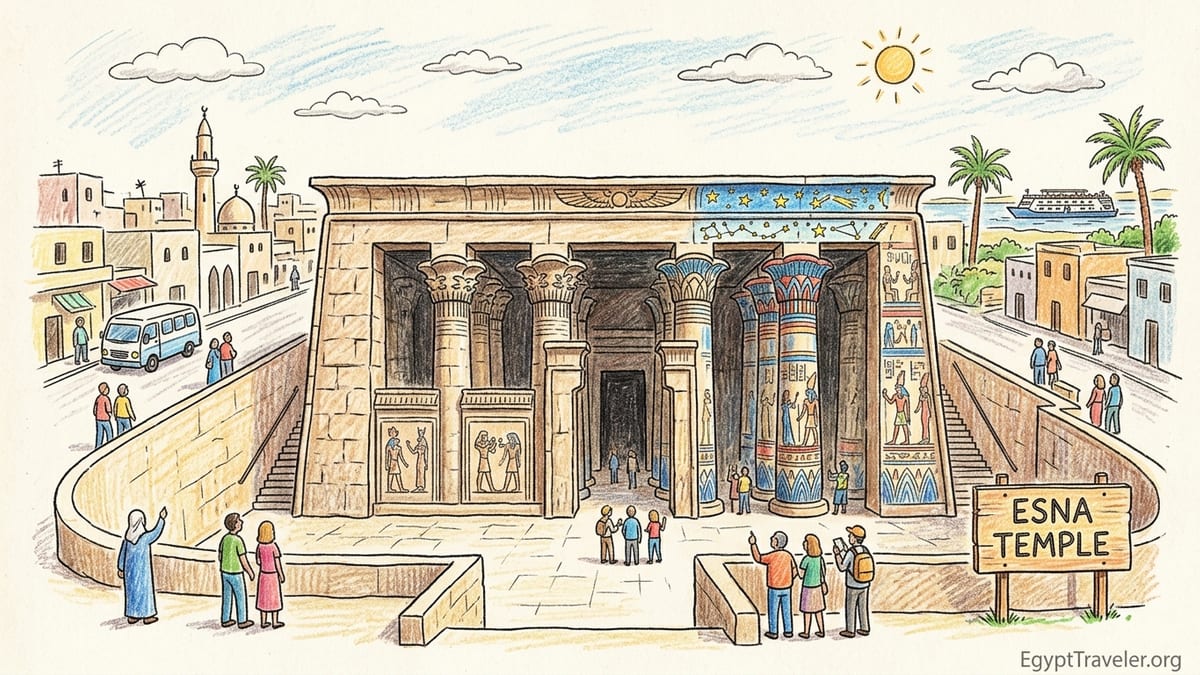
One of the first surprises at Esna is the approach. The temple’s pronaos sits in a sunken pit approximately nine meters below the current street level, the result of centuries of Nile silt, urban construction and debris burying the ancient ground. From the modern square, you look down over the parapet onto the forest of columns and the roofline of the hall, then descend via stairways into a cool, sheltered basin of stone. This dramatic difference in levels makes Esna feel like an archaeological dig embedded in the living town.
The buried setting has shaped the visitor experience. Unlike temples such as Edfu or Kom Ombo, which rise nearly to the surrounding ground level and can be seen from a distance, Esna reveals itself gradually as you descend. The noise of the town fades, replaced by the echo of your footsteps on stone and the calls of the guards. In practical terms, this sunken position also helps moderate temperatures inside the hall, which can be noticeably more comfortable than the exposed courtyards of other sites during midday heat.
Around the rim of the pit, modern Esna carries on with daily life: tuk-tuks honk past, schoolchildren peer over at the ruins, and small cafés pour tea for drivers waiting at the Nile bridge. This juxtaposition of contemporary town and ancient sanctuary is part of Esna’s charm. It feels less like a museum precinct and more like a living neighborhood that happens to cradle a 2,000-year-old monument at its heart.
The Roman Hypostyle Hall and Its Astronomical Ceiling
The standing structure at Esna is the monumental columned hall, or pronaos, begun under the Ptolemies and completed in the Roman period. Its façade once formed the entrance to a much larger temple complex that has largely disappeared under the modern town. Inside, 24 massive sandstone columns fill the space, each with a distinct capital decorated with plants, palm fronds or elaborate floral designs. The capitals and architraves bear cartouches of Roman emperors, including Claudius and Hadrian, shown making offerings to Khnum and the local deities.
Esna’s ceiling is what has drawn international attention in recent years. The northern side carries traditional Egyptian astronomical figures: decans, constellations and the sky goddess Nut arched across the firmament. The southern half shows Roman-style zodiac signs and planetary figures, a rare synthesis paralleled mainly at Dendera. Newly cleaned sections reveal deep lapis-like blues and crisp yellow stars, along with rows of painted vultures and eagles that had been all but invisible beneath centuries of soot from lamps, ovens and nearby houses.
The inscriptions running across the ceiling panels and upper walls are unusually dense and detailed. They include hymns to Khnum and the gods of Esna, complex festival calendars, and lengthy ritual texts. For non-specialists, the key takeaway is how text-heavy the hall feels compared with earlier New Kingdom temples. Even without reading a word of hieroglyphs, you sense that this was a place where meaning was layered on every surface, and the newly legible paintwork helps distinguish figures and signs that once blended into a dark blur.
Restoration, Revealed Colors and Newly Visible Details
Since 2018, a joint Egyptian–German team led by the Ministry of Tourism and Antiquities and the University of Tübingen has been painstakingly cleaning and consolidating the temple’s surfaces. Using mixtures such as ethanol-based gels and controlled poultices rather than abrasive tools, conservators have removed thick black crusts of soot and salts while preserving the fragile original pigments underneath. Progress reports from the project describe how even areas that appeared uniformly black to the naked eye still retained vibrant paints beneath.
The results are striking in person. Columns that once seemed plain now show subtle color transitions in the floral capitals. On the ceiling, bands of hieroglyphic text emerge with crisp outlines, and details such as the feathers on vultures’ wings, the scales of serpents or the patterned hems of royal garments become visible again. Visitors today can see, for example, rows of painted eagles and vultures with alternating heads, inscriptions depicting the zodiac, and finely rendered crowns and jewelry on the gods that were reported as “newly discovered” when the soot layers came off.
This ongoing work means the experience of Esna is changing year by year. Travelers who visited in 2019 and return now often remark that entire ceiling sections they barely noticed before are suddenly vivid. Some areas are still under scaffolding or partially cleaned, giving you a sense of the before-and-after contrast within a single glance. It is one of the few temples in Egypt where you can literally watch conservation in progress and appreciate how much color has been lost elsewhere.
Independent Access from Luxor: Practicalities and Costs
For independent travelers based in Luxor, reaching Esna is straightforward. By car, the drive is typically 45 to 60 minutes along the main Nile Valley road. Most hotels in Luxor can arrange a private car with driver; as of late 2025, visitors commonly report prices in the range of the equivalent of 35 to 60 US dollars for a half-day round trip, depending on the vehicle, negotiation skills and whether additional stops are included. A private car is the simplest way to combine Esna with later visits to Edfu or Kom Ombo on a long day south.
Budget travelers sometimes use local microbuses that run from Luxor toward Esna and Edfu. These depart from informal stands rather than a central bus station, and payment is usually in cash in Egyptian pounds directly to the driver. Fares can be very low, but the trade-offs are crowding, lack of clear schedules, and the need to navigate Arabic-language signage. For most international visitors with limited time, arranging a car through a hotel, local travel agency or an app-based taxi service in Luxor provides a better balance of cost and convenience.
At the site itself, tickets are sold at an official kiosk near the entrance. According to recent Ministry of Tourism and Antiquities fee lists, foreign adult tickets for the Temple of Esna are priced noticeably lower than marquee sites such as Karnak or the Valley of the Kings, making it a relatively budget-friendly addition. Opening hours are broadly aligned with other Upper Egyptian sites, typically from morning to late afternoon, so an early departure from Luxor allows you to visit Esna in cooler hours and still reach Edfu or return to Luxor by midday.
Is Esna Worth a Dedicated Stop on the Road to Edfu?
The key question for many travelers is whether Esna justifies cutting an hour or two from larger, more famous temples. The answer depends on your interests and itinerary. If this is your first and perhaps only trip to Egypt, and you are already feeling rushed trying to fit Karnak, Luxor Temple, the Valley of the Kings, Edfu, Kom Ombo and Philae into a short schedule, Esna may feel like an optional extra. The temple is architecturally more modest than those giants and does not offer towering pylons or massive open courts.
However, if you have a particular interest in ancient art, color or the later phases of Egyptian religious history, Esna becomes far more compelling. The restored ceiling and columns currently offer one of the clearest impressions of how vividly painted these monuments once were, rivaled mainly by sections of Dendera. For photographers, the interplay of restored pigments and shafts of light filtering through the roof creates opportunities very different from the stark stone reliefs at Edfu or Kom Ombo.
In practical terms, a dedicated stop at Esna when driving from Luxor to Edfu typically adds 90 minutes to 2 hours to your day: time to park, buy tickets, explore the hall and perhaps stroll briefly through the adjacent market streets. Travelers who have done this often comment that it breaks up an otherwise monotonous highway drive and provides a gentler, less crowded introduction to Ptolemaic and Roman religious art before confronting Edfu’s vast scale.
Esna by Road vs Esna from the Nile Lock
Many visitors encounter Esna only in passing while their Nile cruise ship queues at the lock that controls the river’s level difference. From the sundeck you may glimpse the town’s minarets, bridges and, in some cases, the temple pit in the distance. Some cruise itineraries include a brief shore excursion during lock waiting times, sending passengers by bus or on foot to the temple and back, often in under an hour. This offers a useful introduction but can feel rushed, with limited time to absorb the details of the restored ceilings or linger for photography.
Visiting by road from Luxor or as part of a private overland transfer is a different experience. You control the timing, so it is possible to arrive early in the morning before group tours or in the later afternoon when the light softens and crowds thin. Without the pressure of a ship’s schedule, you can sit on a bench beneath the columns, walk slowly around each capital to compare the botanical motifs, or spend ten minutes lying on a low wall with binoculars studying individual stars and deities on the ceiling panels.
There are trade-offs. Seeing Esna by road means you miss the theater of the Esna lock passage, where cruise boats, working barges and small private feluccas all jostle for position while passengers wave from deck to shore. On the other hand, focusing solely on the lock means you miss the still-evolving drama inside the temple, where each season of conservation reveals new colors and motifs. For travelers on tight schedules, a compromise is to choose a cruise itinerary that guarantees an organized temple visit at Esna rather than a simple lock transit, then add extra time at Dendera or Abydos from Luxor if painted reliefs are a high priority.
Planning Your Visit: When to Go and How Long to Stay
Like much of Upper Egypt, Esna is best visited in the cooler months from roughly November to March, when daytime temperatures are more forgiving. In the peak of summer, the sunken pit can trap heat, though the shade of the hypostyle hall offers some relief compared with exposed desert sites. Regardless of season, early morning visits tend to be more comfortable and quieter; many group tours arrive mid-morning or late morning when cruise ships are moving through the lock.
Most independent visitors find 60 to 90 minutes inside the temple sufficient for a satisfying visit. This allows time for a slow circuit of the interior, careful study of the ceiling, and a few minutes to sit and take in the atmosphere. Enthusiasts with a strong interest in inscriptions, iconography or photography may easily spend up to two hours, especially if parts of the hall are under active restoration and there is an opportunity to watch conservators at work from a respectful distance.
Beyond the temple, Esna itself is developing gradually as a heritage stop. The historic Wikalat al-Giddawi caravanserai, located near the temple, has also seen conservation work and can sometimes be visited on combined tickets or guided walks, adding an extra cultural layer to a stop in town. Simple cafés and juice stands around the square offer a chance to pause before getting back on the road to Edfu or returning to Luxor, and spending a little time here supports the local community that lives alongside the monument.
The Takeaway
The Temple of Khnum at Esna is no longer the overlooked afterthought it once was. Thanks to ongoing Egyptian–German restoration, it has emerged as one of the most visually striking interiors on the Nile, with a Roman-period hypostyle hall whose painted ceilings, zodiac scenes and elaborately carved columns now read almost like a freshly illuminated manuscript. Its unusual position nine meters below the surrounding streets gives it an intimate, sheltered atmosphere that contrasts sharply with the monumental expanses of Karnak or Edfu.
For travelers deciding how to allocate limited time, Esna is most rewarding if you are curious about color, conservation and the later phases of ancient Egyptian religion. If your priority is sheer scale and iconic silhouettes, you may prefer to focus on larger temples. But if you have even half a day to spare from Luxor or a flexible transfer schedule toward Edfu, a dedicated stop at Esna can add nuance and surprise to a classic Nile itinerary, showing that some of Egypt’s most exciting discoveries today are happening not in new tombs, but in the careful cleaning of surfaces we thought we already knew.
FAQ
Q1. How long does it take to visit the Temple of Khnum at Esna?
Most visitors spend about 60 to 90 minutes inside the temple, enough time to walk the hall, study the restored ceiling and photograph key details without feeling rushed.
Q2. Can I visit Esna as a day trip from Luxor?
Yes. Esna is roughly an hour’s drive from Luxor, so you can easily visit in a half-day by private car or include it as the first stop on a longer road journey to Edfu or Aswan.
Q3. Is Esna included on all Nile cruise itineraries?
Nearly all cruises pass through the Esna lock, but not all include a shore excursion to the temple. Check your specific itinerary and ask whether a guided temple visit is planned during lock waiting time.
Q4. Are the colors inside the temple really as vivid as photos suggest?
In the cleaned sections, the colors are genuinely strong, with deep blues and clearly defined figures. Some areas are still under conservation, so you will also see darker, unrestored patches that highlight the contrast.
Q5. Do I need a guide to appreciate the temple?
A guide is not essential, but a knowledgeable local or Egyptologist can help interpret the astronomical scenes, deities and festival texts, which are especially rich and complex at Esna.
Q6. How does Esna compare with Edfu or Kom Ombo?
Esna is smaller and mostly limited to one hypostyle hall, but its newly restored paintwork and late Roman inscriptions offer a more intimate and color-focused experience than the grand scale of Edfu or the riverside setting of Kom Ombo.
Q7. Is it safe to visit Esna independently?
Esna is a routine stop on Upper Egypt routes, and independent visits by taxi or private car from Luxor are common. As always, use licensed drivers, follow local advice and carry identification and copies of your passport.
Q8. What should I wear and bring for a visit?
Dress modestly with shoulders and knees covered, wear comfortable closed shoes, and bring a hat, sunscreen, water and cash in Egyptian pounds for tickets and small purchases in town.
Q9. Are there facilities near the temple?
Basic facilities such as restrooms and small shops or cafés exist around the temple square, but services are simpler than at major sites, so do not expect large visitor centers or extensive amenities.
Q10. Is Esna still worth visiting if I have already seen Dendera’s painted ceilings?
If you enjoyed Dendera, Esna is a logical and rewarding follow-up. Its ceiling combines Egyptian constellations and Roman zodiac signs, and the ongoing restoration means new details continue to emerge, offering a fresh perspective on painted temple interiors.