


Combining Dendera and Abydos into a single day trip from Luxor is one of Upper Egypt’s most rewarding excursions for travelers who want to go beyond the classic Luxor–Aswan circuit. The loop north along the Nile delivers two of the country’s best preserved and most atmospheric temples, along with long stretches of quiet countryside that few organized tour groups ever see. This guide walks you through how to structure the day, which order works best, how long you will spend on the road, and what to prioritize once you step inside the Temples of Hathor at Dendera and Seti I at Abydos.
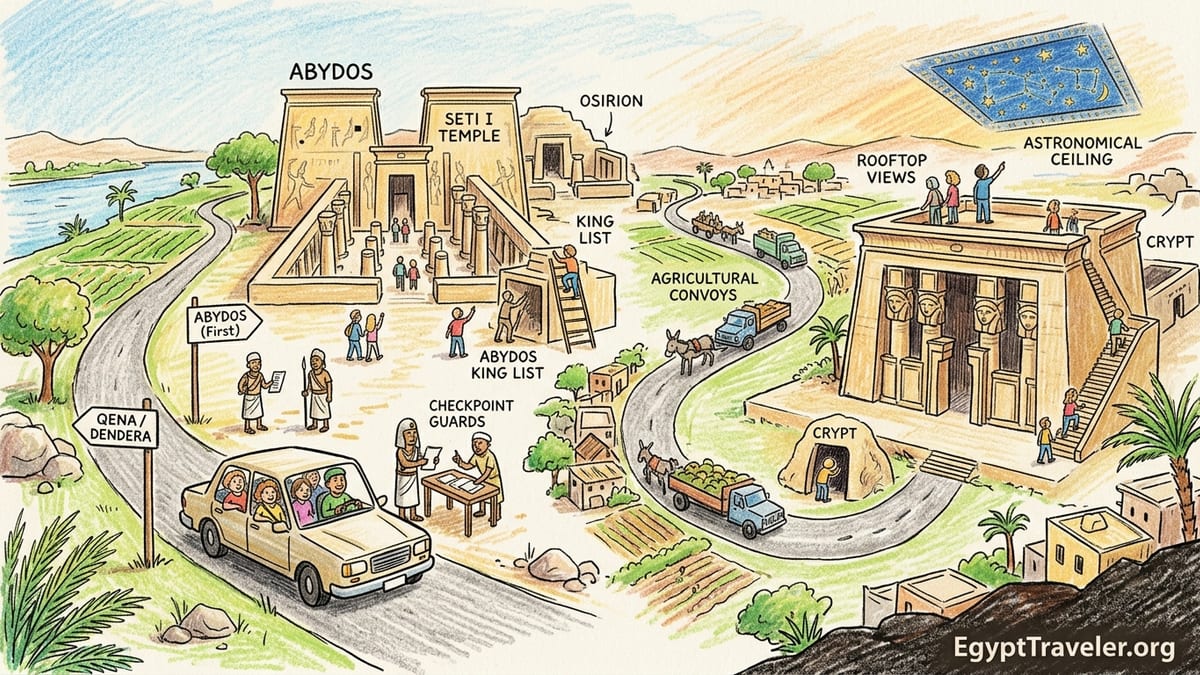
Route Overview and Driving Times from Luxor
On a standard day trip from Luxor that covers both temple complexes, you are looking at roughly 6 to 7 hours of driving in total, with about 360 kilometers covered on a triangular loop. Most private tours and drivers follow the Nile north out of Luxor, pass through Qena for Dendera, then continue farther north and slightly inland to Abydos before returning to Luxor by a more direct road. In practice, that usually means around 1.5 hours each way between Luxor and Dendera, another 1.5 to 2 hours between Dendera and Abydos, and a final 2 to 2.5 hours back from Abydos to Luxor, depending on traffic, checkpoints, and whether you hit any agricultural convoys on the smaller roads.
Commercial operators that advertise “Dendera and Abydos in one day” typically state a 10 to 12 hour excursion. In recent seasons many tours have settled into a pattern of leaving Luxor between 6:00 and 7:00 in the morning and returning around 6:00 in the evening. That time window builds in approximately 4 to 5 hours of actual temple visiting and photography time plus a simple lunch stop at a roadside restaurant or in a village near Abydos. It is a long day, but because large sections of the drive pass through farmland and small towns rather than empty desert, it rarely feels monotonous.
Travelers booking independently usually hire a private car and driver from a Luxor agency or their hotel concierge. As of mid 2026, quotes for a full day private vehicle including fuel and waiting time for this route often fall in the broad range of 80 to 150 US dollars per car, depending on vehicle type, distance covered, and whether a licensed guide is included. Many local providers accept payment in Egyptian pounds at an agreed amount pegged to an approximate dollar value, so it is wise to clarify the currency and the inclusion of tolls or parking before confirming.
Security checkpoints are still part of overland travel in Upper Egypt, and your driver will routinely show paperwork listing your names, passport numbers, and planned route. For most visitors this is simply an administrative formality that may add a few minutes at certain junctions. To avoid delays, make sure the agency that books your transport submits the necessary trip notification to the authorities the day before your excursion, particularly if you are traveling in low season or outside the busiest winter months.
The Most Efficient Order: Abydos First or Dendera First?
There are two realistic ways to structure a combined Dendera and Abydos day from Luxor: Dendera first then Abydos, or the reverse. On paper, starting with Dendera seems logical because it sits closer to Luxor. In practice, most seasoned drivers and guides now recommend starting with Abydos, then stopping at Dendera on the way back. That order makes the driving segments more evenly spaced and ensures you reach Abydos in the cooler, quieter morning hours when light is softer inside the hypostyle halls.
A typical Abydos first itinerary might look like this. Leave Luxor around 6:00, drive north past Qena and continue to the turnoff for Abydos, arriving between 9:00 and 9:30. Spend 2 to 2.5 hours exploring the Temple of Seti I, the famous Abydos King List, the Osirion behind the main temple, and the nearby small temple of Ramesses II. Around noon or shortly after, have an early lunch in a simple restaurant in the modern town or at a local hotel that frequently hosts touring groups. Then depart for Dendera, arriving mid afternoon for another 1.5 to 2 hours before returning to Luxor in the late afternoon or early evening.
Starting with Dendera is sometimes offered when tour companies want to guarantee a fixed lunch stop in Qena or when travelers are unsure how long they will spend at Abydos and prefer to “bank” the shorter site first. That version usually leaves Luxor at 7:00, reaches Dendera by about 8:30, spends 1.5 to 2 hours inside the Temple of Hathor, then continues to Abydos for the late morning and early afternoon, returning to Luxor by 6:00 or 7:00. The main downside is arriving at Abydos in the peak heat window from 1:00 to 3:00, when the sun is strongest and some travelers are already tiring.
For visitors who care deeply about the reliefs and subtle carving at Abydos, prioritizing that site while you are fresh is the best strategy. For those more interested in Dendera’s roof views and colored astronomical ceiling, reversing the order may be better to align the rooftop visit with late afternoon light. In either case, agree the sequence with your driver or tour operator when you book, and make sure you understand how much on site time is guaranteed at each temple rather than leaving it vague.
Private Driver vs Fully Guided Tour
Most travelers tackle Dendera and Abydos either with a private driver and optional local guides at each temple or by joining a fully guided day tour sold through a Luxor travel agency or an international operator. A private driver only arrangement is typically the cheaper and more flexible choice, and it suits independent travelers who already read about the sites and prefer to explore at their own pace. In 2026, you can expect a basic private car with air conditioning to cost roughly what two or three people might pay for seats on a group tour, especially outside peak Christmas and New Year weeks.
Fully guided tours, on the other hand, include a licensed Egyptologist guide who stays with you for the entire day and manages all logistics, from buying tickets and navigating security checks to arranging lunch. This can be a major advantage at Abydos, where the significance of the Osirian cult center, the logic behind the unusual L shaped ground plan, and the details of the King List are less intuitive than the more familiar scenes on the Nile temples around Luxor. A good guide can point out specific scenes of Seti I alongside his son Ramesses II making offerings, and show you where original paint still clings to the delicately carved figures.
One hybrid option is to book the vehicle through your hotel or a local agency and then hire a local guide waiting at the gates of each temple complex. At both Dendera and Abydos, you will often find freelance licensed guides available near the ticket office, some of whom speak English, French, German, or Spanish. You can agree a short 45 to 60 minute walkthrough price on the spot, then continue to wander on your own afterward. This model keeps overall costs down while still giving you expert interpretation for the highlights.
Whichever arrangement you choose, confirm in writing whether entrance tickets are included in your quoted price. As of late 2024, official published ticket prices for foreign adults were around 300 Egyptian pounds for Dendera and a similar order of magnitude for Abydos, with separate small fees for roof access and certain internal areas where applicable. Given Egypt’s inflationary environment, these figures can and do change, so treat them as rough benchmarks rather than fixed numbers. If a tour price seems significantly lower than competitors, check that tickets, guiding, and vehicle insurance are not omitted.
How Much Time to Spend at Each Site and What to Prioritize
If you are doing both temples in a single day from Luxor, budget at least 1.5 hours at Dendera and 2 hours at Abydos as an absolute minimum. Travelers with a strong interest in photography or relief carving will be happier with 2 hours at Dendera and 2.5 to 3 hours at Abydos, but stretching the visits that long usually pushes the day toward the 12 hour mark door to door. Shortening either temple to less than 90 minutes tends to feel rushed, especially if you want to visit side chapels, walk the processional routes, or climb up to the roof at Dendera.
At Dendera, the must see elements inside the main Temple of Hathor are the first hypostyle hall with its Hathor headed columns, the richly painted astronomical ceiling on the upper level, and at least one of the crypts with its unusual reliefs. A practical sequence is to explore the ground level sanctuary axis first, then climb the broad stone staircase on one side to the roof and ceiling, leaving the descent into the crypts for the final portion of your visit. That way, if a roof closure or unexpected queue develops, you have already seen the core of the temple.
At Abydos, the priority is the Temple of Seti I proper. Start with the outer hypostyle hall and work your way into the seven sacred chapels dedicated to different deities and to Seti himself, then look for the Abydos King List in a side corridor where a long series of cartouches lists many of Egypt’s pharaohs from early dynasties through Seti’s time. Behind the main temple, if access is open, walk back to the enigmatic Osirion, a sunken stone structure associated with the cult of Osiris. Finally, if your ticket and timing allow, cross to the smaller Ramesses II temple with its battle scenes and lighter, more open courtyard.
Travelers who arrive on site with a shot list or checklist in hand tend to make better use of their time. For example, a visitor particularly interested in Ptolemaic period iconography at Dendera might head straight to the inner sanctuary reliefs where late rituals and offering scenes are sharply cut and still show traces of blue and yellow pigment. Someone fascinated by royal chronology at Abydos might spend more time comparing the names on the King List with what they saw earlier on the walls at Luxor Temple or in the Valley of the Kings. Building those connections is what turns this long day on the road into one of the intellectual high points of an Egypt itinerary.
Inside Dendera: Astronomical Ceiling, Crypts and Rooftop Views
Dendera’s Temple of Hathor is renowned for its astronomical ceiling, intricate crypts, and remarkably preserved state. The most famous zodiac relief from Dendera now resides in the Louvre, but the replacement ceiling in the upper hypostyle hall remains one of the most striking pieces of painted stonework open to visitors in Egypt. When you climb to the roof, you will often find a guard or attendant pointing out the constellations, decans, and boats of the sun god in the panels overhead, all tinted in deep blues, golds, and blacks. In the late afternoon the warm light slanting through the openings makes the painted stars glow in photographs without the need for artificial filters.
Below ground level, Dendera’s crypts offer a more intimate and enigmatic experience. Access policies can change, but usually at least one narrow crypt is open to visitors at a time, entered through a small doorway off a side chapel and descending via tight stone steps into a confined passage. Here the walls feature unusual reliefs that have inspired everything from serious academic study to speculative fringe theories. Most visitors take their time moving through the low ceilinged chamber, partly because of the awkward footing and partly because the carved details are more visible when you pause and let your eyes adjust.
On the rooftop itself, you can walk along the paved expanse that once hosted ritual processions and festivals for Hathor. From here, the view across the wider Dendera complex reveals the outlines of other structures, including a birth house and the remains of a Coptic church, as well as the green band of cultivated fields and the desert plateau beyond. Photographers often favor this vantage point for capturing the scale of the temple integrated into its landscape, rather than only close up column shots. If your ticket requires an extra fee for roof access, most visitors who pay it consider the additional cost worthwhile.
Elsewhere in the complex, do not miss the exterior rear wall of the Temple of Hathor, where large scale reliefs depict Ptolemaic rulers offering to the gods, and the sacred lake area, which gives a sense of how water functioned in the temple’s ritual life. A leisurely circuit around the outer enclosure wall, if time permits, rounds out your understanding of Dendera as more than a single building and underscores why many repeat visitors recommend a dedicated half day here for travelers with deeper archaeological interests.
Inside Abydos: King List, Osirion and the Finest Reliefs in Egypt
Abydos has an atmosphere very different from the Nile side temples. The Temple of Seti I sits slightly set back from the modern town, approached along a paved path with views across the archaeological zone. Inside, many Egyptologists regard its reliefs as the finest in the country. Figures of gods and pharaohs are carved in crisp, slightly raised relief and then painted, with subtle modeling of muscles and facial features that reward slow, close viewing. Compared with the busier and more eroded scenes at some Theban temples, Abydos often feels like walking into a private chapel of the New Kingdom elite blown up to monumental scale.
The Abydos King List is one of the main reasons archaeology minded travelers undertake the long drive. Carved on a wall of a side corridor, it shows Seti and his son Ramesses performing rituals before a long double row of cartouches containing the names of earlier pharaohs. Not all rulers are included, and part of the fascination lies in who is omitted. Many visitors who have already read about Egypt’s dynasties find it moving to trace the sequence of names in stone, connecting Narmer or Menes at the beginning with familiar figures like Thutmose III and Hatshepsut, and eventually with Seti himself.
Behind the main temple lies the Osirion, a sunken monument built of massive stone blocks set within a trench that is often partially filled with water. Scholars continue to debate aspects of its dating and purpose, but its association with the cult of Osiris as Lord of the Underworld is clear. Access to the walkway around the Osirion can vary depending on conservation work and water levels, so your ability to get close may differ from one year to the next. Even a distant view, however, conveys the monument’s stark power compared with the relatively refined architecture of the Seti temple.
Once you emerge from the rear of the Seti I complex, it is worth making time, if your schedule allows, for the nearby Temple of Ramesses II. Though smaller, it contains vivid battle scenes and offers a useful contrast in style and royal self presentation between father and son. Many day trip itineraries omit this extension by default, especially if a group is running behind schedule, so if it matters to you, tell your guide or driver at the outset that you want to include it, and be prepared to trim a few minutes elsewhere.
Entrance Arrangements, Heat and Practical Logistics
Entrance tickets for Dendera and Abydos are typically sold at on site ticket offices operated under Egypt’s Ministry of Tourism and Antiquities. You will usually find a small booth or building near the entrance parking area, where you can pay in Egyptian pounds in cash and receive a paper ticket. Some organized tours pre purchase tickets for their groups, in which case the guide collects them on your behalf while you wait by the vehicle. Keep your ticket with you inside the site, since guards may ask to see it if you enter restricted zones like roofs or crypts that require a supplementary fee.
Opening hours at both temples generally follow the standard pattern for major Egyptian monuments, with first entry around 7:00 in the morning and closure around 5:00 in the afternoon, though the last ticket sale may cut off earlier in low season. In summer, light and heat become severe by late morning, and the interiors of the temples, while shaded, can still feel warm and stuffy. If you are traveling between May and September, consider front loading as much indoor exploring as possible before midday and saving open air perimeters and rooftops for later in the afternoon when the sun is lower, even if temperatures remain high.
There are small kiosks or vendors near the entrances selling bottled water, soft drinks, and basic snacks, but selection is limited and prices are often higher than in town. Bringing at least one large bottle of water per person from Luxor and a few easy to eat snacks makes the day more comfortable. Modest but practical clothing is advisable: light, breathable fabrics that cover shoulders and knees, plus a hat, sunglasses, and closed shoes suitable for uneven stone surfaces and sand. Sunscreen is essential, and a compact travel umbrella can double as a mobile patch of shade on the more exposed approaches.
Toilets at both sites are functional but basic and may not always stock toilet paper or soap, so carry a small packet of tissues and hand sanitizer. Photography policies allow personal cameras and smartphones in most areas without extra fees, though professional tripod use or commercial filming equipment may require separate permits. As at other Egyptian sites, a small tip to guards who open a closed side room or allow closer access to a viewpoint is customary but should always feel voluntary rather than coerced. If you are uncomfortable with a suggested amount, politely decline before they unlock any doors.
Should Archaeology Enthusiasts Split the Sites Across Separate Days?
For travelers whose primary motivation in visiting Egypt is archaeology rather than general sightseeing, the combined Dendera and Abydos day trip can feel compressed. Each complex merits half a day at minimum, and serious students of temple architecture or religious iconography could easily spend a full day at either site with a sketchbook or camera. The extended drive times also mean that on a one day combo you must watch the clock rather than linger indefinitely over a single chapel or relief panel that catches your interest.
One alternative is to dedicate a full separate day to each temple. For example, you might book a Dendera only excursion from Luxor on one day, leaving after breakfast, spending three to four hours at the site, and returning mid afternoon with time left to visit Luxor Museum or stroll the Corniche. On a different day, you could travel to Abydos alone, depart very early, and devote as much time as you want to the Temple of Seti I, the Osirion, and additional areas of the wider archaeological zone that most short visit tours bypass. This split approach is particularly attractive in the cooler months from November to February, when lower temperatures make long outdoor days more pleasant.
The main drawback of splitting the sites is cost and energy. Two separate days mean hiring a car and driver twice and spending roughly 10 to 12 hours more on the road overall compared with a single long loop. For many travelers with limited time in Egypt, the extra expense and fatigue are not justified when there are still other unvisited highlights in Luxor or along the Nile. A realistic compromise some visitors adopt is to book the combined day for a first visit and simply decide on the spot whether they feel a return trip to one of the temples is essential on a later trip to Egypt.
If you already know that either Dendera’s astronomical ceilings or Abydos’s royal reliefs are a lifelong interest, it is worth designing your itinerary from the outset around a slower visit. That might mean staying overnight closer to Abydos, for instance in the Sohag region, or joining a specialist archaeological tour that builds extended time at these sites into the program. For everyone else, the standard combined day trip typically provides a satisfying overview without feeling like a mere box checking exercise, especially if you travel outside peak midday heat and have at least a basic understanding of what you are looking at before you arrive.
The Takeaway
Planning a Dendera and Abydos day trip from Luxor involves balancing time, budget, and your tolerance for long road days against the exceptional archaeological rewards on offer. Logistically, the loop is straightforward with a private driver or organized tour, and the main variables are start time, site order, and how many hours you build into your schedule for each temple. For most visitors, starting with Abydos in the morning, then enjoying Dendera on the way back, provides the best mix of cooler conditions, manageable driving segments, and good light for photography.
Inside the temples, focusing on a short list of key elements keeps the experience from becoming overwhelming. At Dendera, that means the first hypostyle hall, the painted astronomical ceiling, at least one crypt, and the rooftop processional area. At Abydos, it is the exquisitely carved reliefs of Seti I, the Abydos King List, the seven sanctuaries, the Osirion, and where time permits, the adjacent Ramesses II temple. An informed guide, whether booked for the full day or hired on the spot at each site, can transform the carved scenes from decorative backdrops into a coherent story of royal power and religious devotion.
Ultimately, whether you choose a one day combined trip or split the temples across separate days, visiting Dendera and Abydos pushes your Egypt journey beyond the familiar silhouettes of Luxor and Aswan. The drive itself reveals a slower, more rural Upper Egypt, and the relative quiet of these complexes compared with the major Nile cruise stops offers something increasingly rare at world class monuments: time and space to stand in front of great art in near silence. For travelers willing to invest the hours on the road, it is hard to imagine leaving Egypt without having seen Hathor’s starry ceiling and Seti’s royal gallery in person.
FAQ
Q1. Can you really visit Dendera and Abydos in one day from Luxor?
Yes, it is entirely feasible to visit both temples in a single day from Luxor if you start early and accept a 10 to 12 hour outing with roughly 6 to 7 hours of driving and 4 to 5 hours on site.
Q2. What is the best order to visit the temples on a day trip?
Most travelers find it most efficient to visit Abydos first in the morning, when temperatures and crowds are lower, then stop at Dendera on the return leg to Luxor in the afternoon.
Q3. How early should I leave Luxor for a combined Dendera and Abydos trip?
Leaving between 6:00 and 7:00 in the morning works well, allowing you to reach the first site by mid morning, avoid the worst of the midday heat, and still return to Luxor by early evening.
Q4. Is a private driver enough, or do I need a full time guide?
A private driver is sufficient for logistics, but hiring a licensed guide, either for the full day or on site at each temple, greatly enhances understanding of the reliefs, the King List, and the religious significance of both complexes.
Q5. How much time should I plan to spend at each temple?
For a same day combo, budget at least 1.5 hours at Dendera and 2 hours at Abydos, with more time at each if you are particularly interested in photography or detailed study of the reliefs.
Q6. Are the temples very hot inside, and what should I wear?
Both temples can be warm, especially in summer, even though interiors are shaded. Wear light, breathable clothing that covers shoulders and knees, sturdy closed shoes, and bring a hat, sunglasses, and sunscreen.
Q7. Is it worth paying extra for roof and crypt access at Dendera?
Most visitors who pay the supplemental fees consider them worthwhile, as the rooftop offers expansive views over the complex and the painted astronomical ceiling, while the crypts reveal unusual and finely carved reliefs.
Q8. Can I see the Abydos King List and Osirion on a standard tour?
Yes, the Abydos King List is in a corridor of the main Seti I temple and is usually included in every visit. The Osirion behind the temple is often visible and sometimes accessible, depending on conservation conditions and water levels.
Q9. Should archaeology enthusiasts split Dendera and Abydos into separate days?
Travelers deeply focused on archaeology or temple art often prefer separate days so they can spend three to four unhurried hours at each site, but this approach adds cost and more time on the road compared with the usual combined day trip.
Q10. Are there food and facilities available during the day trip?
Basic toilets and small kiosks selling drinks and snacks exist at both sites, and many tours include a simple lunch stop near Abydos or in Qena, but it is wise to bring your own water and a few snacks from Luxor.