


For many travelers, Upper Egypt is the highlight of a first trip to the country. The stretch of Nile between Luxor and Aswan concentrates some of the most spectacular temples and tombs anywhere in the world, yet the choice of tours, transfers and packages can feel overwhelming when you start to book. This guide looks at how the main tour formats actually work on the ground, compares real products and prices, and helps you decide where to invest in a qualified Egyptologist guide and where you can explore independently without missing too much.
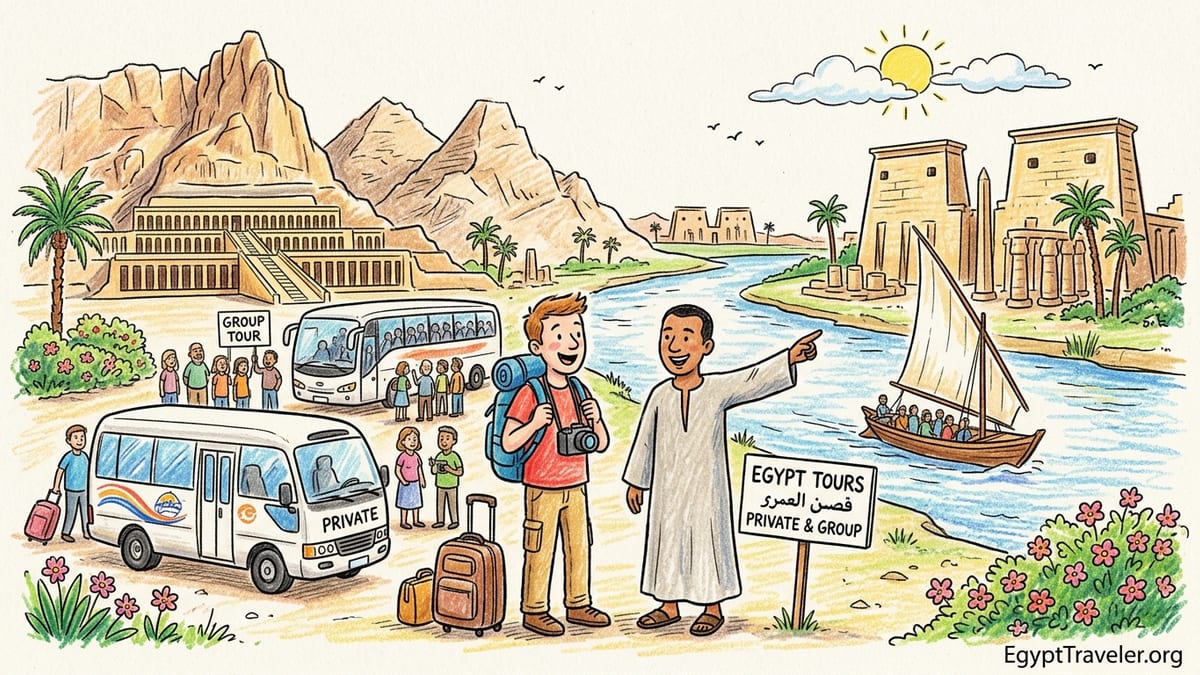
How Upper Egypt Tours Are Typically Structured
Most visitors base themselves in Luxor, Aswan or both, then bolt on day tours, one-way transfers with sightseeing stops, or multi-day circuits. In Luxor, a classic full-day private tour pairs the West Bank sites like the Valley of the Kings and Hatshepsut’s Temple with East Bank giants Karnak and Luxor Temple, usually in 7 to 8 hours with hotel pickup, a licensed Egyptologist and an air-conditioned car. Many local operators advertise this format with phrases such as “East & West Bank full-day private tour,” and prices often fall in the range of about 80 to 120 US dollars per day for the guide alone, or around 40 to 90 US dollars per person when bundled with vehicle and basic entry fees for a small group.
Aswan tours tend to be shorter, often sold as 3 to 5 hour packages that bundle the High Dam, the Unfinished Obelisk and Philae Temple reached by motorboat. Online comparison tools routinely list half-day Philae and High Dam group tours from roughly 25 to 40 US dollars per person, with private versions from about 50 to 80 US dollars per person depending on group size and inclusions. In both Luxor and Aswan, the default assumption in tour descriptions is that you will be picked up at your hotel or Nile cruise boat, driven between sites, then dropped back after the itinerary.
Between the cities, travelers choose either a multi-day Nile cruise, which bakes Edfu and Kom Ombo into a fixed program, or overland transfers by car or minibus that can be booked as simple transport or as sightseeing days. A private Luxor to Aswan transfer via Edfu and Kom Ombo, for example, is advertised by several regional companies as a one-way day trip with stops for temple visits and door-to-door hotel pickup, turning what would be a 3.5 to 4.5 hour straight drive into a 9 to 10 hour touring day.
Finally, specialist archaeology circuits and university-affiliated trips may string together Luxor, Dendera, Abydos, Edfu, Kom Ombo and Aswan into 6 to 10 day itineraries with a resident Egyptologist lecturer. These are less common on mainstream booking platforms but demonstrate how professionals structure time on the ground: more hours in Luxor than anywhere else, targeted visits to Dendera and Abydos, and careful pacing between major monuments.
Private vs Group Tours: What You Actually Get
On paper, many Upper Egypt tours sound similar, but the experience differs sharply between private and group formats. A typical large coach tour in Luxor might advertise hotel pickup, an English-speaking guide and “all main highlights” for a competitive price. In reality, you may spend an hour or more collecting other passengers, then move through sites on a fixed, sometimes rushed schedule. Your time listening to the guide at each monument may be balanced against waiting for fellow travelers to regroup, which can be frustrating in hot weather.
Private tours, by contrast, generally include a dedicated vehicle and guide for your party, flexible timing within opening hours and the ability to prioritize specific tombs or temples. One Luxor-based agency, for example, sells a full-day private West Bank tour that names a particular Egyptologist with nearly a decade of experience and offers tailored commentary plus the option to add on premium tombs such as the Tomb of Nefertari for an extra fee. Another operator in Luxor stresses that its day tours are “private and all-inclusive,” bundling a licensed guide, vehicle, hotel pickup and all listed entry fees into one price, so you rarely take out your wallet at ticket windows.
In Aswan, group Philae and High Dam tours starting around 25 US dollars per person usually share a vehicle and guide with 8 to 20 others. Private versions, sometimes priced roughly from 50 US dollars per person depending on party size, limit the group to your own travel companions and can adjust the order of visits or extend the time at Philae if you are keen photographers or history enthusiasts. When comparing prices, pay close attention to the fine print: “from” rates sometimes exclude temple tickets or motorboat fees, which can add 10 to 20 US dollars per person on the day.
For most independent travelers, a hybrid approach works best. Many choose a private Egyptologist for one intensive day in Luxor and a half day in Aswan, then rely on taxis, trains or self-guiding for smaller sites. Others use group tours for straightforward excursions like a morning at Philae and the High Dam, then invest in private guiding at more complex sites such as the Valley of the Kings, where context and navigation both matter.
Luxor Sightseeing: When a Guide Matters Most
Luxor is where hiring an Egyptologist guide tends to deliver the greatest return. The Valley of the Kings alone contains more than sixty tombs, with a rotating selection open to the public. Standard tickets cover entry to three tombs, and add-ons for sites like the tomb of Seti I or Tutankhamun change regularly in price and availability. On a typical private West Bank tour, your guide will help you choose which tombs to prioritize based on decoration, crowd levels and your interest in particular dynasties, something that is difficult to judge from a guidebook alone.
Full-day private East and West Bank tours commonly include hotel or cruise pickup around 7:30 or 8:00 in the morning, several hours in the Valley of the Kings, a visit to Hatshepsut’s terraced temple at Deir el-Bahari, a stop at the Colossi of Memnon, and afternoon visits to Karnak and Luxor Temple. Several mainstream operators quote prices starting from around 40 to 60 US dollars per person in a small private group, excluding optional extras like hot air balloon rides, while others sell more premium, all-inclusive days at higher rates that bundle lunch and most entry fees. This structure typically allows 30 to 60 minutes of guided explanation at each major site plus some free time for photographs.
There are, however, parts of Luxor where a guide is less critical. Luxor Temple on the East Bank is compact, well-signed and especially atmospheric after sunset when floodlights pick out the colonnades. Many travelers choose to wander this temple independently in the evening, even if they took a guided tour during the day. Likewise, a morning stroll through Luxor’s souqs or a sunset felucca sail on the Nile is easily arranged without a tour, either through your hotel or directly on the riverfront.
If your budget is tight, one strategy that works well in practice is to book a single full-day private Egyptologist in Luxor, focusing on the West Bank’s tombs and Hatshepsut’s temple plus a concise explanation of Karnak. After that, you can return to Karnak or Luxor Temple alone at different times of day using a taxi or ride-hailing service, armed with the context gained from your guided visit.
Dendera and Abydos: Specialist Day Tours From Luxor
The Dendera Temple complex and the temples at Abydos lie north of Luxor and are usually visited as a combined full-day excursion by road. Dendera’s main Hathor Temple is one of the best preserved in Egypt, with a richly decorated hypostyle hall and striking astronomical ceiling scenes. Abydos, historically an important cult center, features the Temple of Seti I with some of the most refined reliefs of the New Kingdom, along with the nearby temple built by Ramesses II. The distance from Luxor means that a round trip by private vehicle can take 8 to 10 hours including driving and visits.
Several Upper Egypt specialists sell private Dendera and Abydos day tours that include an air-conditioned car, an Egyptologist guide and hotel pickup in Luxor. Inclusions vary: some packages focus on transport and guiding only, requiring you to pay for temple tickets on arrival, while others advertise “all entry fees included” at a higher headline price. A representative private option lists private vehicle, expert Egyptologist and door-to-door transfers as standard, underlining the value of having a guide for interpreting the often subtle religious iconography at these sites.
Because Dendera and Abydos receive far fewer casual visitors than Luxor or Aswan, on-the-spot independent arrangements can be less straightforward, and some stretches of public transport require changes that most short-stay travelers prefer to avoid. For that reason, these two temples are among the sites where booking an organized tour, ideally private or in a very small group, makes a clear difference. With a guide, you are likely to spend an hour to 90 minutes at each temple, enough to explore the inner sanctuaries, roof areas where accessible and side chapels without feeling rushed.
Independent travelers with very strong budgets and time may still choose to reach Dendera and Abydos by a mix of train and local taxi, but this is usually more about the experience of slow travel than saving money once you factor in multiple drivers, waiting time and potential language barriers. For most visitors, especially on a first trip, a dedicated private day tour is the most efficient and informative way to see both complexes from Luxor.
Edfu and Kom Ombo: Excursions and Sightseeing Transfers
South of Luxor, the Temple of Horus at Edfu and the riverside double temple at Kom Ombo are often visited either during a multi-day Nile cruise or as stops on a one-way transfer between Luxor and Aswan. Edfu’s temple, one of the most complete surviving Ptolemaic temples, impresses with its towering entrance pylon and intact reliefs. Kom Ombo, overlooking a bend in the Nile, is unusual in being dedicated to two deities and has an associated crocodile museum that many visitors find memorable.
Regional tour companies market several distinct products involving these temples. One common option is a full-day excursion from Aswan that drives first to Kom Ombo and then on to Edfu before returning to Aswan in the evening. Some guides promote this as a way to see both temples without changing accommodation, though it means a long day on the road. Another format is the Luxor to Aswan private transfer via Edfu and Kom Ombo: here the same vehicle that serves as your intercity transport makes sightseeing stops, turning necessary travel into a structured touring day with hotel pickup in Luxor and drop-off at your hotel or cruise in Aswan.
Prices for these sightseeing transfers vary widely depending on whether they are sold as bare transport with optional guiding at each stop, or as full private tours with a resident Egyptologist. Some smaller agencies in Upper Egypt describe their services as “transfer or private tour,” explicitly distinguishing between a point-to-point ride and a day that includes licensed guiding and entrance arrangements. As a rough orientation, travelers posting recent trip reports often mention paying in the range of 100 to 150 US dollars in total for a private car and guide between Aswan and Luxor with stops at two or three temples, split between two people, though packaged offers on international platforms can price higher once commission and included tickets are factored in.
For experienced independent travelers, Edfu and Kom Ombo are among the easier major temples to explore without a guide, especially if you have already had in-depth explanations elsewhere. The layouts are relatively straightforward, with clear axes from forecourts through hypostyle halls into inner sanctuaries, and basic signage is usually adequate to orient you. Many Nile cruise passengers therefore treat guided commentary as a welcome bonus but not a necessity, making these temples ideal candidates for a cheaper group excursion or an unguided stop on a private transfer if you are looking to trim costs.
Aswan Highlights and Combining Tours With Transfers
Aswan itself rewards at least a full day of sightseeing focused around Philae Temple, the High Dam and the Unfinished Obelisk quarry. Philae, relocated to higher ground when the Aswan High Dam was built, is reached by a short motorboat ride and is one of the most picturesque temple complexes in Upper Egypt, with colonnades and pylons reflected in the surrounding water. Standard half-day tours mix a guided walk through the temple, explanation of the rescue project that saved it from flooding and short visits to modern engineering sites, all packed into three to four hours.
Given the mix of historical and modern elements in Aswan, a guide is particularly useful at Philae, where inscriptions and reliefs reflect a blend of Pharaonic and later influences, and at the Unfinished Obelisk, where geological and technical details are often overlooked by unguided visitors. By contrast, the High Dam can be visited relatively quickly and understood through its simple on-site displays, making it less essential to have deep commentary there if your time or budget are limited.
Many travelers also combine Aswan-based tours with onward travel. For example, it is common to spend the morning at Philae and the High Dam with a guide, then transfer by private car to Luxor in the afternoon, stopping at Kom Ombo for an unguided walk. Others schedule a one-way Luxor to Aswan transfer via Edfu and Kom Ombo, then book a separate structured half-day in Aswan the following morning. The practical advantage of these combined formats is that they reduce both backtracking and the need to negotiate multiple separate taxis on long, hot days.
In terms of booking, some local agencies are happy to customize these combinations over messaging apps once you explain your priorities, while larger platforms tend to stick to predefined itineraries. When you compare options, look for clear statements about how many hours you will actually spend at each monument, not just the headline list of inclusions, and ask whether your guide will travel the full route with you or hand you off to local site-based staff along the way.
Multi-Day Archaeology Circuits: Who They Suit
Beyond individual day tours, there is a growing market for multi-day, archaeology-focused circuits that connect Luxor, Dendera, Abydos, Edfu, Kom Ombo and Aswan. Some are packaged as private 5 to 7 day itineraries that begin in Cairo and then move south, promising a named Egyptologist throughout, domestic flights, and all transfers and entries arranged. Others are organized by academic institutions and museums, operating less frequently but offering deeper thematic lectures and behind-the-scenes site visits when permissions allow.
A typical commercial 5 day Nile cruise package with a private guide might start in Luxor with visits to the Valley of the Kings, Karnak and Luxor Temple, then sail to Edfu and Kom Ombo on successive days before finishing with sightseeing in Aswan that includes Philae. A more expansive 7 day private itinerary can add Abu Simbel to the Aswan segment and may also integrate Dendera and Abydos as a separate road excursion, creating an intensive yet coherent route through major temples and tombs. Prices vary significantly depending on ship category, hotel standards and whether guiding is private or shared, but the key selling point is convenience: one booking covers most logistics and nearly all guiding.
These circuits best suit travelers who prioritize depth of interpretation, are comfortable with a structured schedule and prefer not to negotiate day-to-day arrangements. They are also attractive for those visiting in high season, when popular sites around Luxor and Aswan can be busy and having a prearranged timed visit with a guide can reduce stress. However, the trade-off is flexibility and cost. Independent travelers can often replicate the core route using a mix of trains, private transfers and selected day tours at a lower overall price, albeit with more planning effort and some on-the-ground negotiation.
If you are considering one of these multi-day packages, pay particular attention to how many hours are allocated on site rather than in transit, especially in Luxor. It is common for more generic tour programs to compress the Valley of the Kings into a short stop that barely allows for three tombs, then add multiple shopping or workshop visits. Archaeology-focused operators, by contrast, usually schedule longer blocks at key sites and may skip retail stops entirely, a difference that has a major impact on your experience even if the printed itinerary looks similar.
Independent Visits vs Guided Tours: Where to Save and Where to Spend
Deciding which Upper Egypt sites truly require a guide and which are fine to visit independently can save you both money and fatigue. As a rule of thumb, the more complex and layered the site, the more valuable an Egyptologist becomes. The Valley of the Kings and the Temple of Seti I at Abydos, with their dense iconography and long historical narratives, fall firmly into the “guide recommended” category. At these locations, travelers often report that a knowledgeable guide transformed rows of unfamiliar figures and cartouches into a coherent story of afterlife beliefs and royal propaganda.
Conversely, compact temples with clear sightlines and relatively uniform decoration, such as Luxor Temple, Kom Ombo or Edfu after an initial orientation, lend themselves to slower, self-paced exploration. In practice, many travelers use a blended approach: they may take a guided group visit to Kom Ombo as part of a cruise or transfer, then wander back through the site alone for photographs once the commentary ends. Similarly, you might join a private tour that covers key spaces at Karnak, then return another day on your own to explore lesser-visited precincts.
Cost is another factor. In cities like Luxor, going fully independent by hiring local taxis and buying temple tickets yourself can appear cheaper at first glance, but add-on expenses such as informal “site guiding,” tips and time lost to negotiations can erode those savings. A mid-range private day tour that transparently includes a licensed Egyptologist, transport and most entrance fees may end up similar in cost to a do-it-yourself day where you pay for multiple short rides and occasional on-the-spot guides at each monument.
Ultimately, a practical strategy for many visitors is to identify two or three “anchor” days with professional guiding in Luxor and Aswan, covering the Valley of the Kings, at least one major temple complex in each city, and ideally Dendera and Abydos. Additional site visits, repeat visits at dusk or casual experiences such as souq visits and Nile felucca rides can then be done independently, using the knowledge gained from your guided days to enrich your self-guided time.
The Takeaway
Planning Upper Egypt is as much about pacing and format as it is about choosing which temples to see. The main tour products on the market today range from budget-friendly group excursions in Aswan to highly personalized private days in Luxor, specialist Dendera and Abydos forays and one-way sightseeing transfers that turn necessary travel between Luxor and Aswan into memorable touring days. Each comes with trade-offs between cost, flexibility and depth of interpretation.
If you are trying to decide where to invest in a guide, Luxor’s West Bank and the Dendera and Abydos temples deserve priority, followed by Philae in Aswan. Edfu, Kom Ombo and compact sites like Luxor Temple are easier to appreciate independently once you have some background, making them good candidates for group tours or simple stops on a transfer. Multi-day archaeology circuits and Nile cruises with private Egyptologists offer convenience and structure, particularly attractive in peak season, while independent combinations of trains, taxis and selected private tours suit travelers who value flexibility and are comfortable making arrangements on the ground.
Whichever format you choose, be realistic about heat, distances and crowding. Build in time at each monument for both guided explanation and quiet exploration, and ask specific questions about inclusions such as entry fees, boat rides and hotel pickups when you book. With a thoughtful mix of guided and independent days, Upper Egypt’s temples and tombs reveal themselves not just as checklist items, but as a connected landscape of history that you can explore at your own pace.
FAQ
Q1. Do I really need a guide for the Valley of the Kings in Luxor?
For a first visit, a licensed Egyptologist is strongly recommended. The site is extensive, ticket rules can be confusing, and good guiding helps you choose which tombs to see and understand the dense decoration and afterlife texts.
Q2. Are Dendera and Abydos safe and practical to visit on a day trip from Luxor?
Yes, they are commonly visited as a combined full day by private car from Luxor. Most travelers book an organized tour that includes hotel pickup, an Egyptologist and transport, which simplifies logistics and maximizes time on site.
Q3. How much does a typical private full-day tour in Luxor cost?
Prices vary, but many operators quote around 80 to 120 US dollars for a full day with a private Egyptologist, plus the cost of transport and entrance fees. Bundled packages that include everything often work out to roughly 40 to 90 US dollars per person in a small private group.
Q4. Is it cheaper to visit Luxor and Aswan sites independently instead of booking tours?
Independent visits can be cheaper if you are comfortable arranging taxis, tickets and occasional local guides yourself. However, by the time you factor in transport, tips and time lost to negotiation, a transparent private tour that includes guiding and main entries may offer better overall value, especially for complex sites.
Q5. What is the advantage of a Luxor to Aswan transfer with sightseeing stops?
These one-way transfers turn the necessary journey between Luxor and Aswan into a full sightseeing day, usually stopping at Edfu and Kom Ombo. You save a hotel night of backtracking and use your travel day to see key temples instead of sitting in transit.
Q6. Are group tours in Aswan worth it, or should I book private?
Group tours to Philae Temple and the High Dam can be excellent value if you do not mind a fixed schedule and sharing the guide with others. Private tours cost more but allow more time at Philae, flexible pacing and easier photography without feeling rushed.
Q7. Which sites in Upper Egypt are easiest to explore without a guide?
Luxor Temple, Kom Ombo and, after an initial orientation, Edfu are among the easier sites to visit independently. They are compact, have straightforward layouts and basic signage. Many travelers also enjoy self-guided strolls through Luxor’s markets and along the Nile.
Q8. How many days should I plan for Luxor and Aswan altogether?
A balanced first-time itinerary usually allows at least three full days in Luxor and one to two full days in Aswan, not counting travel time between them. This gives enough time for key sites, a Dendera and Abydos excursion if desired, and some unstructured hours by the Nile.
Q9. Do standard tours include all entrance fees and extras like boat rides?
Inclusions vary widely. Some “all-inclusive” private tours bundle main entry tickets and boat rides, while budget options may exclude temple tickets and the Philae motorboat, which you pay for on the day. Always check the detailed description or ask the operator before booking.
Q10. When is the best time of year to take Upper Egypt tours?
The most comfortable months are typically from late October to March, when daytime temperatures are lower. Tours run year-round, but in hotter months it is wise to start early, choose air-conditioned vehicles and schedule indoor or shaded sites for midday wherever possible.