


Perched on a bend of the Nile between Aswan and Edfu, Kom Ombo is one of Egypt’s most distinctive temples: a rare double sanctuary where two gods share a perfectly mirrored plan. For independent travelers willing to step outside cruise schedules, this compact riverside complex offers a vivid glimpse of Ptolemaic religion, ancient medicine and crocodile cults, all within an easy stop on the road between Aswan and Luxor.
Understanding Kom Ombo’s Unusual Double Design
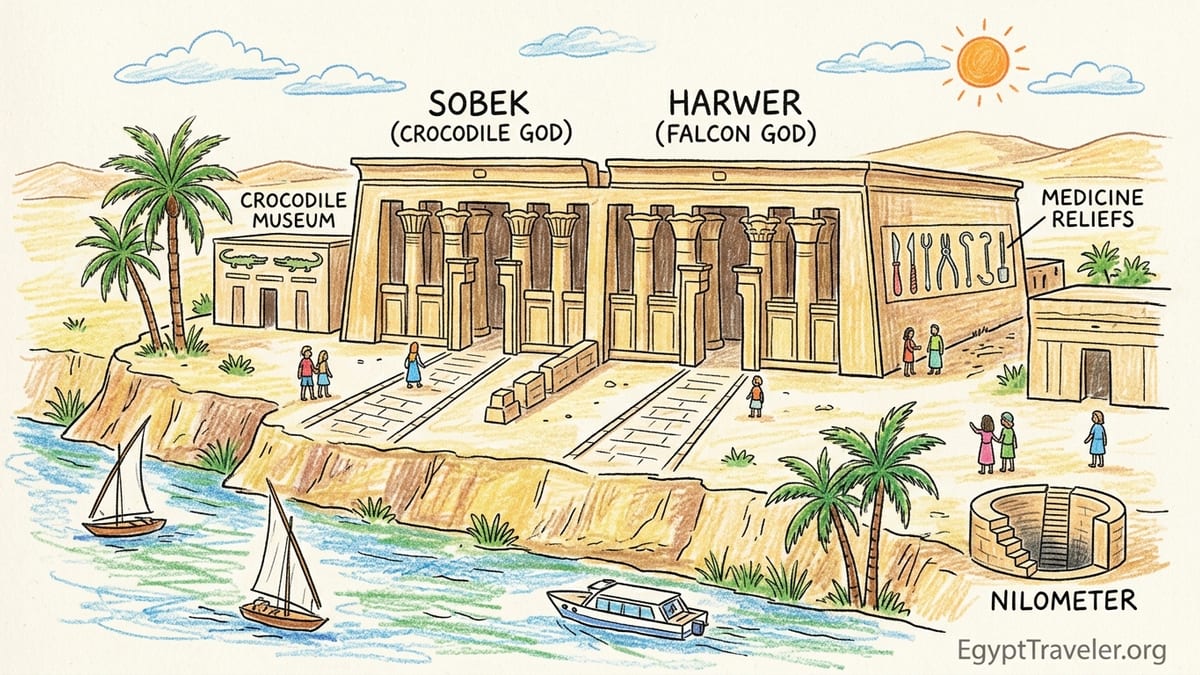
The defining feature of Kom Ombo is its dual-axis layout. Instead of a single central sanctuary, the temple is split down the middle into twin, near-symmetrical halves. One side is dedicated to Sobek, the crocodile god associated with the Nile’s waters and fertility. The other honors Harwer, or Horus the Elder, a falcon god linked with protection and kingship. From the outer gateway inwards, doors, halls, shrines and even some decorative motifs are duplicated so that each deity receives equal architectural attention, a feature explicitly highlighted in descriptions by Egypt’s Ministry of Tourism and Antiquities.
Walking in from the entrance, you will notice two parallel processional paths unfolding in front of you. The main forecourt once had a dividing line down its center, and the great hypostyle hall that follows can be mentally split in two: Sobek’s side on your right, Harwer’s on your left as you face toward the Nile. Continue further and you arrive at two separate sanctuaries, each with its own inner rooms. Independent travelers often linger in the middle of the axis, turning slowly to see how doorways, niches and columns subtly mirror each other, like standing between two temples welded together.
This duality is not only architectural. Each god presides over a triad: Sobek with Hathor and Khonsu, Harwer with Tasenetnofret and Panebtawy. Many reliefs show offerings presented twice, once to the crocodile god and his companions, once to the falcon god and his family. When exploring, it helps to consciously follow one axis at a time: walk in along Sobek’s right-hand route, exit back to the forecourt, then repeat on Harwer’s left-hand side. Even without a guide, this simple method makes the temple’s conceptual layout far clearer.
Because most cruise groups are whisked through quickly, many visitors never fully register this split personality. Independent travelers have the advantage of time. If you arrive outside peak group hours, you can stand in the shadowed hypostyle hall, line up your view along each axis, and appreciate why Kom Ombo is frequently used in textbooks and official guides as the classic example of a “double temple.”
Sobek, Harwer and the Crocodile Cult
Kom Ombo’s setting on a curve of the Nile shaped its spiritual identity. Ancient texts and modern museum panels alike explain that sacred crocodiles basked on the riverbank here. Sobek, portrayed with a crocodile head and human body, embodied both danger and life-giving water. Locals sought his protection from the animals that stalked the river, while also hoping he would grant fertility to their fields and families. The temple’s Sobek side reflects this ambivalence: many images are both awe-inspiring and faintly menacing, with rows of crocodile figures carved along walls and cornices.
By contrast, Harwer or Horus the Elder appears as a falcon-headed figure wearing the double crown. His role emphasizes order, legitimate kingship and celestial oversight. Reliefs on his half of the temple often show pharaohs being crowned, purified or led by the hand. For an independent visitor, it can be useful to pick one easily recognized scene on each side. For example, on Sobek’s axis many guides point out a panel showing a cow being washed, linked in modern interpretation to ritual cleanliness and perhaps health. On Harwer’s side, look for scenes of the king receiving life symbols from the gods, reinforcing the protective character of the falcon deity.
Outside the main temple, the Crocodile Museum helps make these mythic figures tangible. Excavations around Kom Ombo uncovered hundreds of crocodile mummies, some tiny hatchlings, others several meters long. A curated selection is displayed in climate-controlled halls beside the temple. Displays typically include a large adult crocodile wrapped in linen, smaller specimens, eggs and votive objects. Panels (mostly in Arabic and English) explain how crocodiles were reared, fed, then mummified when they died, serving as incarnations or emissaries of Sobek.
Entry to the Crocodile Museum is usually included in the main site ticket or as a small supplement, depending on current policy. Budget around 20 to 30 minutes inside. Photography may be restricted, and bags are often screened. Importantly, the museum is air-conditioned, making it a welcome break after walking the exposed temple courtyard in Upper Egypt’s sun, especially between March and October when daytime temperatures regularly exceed 35°C.
Riverside Setting, Nilometer and “Medical” Reliefs
Kom Ombo stands on a low bluff almost directly above the Nile, and its orientation makes the river feel like part of the complex. If you arrive by cruise boat, you step from the gangplank onto a riverside promenade and see the temple rising just above you, rows of columns silhouetted against the sky. Even if you arrive by car, take a moment to walk down to the embankment and look back toward the ruins. Late afternoon is particularly atmospheric: river water turns coppery, feluccas and small motorboats pass by, and the west-facing reliefs catch a warm glow.
One of the most evocative features for historically minded travelers is the Nilometer tucked at the edge of the complex. Essentially a stepped well linked to the river, it was used to measure the Nile’s flood levels. Priests descended the stairs to read water marks and predict agricultural prospects, taxation and ritual calendars. Today you can peer down into its depths; in the dry season, only the lowest steps are damp. Independent visitors often find the Nilometer area quieter than the main halls, providing a sense of how intimately the temple’s rituals were tied to seasonal changes in the river.
Another highlight is the set of reliefs frequently interpreted as depicting ancient medical instruments. These are on an outer wall near the rear of the temple, accessible via the ambulatory corridor. Look for a vertical panel carved with rows of small, precise shapes: objects that modern observers liken to scalpels, forceps, hooks, bottles and even a birthing chair. Scholars caution that direct one-to-one identifications with modern tools can be speculative, but there is broad agreement that the scene is associated with healing and temple medicine, a natural association in a sanctuary devoted to protective and fertility-linked deities.
Cruise groups often hurry past this section, so independent travelers should make a point of asking any on-site guardian to indicate the “doctor tools” if you are unsure of the location. For a practical example, some recent visitor reports describe drivers or local guides including a quick stop here only if specifically requested. Plan to reserve at least ten minutes to examine the panel, compare the carved shapes with the explanatory sketches sometimes drawn in the sand by enthusiastic guards, and imagine the temple’s role as a ritual healing center in late Ptolemaic and Roman times.
Getting to Kom Ombo from Aswan, Edfu and Nile Cruises
Kom Ombo sits roughly 45 kilometers north of Aswan and about 65 kilometers south of Edfu along the east bank of the Nile. Road travel is straightforward for independent visitors, though specific regulations on tourist movement can shift over time. As of recent seasons, most travelers arrange a private car and driver through their Aswan or Luxor hotel, through a reputable local agency, or via ride-hailing style services that operate in larger Egyptian cities and coordinate intercity transfers through local partners.
From Aswan, a one-way road transfer to Kom Ombo typically takes around 45 minutes to 1 hour, depending on traffic and checkpoints. Travelers report recent prices in the range of the equivalent of 30 to 60 US dollars for a half-day private car including waiting time, especially if negotiating locally with a licensed driver who regularly carries tourists between Aswan, Kom Ombo and Edfu. From Edfu, the drive usually takes around one hour. When pricing, confirm whether the agreed amount covers fuel, waiting time at the temple, and any additional stop such as a roadside café or viewpoint over the fields.
Many independent travelers choose to visit Kom Ombo as part of a longer transfer between Aswan and Luxor, combining stops at both Kom Ombo and Edfu temples. In that case, a full-day one-way car transfer with both sites and generous visiting time can run roughly the equivalent of 70 to 140 US dollars per vehicle, depending on season, vehicle size and booking channel. It is wise to request a written or WhatsApp confirmation detailing the departure time, included stops and total price in Egyptian pounds, since exchange rates change frequently.
If you are already traveling on a standard 3 or 4 night Nile cruise, Kom Ombo is usually included as a short shore excursion, often in the late afternoon or early evening. Boats tie up directly below the temple, and passengers walk up a few minutes to the gate. Cruise visits commonly allow 45 to 60 minutes for the temple and museum, which is enough for a quick overview but can feel rushed. Independent travelers sometimes choose to stay overnight in Aswan and then return later by road to experience the site at a quieter time, particularly if their cruise visit coincided with multiple boats docking at once.
Tickets, Opening Hours and How Long to Spend
Entry tickets for Kom Ombo are sold at a small kiosk near the site entrance and are typically priced in line with other major Upper Egyptian temples. Exact amounts change periodically with national pricing updates, but many recent visitors report standard adult tickets costing the local equivalent of a modest restaurant meal in Aswan, with discounted rates often available for students carrying valid international ID. Children under a certain age may enter free when accompanied by adults, though families should verify current policy at the ticket window.
Official opening hours commonly run from early morning to late evening, often around sunrise to 9 or 10 pm, which allows for both daylight and night-time visits. Schedules can be adjusted for Ramadan or special events, so for early-start itineraries it is worth asking your Aswan hotel reception to call ahead the day before to confirm. Arriving in the first two hours after opening, or in the last two hours before closing, usually results in fewer tour groups and cooler temperatures, especially from April through October.
For most independent travelers, 60 to 90 minutes is a comfortable amount of time for the temple itself, with an additional 20 to 30 minutes for the Crocodile Museum. This allows you to walk each axis slowly, examine the major reliefs, visit the Nilometer, circle the ambulatory corridor and then cool off in the museum. Travelers who enjoy photography or detailed epigraphy can easily stretch their stay to two hours or more, especially if they are timing their shots with the angle of the sun on particular walls.
Lighting changes dramatically over the course of the day. Midday sun can flatten relief details and make the open courtyard extremely hot. Late afternoon tends to produce the most rewarding combination of soft light, visible relief depth and bearable temperatures. After dark, artificial lighting emphasizes columns and doorways, creating a dramatic atmosphere but making it harder to see fine carving. A practical compromise for photographers is to arrive about 90 minutes before sunset, explore and shoot in natural light, then stay long enough to see the first floodlights come on before returning to your car.
Independent Visits vs Transfers with Edfu
A key planning decision is whether to treat Kom Ombo as a standalone excursion or pair it with Edfu during a longer transfer day. On its own, Kom Ombo works well as a half-day trip from Aswan. You can leave after breakfast, arrive mid-morning while many cruise groups are elsewhere, explore at an unhurried pace, visit the Crocodile Museum, then return to Aswan for a late lunch. This option is particularly appealing if you are already visiting Edfu on a separate day by road or on another cruise, or if you prefer shorter outings in the desert heat.
However, many independent travelers find that combining Kom Ombo and Edfu into a single one-way transfer between Aswan and Luxor makes practical and financial sense. A typical itinerary might depart Aswan around 8 am, stop at Kom Ombo from roughly 9 to 10:30 am, continue to Edfu for a generous 2 to 3 hour visit including lunch nearby, then reach Luxor in the late afternoon or early evening. By paying a single negotiated rate for the whole day, you avoid backtracking and make efficient use of the driving time that you would otherwise spend on a plain intercity transfer.
The trade-off is fatigue and crowding. Edfu is a larger, more enclosed temple, and by midday in high season its inner halls can feel crowded and hot. If you are traveling with young children, older relatives or anyone sensitive to heat, splitting the two sites across separate days, with a return to an air-conditioned base in Aswan, may prove more comfortable. On the other hand, experienced travelers short on time often report that the combined transfer day provides a satisfying “mini temple circuit” between Aswan and Luxor.
For those who have already visited many major Egyptian monuments, Kom Ombo’s uniqueness can justify a focused visit even without Edfu. The dual sanctuary, medical reliefs and crocodile mummies offer something distinct from Karnak, Philae or Luxor Temple. If your schedule allows only one additional stop between Aswan and Luxor beyond the headline sites, Kom Ombo is a strong candidate because it is compact, unusual and relatively easy to navigate independently.
Practical Tips for Beating the Crowds and Visiting Smoothly
The majority of Kom Ombo’s visitors still arrive on Nile cruises that follow set schedules, often stopping in the late afternoon or early evening. Independent travelers can use this to their advantage by planning around those waves. In practice, many cruise boats reach Kom Ombo between approximately 4 and 7 pm, meaning that mid-morning and early afternoon can be surprisingly quiet, even in high season. Before your trip, ask your Aswan hotel or a local agent roughly what time the big boats are expected on your intended day and adjust your departure accordingly.
Dress for intense sun and reflected heat from pale stone. Lightweight long sleeves, a wide-brimmed hat, sunglasses and closed-toe walking shoes are advisable, along with a refillable water bottle. While small kiosks near the entrance usually sell bottled water and soft drinks, prices can be higher than in town. Some travelers bring electrolyte tablets to dissolve in water, particularly if combining Kom Ombo with a longer drive to or from Edfu. Simple snacks such as nuts, dates or packaged biscuits can keep energy up, especially since dining options immediately around the site are limited to basic cafés and juice stalls.
Inside the temple, there is minimal interpretive signage compared with sites like the Egyptian Museum or major Luxor temples. Independent visitors benefit from bringing a printed plan or a guidebook chapter specifically covering Kom Ombo. Some travelers also download offline articles or maps to their phones before leaving Wi-Fi zones, since mobile data coverage can fluctuate. On-site, unofficial guides and guardians may offer impromptu explanations or point out details such as the medical relief or a particularly sharp Sobek carving in exchange for a small tip. If you prefer to explore alone, a friendly but firm “la shukran” (no thank you) usually suffices.
Photography is widely allowed in the open-air parts of the temple. Tripods can attract extra attention from guards and may incur an additional fee or be refused at busy times, so check current rules at the gate. In the Crocodile Museum, flash and video are often restricted or banned to protect the mummies. Signage at the entrance outlines current policy; when in doubt, ask the attendant before shooting. For best low-light results in the hypostyle hall and after sunset, a camera with good high-ISO performance or a modern smartphone in night mode is more practical than bulky support gear.
FAQ
Q1. How long do I really need at Kom Ombo Temple, including the Crocodile Museum?
Most independent travelers find that about 60 to 90 minutes inside the temple plus 20 to 30 minutes in the Crocodile Museum is enough for a satisfying visit. If you enjoy photography or detailed relief study, plan for up to two hours total.
Q2. Is Kom Ombo worth visiting if I am already seeing Philae, Karnak and Edfu?
Yes, Kom Ombo offers several experiences you will not find elsewhere in the same combination: a true double-axis temple shared by Sobek and Harwer, a well-preserved Nilometer, reliefs associated with ancient medical instruments and a dedicated Crocodile Museum.
Q3. Can I visit Kom Ombo independently without joining a Nile cruise excursion?
Yes. You can hire a private car and driver from Aswan or Edfu, or include Kom Ombo in a one-way transfer between Aswan and Luxor. You buy your own ticket at the gate and explore at your own pace, with no obligation to follow cruise-group timings.
Q4. What is the best time of day to visit Kom Ombo to avoid crowds and heat?
Early morning and the last two hours before closing usually have fewer cruise groups and more manageable temperatures. Late afternoon light is excellent for photography, but it coincides with many cruise visits, so arriving slightly earlier can help you enjoy quieter corners before boats dock.
Q5. How much should I budget for transport to Kom Ombo from Aswan?
Recent traveler reports suggest that a private round-trip car from Aswan, including waiting time, often costs the equivalent of roughly 30 to 60 US dollars per vehicle. Exact prices vary by season, vehicle type and negotiation, so confirm a total in Egyptian pounds in advance.
Q6. Is it better to visit Kom Ombo on its own or combine it with Edfu during a transfer?
If you value a relaxed pace and are sensitive to heat, a standalone half-day trip from Aswan works well. If your time is limited and you want to minimize backtracking, combining Kom Ombo and Edfu in a one-way transfer between Aswan and Luxor is efficient, as long as you are comfortable with a full sightseeing day.
Q7. Are there guides available on site, and do I need to book in advance?
Licensed guides and informal local guides are often available near the entrance or arranged through Aswan hotels. For deep historical context, booking a licensed Egyptologist in advance is helpful, but confident independent travelers can explore with a good guidebook or offline resources and rely on occasional explanations from on-site staff.
Q8. What should I wear and bring for an independent visit to Kom Ombo?
Wear light but modest clothing, a hat, sunglasses and sturdy shoes. Bring water, sunscreen, a small snack, and either a printed plan or downloaded information about the temple. A compact camera or smartphone with good low-light performance is useful for inner halls and evening visits.
Q9. Is the Crocodile Museum suitable for children or sensitive visitors?
The museum displays real crocodile mummies but presents them in a calm, educational way rather than as a horror exhibit. Most families report that school-age children find the mummies fascinating rather than frightening, though very young or sensitive visitors may prefer to move through quickly.
Q10. Are there facilities near the temple, such as toilets and places to buy drinks?
Yes. Basic toilets and small kiosks selling bottled water, soft drinks and simple snacks are usually available near the entrance and along the access path from the river. Facilities are functional rather than luxurious, so it is wise to arrive with essentials like tissues, hand sanitizer and your own refillable bottle.