


Upper Egypt is usually marketed as a Nile cruise from Luxor to Aswan, but you can see the same temples by road, sleep in characterful hotels on land, and control your own pace. This guide lays out a land-focused regional itinerary that connects Luxor, Dendera and Abydos, Esna, Edfu, Kom Ombo and Aswan without assuming you are cruising, and shows how to swap in a short cruise if you decide you want some time on the river.
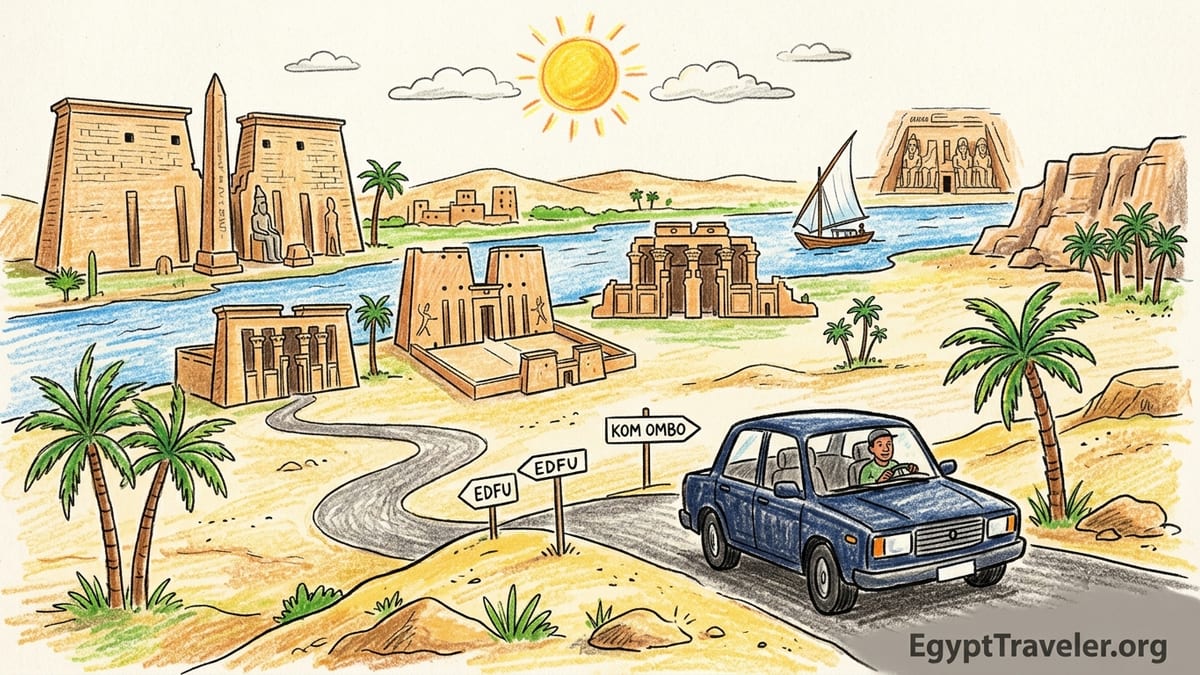
How Long to Spend and How to Move Around
For a satisfying land itinerary between Luxor and Aswan that includes Dendera, Abydos, Esna, Edfu and Kom Ombo, most travelers should plan at least five full days in Upper Egypt, with seven or eight days giving you room to slow down. A compact version might be three nights in Luxor and two in Aswan, while a deeper trip could easily stretch to four or five nights in Luxor, one in Edfu or Kom Ombo and three in Aswan. The key decision is whether Dendera and Abydos are must-sees for you or a bonus after you have covered Luxor and the main valley temples.
Between cities, the backbone of your trip is private road transport. On this stretch of the Nile Valley, independent car hire is uncommon and self-driving is not recommended for first-time visitors, so most people book point-to-point transfers with stops. A common real-world example is a one-way private car from Luxor to Aswan with sightseeing at Edfu and Kom Ombo, sold by local operators for a flat per-car rate that is typically similar to or slightly higher than a bare transfer without sightseeing. Hotel front desks in Luxor and Aswan routinely arrange these transfers, as do established local agencies whose prices include fuel, driver, basic waiting time and often an Egyptologist guide.
Public transport technically exists in the form of trains and service taxis, but these are not practical for chaining multiple temples in one day. For instance, you could ride a morning train from Luxor to Edfu, then a later train to Kom Ombo and Aswan, but you would still need to negotiate local taxis at each station and risk losing hours in the heat. If your time is limited to under a week, a sequence of pre-booked private transfers will preserve far more sightseeing time and reduce friction compared with improvising on the spot.
Road regulations in Upper Egypt can evolve, and there are often safety convoys for certain stretches and sensibly enforced restrictions on driving late at night. This is another reason private transfers are preferable: local drivers and agencies know the current rules and build departure times around them. In practical terms, that means early starts are standard for long days such as a Luxor–Abydos–Dendera loop or a Luxor–Edfu–Kom Ombo–Aswan transfer, with most itineraries aiming to have you off the open road before early evening.
Basing Yourself in Luxor
Luxor is the natural base for the northern half of this itinerary. Most travelers split their time between the East Bank, where the town center, Luxor Temple and the bulk of hotels sit, and the quieter rural West Bank, closer to the Valley of the Kings. For a classic first visit, two or three nights on the East Bank works well. In practice, that might mean staying at a midrange Nile-front hotel on the Corniche, where the majority of tour offices, banks and ATMs are, or in a guesthouse across the river reached by a short public ferry ride.
Luxor gives you easy access to Dendera and Abydos as day trips, plus enough in-town sights for at least two days of exploring. A common pattern is to dedicate one full day to the West Bank (Valley of the Kings, Hatshepsut’s temple, Medinet Habu and the Colossi of Memnon) and another to the East Bank (Karnak, Luxor Temple and the Luxor Museum). After that, additional days can be given to northern excursions, a hot-air balloon ride, or simply slower revisits to favorite temples at quieter times of day.
Because Luxor is such a tourism hub, it is also where you will find the greatest variety of practical services that make a land itinerary smoother. Local operators advertise in hotel lobbies and on street-front signs along the Corniche, selling private cars for Dendera and Abydos, shared minibuses to Edfu and Kom Ombo, and one-way transfers to Aswan with sightseeing. Prices fluctuate but as of mid-2026, typical quotes for a full-day private car to Dendera and Abydos for two people are around the cost of a midrange hotel night in Luxor. Shared day trips to a single site are often cheaper, though they come with fixed departure times and less flexibility at each temple.
If you are arriving in Luxor by air from Cairo or another city and want to minimize hotel hops, you can keep Luxor as your base for the first three or four nights of this itinerary, tackling Dendera and Abydos while you are still fresh from your flight. After that, shifting gradually south toward Aswan is more comfortable than trying to day-trip to the far southern temples and back to Luxor on a single exhausting day.
Dendera and Abydos as Day Trips from Luxor
Dendera and Abydos sit north of Luxor and work best as day trips, either combined into one long excursion or split into separate days for a deeper look. Dendera, with its Temple of Hathor, lies roughly an hour and a half by road from Luxor, while Abydos, home to the Temple of Seti I, is farther again and brings the total driving time for a Luxor–Dendera–Abydos loop to roughly six hours. In practice, most itineraries run from around 7 am to late afternoon, including sightseeing and a stop for lunch.
Many local agencies and hotel tour desks in Luxor sell a combined Dendera and Abydos day trip that leaves early, stops first at Abydos when it is still relatively cool, then calls at Dendera on the way back to Luxor. This allows you to see the exquisite reliefs of Seti I with fewer tour groups and then immerse yourself in the astronomical ceilings at Dendera, famous for their vivid blues and detailed zodiac imagery. On a typical shared group tour, expect limited time at each site and a quick lunch at a roadside restaurant or in a small town; a private car and guide will allow you to linger longer in the relief halls and chapels, at a higher cost.
Splitting the sites into two separate day trips from Luxor makes for significantly more relaxed days, especially in warmer months, but doubles the total driving time and transport cost. This approach appeals most to travelers with a special interest in temple art or those building a longer Upper Egypt stay. For example, a repeat visitor might book one day focused solely on Dendera’s roof chapels and crypts and a second day at Abydos to follow the famous king list and visit the nearby Ramesses II temple at leisure.
In all cases, it is wise to organize these excursions at least a day in advance through your hotel or a trusted local agency. Confirm whether entrance fees and guiding are included, what time you will return to Luxor, and whether there are any current road restrictions that affect departure times. If you arrive in Luxor late in the day, allow yourself at least one full day in town before attempting a long Dendera–Abydos run, so you are not fighting jet lag on narrow Upper Egyptian roads.
Luxor to Esna, Edfu and Kom Ombo by Road
South of Luxor, the temples of Esna, Edfu and Kom Ombo sit naturally along the road corridor to Aswan and are ideal to see as part of a one-way transfer. You can theoretically treat Edfu and Kom Ombo as day trips from Luxor, especially Edfu which is about 115 kilometers south, but a more efficient approach is to combine them with a move of base. That way, each temple stop breaks up the drive rather than adding extra hours onto a round-trip from Luxor.
A popular real-world plan looks like this: check out of your Luxor hotel after an early breakfast, drive about an hour to Esna to visit the Temple of Khnum, continue for roughly two more hours to Edfu for the Temple of Horus, then carry on for another hour and a half to Kom Ombo to see the riverside double temple of Sobek and Haroeris. After a final hour and a half of driving, you arrive in Aswan by late afternoon and check into your hotel overlooking the Nile or on Elephantine Island. In total, that is roughly nine to ten hours door to door, including temple time and a lunch stop, and uses the day as a long scenic transfer rather than a blank driving day.
Travelers who prefer shorter days can break this stretch with an overnight midway. Edfu, roughly halfway between Luxor and Aswan, has a handful of simple hotels that cater mainly to domestic travelers and overland groups. Spending the night there allows you to see the temple in the quieter early morning, then continue south to Kom Ombo and Aswan later in the day. Alternatively, you could stay in Kom Ombo at a modest guesthouse within sight of the river, walking to the temple for sunset as cruise ships tie up below. While these towns do not yet have the variety of dining or nightlife found in Luxor and Aswan, they offer a more local feel and shorter driving segments.
For travelers who have already spent heavily on organized tours elsewhere in Egypt, a lighter option is to book only the private car with an English-speaking driver and explore the temples independently, buying entrance tickets on arrival. This keeps costs lower than a fully guided day and suits those who are happy to read up on the sites in advance or use a guidebook. If you do choose this route, remember to carry cash for entrance fees, tipping guards and drivers, and buying water or snacks around the sites where card payment is unreliable.
Aswan as a Southern Base and Longer Variations
Aswan is the southern anchor of this itinerary and rewards at least two or three nights, more if you plan to add Abu Simbel or simply want downtime by the river. The city has a gentler pace than Luxor, with feluccas gliding past granite outcrops and palm-fringed islands. Classic sights such as Philae Temple, the Unfinished Obelisk and the Nubian Museum can fill a full day on their own, while another morning can be devoted to a boat trip to a Nubian village further upriver.
In practical terms, Aswan is also a transport node. Many travelers arrive by air from Cairo and then work north overland to Luxor, while others do the reverse. Whichever direction you choose, the structure of the itinerary remains the same: use Luxor and Aswan as your main bases and treat Esna, Edfu and Kom Ombo as sightseeing stops between them. From Aswan, day trips to Kom Ombo are common, usually as part of an excursion that includes a felucca ride or a sunset drink by the river afterward. However, once you are already in Aswan for several nights, it is often more efficient to have seen Kom Ombo during the transfer so you can devote your Aswan days to local attractions or the long early-morning drive to Abu Simbel.
For a longer route variation, consider adding extra nights on the West Bank of Luxor and at least one night in a Nubian guesthouse near Aswan. This transforms the trip from a temple checklist into a slower journey through rural Upper Egypt. For example, you might spend your first three nights in Luxor proper, then two nights in a village guesthouse surrounded by sugarcane fields, before heading south over two days with a night in Edfu. After three or four nights in Aswan, including a pre-dawn Abu Simbel day trip, you could end your itinerary with a final quiet night on an island reached by small motorboat, watching the last cruise ships of the season drift past.
Longer stays also make it easier to work around seasonal factors. In the cooler months from roughly November to March, a compact five or six day route that includes Dendera and Abydos is realistic. In the hotter period, reducing long days and prioritizing early-morning visits makes a major difference to comfort. That might mean splitting Dendera and Abydos over two days, visiting Edfu as soon as the site opens, or scheduling Kom Ombo for very late afternoon when the sun is lower and the river breeze picks up.
Substituting a Nile Cruise for Part of the Route
Even if you prefer to be based on land, you can easily insert a short cruise into the middle of this itinerary without rewriting everything. The temples and towns discussed in this guide are on the standard cruise route between Luxor and Aswan, so most cruise itineraries already include Esna, Edfu and Kom Ombo. In practice, this means you could structure your trip as several nights in Luxor, followed by a three- or four-night cruise to Aswan, then at least two nights in a hotel in Aswan at the end.
Operationally, very little changes: you would still treat Dendera and Abydos as day trips by road from Luxor before boarding the ship, and you would still sleep in hotels in Luxor and Aswan. The main difference is in how you travel the central section. Instead of a full-day private transfer with temple stops, you let the cruise ship handle the transport while you unpack once and watch rural life along the river. This is particularly appealing for travelers who value comfort and prefer to avoid multiple long road days in a row.
Another hybrid approach is to drive one way and cruise the other. For instance, you might start with a southbound road transfer from Luxor to Aswan via Esna, Edfu and Kom Ombo, spending a few nights in Aswan and visiting Abu Simbel. Afterward, you would board a northbound cruise back to Luxor, seeing Edfu and Kom Ombo again at a different time of day, or simply relaxing onboard while other passengers disembark to sightsee. Because cruise schedules can shift according to river traffic and lock timings, it is important to build some flexibility into the days before and after your sailing segment.
Whichever combination you choose, the underlying land itinerary stays intact. Dendera and Abydos remain day trips from Luxor, Luxor and Aswan remain your main accommodation hubs, and Esna, Edfu and Kom Ombo remain mid-journey temples whose exact visitation style depends on whether you arrive by car or by boat. Thinking of the cruise as a moving hotel that substitutes for just one long driving day helps you keep planning straightforward and avoids having to rework the entire route if you decide to add or remove it later.
Shorter and Longer Sample Routes
To see how these pieces fit together in real life, it helps to look at concrete sample itineraries. A tighter five-night land route might look like this for a first-time visitor: three nights in Luxor, then a full-day private transfer to Aswan with temple stops, followed by two nights in Aswan. In that version, you devote your first two Luxor days to the East and West Bank sites, then decide whether to book the combined Dendera and Abydos day trip on your third day. On day four, you check out, drive south via Esna, Edfu and Kom Ombo, and arrive in Aswan by early evening. Days five and six focus on Philae, the Nubian Museum and perhaps a felucca ride, before you continue your wider Egypt journey.
A more leisurely eight- or nine-night version could begin with four nights in Luxor, one night in Edfu or Kom Ombo, and three or four nights in Aswan. With this extra time, you might allocate one Luxor day solely to Dendera and Abydos, allowing for more temple time and a relaxed lunch, and another day to revisit a favorite site such as Karnak at sunrise or sunset. Breaking the Luxor–Aswan road into two days shortens each driving segment and opens up the possibility of evening strolls in provincial towns where you will see few other tourists once the buses and cruise passengers have departed.
Travelers who are particularly sensitive to heat or motion sickness often prefer to cluster multiple nights in each base and minimize one-night stays. In that case, you could keep the basic structure of four nights in Luxor and three in Aswan, but still treat the Luxor–Aswan day as a long temple transfer with at least Edfu and Kom Ombo built in. Esna can be added or skipped depending on how early you are willing to start and how many hours you are comfortable spending on the road. There is no single right answer; what matters is matching driving time and check-in fatigue to your own travel style.
For repeat visitors or serious archaeology enthusiasts, the region supports even more extended stays. Some travelers arrange a full week just in Luxor, working in multiple trips to Dendera and Abydos as well as lesser-visited West Bank tombs, then treat Aswan as a separate three- or four-night chapter focused on Nubian culture and lake temples. Others link this Upper Egypt route with overland journeys further north along the Nile, using the same pattern of private cars, small-town overnights and city bases that makes the Luxor–Aswan stretch so flexible.
The Takeaway
Planning Upper Egypt without defaulting to a Nile cruise is not only possible, it can be deeply rewarding. By using Luxor and Aswan as your primary bases and treating Dendera, Abydos, Esna, Edfu and Kom Ombo as day trips or strategic stops in between, you gain control over your daily rhythm and can choose how intensively to explore each site. Private transfers by road turn long driving days into temple-hopping journeys, with plenty of chances to pause for tea in small towns and watch life unfold along the canals and fields.
The core structure of the itinerary is straightforward: spend several nights in Luxor, visit Dendera and Abydos by day, then work your way south by car via Esna, Edfu and Kom Ombo to reach Aswan for a final block of river time. Around that skeleton you can add comforts such as upgraded hotels, slower rural overnights, or a short cruise for part of the route. Because the same temples appear on both land and river itineraries, you can insert or remove a cruise segment without upending your entire plan.
Above all, allow enough time. While it is physically possible to rush from Luxor to Aswan in a single day and tick off Edfu and Kom Ombo on the way, the real magic of Upper Egypt lies in unhurried hours inside shadowed hypostyle halls and quiet moments on the riverbank after the buses have gone. Whether you choose five, seven or ten days between Luxor and Aswan, prioritize early starts, smart clustering of sights and a pacing that lets the Nile and the temples feel like a journey rather than a race.
FAQ
Q1. Is it realistic to visit both Dendera and Abydos as a day trip from Luxor?
Yes, many travelers visit both Dendera and Abydos in one long day from Luxor, with around six hours of total driving. It is tiring but manageable if you start early and accept that you will not see every detail at each site.
Q2. Can I visit Edfu and Kom Ombo as separate day trips from Luxor instead of during a transfer?
It is possible to do Edfu and Kom Ombo as a long day trip from Luxor by private car, but most travelers find it more efficient to visit them while moving between Luxor and Aswan so that the sightseeing breaks up the journey.
Q3. Do I need to book all my private transfers in advance or can I arrange them on arrival?
You can sometimes arrange transfers on arrival through your hotel, but in busy periods it is safer to book longer routes like Luxor to Aswan with temple stops at least a few days in advance so that a reliable car and driver are guaranteed.
Q4. Is it safe to travel by road between Luxor and Aswan?
For most visitors, traveling by road between Luxor and Aswan with a licensed driver is considered safe, though you should follow local advice, travel mostly in daylight, and use established agencies or hotel-recommended drivers.
Q5. How many nights should I spend in Luxor versus Aswan?
A balanced first-time itinerary might allocate three or four nights to Luxor and two or three to Aswan, with Luxor used as a base for Dendera and Abydos and Aswan for Philae, local islands and optional Abu Simbel.
Q6. Can I add a short Nile cruise without changing my whole land itinerary?
Yes, you can easily insert a three or four night cruise between Luxor and Aswan and still keep the rest of your plan the same, using hotels at both ends and day trips by road for Dendera and Abydos.
Q7. Are there budget-friendly options for seeing these temples without a private guide?
Budget travelers often hire only a car and driver or join shared minibus trips sold by local agencies, then explore the temples independently with a guidebook, which keeps costs lower than a fully guided private tour.
Q8. What is the best time of year for a land-focused Upper Egypt itinerary?
The most comfortable months for a land itinerary are roughly November to March, when daytime temperatures are milder and long road days and temple visits in the open sun are easier to manage.
Q9. Should I stay in Edfu or Kom Ombo overnight, or just use Luxor and Aswan as bases?
Most travelers base themselves only in Luxor and Aswan, but an overnight in Edfu or Kom Ombo can be rewarding if you want shorter driving segments and quieter temple visits before or after the main tour groups arrive.
Q10. Do I need to buy tickets for the temples in advance?
No, temple tickets in Upper Egypt are usually purchased on arrival at the entrance kiosks, though you should carry cash and check if any special areas, such as temple roofs or crypts, require separate tickets on the day.