


Upper Egypt has more world class temples than most travelers can fit into a single itinerary. Between Karnak, Luxor Temple, Dendera, Abydos, Edfu, Kom Ombo, Esna, Philae and the great West Bank monuments, even a ten day trip forces hard choices. This guide compares the major sites by preservation, reliefs, architecture, crowds and ease of access and then suggests specific combinations for different kinds of travelers so you can build a trip that feels rich rather than rushed.
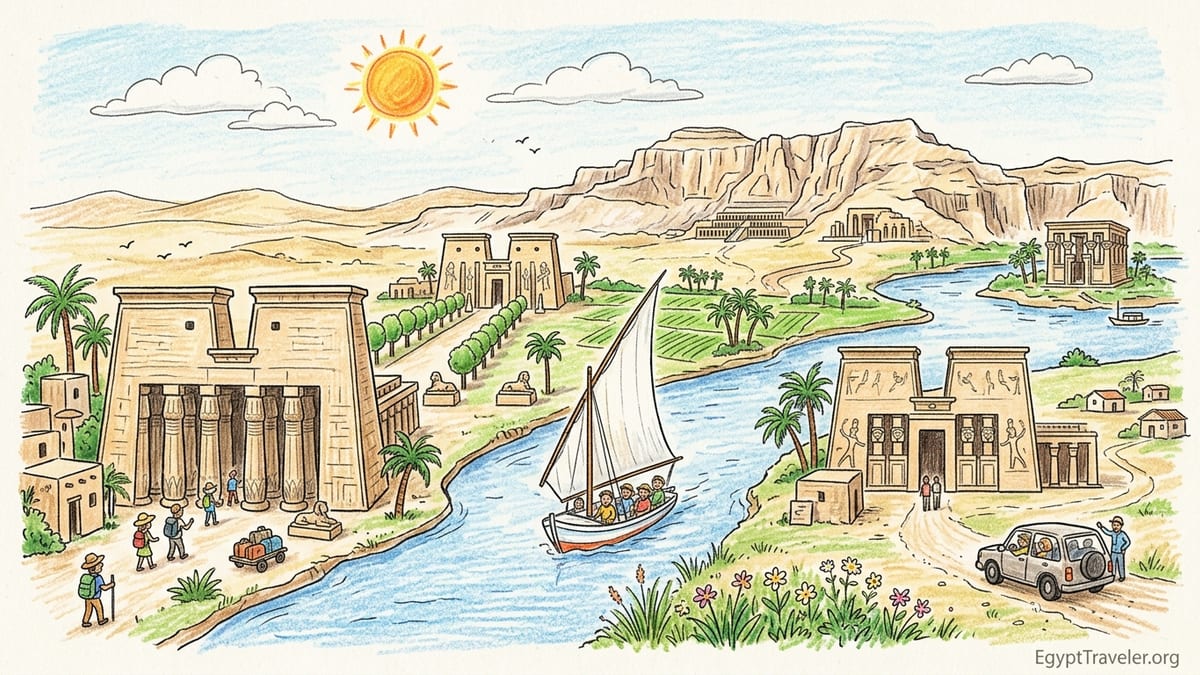
How to Think About Temple Hopping in Upper Egypt
Most visitors arrive in Luxor with a Nile cruise or a classic Cairo–Luxor–Aswan itinerary that allows three to five nights in Upper Egypt. Tour brochures list a dozen famous temples, but in practice you might only have time for four to eight substantial visits before fatigue sets in. Instead of trying to “collect” every monument, it helps to group temples by what they do best: colossal architecture, vivid reliefs and color, riverside atmosphere, or a sense of solitude and pilgrimage.
For example, the Great Hypostyle Hall at Karnak overwhelms with scale and forest like columns, while Dendera’s Temple of Hathor is prized for its near intact roof and painted astronomical ceilings. Edfu feels like walking into a complete Ptolemaic temple, walls and pylons towering above you, but often with dense cruise crowds. Abydos offers arguably the most refined reliefs in Egypt but takes a three hour drive each way from Luxor, so it rewards travelers willing to trade time and comfort for depth.
Cost and logistics matter too. A standard group tour from a midrange Luxor hotel to Karnak and Luxor Temple might be included in a 3 or 4 day package and take half a day, with minimal extra expense beyond your ticket. A private day trip by car and guide to Dendera and Abydos from Luxor typically runs in the low hundreds of US dollars for two people, depending on the operator, because of distance, fuel and the mandatory security routing. Building your plan around what you value most saves both money and precious daylight hours.
Karnak and Luxor Temple: The Core Urban Double
Karnak and Luxor Temple sit just a few kilometers apart on the East Bank and are linked by the restored Avenue of Sphinxes, yet they feel very different. Karnak is a vast religious complex centered on the Precinct of Amun with layers from the Middle Kingdom through the Ptolemaic period and famously includes the Great Hypostyle Hall, obelisks of Thutmose I and Hatshepsut and the sacred lake. It is one of Egypt’s most visited sites after the Giza Plateau and you feel that popularity in peak season when tour buses from Red Sea resorts arrive mid morning and again in the afternoon.
Luxor Temple, by contrast, is more compact and theatrical, especially at night when columns and statues are floodlit and the modern city hums just beyond the walls. The temple preserves an elegant sequence from Amenhotep III to Ramesses II, with later Roman and Islamic layers including a still active mosque set above the ancient courtyard. Because it opens into the town, it is easy to visit independently on foot from many riverfront hotels, and a sunset or evening visit can fit even a short layover.
If you only have one full day in Luxor, Karnak plus Luxor Temple is the natural combination. Many guided itineraries visit Karnak in the cooler early morning, break for lunch, then return to Luxor Temple near sunset or after dark. This pairing gives you a sense of pharaonic power on a civic scale at Karnak and a more intimate, atmospheric experience at Luxor Temple without significant extra transport. For travelers who are not temple enthusiasts, seeing just these two plus one or two West Bank sites already delivers a strong impression of ancient Thebes.
Dendera and Abydos: Painted Ceilings and Pilgrimage Calm
North of Luxor, Dendera and Abydos offer a different mood. The Temple of Hathor at Dendera, near Qena around 60 kilometers from Luxor, is one of the most intact temples in Egypt, with a largely preserved roof, dark crypts and famous blue astronomical ceilings where conservation work has revealed vivid color. The first hypostyle hall, topped by Hathor headed columns, is among the most photogenic interiors in the country and appeals to travelers who loved the colored tombs in the Valley of the Kings but want to see that artistry on a monumental scale.
Abydos, about 160 kilometers north of Luxor, is anchored by the Temple of Seti I, long a major cult center of Osiris. The reliefs here are exceptionally finely carved, with delicate modeling and complex theological scenes, and the site also preserves the Abydos King List, a carved sequence of royal cartouches that fascinates anyone with even a passing interest in Egyptian chronology. Behind the main temple lies the Osireion, a symbolic tomb linked to Osiris, which adds to the strong sense of pilgrimage and myth that permeates the site.
From Luxor most visitors join a private car and guide for a long day that combines Dendera and Abydos, leaving around 6 or 7 in the morning and returning early evening. The roads include several police checkpoints and can be dusty and slow, which is why many first time visitors decide that Dendera alone is enough. If you are an archaeology enthusiast or a repeat visitor, Abydos feels markedly different from the big Nile temples: village atmosphere, relatively low visitor numbers outside peak groups and a chance, if you overnight in one of the simple local hotels, to walk to the gate for the 7 am opening and have entire halls almost to yourself.
In terms of a selection guide, Dendera is the better choice for travelers interested in color, intact architecture and a manageable outing of around five to six hours from Luxor. Abydos deserves the extra time for those who care about religious history, sophisticated relief carving and the idea of seeing a place that has been sacred for over three thousand years but remains far less commercialized than the big city temples.
Edfu, Kom Ombo and Esna: Classic Cruise Temples and How to Prioritize
South of Luxor, most Nile cruises call at Edfu, Kom Ombo and often Esna as they sail toward Aswan. Edfu, dedicated to Horus, is one of the best preserved Ptolemaic temples, still encased in its high enclosure walls with a towering pylon entrance, intact roofed halls and extensive ritual scenes on almost every surface. Walking through its darkening corridors can feel like stepping back into a functioning temple. The tradeoff is crowds: cruise ships often arrive within minutes of each other and groups converge at the front gate, especially if horse drawn carriages are used for transfers from the dock.
Kom Ombo, perched directly on a bend of the Nile, is smaller and partially ruined but enjoys one of the most beautiful settings in Upper Egypt. The double temple layout, honoring both Sobek the crocodile god and Horus the Elder, is easy to grasp even for non specialists, and the attached crocodile museum with mummified crocodiles tends to be a favorite with families. Because many cruises schedule Kom Ombo either around sunset or in the evening, visitors often remember the golden river light or the dramatic artificial lighting as much as the architecture itself.
Esna, sometimes visited by cruise or by road from Luxor, is a compact temple of Khnum sunken below modern street level in the center of town. Recent cleaning has revealed bright painted reliefs on the ceiling and columns that surprise travelers who assume that temple interiors are always sand colored. The excavation pit like setting and the living city above create a strong contrast between ancient and modern Egypt. Esna works particularly well as a short stop when sailing or driving between Luxor and Edfu rather than as a stand alone goal.
If your time is limited and you are not on a cruise, Edfu is the best single representative of the Ptolemaic riverside temples but can feel intense at peak hours. Independent travelers sometimes hire a private car from Luxor to Edfu and Kom Ombo in one long day, leaving before dawn, but for most people these sites are simplest as part of a cruise where transfers and security are already arranged. For a traveler sensitive to crowds, it can make sense to skip Edfu and focus instead on Kom Ombo and Esna, where visits can feel lighter and often shorter.
Philae and the West Bank: Temples in Landscape
Near Aswan, the Temple of Isis at Philae offers a different experience again. Relocated stone by stone to Agilkia Island after the construction of the Aswan High Dam, it is reached by a short motorboat ride, which adds to the sense of journey and separation from the modern city. The temple itself is late Ptolemaic and Roman in date, with kiosks and colonnades framing the water and reliefs that show the endurance of Egyptian religious imagery into the Roman imperial era. Many visitors remember the sound of lapping water and the shimmer of late afternoon light on the pylons as much as any specific carving.
On Luxor’s West Bank, several key temples complement the tombs of the Valleys of the Kings and Queens. The mortuary temple of Hatshepsut at Deir el Bahari rises in terraces against limestone cliffs and is one of the most recognizable silhouettes in Egypt. Its colonnades and ramps create sweeping vistas rather than enclosed interiors, so it works particularly well in the early morning when the sun lights the facade and tour buses have not yet fully arrived. Nearby, Medinet Habu, the mortuary temple of Ramesses III, preserves some of the best exterior reliefs and patches of original wall painting in Thebes and often sees lighter crowds than the East Bank giants.
Further north along the cultivation, the Ramesseum, mortuary temple of Ramesses II, feels half ruined but deeply atmospheric. Travelers who have already seen Karnak and Luxor Temple often comment that at the Ramesseum they can finally slow down, sit in a fallen court and listen to wind rustle through palm trees without constant tour chatter. These West Bank temples pair well with valley tombs and offer a chance to experience ritual architecture in a landscape of cliffs, fields and villages rather than inside a walled urban complex.
For a first time visitor with two full days in Luxor and one in Aswan, a strong temple combination might include Karnak, Luxor Temple by night, Hatshepsut’s temple, Medinet Habu and Philae. This balances different architectural styles, river and desert settings, and both day and evening lighting conditions. Travelers keen to avoid heat and crowds might reverse typical orders, visiting Medinet Habu and the Ramesseum in the middle of the day when large groups are focused on tombs, and saving Karnak for the last two hours of daylight.
Comparing Temples by Preservation, Atmosphere and Access
From a preservation and relief quality standpoint, Dendera, Edfu and Philae stand out among the Ptolemaic group, while Abydos and Medinet Habu shine for New Kingdom and later art. Dendera’s roofing and crypts make it feel unusually complete, and its astronomical ceilings and zodiac motifs fascinate many visitors even if they have seen multiple other temples. Edfu’s massive walls, intact pylon and sequence of forecourt, hypostyle halls and sanctuary give a textbook example of temple layout. Abydos offers some of the finest raised reliefs in the country, subtle enough that photographers often switch to a tripod or high ISO to capture the modeling in low light.
Atmosphere and crowd levels vary sharply. Karnak and Edfu are often the most crowded, along with Hatshepsut’s temple in high season when buses from Red Sea resorts arrive on day trips. Luxor Temple, Philae and Kom Ombo can be busy yet feel more relaxed because of their riverside settings and the possibility of evening visits. Abydos, Medinet Habu, the Ramesseum and, to a lesser extent, Esna tend to see fewer buses, so even at midday you may share large spaces with only a handful of other travelers and local guides. For some visitors, that sense of quiet is more memorable than the most impressive hypostyle hall.
Access difficulty ranges from a short taxi ride to more involved full day commitments. Karnak, Luxor Temple and the West Bank temples are easily reached by taxi or ride share from central Luxor hotels and guesthouses, with travel times typically under 30 minutes in normal traffic. Dendera is around an hour to ninety minutes by car from Luxor, with most tourists using a private driver or organized tour. Abydos requires about three hours each way by road with security checkpoints and relatively basic roadside facilities, which is why many choose an organized tour rather than public transport.
Your tolerance for early starts, long drives and repeated security checks will shape how many of the more remote temples you include. For example, a traveler staying in a midrange Luxor hotel might decide that an extra morning at the pool and a leisurely evening at Luxor Temple beats sitting in a minivan for six hours to reach Abydos. A dedicated archaeology enthusiast, on the other hand, may gladly accept a bumpy road and a simple roadside lunch for the reward of seeing Seti I’s reliefs almost alone.
Recommended Combinations for Different Types of Travelers
For first time visitors with four to five days between Luxor and Aswan, a strong short list focuses on variety rather than sheer numbers. One practical combination is Karnak, Luxor Temple, Hatshepsut’s temple, Medinet Habu and Philae, plus one cruise style stop such as Kom Ombo if it fits your route. This mix delivers colossal architecture, colored reliefs, desert cliffs, an island temple and both day and night visits without requiring any single day longer than eight to nine hours door to door.
Archaeology enthusiasts or repeat visitors might prioritize sites with distinctive relief programs and calmer atmospheres. In that case Abydos and Dendera as a combined day from Luxor become almost non negotiable, along with Medinet Habu and the Ramesseum on the West Bank. Adding Karnak in the late afternoon, focusing on side chapels and less visited corners rather than just the main axes, rounds out a deeper dive. Edfu can be worthwhile if you have not yet seen a fully preserved Ptolemaic temple, but if you have already explored Dendera in detail, Edfu may feel more redundant than essential.
Travelers with very limited time, such as those flying into Luxor for just two nights or arriving on a Red Sea day trip, need to be even more selective. With one full day, choose either a Karnak plus Luxor Temple combination or a West Bank day that pairs Hatshepsut’s temple with a couple of tombs and a short stop at Medinet Habu. Adding Dendera, Edfu or Abydos to such a compressed schedule usually leads to rushed visits and heat exhaustion. If you have a single extra half day, an evening at Luxor Temple or a short visit to Esna from a cruise can be a rewarding low effort addition.
Families and travelers sensitive to crowds may want to avoid peak hours at the headline sites. One practical tactic is to accept that you may skip one or two famous temples if conditions are not right. For instance, if your cruise arrives at Edfu along with five others and the horse carriage queue looks chaotic, it can be perfectly reasonable to stay on deck and enjoy the quiet ship while most passengers visit the temple. Later in the trip you might spend more time at Medinet Habu or the Ramesseum where your children can explore without constant jostling.
The Takeaway
If you try to see every major temple between Qena and Aswan in a single trip, the sites will eventually blur together. The key is to choose places that feel genuinely distinct: Karnak for monumental urban scale, Luxor Temple for nocturnal atmosphere, Dendera for painted ceilings, Abydos for refined reliefs and pilgrimage mood, Edfu for an almost complete Ptolemaic temple, Kom Ombo and Philae for riverside settings, and Medinet Habu or the Ramesseum for quieter West Bank experiences.
In practice, most travelers are happiest when they accept they will miss a few famous names and instead give themselves time to sit in a hypostyle hall, trace a line of hieroglyphs with their eyes or watch light change on a pylon. Whether you gravitate toward grand processional ways or secluded desert shrines, Upper Egypt offers more than enough variety to build a temple selection that fits your interests, energy and schedule. Thoughtful choices will reward you with memories of individual places and moments rather than a blur of stone and sand.
FAQ
Q1. If I only have one full day in Luxor, which temples should I prioritize?
For a single day in Luxor, most travelers get the best balance by visiting Karnak in the morning and Luxor Temple around sunset or after dark. This combination shows you both the grand scale of ancient Thebes and a more intimate, atmospheric temple without long drives or complex logistics.
Q2. Is the long day trip to Dendera and Abydos from Luxor really worth it?
The combined trip is worthwhile if you care deeply about temple art and can tolerate six hours in a car. Dendera offers some of the best preserved painted ceilings in Egypt, while Abydos has exceptionally fine reliefs and a quieter, pilgrimage like atmosphere. If you dislike early starts and long drives, visiting Dendera alone is a more comfortable compromise.
Q3. How do Edfu and Kom Ombo compare for someone on a Nile cruise?
Edfu feels like entering a fully intact Ptolemaic temple, with towering walls and a classic layout, but it is often crowded when several cruise ships dock at once. Kom Ombo is smaller and more ruined but enjoys a beautiful riverside setting and a simple double temple plan that many visitors find easier to absorb, especially during a sunset or evening visit.
Q4. Are there temples in Luxor that are impressive but less crowded?
Yes. On the West Bank, Medinet Habu and the Ramesseum usually see fewer buses than Karnak, Luxor Temple or Hatshepsut’s temple. Their large open courts, well preserved reliefs and village edge locations make them ideal for travelers who want time to explore without constant crowds.
Q5. Do I need a guided tour for sites like Dendera, Abydos and Philae?
A local guide is highly recommended for Dendera, Abydos and Philae because their reliefs and chapels are dense with symbolism that is easy to miss when visiting alone. In practice, many travelers book private or small group tours from Luxor or Aswan, which bundle transport, required permits or security arrangements and guiding into a single price.
Q6. How should I plan around heat and sun when visiting open air temples?
Plan major temple visits for early morning or late afternoon, especially in warmer months. Sites with shaded interiors, such as Dendera, Edfu and parts of Karnak, are more tolerable around midday than exposed facades like Hatshepsut’s temple. Carry water, wear a wide brimmed hat and light clothing, and consider building in a midday rest back at your hotel if you are not used to desert conditions.
Q7. Is it better to see Philae Temple during the day or in the evening?
Both have advantages. A daytime visit makes it easier to appreciate relief details and photograph the island setting, while an evening sound and light show focuses more on storytelling and atmosphere. If you only have time for one, a late afternoon visit that extends into early evening often gives you a mix of good light and softer temperatures.
Q8. Can I visit Esna or Dendera without joining a large bus tour?
Yes. From Luxor you can hire a private taxi and, where required, arrange local permits through your hotel or a small local agency. Many midrange guesthouses and boutique hotels work with trusted drivers who make regular runs to Esna and Dendera, and sharing the car with another couple can keep costs reasonable while avoiding the rigid timetable of big group tours.
Q9. How many temples can I realistically enjoy in one day without fatigue?
Most travelers find that two substantial temple visits plus one shorter stop is the upper limit before everything starts to look the same. For example, pairing Karnak with Luxor Temple, or Hatshepsut’s temple with Medinet Habu and a brief photo stop at the Colossi of Memnon, keeps the day full but still allows time to rest, eat and absorb what you have seen.
Q10. Should I skip any famous temples if I am sensitive to crowds or mobility issues?
If crowds or mobility are concerns, it is completely sensible to skip or shorten visits to heavily trafficked sites like Edfu or the busiest hours at Karnak. Instead, focus on temples with easier approaches, more seating and generally lighter visitor numbers, such as Medinet Habu, the Ramesseum, parts of Dendera and quieter times at Luxor Temple or Philae.