


For many travelers, the journey between Luxor and Aswan is where an Egyptian itinerary either opens up beautifully or turns into a long, wasted transfer day. In 2026 a growing number of companies now sell the Luxor to Aswan route with stops at Edfu and Kom Ombo as a distinct one-way product, aimed squarely at visitors who are skipping a Nile cruise yet still want to follow its classic temple route. Understanding how that overland option compares with a simple private car or the train will help you decide how to spend one of your most valuable days in Upper Egypt.
The Route in Context: Why This Stretch Matters
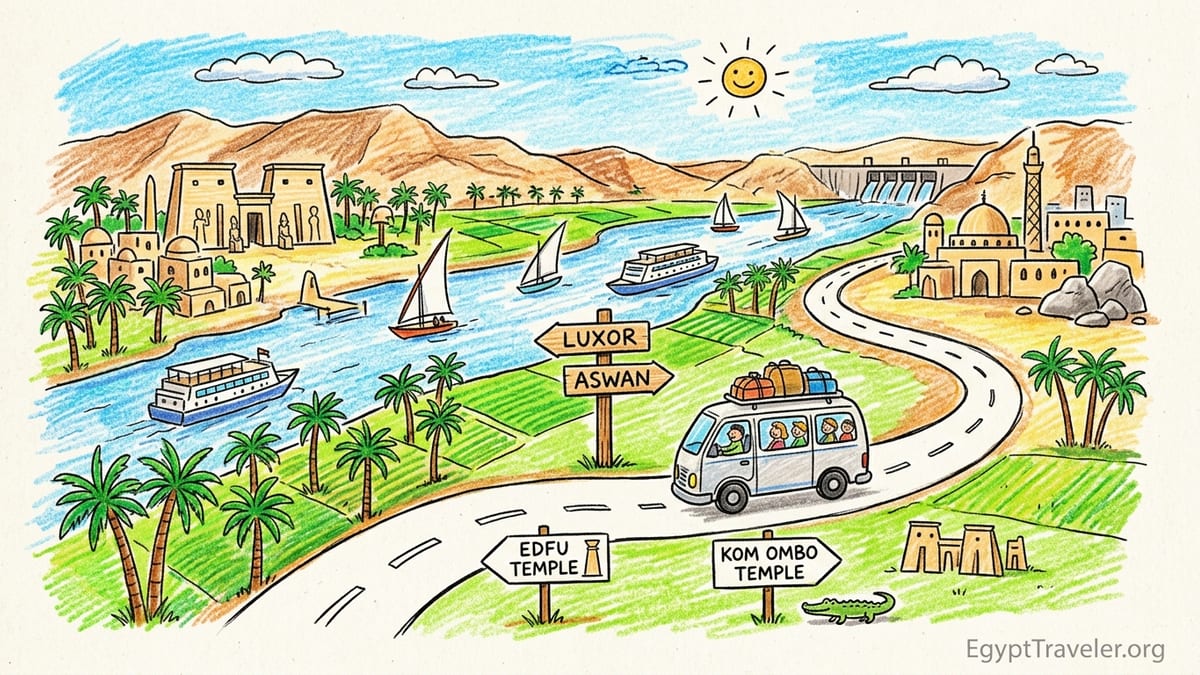
The road between Luxor and Aswan runs for roughly 220 kilometers, tracking the Nile south through small villages and fields. On a non-stop drive, it is a three and a half to four hour journey in a private car, depending on traffic and checkpoints. With temple stops at Edfu and Kom Ombo added, it turns into a full sightseeing day that mirrors the key shore excursions of a standard Nile cruise without requiring you to sleep on a boat.
Edfu Temple, dedicated to Horus, is often described by guides as one of the most complete temples in Egypt. Kom Ombo, a double temple to Sobek and Haroeris, sits closer to Aswan and includes a small crocodile museum that many travelers remember long after the stone reliefs blur together. On cruises these two stops can feel rushed and crowded, since several ships may dock at once. By road, especially outside peak arrival windows, they can be notably quieter.
For travelers not taking a cruise, this corridor fills an obvious gap. Without the road-and-temple combo, your options boil down to a direct private transfer between hotel doors or a train ride with no chance to get off for sightseeing. That is why local operators increasingly market “Luxor to Aswan via Edfu and Kom Ombo” as a standalone product rather than just a customized taxi ride.
Thinking of this day as a decision between pure transportation and transportation-plus-sightseeing is the key. Once you decide how important these two temples are to your trip, the right mode of travel usually becomes clear.
Option 1: Direct Private Transfer Between Luxor and Aswan
A direct private transfer is the simplest way to move between Luxor and Aswan while staying on land. Most agencies quote three and a half to four hours curb to curb if you are traveling in daytime and not stopping at sights. Companies in 2026 commonly advertise door-to-door service from a Luxor hotel or the airport straight to your hotel in Aswan in an air-conditioned sedan or van with an English-speaking driver.
Prices fluctuate with fuel costs and season, but as a broad example, a basic private car for two people without sightseeing can run from around 80 to 120 US dollars total, with larger vans for families sometimes quoted in the 120 to 160 dollar range. The rate usually includes bottled water, all mandatory road permits, and luggage handling, but does not include any guiding because you are not making sightseeing stops.
In practical terms, luggage is handled very straightforwardly. Your driver meets you at your pickup point, loads everything into the vehicle, and it stays locked inside until you arrive in Aswan. You do not need to move suitcases on and off platforms, watch overhead racks, or keep an eye on your bags in crowded train corridors. For travelers with several suitcases, photography equipment, or young children, that low-friction aspect can matter more than saving money.
The downside is that the day becomes pure transportation. You see the fields and villages of Upper Egypt through a window, but you skip two of the region’s most significant Ptolemaic temples. If you are already feeling “templed out” or have visited similar sites like Dendera and Esna, that might be an advantage. If this is your only chance to see Edfu and Kom Ombo, however, a direct private transfer can feel like a missed opportunity.
Option 2: One-Way Guided Transfer With Edfu & Kom Ombo Stops
The increasingly popular middle ground is a one-way private transfer that bakes in guided visits at Edfu and Kom Ombo. Several local and international operators now market this as a specific product, often named along the lines of “Luxor to Aswan via Edfu & Kom Ombo” or “Private transfer with temple stops.” It is still fundamentally a transfer, but structured like a mini tour.
In this model you are picked up at your Luxor accommodation in the morning, with your luggage loaded into the car or van. At Edfu, generally reached in around 1 hour 45 minutes from central Luxor, you meet your guide if they are not already riding with you. After a guided visit, you continue south to Kom Ombo, then arrive in Aswan early evening. Your bags remain in the vehicle while you tour, typically with the driver staying with the car at all times.
Prices vary by inclusions, but a realistic 2026 range for two travelers might fall between 120 and 200 US dollars for a private sedan or small van with driver and guide. Some products climb higher if they include entrance tickets and lunch. For example, one recent package marketed to English-speaking visitors priced a private Luxor to Aswan transfer with both temple stops and luggage handling at about 60 to 80 US dollars per person when booked for two, not including tips or temple tickets. Shared mini-van versions can cost less per person but extend the day and reduce flexibility.
This hybrid approach works particularly well if you care about the temples but do not want the structure or cost of a multi-night cruise. You get curated commentary at two major sites, a comfortable door-to-door journey, and you arrive in Aswan with the temples checked off rather than occupying an extra day trip later.
How Long the Day Really Takes
Brochure copy often understates the time required. In reality, a private Luxor to Aswan day that includes guided visits to Edfu and Kom Ombo typically runs 8 to 10 hours from hotel pickup to hotel drop-off. The exact duration depends on how long you spend at each temple, how busy the sites and checkpoints are, and whether you stop for lunch on route.
A rough time breakdown looks like this. Expect about 1 hour 45 minutes to 2 hours of driving from Luxor to Edfu. Most informed guides recommend at least 60 to 75 minutes on site there for a meaningful visit, plus around 15 minutes for parking and walking between the car and the entrance. The drive from Edfu to Kom Ombo is shorter, often around 1 hour. At Kom Ombo, 45 to 60 minutes is usually enough to see the temple plus the crocodile museum without feeling rushed.
From Kom Ombo, you have about 1 hour to 1 hour 15 minutes left to reach Aswan city. Add in a 30 to 45 minute roadside lunch or coffee stop, a fuel stop, and a margin for traffic or checkpoints, and many travelers find the day easily reaches 9 hours. For instance, a common real-world pattern sees guests leaving Luxor around 8:00 in the morning and reaching their Aswan hotel at roughly 17:00.
If you choose a direct transfer without temple visits, that same route compresses dramatically. You still need road permits and may hit checkpoints, but with only a short comfort stop, many drivers quote around four hours door to door. That can make sense if you need to reach Aswan in time for a late-afternoon flight or want a quieter day between intensive sightseeing blocks.
Temple Time: How Long Edfu & Kom Ombo Deserve
The two temples on this route reward different styles of visits, and that shapes how you should structure your day. Edfu, built in the Ptolemaic period and dedicated to Horus, is one of the best-preserved major temples in Egypt, with towering pylons, intact reliefs, and a coherent ritual layout. Guides who know the site well often argue that anything under an hour on the ground is a compromise, with 90 minutes ideal for travelers who enjoy detail and photography.
In practical terms, many transfer tours allocate about 60 minutes at Edfu. That is enough for a guided walk from the first pylon through the courtyard into the hypostyle hall and sanctuary, plus some free time for photos and a brief pause to appreciate the reliefs. If you know you are especially interested in temple architecture or mythology, speak to your operator in advance and ask for extra time here, even if that means spending a little less time at Kom Ombo or leaving Luxor earlier.
Kom Ombo is smaller and easier to grasp quickly. Its double layout, with mirror-image sanctuaries for Sobek and Haroeris, and the well-documented crocodile mummy museum can be covered in about 30 to 45 minutes at a relaxed pace. Many visitors appreciate arriving here later in the day when the temple glows in low light, but that can also coincide with busier evening tour groups. If crowds bother you, consider asking your driver and guide to time Kom Ombo for mid-afternoon rather than sunset and reserve at least 15 minutes for the museum alone.
Taken together, most travelers will feel satisfied with approximately 2 to 2.5 hours of combined temple time split between the two sites. That balance makes the overall transfer day feel like a proper sightseeing experience without stretching into an exhausting marathon.
Luggage, Tickets and Guide Logistics
One of the main advantages of a private transfer, whether direct or with temple stops, is straightforward baggage handling. In both models, your luggage stays in the vehicle between cities. On guide-accompanied itineraries, the driver almost always remains with the car in the parking area while you tour, which reduces concerns about theft. Nonetheless, it is sensible to keep valuables such as passports, cash, and electronics in a small daypack that you carry into the temples, leaving only clothing and non-essentials in the boot.
Ticketing works differently depending on the product you book. Some higher-priced road transfers advertise “all-inclusive” or “with tickets,” which usually means the company prepurchases entry for Edfu and Kom Ombo and the guide collects them on arrival. Others, including many midrange offers, quote a lower base price and leave tickets for you to pay on the day in Egyptian pounds. Official foreigner ticket prices have risen in recent years and are periodically updated, so checking the latest rates shortly before your trip is wise. As of late 2024 the Ministry of Tourism and Antiquities price tables listed separate adult and student rates for each site; you should expect your guide or driver to steer you to the correct ticket window.
Guides can be arranged in a few different ways. Some operators send a licensed Egyptologist to accompany you all day from Luxor to Aswan. Others use local site guides who meet you at Edfu and Kom Ombo separately. The all-day guide model usually costs more but provides continuity, which can be valuable if you enjoy connecting themes between different temples. Whichever model you choose, clarify in writing whether the price includes an English-speaking guide, guiding in another language, or simply a driver who will not enter the sites with you.
Finally, check small but important details before you pay a deposit. Ask what type of vehicle will be used, how many seats it has relative to your group size, whether child seats can be provided if needed, and what time your pickup will be. Many road journeys on this route start between 7:30 and 8:30 in the morning to take advantage of cooler hours at Edfu and to avoid arriving in Aswan too late in the evening.
Why This Road Route Appeals to Travelers Skipping a Cruise
For travelers who decide against a Nile cruise, the main fear is missing the slow, temple-studded journey between Luxor and Aswan that so many itineraries are built around. A one-way road transfer with Edfu and Kom Ombo stops addresses that gap. It compresses the key cruise excursions into a single efficient day, frees up nights for boutique hotels in Luxor and Aswan, and often costs substantially less than a multi-night sailing, especially for solo travelers or couples.
Consider a common scenario. A couple receives quotes of around 3,000 to 3,500 US dollars for a three or four night upscale cruise between Luxor and Aswan. By contrast, they might spend a few hundred dollars total on a private car with temple stops, then allocate their savings to extra nights in a characterful guesthouse in Aswan and a sunrise trip to Abu Simbel. They still see Edfu and Kom Ombo, but they control their daily rhythm and avoid the fixed schedule and dressier atmosphere of some cruise ships.
There is also a practical advantage in terms of itinerary flexibility. Without a cruise’s fixed departure day, you can choose exactly when to move between the two cities based on your onward flights, train connections, or simply how you feel. If you wake up in Luxor after an intense day in the Valley of the Kings and decide you need a slightly slower morning, a private driver can usually adjust your pickup by an hour. A cruise cannot wait for you.
That said, the road route is not an automatic replacement for every aspect of a Nile cruise. You will not get the long, slow views of rural life from a sun deck or the social element of meeting other travelers on board. But as a targeted solution for seeing the classic temples while keeping your accommodation on land, the Luxor to Aswan via Edfu and Kom Ombo combination is an efficient and increasingly popular answer.
Train Alternative: When Rail Makes More Sense
The train between Luxor and Aswan remains the default choice for many budget-conscious or rail-curious travelers. Egyptian National Railways runs numerous services along this trunk route, including slower third-class options and faster first and second-class air-conditioned trains. As of 2025, typical first-class fares on this stretch were often listed around the equivalent of 5 to 10 US dollars, with second class somewhat cheaper, making it a fraction of the cost of a private car.
In practical terms the train covers the distance in roughly three to three and a half hours for many services, with some slower stopping trains taking longer. Trains depart throughout the day, and some travelers prefer to book morning departures to maximize time in their next city. Once on board, you can watch the landscape roll by without worrying about checkpoints or road conditions, and you can stretch your legs in the corridor or visit the basic snack bar on many trains.
The main limitation is that you cannot easily incorporate Edfu and Kom Ombo into a straightforward Luxor to Aswan rail journey. While both towns have stations, hopping off the train with full luggage, arranging local transport to the temples, securing storage for your bags, then catching another train onward all in one day is complex enough that most visitors do not attempt it. If you take the train, you are essentially choosing transportation only and planning to see those temples on a separate day trip from either Luxor or Aswan, which adds cost and time.
Train travel also involves more self-management of luggage and logistics. You need to make your way to the station, navigate the platforms, manage bags during boarding, and keep an eye on your belongings in a shared environment. Many foreign visitors book first-class seats for greater comfort and a bit more space, but even there overhead racks and under-seat areas can be crowded at peak times. For confident independent travelers with light luggage, that is a fair trade-off for the low fare. For families, older travelers, or those with multiple suitcases, the convenience of a private vehicle can outweigh the price difference.
The Takeaway
Seen clearly, the Luxor to Aswan decision breaks into three distinct choices. A direct private transfer gets you door to door in around four hours with minimal friction, but gives you nothing more than a snapshot of the Nile Valley from the window. A one-way private transfer with guided stops at Edfu and Kom Ombo turns the same geographic shift into a full temple day, mirroring cruise excursions while keeping you land based. The train provides the cheapest and sometimes quickest connection, but it is essentially transport only and is poorly suited to combining with en route sightseeing if you are carrying full luggage.
If you consider Edfu and Kom Ombo essential and you do not plan to take a Nile cruise, the road transfer with temple stops is the option that most efficiently solves the problem. It combines door-to-door convenience, secure luggage handling, and curated visits to two important sites into a single calendar day. If budgets are tight and the temples are a lower priority, the train is attractive, with the understanding that you are trading away those visits or pushing them into a separate excursion. And if your priority is simply arriving in Aswan rested and ready for Abu Simbel or Philae the next morning, a straightforward private transfer can be the calmest way to cross Upper Egypt.
Whichever option you choose, anchor your decision in how you want this day to feel. In a packed Egyptian itinerary, transforming one necessary transfer into a highlight can be worth more than shaving an hour off the journey or saving a small amount of money. Decide whether you want this stretch of the Nile to be a quick hop or a curated temple corridor, plan accordingly, and the route between Luxor and Aswan will support rather than stress your wider trip.
FAQ
Q1. Is it safe to leave my luggage in the car while visiting Edfu and Kom Ombo?
In most private transfer arrangements the driver stays with the locked vehicle in the parking area while you tour, which significantly reduces risk. You should still carry passports, cash, and electronics with you in a small daypack and avoid leaving obviously valuable items visible inside the car.
Q2. What is a realistic budget for a private Luxor to Aswan transfer with temple stops?
For two travelers in 2026, a realistic ballpark for a private sedan or small van with driver and guide is roughly 120 to 200 US dollars total, depending on season, whether temple tickets and lunch are included, and the reputation of the operator. Shared mini-van options can lower the per-person price but add time and reduce flexibility.
Q3. How far in advance should I book a transfer via Edfu and Kom Ombo?
For high season months from October through April it is sensible to book at least a few weeks in advance, especially if you want a specific departure time or a guide in a less common language. In quieter months, many travelers arrange transfers a few days ahead, but last-minute bookings can mean fewer vehicle and guide choices.
Q4. Can I do the same Edfu and Kom Ombo route in reverse, starting from Aswan?
Yes. Many operators sell the itinerary in both directions, Aswan to Luxor or Luxor to Aswan, with the same basic structure: hotel pickup, Edfu and Kom Ombo temple stops, and hotel drop-off at the other end. The driving times and recommended temple durations are similar in reverse.
Q5. Do I need an Egyptologist guide, or is a driver enough?
A driver alone is sufficient if you mainly want the convenience of door-to-door transport and a quick look at each temple. However, a licensed guide can add significant value by explaining the reliefs, layout and symbolism, and by helping with tickets and timing. Travelers who care about history usually find the extra cost worthwhile on this particular day.
Q6. Are Edfu and Kom Ombo suitable for travelers with limited mobility?
Both temples involve uneven stone surfaces, some steps, and walking between the parking area and the main complex. Travelers with limited mobility can often manage a partial visit focusing on the outer courtyards and main reliefs with frequent rests. It is important to discuss mobility needs with your operator in advance so they can advise honestly and allow extra time.
Q7. How does the cost of the train compare with a private transfer?
The train is usually far cheaper. First-class tickets between Luxor and Aswan often cost the equivalent of a few US dollars per person, whereas private transfers are priced in the tens or low hundreds of dollars per vehicle. The trade-off is the lack of en route temple visits and the extra effort of handling your own luggage and station logistics.
Q8. What time should I leave Luxor if I want to reach Aswan before dark?
If you are including Edfu and Kom Ombo, a departure between 7:30 and 8:30 in the morning typically results in an arrival in Aswan around late afternoon, assuming normal stops and unhurried visits. For a direct transfer without sightseeing, leaving anytime before early afternoon usually allows you to arrive before sunset outside of midwinter’s shortest days.
Q9. Can I visit Edfu and Kom Ombo as a separate day trip without changing hotels?
Yes. Several companies sell day trips from Luxor that visit Edfu and Kom Ombo and then return to the same hotel in Luxor, and similar excursions run from Aswan. This can work well if you prefer to take the train between the cities on a different day but still want to see the temples.
Q10. Do I need to carry cash for temple tickets and tips, or are cards accepted?
Carrying cash in Egyptian pounds is strongly recommended for temple tickets, small purchases, and tips. Card acceptance at ticket offices and roadside stops can be inconsistent even when card machines are present, and connectivity issues are common. Bringing local currency ensures you can pay quickly and avoid delays.