


Far from the Nile cruise routes and the selfie crowds at Giza, the oases of Dakhla and Kharga preserve some of Egypt’s most atmospheric archaeological landscapes. These southern oases do not compete with Siwa’s salt lakes or the White Desert’s chalk formations. Instead, they offer something different: layered desert history, from Old Kingdom outposts and Persian-era shrines to Roman forts and early Christian cemeteries, scattered across palm groves and escarpments along ancient caravan roads. For travelers who care more about inscriptions than infinity pools, understanding how these sites fit together in time and space is the key to deciding whether Dakhla, Kharga, or both deserve a coveted slot in an Egypt itinerary.
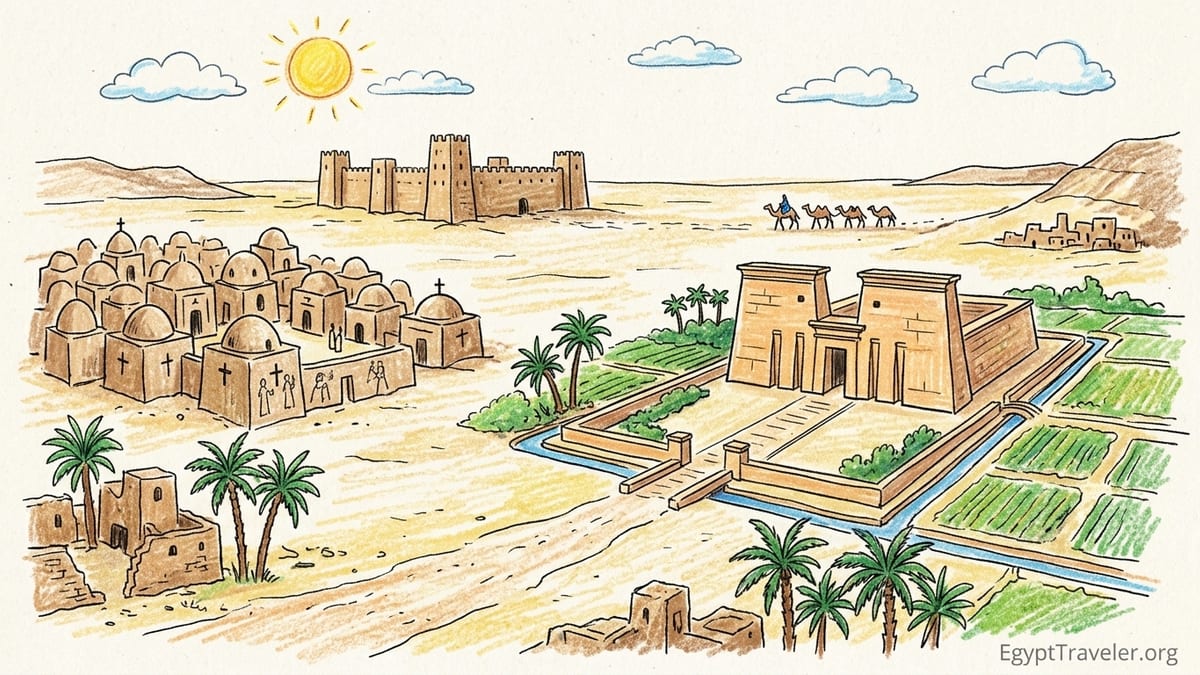
From Nile Frontier to Desert Crossroads: Why These Oases Matter
Dakhla and Kharga sit in Egypt’s Western Desert, in today’s New Valley governorate, several hundred kilometers southwest of Luxor and Asyut. Long before paved highways, these basins were crucial stops on desert routes linking the Nile Valley with Sudan and the deep Sahara. Kharga in particular lay at the meeting point of the north–south Darb el-Arbaeen caravan road and an east–west route toward Dakhla, a crossroads that helped turn the oasis into a strategic hub guarded by chains of forts and temples.
For archaeologists, the two oases read like open textbooks. Dakhla preserves strong traces of Old Kingdom activity as Egypt’s rulers pushed into the Western Desert. Both oases then saw renewed importance under the Persians and especially under Roman rule, when irrigation, agriculture, and security works turned them into fortified agricultural estates. By late antiquity, early Christian communities were carving chapels and painting crosses in the shadow of Roman walls, an evolution dramatically visible at Kharga’s sprawling al-Bagawat cemetery.
For travelers, the appeal is twofold. First, most sites see only a trickle of visitors even in peak winter months, so a visit can feel like private fieldwork rather than mass tourism. Second, the archaeology here is inseparable from the desert environment. Rock-cut tombs open out over dunes, mudbrick forts rise from barren plains, and Ptolemaic and Roman temples stand amid date palms and qanat-fed fields. This guide focuses on those layers and explains where you can experience each period on the ground, along with current practical details to help you plan days in the field.
What you will not find here are salt pools, sandboarding circuits or off-road jeep rallies that shape trips to Siwa or the White Desert. Instead, think of Dakhla and Kharga as long, low-key field seasons compressed into a few days of travel, focused on inscriptions, architecture, and the way ancient people survived and prospered in a tough environment.
Old Kingdom Foundations: Early Desert Expansion
Evidence from both archaeology and ancient expedition texts shows that Egyptians were using Western Desert routes by the Old Kingdom, especially from the 5th and 6th Dynasties onward. Inscriptions of officials like Harkhuf narrate journeys south and west of the Nile into desert regions, and substantial Old Kingdom remains at Dakhla suggest that this oasis already functioned as a staging post and agricultural base. Scholars studying Old Kingdom ceramics and settlement traces at Dakhla have argued that these expeditions were tied to mining, trade with Nubia, and control of desert populations.
On the ground today, travelers see this early phase most clearly at Qila al-Dabba in Dakhla. Here, a cluster of mudbrick mastaba tombs, including some more than ten meters high, dominates a low rise near the oasis edge. The tombs are attributed to local elites and officials during the 6th Dynasty, when central authority tried to anchor its presence in the Western Desert. Although heavily eroded, the scale of the structures and their location overlooking fields and desert underline how important Dakhla had become by the late Old Kingdom.
In Kharga, Old Kingdom traces are less monumental to the casual visitor, but the caravan route that would later be called Darb el-Arbaeen probably began to take shape in this period. Later texts and archaeology show that this north–south axis, running between Sudan and Middle Egypt, used Kharga as a major watering and control point. When you stand today at the edge of Kharga town looking toward the desert, you are facing a corridor that has funneled traders, soldiers, and migrants for more than four thousand years.
For a traveler planning an Old Kingdom focused visit, Dakhla is the stronger draw. A realistic program would combine Qila al-Dabba with time in the medieval village of Qasr al-Dakhla, to see how desert settlement evolved from pharaonic to Islamic times in the same landscape, and perhaps a stop at the local heritage or community museum in Mut where Old Kingdom artifacts from the oasis are sometimes displayed.
Persian Imprints: Achaemenid Presence in the Desert
After the conquest of Egypt by the Achaemenid Persians in the 6th century BCE, the Western Desert oases saw new investment. Persian administrators valued these basins as secure agricultural zones and as stepping stones to Nubia and the deep Sahara. In Kharga, particularly at sites like Ain Manawir, excavations have uncovered Aramaic and Demotic documents carved or inked on ostraca, recording land leases and water rights under the Persians. These texts give a granular picture of daily life in a desert farming community within an imperial system.
For visitors, the most tangible Persian-era experience in Kharga is the sense that this was the moment when formal imperial administration really locked in, laying groundwork for the later Roman fort network. While Ain Manawir itself is more a research site than a standard tourist stop and access can be restricted, the New Valley Museum in Kharga town displays finds from Persian and later periods. Labeling remains modest, but bilingual panels outline how irrigation systems such as underground qanats allowed year-round cultivation under both Persian and subsequent rulers.
Dakhla’s Persian-era visibility is subtler to non-specialists. Pottery sequences and occasional architectural fragments suggest continued occupation and agricultural development, especially in areas like Ain Asil, which transitioned from a pharaonic administrative center toward later provincial use. At Ain Asil, low mudbrick walls and house plans have been exposed by excavations, and some signage in Arabic and English typically explains that the site spans late pharaonic into Persian and early Ptolemaic horizons.
On a practical level, travelers interested in this layer should view it as part of a continuous narrative rather than a stand-alone attraction. A day that includes Ain Asil, with its administrative remains, followed by Deir al-Hagar with its later Roman temple, helps make sense of how power and water management shifted as Egypt passed from native dynasties to Persian satraps and then to Greco-Roman rule.
Roman Desert Strategy: Forts, Temples and Agricultural Estates
The Roman period is the most visually striking layer in both Dakhla and Kharga. Between the first and fourth centuries CE, imperial planners treated these oases as combined farming colonies and security corridors. Fortified settlements, aqueducts, and shrines appeared along caravan lines, forming what one UNESCO dossier has described as a coherent strategic project. At Kharga in particular, the chain of late Roman forts and villages still punctuates the desert fringes, their high mudbrick walls visible for kilometers.
In Dakhla, Deir al-Hagar is the star Roman monument for visitors. Set on the desert edge about 15 to 20 kilometers from Mut, this sandstone temple dedicated mainly to Amun-Re and other deities was begun in the early Roman period, with cartouches of emperors such as Nero and Vespasian carved in relief. The temple was partly restored in recent decades, and travelers can now walk through its forecourt and sanctuary, studying reliefs that blend traditional pharaonic iconography with Roman titulary. As of mid-2026, Deir al-Hagar usually keeps standard Upper Egyptian archaeological-site hours, roughly 8:00 to 17:00 in the cooler months and extending toward 18:00 in summer, though travelers should confirm the precise schedule with their hotel in Mut or a local operator before setting off, because opening times in the Western Desert can change with staffing or heat.
Nearby, the rock-cut tombs of al-Muzawwaqa form a Roman-period necropolis famous among specialists for its painted astronomical ceiling in the tomb of Petosiris and vivid scenes of deities rendered in a style influenced by classical art. Access to the inner painted chambers has fluctuated over the last decade in an effort to protect fragile pigments. Recent visitors report that some tombs are occasionally closed or viewed only from the doorway, and that small extra fees for lighting may be requested on top of the main ticket. Photography rules can shift; in many Egyptian antiquities sites, personal photography without flash is gradually being allowed under a combined ticket that covers camera use, but enforcement in the oases can be inconsistent. It is safest to expect to keep a phone camera low profile and ask the on-site guardian what is currently allowed.
Ezbet Bashendi, closer to cultivated land, showcases both Roman and later domestic architecture. Mudbrick houses with upper stories and vaulted rooms, along with nearby tombs, give a sense of how Roman-period villagers lived in compact settlements straddling field and desert. Combined with Ain Asil, which preserves remains of a pharaonic and later administrative center with thick mudbrick walls and storage areas, these sites sketch out a Roman-era oasis world of priests, farmers, and officials tied into long-distance trade routes.
Kharga offers a broader overview of Roman strategy. Across the oasis, forts like Umm al-Dabadib and Qasr al-Labekha, along with smaller outposts, still stand with walls more than ten meters tall. Many of these are not yet equipped for routine tourism, lying off rough tracks and often visited only by specialist tours, but they illustrate how the Romans turned Kharga into a military-agricultural limes along the Darb el-Arbaeen. Even if you never reach those remote forts, understanding their existence enriches a visit to the more accessible temples and the New Valley Museum, which features models and finds related to the fort network.
Early Christian Landscapes: Cemeteries and Desert Piety
By late antiquity, the desert forts and caravan stations at Kharga and Dakhla existed side by side with emerging Christian communities. In Kharga, the most impressive surviving early Christian landscape is the cemetery of al-Bagawat, a vast clustering of mudbrick chapels rising on low hills about three kilometers northwest of modern Kharga town. Used from at least the 3rd to the 7th centuries CE, al-Bagawat contains hundreds of domed chapels whose plastered interiors once carried painted biblical scenes, crosses, and donor inscriptions.
Walking the lanes between chapels at al-Bagawat gives a tangible sense of how early Christians in the desert commemorated their dead while reusing and repurposing Roman-era architectural forms. Some chapels incorporate reused stone blocks with pharaonic reliefs, visible in jambs or thresholds, emphasizing how Kharga’s communities lived amid the physical remains of earlier religions. A local guardian typically accompanies visitors to unlock particularly well-preserved chapels and may point out details such as depictions of Daniel in the lions’ den or processions of martyrs in fragmentary frescoes.
Opening hours at al-Bagawat broadly track those of other antiquities sites in the region, often from around 8:00 to 17:00 in winter and slightly longer in summer. As with other Western Desert sites, staffing levels and heat can lead to sudden changes, especially on Fridays or during public holidays, so it is wise to ask in Kharga town the day before. Entry tickets for al-Bagawat are usually sold at the gate or at a shared ticket office that may also cover nearby Hibis Temple; combined pricing can change, so travelers should be prepared with Egyptian pounds in small notes.
In Dakhla, the Christian layer is woven into the urban fabric of Qasr al-Dakhla, the medieval village that crowns a low hill at the oasis margin. Although the surviving architecture is primarily medieval Islamic, with narrow covered lanes, mudbrick houses and a mosque, the site sits atop earlier occupation layers, and reused pharaonic and Roman stone appears in lintels and thresholds. Walking a guided loop through Qasr with a local resident gives insight into how religious and social life evolved as Coptic communities gradually became part of an Islamic town while still inhabiting the same defensive knoll at the desert’s edge.
Where to See Each Period on the Ground
Because sites in the southern oases cluster by chronology as much as by geography, it helps to think less in terms of “doing Dakhla” or “doing Kharga” and more in terms of hunting specific historical layers. For Old Kingdom remains, Dakhla’s Qila al-Dabba is the clearest destination. A full morning visit allows time to scramble carefully around the mudbrick mastabas, examine their placement relative to the current fields, and appreciate how local elites mirrored Nile Valley funerary architecture deep in the desert.
To trace Persian and early Ptolemaic administration, combine Ain Asil in Dakhla, where low walls and house plans reveal a governing center, with gallery time in Kharga’s New Valley Museum. In a single day in each oasis, you can go from standing inside an excavated governor’s residence in Dakhla to studying ostraca and irrigation installations from Kharga’s Persian and Greco-Roman farms, building a mental picture of desert bureaucracy over several centuries.
For Roman religious and strategic architecture, pair Deir al-Hagar and al-Muzawwaqa in Dakhla with Hibis Temple and the fort landscapes at Kharga. Hibis, located a few kilometers north of Kharga town, is a large sandstone temple begun in the late Saite period and heavily decorated in the Persian and early Persian-influenced eras, then modified under the Ptolemies and Romans. Visitors approach along a processional way lined with reconstructed columns, then step into hypostyle halls rich with reliefs of deities like Amun, Horus, and Osiris combined with imperial cartouches. From there, the drive out toward the desert rim reveals, in the distance, the silhouettes of Roman forts that once anchored farms and guarded routes.
For early Christian life, focus a half-day on al-Bagawat, then another half-day wandering Qasr al-Dakhla’s mudbrick alleys with a guide who can point out reused stones and the layout of former Christian neighborhoods. In effect, you move from a city of the dead, where families painted biblical scenes around burials, to a living town that evolved out of late antique Christian communities into a still-inhabited Islamic village.
Travel Logistics: Distances, Heat and Site Pairings
Reaching the southern oases usually requires either a long overland drive or a domestic flight to Kharga. Road distances give a sense of commitment. From Luxor to Kharga is roughly 340 to 380 kilometers depending on route, taking around five to six hours by private car under current road conditions. From Kharga to Dakhla it is about 200 to 220 kilometers, often three to four hours along the main desert highway. Travelers commonly arrange these transfers through Cairo-based tour operators or local agencies in Luxor or Asyut, since permits and checkpoints can change and it is advisable to use drivers familiar with local police procedures.
Within each oasis, archaeological sites are spread out but can be grouped efficiently. In Dakhla, Deir al-Hagar and al-Muzawwaqa lie in the same general direction from Mut and can comfortably be combined in one day. Many visitors spend the cooler early morning at al-Muzawwaqa, when climbing around rock-cut tombs is less taxing, then move to Deir al-Hagar for late morning and early afternoon, when the temple’s shaded halls offer some respite. Qila al-Dabba and Ezbet Bashendi are reachable on separate half-days, often coupled with exploring Qasr al-Dakhla either at the end of the day or on a separate morning.
In Kharga, al-Bagawat, Hibis Temple, and the New Valley Museum form a logical trio near the main oasis town. With an early start, you can tour Hibis in the morning, move on to al-Bagawat before midday heat peaks, and then retreat to the museum in the afternoon. More remote Roman forts such as Umm al-Dabadib require high-clearance vehicles, prior permission, and sometimes overnight camping logistics, and are better left to specialist archaeological tours rather than casual travelers.
Heat is the decisive factor in planning. Even in winter months, the sun can be intense; in late spring and early autumn, midday temperatures climb to levels that make open desert sites physically draining. Site guards and local guides often encourage travelers to visit exposed necropoleis and hilltop villages in the early morning or late afternoon and reserve indoor or partially sheltered spaces for the hotter hours. Carrying at least two liters of water per person for a half-day of field visits, along with sun protection and closed shoes suitable for loose rock, is not optional but basic safety.
Tickets, Opening Hours, Guides and Photography
Egypt’s Ministry of Tourism and Antiquities sets official ticket prices and opening hours, which are subject to periodic adjustments. As of mid-2026, most Western Desert archaeological sites follow a broad pattern of opening from about 8:00 until late afternoon, with slight seasonal variations and occasional early closure during sandstorms or extreme heat. However, detailed, up-to-date schedules for remote oases are not always publicized, and changes can occur faster than printed guidebooks or tour company brochures are updated.
In practice, travelers staying in Mut (for Dakhla) or Kharga town should ask their hotel reception or local agent the evening before. Staff usually know if, for example, al-Muzawwaqa is temporarily closed to protect paintings, or if Hibis Temple is operating on reduced hours due to conservation work. Ticket offices are typically located at or near the site entrance and accept Egyptian pounds in cash; card facilities are inconsistent. Combined tickets sometimes cover clusters of sites in one oasis, but arrangements change, and visitors should be prepared to purchase separate entries for major monuments like Hibis, al-Bagawat, Deir al-Hagar, and others.
Photography policy in Egypt has slowly liberalized. National regulations now permit personal photography without flash or tripods at many antiquities sites, often under a single “camera ticket,” but enforcement on the ground can lag, especially in remote areas. At Deir al-Hagar and Hibis, visitors commonly take non-flash photos with phones or small cameras, while at sensitive painted tombs such as those at al-Muzawwaqa, rules can be stricter or changeable. It is wise to ask the site guardian or inspector directly what is currently permissible and to assume that professional gear, drones, or tripods will require special permits organized in advance through an agency or the ministry.
Local guides add substantial value in the southern oases. In Dakhla, hiring a resident guide in Mut or Qasr al-Dakhla brings not only explanations of pharaonic and Roman remains but also insight into more recent history, from Ottoman-period architecture to 20th-century irrigation projects. In Kharga, English-speaking guides familiar with both the early Christian iconography at al-Bagawat and the Roman military landscape can help connect disparate sites into a coherent narrative. Rates vary and are often negotiated directly; many visitors arrange full-day packages that include vehicle, driver, and guide rather than hiring them separately.
Choosing Between Dakhla, Kharga or Both
History-focused travelers usually face a practical decision: is it worth investing the time and logistics to visit both oases, or should you choose one? The answer depends largely on your interests and the structure of your broader Egypt itinerary. Those with a strong fascination for Old Kingdom and Roman religious architecture within a compact circuit may lean toward Dakhla, where Deir al-Hagar, al-Muzawwaqa, Qila al-Dabba, Ain Asil, Ezbet Bashendi, and Qasr al-Dakhla can form an intense two or three days of visits without excessively long daily drives.
Travelers more drawn to late Roman frontier strategy and early Christian archaeology might prioritize Kharga. The combination of Hibis Temple, al-Bagawat, the New Valley Museum, and the visible but often off-limits chain of Roman forts paints a unique picture of a desert crossroads at the edge of empire. Standing amid the chapels of al-Bagawat while looking across to the outlines of Hibis and the modern town gives a powerful sense of continuity from pharaonic cult, through Christian burial, to contemporary oasis life.
For those with a week or more to spare beyond the Nile valley, visiting both oases creates a rewarding arc. One practical approach is to travel from Luxor or Asyut to Kharga, spend two nights focusing on Hibis, al-Bagawat, and the museum, then continue by road to Dakhla for three nights of temple, tomb, and village exploration. From Dakhla, travelers can either return east toward the Nile or, with appropriate security clearances and up-to-date advice, continue north through other Western Desert oases toward Bahariya or Cairo, though such multi-oasis traverses are subject to changing regulations.
Compared to Siwa or White Desert trips, itineraries to Dakhla and Kharga feel quieter and more specialized. There are fewer ecolodges and boutique resorts, more modest guesthouses and local hotels, and a stronger emphasis on archaeological day trips rather than landscape-driven camping circuits. For many history-minded travelers, that is precisely the attraction: days spent reading reliefs and mudbrick instead of ticking off dune activities.
The Takeaway
Dakhla and Kharga are not side trips to bolt onto a rushed week in Cairo and Luxor. They are destinations for travelers willing to trade convenience for context, long drives for long horizon lines, and resort-style comforts for the pleasure of standing alone in a Roman temple court or an early Christian cemetery. Understanding their chronological layers is the key to making that investment worthwhile.
In Dakhla, the story begins with Old Kingdom tombs at Qila al-Dabba and continues through Persian and Roman administrative sites like Ain Asil, vibrant Roman temples and necropoleis at Deir al-Hagar and al-Muzawwaqa, and medieval lanes in Qasr al-Dakhla that still echo with the rhythms of oasis life. In Kharga, the emphasis shifts to crossroads and control: the Darb el-Arbaeen caravan axis, Persian documents from desert farms, chains of late Roman forts, the monumental temple of Hibis, and the distinctive Christian chapels of al-Bagawat.
Whether you choose one oasis or both, success lies in realistic pacing and clear expectations. Confirm current opening hours locally, pair sites intelligently to limit backtracking and midday exposure, and consider engaging knowledgeable guides who can bridge the gap between eroded mudbrick and the complex histories it hides. What you get in return is a rare kind of Egyptian travel, where empty visitor books and distant fort silhouettes replace the bustle of major sites, and where the layers of Old Kingdom, Persian, Roman, and Christian history still lie visibly stacked along desert edges.
For committed archaeology enthusiasts, that trade-off is often more than worth the extra kilometers. Dakhla and Kharga offer some of the clearest windows onto how ancient Egyptians and their successors understood, used, and guarded the desert. Put simply, if you want to see not just the monuments of the Nile but the machinery of empire at its driest frontier, the southern oases deserve serious consideration in your Egypt plans.
FAQ
Q1. How many days do I need to visit Dakhla and Kharga properly?
Most archaeology-focused travelers allow at least two full days in each oasis. That usually means four nights if you visit both, with one arrival or transfer day and three full days of site visits. With less time, it is better to focus on just one oasis and avoid rushing long drives and heat-exposed sites.
Q2. Can I visit the oases independently, or do I need to book a tour?
Independent travel is possible, but most visitors arrange at least transport and permits through a local agency or hotel. Police checkpoints and changing regulations mean drivers familiar with the routes are very helpful. If you are comfortable with basic Arabic and patient with bureaucracy, you can organize things on the ground in Luxor, Asyut, Kharga, or Mut, but pre-arranged logistics save time.
Q3. Are Dakhla and Kharga safe for travelers right now?
Security conditions can change, but the Western Desert oases are generally calm, with a strong police and army presence along main roads. The main risks are road fatigue and heat rather than crime. Before traveling, check your home country’s latest advice and confirm with a reputable Egyptian operator or hotel regarding any current restrictions on specific routes or oases.
Q4. When is the best time of year to explore these archaeological sites?
The most comfortable months are roughly November through March, when daytime temperatures are cooler and walking to hilltop tombs and forts is more manageable. April and October can still be workable with early starts, while high summer brings extreme heat that makes midday site visits difficult. Sandstorms are more likely in spring, which can occasionally close roads or sites temporarily.
Q5. What kind of accommodation can I expect in Dakhla and Kharga?
Accommodation is simpler than in Nile-side cities. In Kharga, options include mid-range hotels and government-run guesthouses aimed at Egyptian travelers. Dakhla offers family-run lodges and small hotels around Mut and nearby villages, some with traditional mudbrick architecture and basic modern comforts such as private bathrooms and Wi-Fi. Luxury resorts and international chains are not yet a feature of these oases.
Q6. Do I need a special permit to visit the Roman forts in Kharga?
Access rules for remote forts like Umm al-Dabadib can change and often involve permits obtained through the Ministry of Tourism and Antiquities or local security authorities. Many independent travelers limit themselves to the more accessible sites, such as Hibis Temple, al-Bagawat, and the New Valley Museum, while specialist archaeological tours handle paperwork and logistics for deeper excursions to isolated forts.
Q7. Is it realistic to combine Dakhla and Kharga with a classic Nile cruise?
Yes, but it adds significant overland travel. A common pattern is to cruise between Luxor and Aswan, then travel by road from Luxor to Kharga for two nights, continue to Dakhla for another two or three nights, and finally return toward the Nile or onwards to other oases. This works best if you have at least two weeks in Egypt and are comfortable with several long driving days.
Q8. What should I wear and bring for day trips to these sites?
Light, breathable clothing that covers shoulders and knees, a wide-brimmed hat, sunglasses, and sturdy closed shoes are essential. Carry at least two liters of water per person for a half-day outing, along with high-SPF sunscreen, snacks, and a lightweight scarf for sun and dust. A small flashlight or headlamp is useful for dim tomb interiors, and a backup power bank keeps phones and cameras running.
Q9. Are English-language explanations available at the sites?
Some major sites, such as Hibis Temple, Deir al-Hagar, and the New Valley Museum, have basic bilingual signage in Arabic and English. However, many smaller sites offer little or no interpretation beyond a guardian’s brief comments. Travelers who want deeper context usually bring a detailed guidebook or hire a local guide who can explain iconography and historical background in English or another major language.
Q10. How do Dakhla and Kharga compare to Siwa or the White Desert for first-time visitors?
Siwa and the White Desert appeal strongly to landscape and adventure travelers, with salt lakes, dunes, and popular overnight camping trips. Dakhla and Kharga are quieter and more archaeology-driven, focused on temples, tombs, forts, and historic villages. First-time visitors with limited time often choose Siwa or the White Desert, while those on a second or longer trip, or with strong historical interests, gravitate to the southern oases.