


Siwa Oasis in Egypt’s Western Desert has long been marketed as a remote sanctuary of palm groves, salt lakes and Amazigh culture at the edge of the Great Sand Sea. Official tourism materials still lean on that image of seclusion and simplicity. On my recent visit, after two long days of buses and shared cars from Cairo, I arrived expecting silence, starry skies and a sleepy town with a few family-run guesthouses. Parts of Siwa delivered exactly that. Other parts felt like a ready-made backdrop for Instagram, with 4x4 convoys lining up at the same salt pools, queues forming for sunset photos and cafés branding themselves around viral shots. The gap between the “untouched oasis” on the brochure and the reality on the ground was where my trip got complicated.
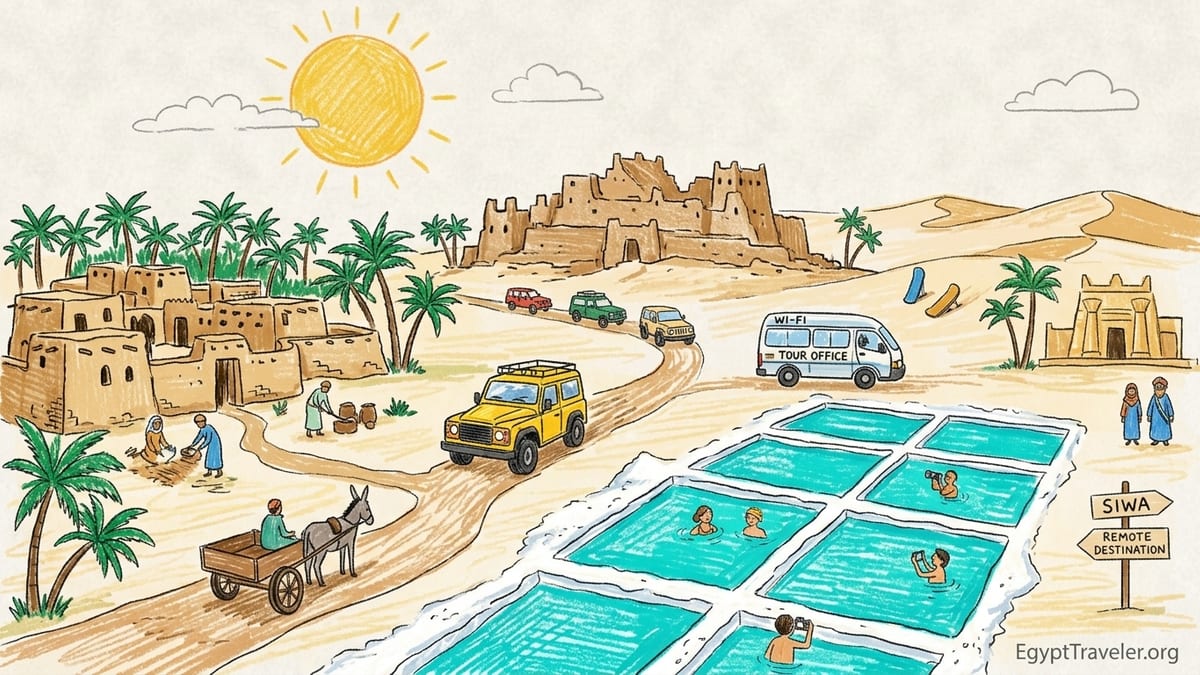
From Remote Dream To Recognizable Destination
The first surprise hit even before I saw a palm tree. As our minibus rolled into town, we passed a string of new guesthouses, desert tour offices and cafés with English and Arabic signs advertising Wi‑Fi, fresh juices and “salt lake photoshoots.” Official messaging still calls Siwa “Egypt’s most remote desert oasis,” and geographically that is true. It sits roughly 560 to 600 kilometers west of Cairo, near the Libyan border, surrounded by dunes and salt flats. But culturally and visually, it now shares a lot with other popular adventure destinations: Instagrammable stops, packaged activities and a clear circuit that many visitors follow.
Local and international tour companies sell almost identical two or three day Siwa packages. A typical itinerary includes Shali Fortress, a salt lake float, Cleopatra Spring, the Oracle Temple at Aghurmi, a 4x4 excursion into the Great Sand Sea with sandboarding and a sunset stop at a hot or cold spring. In theory this hits the highlights. In practice, when you follow this script hour by hour, you often move in a convoy of similar jeeps, meet the same souvenir sellers at each stop and watch the same poses repeat in front of the same turquoise pools.
None of that makes Siwa inauthentic. The oasis is still home to a predominantly Amazigh (Berber) community with its own language, architecture and rituals, and locals are understandably leaning into tourism as an income source. What changed is how visible the tourism economy has become. Motorbikes weave between donkey carts, new brick hotels rise next to traditional kershef houses, and photo spots are curated with benches, swings and viewpoints. I arrived expecting a village on the fringe of tourism and instead met a destination squarely in its growth phase.
The Salt Pools: Natural Wonder Framed For Social Media
Nothing represents Siwa’s transformation more clearly than the famous salt pools. Photos of perfect square pools with milky white rims and electric blue water helped catapult Siwa into social feeds worldwide. These pools are real, formed by small excavations in the salt crust around the oasis, and the high salinity does make you float almost effortlessly. The first time I lowered myself into one, the light wind across the surface and the silence of the surrounding flats felt almost unreal.
The catch is that the most photogenic pools on the main road west of town now operate almost like open-air studios. My driver pulled into one of several organized stops, each with a makeshift parking area, shaded rest hut and sometimes a basic changing corner. A man approached with a laminated price sheet for pool access, tea and phone protection bags. Fees are not fixed across the area, but at the spot I visited, the driver and attendant negotiated a bundled rate that covered parking and time at a few pools. It was not extortionate, and money does go to local families, yet the interaction felt more like buying a packaged attraction than spontaneously discovering a natural phenomenon.
Once we walked down to the pools, the social media choreography began. Groups queued at the two brightest pools, each person taking a turn sitting on the salt edge, floating on their back or pretending to read a book in the water while a friend fired off photos. People were considerate and took turns, but the pauses and poses broke the sense of remoteness. Instead of gazing across the salt flats toward the Libyan horizon, most eyes were fixed on screens. I joined in, too, trying to get that “floating in neon-blue water” shot. Looking back, this was where I first realized I was participating in the very pattern I would later criticize.
4x4 Excursions And The Conveyor Belt Feeling
Desert safaris into the Great Sand Sea remain one of Siwa’s big draws, and for good reason. The dune fields west of the oasis are towering and beautiful, shaped by wind and light in constantly shifting patterns. Most travelers book a half-day or full-day 4x4 trip that includes dune bashing, sandboarding and stops at at least one hot and one cold spring. Local Siwan drivers know the dunes exceptionally well and take safety seriously in this harsh environment.
On my visit, prices for a shared 4x4 excursion quoted by guesthouses and small agencies hovered in a similar range per person for an afternoon and evening trip including several stops and a simple dinner. Private trips in a dedicated vehicle cost more, usually calculated per jeep rather than per traveler. These are reasonable figures for the distance, fuel and driver expertise, and provide direct employment for local guides and camp cooks. The issue was not cost but pacing and priorities.
We left town after lunch in a convoy of four jeeps, each with a small flag attached for visibility in the dunes. The first hour felt thrilling as we climbed and dropped steep slopes, the drivers clearly experienced in reading the sand. But the stops followed a predictable sequence: a high dune for sandboarding photos, a cold spring framed by reeds and a low concrete rim, and a hot spring encircled by a basic café and changing area where several different tour groups arrived within minutes of each other. At each site, we had 20 to 40 minutes, just long enough to take a few photos, drink tea and maybe swim, but not long enough to feel rooted in the place or to talk deeply with our Siwan hosts.
By the time we reached the sunset viewpoint, a hill overlooking a salt lake and the western dunes, more jeeps had gathered. Drivers knew exactly what time the sun would touch the horizon and parked in a semi-circle, laying out mats and small fires for tea. It was undeniably beautiful, but as people carefully positioned themselves along the ridge for photos, I realized this was the third orchestrated sunset of my broader Egypt trip, each one marketed as a singular, transformative moment. Here in Siwa, the choreography of jeeps, tripods and shared playlists made it feel less like a wild desert and more like a well-rehearsed show.
Shali Fortress And Siwan Culture: Special, But Easy To Rush
Despite all of this, Siwa still holds places where its history and culture feel distinct and resilient. The ruined fortress of Shali rising above the modern town is one of them. Built in the 12th or 13th century from kershef, a mixture of salt and mud, Shali once sheltered the whole community behind its walls. Heavy rains and time eroded many of its tight alleys and tower-like houses, but recent restoration efforts funded by Egyptian authorities and the European Union have stabilized parts of the structure and reopened it to visitors. Walking up through the restored passages, with bits of old wall, mosques and small rooms revealed at every turn, gave me a tangible sense of Siwa as a fortified world apart.
From the upper viewpoints of Shali, the view over the modern town, palm groves and distant lakes is still one of the most impressive panoramas in Siwa. Standing there in the late afternoon, I watched kids playing football below and women in traditional dress moving between houses. Shali can be busy at sunset, but when I visited in the morning there were only a handful of other travelers, and the place felt closer to a living ruin than a prop. Interpretation signs are limited, yet hiring a local guide who grew up nearby and can point out details like old grain storage niches or mosque restorations makes the site much richer.
Equally important, though less photographed, are the everyday Siwan spaces around Shali. Side streets house small bakeries selling rounds of fresh palm-wood fired bread, simple Amazigh restaurants serve tagines and couscous flavored with local olives, and community squares host evening gatherings. Unfortunately, many short itineraries allocate more time to posed salt pool stops than to wandering these streets. I made the same mistake, assuming I could “fit in” culture between excursions. In reality, Siwa’s distinctiveness comes through gradual observation and conversation, not quick walk-throughs.
Where The Hype Outran The Experience
If one place symbolized my disappointment, it was Cleopatra Spring near the heart of the palm groves. This circular stone pool, fed by slightly warm water, is often described as a timeless bathing spot where travelers and locals meet. It appears in countless guides and social posts as a must do in Siwa. I arrived expecting a rustic, shaded pool with a simple café and families relaxing at the water’s edge.
What I found was a tightly ringed concrete pool with a line of souvenir stalls, cafés and juice bars squeezed around it. Loud music spilled from a couple of speakers, plastic chairs crowded the perimeter and people jumped into the water while others tried to enjoy a quieter swim. There were still local families there, and older men sipping tea while watching the scene, but the overall vibe leaned closer to a busy public pool than to a desert oasis spring. Prices for drinks were reasonable compared to Cairo café prices yet were clearly set for visitors, and attention focused heavily on capturing mid-air jump shots and underwater videos.
The problem was not that Cleopatra Spring was popular. It made sense that a central, easily accessed pool would become a gathering point, particularly for Egyptian visitors from cities who come to Siwa precisely for a lively, social atmosphere. The gap lay between the way the spring is still framed in many descriptions and how it currently feels. If I had arrived expecting a casual, bustling swim spot with cafés and music, I might have enjoyed it more. Instead, I spent my time mentally comparing reality against a more tranquil image.
This experience underlined something important about Siwa today. Many of its best known sites now function like small hubs built around photography and short visits. The springs are ringed with cafés, the most accessible salt pools with small businesses and the dunes with standardized tour stops. These are not inherently negative developments, especially for income in an isolated region, but they can leave travelers chasing an idea that existed ten or fifteen years ago instead of appreciating what is present now.
The Slower Moments That Felt Genuinely Distinctive
Fortunately, other parts of my time in Siwa restored the sense of being somewhere truly distinctive. One evening, instead of joining another structured excursion, I rented a simple bicycle from my guesthouse and pedaled out toward the palm groves and smaller villages beyond the main town. The rental price for the day was modest and included a basic lock and a quick sketch of suggested routes from the guesthouse owner.
Once I turned off the main road, traffic thinned to a trickle of motorbikes, donkey carts and children walking home from school. Adobe houses built in traditional styles lined the lane, with carved wooden doors and small rooftop terraces. Older Siwan men in long robes sat in doorways chatting in Siwi language, while women moved more discreetly around side paths. I passed small olive presses and date storage sheds, and at one point a farmer invited me to taste a fresh date from his grove. Without the pressure of a schedule, I could stop whenever something caught my eye.
Later that night, a local friend introduced me to a family who occasionally host visitors for dinner in their home. We sat on low cushions in a courtyard, eating bread, vegetable stews and grilled chicken seasoned with local herbs. Conversation moved slowly between Arabic and scattered English phrases, and I learned more about the pressures of tourism, rising land prices and seasonal work than any guidebook could have offered. There were no performances or demonstrations, only everyday life shared for a couple of hours. It was here, rather than on the salt lakes, that Siwa felt unquestionably itself.
Another surprisingly powerful moment came back at Shali Fortress, but at night. After dinner, I walked up one of the lit paths alone. The crowds had gone, and only a few dim lights glowed among the ruins. The rough texture of the kershef walls, the sound of wind through the alleys and the faint call to prayer from a nearby mosque combined into something that felt older than any photo angle. Standing there under a clear desert sky, the marketing slogans about a “remote sanctuary” finally aligned with reality, albeit for a brief window when no tour group was around.
What I Did Wrong: Chasing The Same Viral Stops
Looking back, I can see clearly how my own choices amplified the sense that Siwa had become a stage for Instagram. I arrived with a mental checklist shaped by travel blogs and social media: float in a salt pool, watch sunset in the dunes, jump into Cleopatra Spring, pose in front of Shali Fortress. When local drivers and tour sellers proposed exactly these activities in a compressed two day schedule, I accepted without pushing for anything different. I let my trip be defined by what photographs best instead of what might teach me most.
I also underestimated how condensed many Siwa itineraries are. Because of the long trip from Cairo or Alexandria, travelers often try to squeeze the oasis into two nights and one full day of activities. That encourages a hit-and-run style of sightseeing. I was guilty of this too, packing a salt pool visit, Shali, Cleopatra Spring and an afternoon desert safari into a single day. There was barely any room for spontaneous wandering, conversations with Amazigh elders or simple sitting in a café where no one checked a watch.
By moving around mainly in private or semi private vehicles, I also reduced my chances of interacting with everyday life. Jeeps and transfers are practical in a region where distances between sites can be significant, but they create a bubble. Walking or cycling through villages, riding shared microbuses within the oasis and using local guides recommended by residents rather than only guesthouse tour desks all open more avenues for connection. I realized that if I treated Siwa like a theme park with fixed rides, I would only ever experience its surface.
Most importantly, I arrived with nostalgia for a version of Siwa I had never personally known: a quieter, less connected oasis prior to the expansion of domestic tourism and social media. Locals I spoke with pointed out that while they miss some aspects of older life, tourism has brought jobs, education and infrastructure. My frustration at crowded springs risked overlooking those benefits. The onus is on visitors not to romanticize poverty or isolation in the name of “authenticity,” but to make trip choices that support deeper, fairer forms of exchange.
The Siwa Trip I Would Plan Next Time
If I were to return to Siwa, I would design a very different itinerary. First, I would allow at least three full days on the ground, not counting travel time. The extra day would create space for unstructured roaming and chance encounters rather than sprinting between landmarks. I would still visit a salt pool and experience the Great Sand Sea, but I would schedule them away from the busiest weekend times and accept that I might skip the most famous pools in favor of quieter, less photographed ones recommended by local guides.
Second, I would shift the balance between photo driven stops and cultural immersion. That might mean one afternoon desert safari instead of two, and a full morning spent in and around Shali Fortress with a local historian or community guide. I would consciously prioritize time in Siwan villages, markets and family guesthouses over repeat sunset viewpoints. A cooking lesson using local dates and olives, an introduction to Siwi language phrases or a visit to a women run handicraft cooperative would all help redirect spending into parts of the community that do not sit directly on the main tour circuit.
Third, I would include an overnight desert component that feels less like a quick show and more like slow camping. Some operators already offer one night in a simple desert camp with a proper evening around the fire, storytelling, stargazing and a quiet dawn. Joining a small group or private version of this, with clear agreements about group size, music volume and environmental impact, would probably deliver the sense of remoteness I had expected from the start. It would also spread income to desert camp owners, cooks and drivers further from town.
Finally, I would travel mentally prepared for Siwa as it is in the mid 2020s, not as a frozen postcard. That means expecting cafés around popular springs, recognizing that domestic Egyptian tourism now dominates high season and acknowledging that motorbikes and smartphones are as much a part of the landscape as palm trunks and mud brick. Within that reality, there is room to seek out slower experiences and relationships: talking to your driver about his family rather than just the next dune, buying olives from a farmer who explains his harvest, or taking an early morning walk when streets are quiet and the air is still cool.
The Takeaway
Siwa Oasis was more touristy than I expected, but it was not ruined. It is a living place where Amazigh culture, desert geography and a rapidly growing tourism economy intersect. The glossy image of an untouched sanctuary no longer fits neatly, especially at high traffic sites like Cleopatra Spring, the most promoted salt pools and standard sunset stops in the Great Sand Sea. Yet between those orchestrated moments lie fragments of the oasis that remain deeply distinctive: the alleys of Shali Fortress, the taste of dates eaten under a palm, the cadence of the Siwi language drifting across a courtyard at night.
If there is a lesson in my visit, it is that travelers share responsibility for how destinations feel. When we chase the same three viral locations and measure a place by our photo roll, we help create the very stage-managed atmosphere we later lament. When we slow down, accept that not every moment needs to be spectacular and choose to spend time and money on conversations rather than backdrops, a different Siwa emerges. It may be less photogenic in the narrow sense, but it is richer, more complicated and ultimately more memorable.
On my next trip, I hope to find that Siwa again. Not by rewinding time to a pre-tourism past, but by approaching the oasis with more humility, more curiosity and a willingness to let it be what it is now. Between the souvenir stalls and the salt lakes, there is still a desert sanctuary to be found. To reach it, you just have to look beyond the most familiar frames.
FAQ
Q1. Is Siwa Oasis still worth visiting if it feels more touristy now?
Yes. Siwa remains geographically remote and culturally distinct, especially if you give yourself enough time to explore beyond the main Instagram stops and support local guides, family guesthouses and village businesses rather than rushing through a two day package.
Q2. How many days should I spend in Siwa to avoid a rushed, photo driven trip?
Plan for at least three full days on the ground, not counting travel. This allows one day for cultural sites like Shali and village walks, one for a desert safari and salt pools, and one flexible day for slower exploration.
Q3. Are the famous Siwa salt pools as magical as they look online?
The color and buoyancy are genuinely striking, but the most popular pools can be busy and organized around photography. Ask locals about quieter spots or visit early or late in the day to experience more of the landscape and less of the queues.
Q4. What did you find disappointing about Cleopatra Spring?
I expected a tranquil, rustic pool, but found a concrete ring crowded with cafés, stalls and loud music. It functions more like a lively public swim and hangout area than a silent desert spring, which is enjoyable if you adjust your expectations.
Q5. How can I experience Siwan culture without treating it like a show?
Choose small guesthouses run by local families, take unhurried walks or bike rides through villages, eat in simple Amazigh restaurants and, when possible, accept invitations to homes or community events arranged respectfully through people you already know.
Q6. Are 4x4 desert safaris in Siwa ethical and sustainable?
They provide important income for local drivers and camp staff, but convoys and dune bashing have environmental impacts. Look for small group or private trips that avoid racing behavior, limit vehicle numbers and include clear guidelines on waste and noise in the desert.
Q7. Is it possible to visit Siwa without booking a full package tour from Cairo?
Yes. You can travel independently by bus or shared transport to Siwa, then arrange activities through local guesthouses, guides and drivers once you arrive. This often creates more flexibility and keeps more money in the local economy.
Q8. What slower experience in Siwa felt most special to you?
A simple evening bicycle ride through palm groves and villages, followed by a home cooked meal with a Siwan family, offered the clearest sense of everyday life and made the oasis feel genuinely unique.
Q9. How crowded does Siwa get during peak times?
During Egyptian holidays and winter weekends, popular springs, salt pools and dune viewpoints can feel very busy with domestic visitors. Traveling midweek, in shoulder seasons or planning sunrise and late evening visits helps avoid the thickest crowds.
Q10. What would you do differently on a return trip to Siwa?
I would stay longer, reduce the number of staged photo stops, spend more time in Shali and nearby villages, book one overnight desert camp instead of multiple short safaris and consciously prioritize conversations, meals and walks over chasing the most famous backdrops.