


Driving the Western Desert highway from Cairo to Luxor through the oases of Bahariya, Farafra, Dakhla and Kharga is one of Egypt’s most rewarding overland journeys. It is also one of the most misunderstood. On paper it looks like a simple ribbon of asphalt across the Sahara. In reality it is a multi-oasis expedition that demands time, planning and respect for distance, climate and desert logistics. Compress it into a rushed long weekend and you will experience little more than fuel stops and police checkpoints. Give it a week or more and you begin to understand why these depressions in the sand have anchored trade, faith and settlement for millennia.
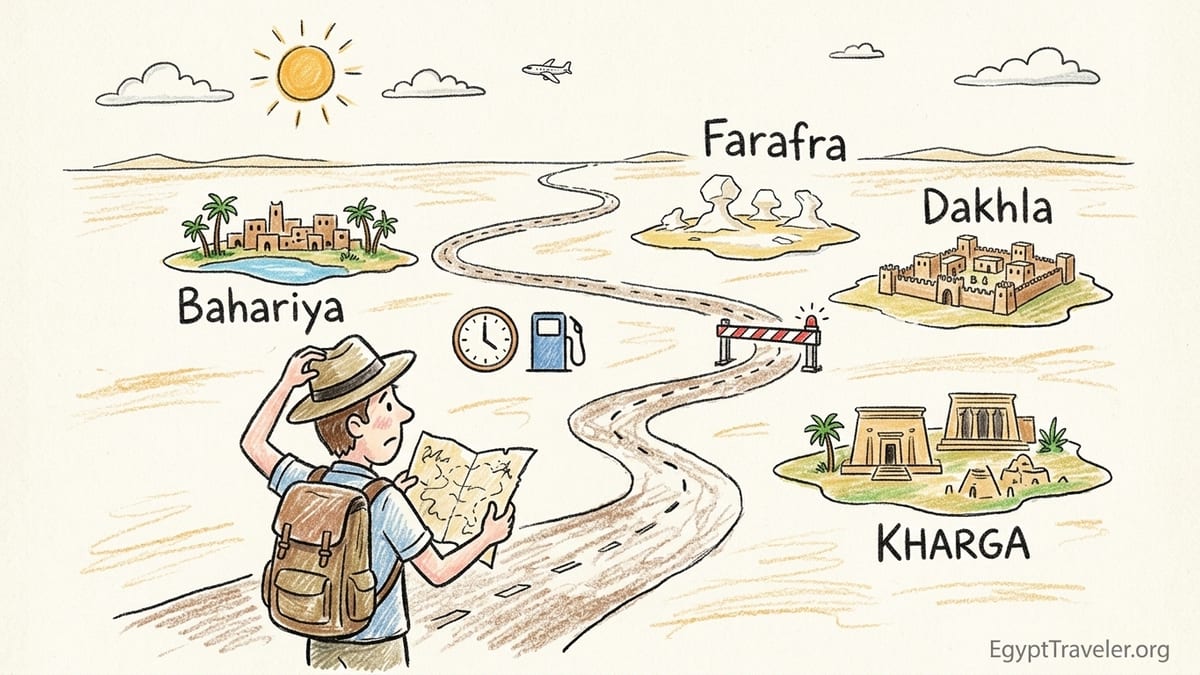
The Western Desert Loop: Cairo to Luxor by Way of the Oases
Egypt’s official tourism authorities describe a desert highway that leaves Cairo, swings southwest into the Western Desert, then bends back toward the Nile Valley to reconnect near Luxor. Along that arc you pass through four major oases in sequence: Bahariya, Farafra, Dakhla and Kharga. Together they form a chain of green basins in an otherwise empty expanse. Modern asphalt and fuel stations have replaced camel caravans and wells, but the sense of moving from island to island across a sea of sand remains strong.
From a distance perspective, this is not a casual detour off the Giza Plateau. The drive from Cairo to Farafra is given as roughly 545 kilometers on Egypt’s official “Experience Egypt” platform, with around 180 kilometers between Bahariya and Farafra along the same road. That single ribbon of tarmac then continues several hundred more kilometers through Dakhla and on to Kharga before turning east toward the Nile. Over the full route from Cairo to Luxor via the oases, many operators speak in terms of 1,000 kilometers or more of road when you include side trips, White Desert loops and detours for springs and archaeological sites.
Although the Western Desert highway is paved and usually in reasonable condition, it is not a multi-lane expressway with towns every half hour. Outside the main oases the landscape is almost entirely uninhabited. There are long intervals with no substantial services beyond infrequent police checkpoints. That isolation is part of the appeal, but it is also why this journey must be approached as a proper overland route rather than a string of day trips. Fuel, water, food and overnight stops need to be plotted in advance, especially if you are considering detours into areas like the White Desert, Djara Cave or outlying villages.
Security procedures also shape the journey. Checkpoints at the edge of Cairo, around Bahariya and at intervals between the oases monitor who is entering and leaving desert regions. As of late 2026, tourists heading into the deeper desert zones such as the White Desert National Park are expected to travel with a licensed operator who can secure permits. You can usually move between the major oases on the main highway without an escort, but conditions and rules can change, and travelers are advised to check current guidance with a reputable Cairo or Luxor based agency before departure.
Why This Is Not a Three Day Road Trip
The raw distance figures are only part of the story. On paper, someone might calculate that if Bahariya is roughly four hours from Cairo, Farafra another two, Dakhla a further three and Kharga two more, then a determined driver could barrel down the entire oasis chain in a day or two. In practice that approach misses almost everything that makes the Western Desert worthwhile. It also runs counter to sensible safety and fatigue management in an environment where roadside assistance is limited and mobile coverage can be patchy.
Driving in Egypt’s desert provinces often means dealing with strong crosswinds, occasional drifting sand on the tarmac and long, hypnotic straights that can easily induce drowsiness. Add stop-and-go delays at checkpoints, refueling stops in chaotic forecourts and the need to slow through village fringes and you quickly realize that nominal four hour segments expand into most of a day. Many local drivers refuse to undertake more than one inter-oasis leg per daylight period, especially in summer when mid-afternoon heat can be intense even inside an air-conditioned vehicle.
Time pressure also undermines what you have come to see. Bahariya’s Golden Mummies Museum and associated tombs at the Valley of the Golden Mummies in Bawiti merit at least half a day if you want more than a quick glance at display cases. The chalk formations of the White Desert, best accessed via Farafra, are usually experienced on an overnight or two night camping circuit rather than a roadside photo stop. Dakhla’s mud brick villages and early Christian sites need time to wander. Kharga’s temples and caravan routes tell a story that stretches from Pharaonic frontier outposts to Roman fortresses and 20th century desert rail. None of that reveals itself on a schedule built entirely around odometer readings.
Most serious Western Desert itineraries planned by Egyptian operators start at five or six days for Cairo to Luxor via the oases, and many recommend eight to ten days for travelers who actually want to walk among dunes, soak in springs and linger in oasis towns. A six day version already means some long driving days and careful choices about what to skip. Once you factor in the realities of heat, driver fatigue and the need for permits and briefings at key points, attempting to squeeze this desert grand tour into three or four days becomes both impractical and unwise.
Bahariya: Gateway Oasis, Golden Mummies and Black Desert Rims
Bahariya is the logical first overnight stop once you leave Cairo. Located several hundred kilometers southwest of the capital, it functions as both an agricultural basin and a desert-safari hub. The main town, Bawiti, has simple hotels, guesthouses and a cluster of desert tour agencies that arrange trips into the surrounding Black Desert, dunes and White Desert National Park. For many travelers this is the point at which an urban Egypt experience transitions into something altogether more Saharan.
The oasis first came to wider attention in the 1990s when local excavations uncovered a vast Greco Roman era necropolis now commonly referred to as the Valley of the Golden Mummies. Today the Golden Mummies Museum in Bahariya presents a selection of richly decorated mummy cases, funerary masks and tomb goods that underline the oasis’s role on ancient trade and cultural routes. A traveler arriving from Cairo mid afternoon can visit the museum and nearby tombs before sunset, then head to a rooftop terrace restaurant in Bawiti for grilled chicken, rice and salad under a sky unpolluted by big city light.
In practical terms, Bahariya is an important place to check your vehicle and logistics. Fuel is available at pumps in and around Bawiti, but queues and supply interruptions are not unheard of. Many overland drivers fill their main tank and any jerry cans here before continuing, even if they plan another stop in Farafra. There are small supermarkets for packaged snacks, plenty of bakeries for flatbread and a handful of mechanics who are used to patching up 4x4s that have taken a beating on dunes. For those on organized tours, this is often where you meet your desert guide and transfer from a Cairo city car or minibus into high clearance four wheel drives.
While it is possible to arrive from Cairo and push on to Farafra in the same day, a night in Bahariya is strongly recommended. It allows time to adjust to a slower rhythm, acclimatize to the dry air and, for those heading on to camp in the White Desert, sort equipment and clothing. If your schedule has some flexibility, a two night stop here opens up a day trip into the Black Desert, where conical hills of dark volcanic rock rise out of the sand in soft morning or late afternoon light, and nearby hot and cold springs provide a memorable soak.
Farafra: White Desert Landscapes and Springs
From Bahariya, the Western Desert highway runs roughly 180 kilometers southwest to Farafra, a segment many travelers describe as one of the most atmospheric asphalt drives in Egypt. For long stretches you see nothing but sand plains and low ridges under an enormous sky. Occasional police or military checkpoints break the monotony and serve as a reminder that, despite the emptiness, this is a monitored frontier region. Most travelers allow four to five hours for the leg, factoring in a rest stop, photos and possible delays.
Farafra itself is a compact oasis town with a quieter feel than Bahariya. Date palms, small fields and low houses cluster around a modest center with fuel, shops and basic accommodation. Its real draw, however, lies just beyond town in the outcrops and basins of chalk rock that form the core of Egypt’s famous White Desert. Here, wind and time have sculpted luminous limestone into pillars, mushrooms, towers and whorls that glow orange at sunset and seemingly luminescent under a full moon. Egyptian tourism material often places Farafra about 545 kilometers southwest of Cairo, and travelers who have come the road from the capital can feel the psychological distance in the silence and star fields.
Accessing the heart of the White Desert requires leaving the main highway and traveling on desert tracks. By law and for safety, this is an area where foreign visitors are expected to join a licensed safari operator based in Bahariya or Farafra. These guides arrange the necessary permits, carry recovery gear and know which areas are currently open. Popular trips include one or two night loops that start in Bahariya, visit the Black Desert and crystal formations, camp in the White Desert and then continue to Farafra, with a soak in one of the area’s hot or warm springs a welcome end to days of dust and sun.
For independent overlanders staying on asphalt, Farafra still merits at least one night. You can walk or arrange short drives out to accessible viewpoints on the edge of the chalk fields, visit a local art house that uses desert materials for its work, and relax in simple garden guesthouses fed by spring water. If your itinerary allows, two nights here give a buffer in case sandstorms delay White Desert access, and offer time to recover before the longer haul to Dakhla.
Dakhla: Mud Brick Villages, Archaeology and Oasis Life
The road from Farafra to Dakhla marks a transition from the stark whiteness around Farafra into a landscape where dunes, escarpments and cultivated fields feel more intertwined. It is one of the longer inter-oasis legs, and travelers commonly allocate most of a day to the drive, including checkpoint formalities and a lunch stop. Rough estimates from recent road trip accounts suggest journey times of six hours or more, depending on conditions. Arriving in Dakhla at dusk with the palms glowing green against the last light is one of the classic Western Desert moments.
Dakhla Oasis is known as “the inner oasis,” and it feels more populous and varied than Farafra. Its mud brick villages, some perched on low hills, preserve traditional building techniques and street plans. Places such as the old Islamic quarter of Al Qasr, with its narrow alleys and wooden lintels carved with Quranic inscriptions, reward slow exploration on foot with a local guide. Elsewhere you find monasteries and early Christian remains that attest to Dakhla’s role as a refuge and frontier in late antiquity, as well as Pharaonic and Roman era remains that underline its long occupation.
Water lies at the heart of Dakhla’s appeal. Springs and pools dot the surrounding fields, and many guesthouses organize late afternoon trips to local hot springs where visitors share space with farmers and families. Compared with the more tourism focused springs near Bahariya and Farafra, several pools around Dakhla retain a strongly local character, especially outside peak holiday periods. Sitting on the edge of a steaming pool, listening to frogs and distant voices while the sky fills with bright desert stars, gives a sense of oasis life that hotel lobbies cannot match.
Archaeologically inclined travelers can use Dakhla as a base to visit sites such as Deir el Hagar, a Roman temple set against a rocky backdrop, and nearby necropolises that have yielded remarkable painted tombs. Several current itineraries from specialist desert operators price Dakhla as a highlight, allocating two or even three nights here in eight or ten day Western Desert circuits. Even if your own schedule is tighter, one full day between arrival and departure is the minimum if you hope to see both a historic village and a spring.
Kharga: Crossroads of Caravans and Gateway to the Nile
Continuing south and slightly east, the highway from Dakhla to Kharga closes the loop of the oasis arc before the road finally bends back toward the Nile Valley. Driving times between the two oases again run to most of a day, and Kharga’s slightly larger scale becomes apparent as you approach. Official Egyptian tourism material notes that Kharga is the largest and southernmost of the four linked oases on the Western Desert highway between Cairo and Luxor, and you feel its role as a regional center in the wider range of services and institutions compared with Bahariya or Farafra.
Historically, Kharga was a major intersection of caravan routes crossing the eastern Sahara. UNESCO documentation related to the region’s archaeological sites emphasizes its significance as a crossroads that connected Nile Valley cities with oases deeper in the desert and with routes leading toward Sudan and Libya. Temples like Hibis, with its well preserved reliefs from the Persian and later periods, and the late antique necropolis of El Bagawat, where hundreds of Christian chapels cluster on a low rise, speak to a long continuity of transit, worship and defense. Travelers today can visit these sites on half day excursions from Kharga town, usually timed for early morning or late afternoon to avoid the fiercest heat.
Modern Kharga feels less like a remote outpost and more like a small provincial city. There are multiple fuel stations, banks, basic hotels and local restaurants. For overland travelers this makes it a natural place to regroup after the smaller oases. Vehicles that have accumulated desert dust and a few rattles can be checked here at better equipped workshops, and travelers can restock on medicines and supplies before either continuing toward Luxor or heading north toward Asyut and the Nile by a different route. Several travelers have reported onward shared taxis and minibuses from Kharga to Upper Egyptian cities as an alternative to private drivers, although services and schedules can fluctuate.
The road from Kharga to Luxor provides the final leg of the Western Desert loop. References from drivers participating in the Cross Egypt Challenge motorbike event and recent overland blogs suggest a road distance of around 300 to 350 kilometers, often covered in roughly five hours of driving time under normal conditions. Part of the route involves cutting east to meet the Nile Valley near towns like Asyut or Qena before turning south to Luxor, depending on current security guidance. Although this segment leaves the strict desert behind, it still demands attention to checkpoints and timing, and many travelers aim to reach Luxor by mid afternoon rather than driving after dark among trucks and buses.
Road Conditions, Fuel, Food and Checkpoints
Although much of the Western Desert highway is straightforward two lane asphalt, conditions can vary from fresh blacktop to worn surfaces with potholes and undulations. After rare rains or prolonged periods of high wind, sand can drift onto the carriageway and reduce visibility. Road works and diversions occur sporadically. Night driving is strongly discouraged, not only because of fatigue and camels that occasionally wander close to the tarmac, but also because unlit or badly lit vehicles and speed bumps are common. Most desert tour operators and experienced Egyptian drivers insist on daylight departures and conservative speeds.
Fuel planning is critical. There are functioning petrol stations in each major oasis, often several in Bahariya and Kharga, but supply can be inconsistent in smaller facilities and during local disruptions. As of 2026, prices for standard 92 octane petrol and diesel remain subsidized and comparatively low by international standards, but travelers should not count on finding every grade available at every stop. Many self drivers make a habit of topping up the tank on arrival and departure from each oasis, and carrying at least one jerry can if their vehicle and permit conditions allow. Guides operating 4x4 safaris into the dunes typically bring additional fuel reserves in the back of their vehicles.
Food logistics are simpler but still benefit from planning. All four oases have local restaurants serving grilled meats, stews, rice, salad and bread, as well as grocers selling bottled water, biscuits, tinned fish, cheese triangles and fruit when in season. However, opening hours can be irregular and some places close early outside holiday periods. On long driving days between oases, it is wise to carry a picnic and several liters of water per person rather than relying on finding a convenient cafe en route. Organized tours usually include picnic lunches and camp dinners prepared by drivers or cooks using portable gas stoves.
Checkpoints shape the rhythm of the trip. At the outskirts of Cairo, on the road toward Bahariya, in the approaches to Farafra, Dakhla and Kharga, and at intervals between them, security forces record vehicle details and passport data. For foreigners, this often means presenting your passport, visa and, if on an organized tour, a copy of your itinerary in Arabic prepared by your agency. Occasionally, travelers are asked to accept an armed police escort vehicle for a particular segment, especially if traveling at off peak times or during heightened security alerts. Current experience suggests that polite patience and allowing plenty of time for these interactions is essential to a stress free journey.
Permits, Guides and When to Hire a Driver or 4x4
Travel regulations in Egypt’s Western Desert change more frequently than road markings. Over the last decade, official advice from foreign ministries and local enforcement practices have shifted several times in response to regional events. As of late 2026, a general pattern has emerged. Foreign visitors may travel to the oasis towns themselves by public bus or standard private car on main roads, subject to checkpoints and occasional escort requirements. However, venturing off the main asphalt and into deeper desert zones almost always requires a licensed guide and specific permits obtained through a registered Egyptian travel agency.
This distinction matters for planning. A confident driver with experience in North African or Middle Eastern traffic may decide to rent a car in Cairo and drive on paved roads to Bahariya, continue to Farafra, Dakhla and Kharga, and then exit via Luxor, relying on local guesthouses and public fuel stations. In that scenario, the main challenges are long distances, navigation and dealing with checkpoints in Arabic. By contrast, trying to self drive into the White Desert, trackside springs, remote rock art sites or cross country routes between oases would not only be illegal without permits and a guide, but also unwise from a safety perspective.
Hiring a private driver with a standard sedan or minivan can make sense for travelers who want flexibility within the oases and on highway segments but do not wish to handle Egyptian road culture themselves. Many Cairo based agencies quote multi day rates that include the driver’s accommodation and meals, fuel and basic vehicle costs. Specific figures vary with fuel prices and demand, but overland travelers should expect multi day Western Desert hires to represent a significant portion of their trip budget. Checking that your driver has made this route before, and that the vehicle is in good mechanical condition with working air conditioning and seat belts, is more important than shopping for the absolute lowest price.
For any itinerary that includes camping in the White Desert or side trips into dune fields and unpaved tracks, a 4x4 and an experienced driver guide are non negotiable. Local operators based in Bahariya and Farafra run rugged Toyota Land Cruisers or similar high clearance vehicles equipped with sand plates, compressors, spare tires and emergency communications. Joining one of their scheduled departures, or arranging a private safari as part of a longer Cairo to Luxor circuit, is the safest way to see the classic chalk formations, Black Desert hills and remote springs. Independent overlanders with their own expedition rigs still need to secure permits through an agency and may be asked to travel in convoy with a local vehicle in sensitive areas.
Suggested 6, 8 and 10 Day Cairo–Luxor Western Desert Itineraries
Translating distances and logistics into real world schedules helps clarify how much time you should allow. The following examples are based on current operator practice and on-the-ground travel reports, and they assume travel in reasonable weather with no major road closures. They are intended as frameworks rather than rigid prescriptions, and travelers should always confirm specific driving times and overnight options close to their departure date.
A compact six day itinerary might look like this. Day 1: Cairo to Bahariya, arriving by mid afternoon for a visit to the Golden Mummies Museum and an overnight in Bawiti. Day 2: Bahariya to the Black Desert and White Desert with a licensed 4x4 operator, camping among chalk formations under the stars. Day 3: White Desert to Farafra for lunch and a spring visit, then continue on asphalt to Dakhla for a late arrival and two night stay. Day 4: Full day in Dakhla to explore a mud brick village like Al Qasr, visit Deir el Hagar and relax in a hot spring. Day 5: Drive Dakhla to Kharga, with a late afternoon visit to Hibis Temple or El Bagawat. Day 6: Kharga to Luxor, arriving by late afternoon. This schedule already includes two long driving days and little slack for weather or delays.
An eight day version builds in more breathing room and is closer to what many desert specialists now recommend. One option is to spend two nights in Bahariya, using the full day in between for a Black Desert and local springs loop without needing to pack up camp immediately. From there you could still spend a night in the White Desert, then move on to Farafra for a relaxed afternoon and overnight in a spring fed guesthouse. Two nights in Dakhla would allow for separate days devoted to heritage sites and to springs and walks, followed by one or two nights in Kharga depending on how much time you want for its archaeological remains before turning toward Luxor.
A ten day Cairo to Luxor odyssey allows the desert to breathe. You might allocate two nights in Bahariya, one or two camping nights in the White Desert, two in Farafra, two in Dakhla and two in Kharga. This structure gives space to adjust for sandstorms, unforeseen checkpoint delays or simply the desire to linger in a particular oasis that resonates with you. It also makes it more realistic to incorporate lesser known stops such as smaller spring villages, viewpoints on escarpments or side trips to nearby ruins without compromising safety or rest. In high summer, spreading the driving across more days also lets you arrange departures very early in the morning and enjoy siestas during the hottest hours.
In all three versions, a mix of private driver or transfers between the oases and specialist 4x4 guides for off road segments is often the most practical approach. Self driving the entire loop in a rental car is possible on paper, but the time required to secure permits, negotiate checkpoints in Arabic and deal with any mechanical or bureaucratic hiccups can quickly erode the pleasure of the trip for those unfamiliar with Egypt. For many visitors, reserving a structured multi day Western Desert circuit with a reputable operator that clearly explains what is included, which roads are used and how they handle permits and safety is the surest way to experience this remarkable stretch of Sahara.
The Takeaway
Seen on a map, the Western Desert highway looks like a simple connection between Cairo and Luxor that happens to cross a few oases. Experienced on the ground, it is a distinct journey in its own right. The sequence of Bahariya, Farafra, Dakhla and Kharga traces a long history of adaptation to aridity, of trade and pilgrimage, of shifting frontiers and modern consolidation. The distances are significant, the services intermittent and the regulations fluid, yet for travelers who prepare properly the rewards are immense.
Planning this route starts with time. Allow at least six days if you want more than a blur of asphalt and checkpoints, and consider eight or ten if you hope to walk in mud brick lanes, float in hot springs, wander chalk valleys and sit quietly among Christian chapels in the desert dusk. Build your days around safe daylight driving segments, know where you will refuel and sleep, and be realistic about how much ground you can cover without turning the trip into an endurance test.
Finally, think carefully about how much responsibility you want to carry personally. Confident drivers with regional experience may enjoy handling the asphalt legs between oases, but desert camping and off road exploration belong in the hands of licensed 4x4 guides with the right equipment and permits. Others will prefer to contract a full Cairo to Luxor package that bundles drivers, guides, vehicles and paperwork into a single organized route. Either way, treating the Western Desert oases road trip as a true overland expedition rather than a convenient shortcut transforms it from a line on your itinerary into one of the defining experiences of an Egyptian journey.
FAQ
Q1. Is it currently possible to self drive the entire Cairo–Bahariya–Farafra–Dakhla–Kharga–Luxor route?
It is generally possible to drive a private or rental car along the main paved highway linking these oases, but conditions and rules can change. You should check with a reputable Cairo or Luxor based agency and review your home country’s latest travel advice before committing. Off road segments, including most routes inside the White Desert, require permits and a licensed guide and are not suitable for independent driving.
Q2. How many days should I realistically plan for this Western Desert oases trip?
A minimum of six days is needed to travel from Cairo to Luxor via Bahariya, Farafra, Dakhla and Kharga with at least brief stops in each oasis and one night in or near the White Desert. Eight days allows more time in Dakhla and Kharga and a less hurried pace. Ten days creates space for extra nights in your favorite oases, rest days and the flexibility to handle delays from sandstorms or checkpoint procedures.
Q3. Do I need a 4x4 vehicle for the whole journey?
You do not need a 4x4 for the main asphalt highway between the oases. A reliable sedan or minivan with good air conditioning is adequate for Cairo to Bahariya, Farafra, Dakhla, Kharga and onward to the Nile. However, any trip that leaves the main road to explore dunes, remote springs or the interior of the White Desert requires a proper 4x4 and an experienced driver guide. Most travelers combine standard vehicles for intercity legs with specialist 4x4s for off road excursions.
Q4. How often will I find fuel stations and food along the route?
Each of the four major oases has petrol stations and simple restaurants, but there is usually nothing substantial in between except security posts. You should refuel whenever you arrive in a new oasis and carry enough water and snacks for a full day in case of delays. Do not assume that every station will stock all fuel grades or be open around the clock. In practice, careful planning turns fuel and food into manageable concerns rather than sources of anxiety.
Q5. Are special permits required to visit the oases or the White Desert?
To stay in the oasis towns themselves usually does not require special permits beyond your normal Egyptian visa, but regulations can shift and checkpoints will record your details. To enter protected desert areas such as the White Desert National Park, or to undertake multi day camping or off road routes, permits obtained through a licensed Egyptian travel agency are required. These are typically handled by local safari operators based in Bahariya or Farafra as part of a tour package.
Q6. What are the road conditions like and is night driving safe?
The Western Desert highway is paved but ranges from smooth to potholed, with occasional sand drifts and unmarked speed bumps. There is limited lighting and some vehicles travel without proper headlights. For these reasons, night driving is not recommended. Most desert guides schedule departures at first light and aim to reach the next oasis by mid to late afternoon, minimizing exposure to darkness and to peak heat in summer.
Q7. When is the best season for a Western Desert oases road trip?
The most comfortable periods are typically from late October to early April, when daytime temperatures are moderate and nights can be cool or even cold. Winter is ideal for camping in the White Desert, provided you have warm clothing and suitable sleeping bags. High summer from June through August brings intense heat that shortens safe driving windows and can make daytime exploration uncomfortable, though some experienced travelers still go with very early starts and long midday rests.
Q8. Can I travel this route by public transport instead of renting a car?
Public buses and shared minibuses link Cairo and Upper Egyptian cities with the oases, and there are services between some of the oases themselves. However, schedules can be limited and subject to change, and vehicles may be crowded. Using public transport is possible for flexible, budget minded travelers who speak some Arabic and are content to see a few key sights with local taxis. It is less suitable if you want to follow a precise multi day itinerary or include remote archaeological sites and desert springs.
Q9. How isolated will I feel between the oases and is there mobile coverage?
Between oases you will often drive for an hour or more without seeing any settlement beyond checkpoints or maintenance depots. This isolation is part of the appeal but requires a dependable vehicle and extra water. Mobile coverage tends to be good in and near the oases and intermittent or absent on the open road. Many desert operators carry satellite phones for emergencies, and independent travelers should not rely entirely on smartphone maps or messaging when planning their safety margins.
Q10. What should I prioritize if I only have six days for the trip?
With six days, consider focusing on a night in Bahariya, an overnight White Desert safari between Bahariya and Farafra, at least one full day and night in Dakhla for a mud brick village and a spring, and one night in Kharga with time for Hibis Temple or El Bagawat before heading to Luxor. This still provides a sense of each oasis’s character while recognizing the time lost to long desert drives and checkpoint stops.