


The first time I slid into Siwa’s hot springs, I had sand in my hair from the Great Sand Sea and a fine crunch of dust between my teeth. By the time I left a few days later, I had soaked both at Cleopatra’s Bath on the edge of town and in the sulphuric hot spring at Bir Wahed far out in the dunes. The two experiences could not have been more different: one ringed by juice cafés and phone cameras, the other reached after a hard run through the sand in a 4x4 and shared with only a handful of people watching the sky turn red over the desert. What follows is a practical, sensory comparison drawn from those visits, for travelers trying to decide which spring deserves their time in Siwa.
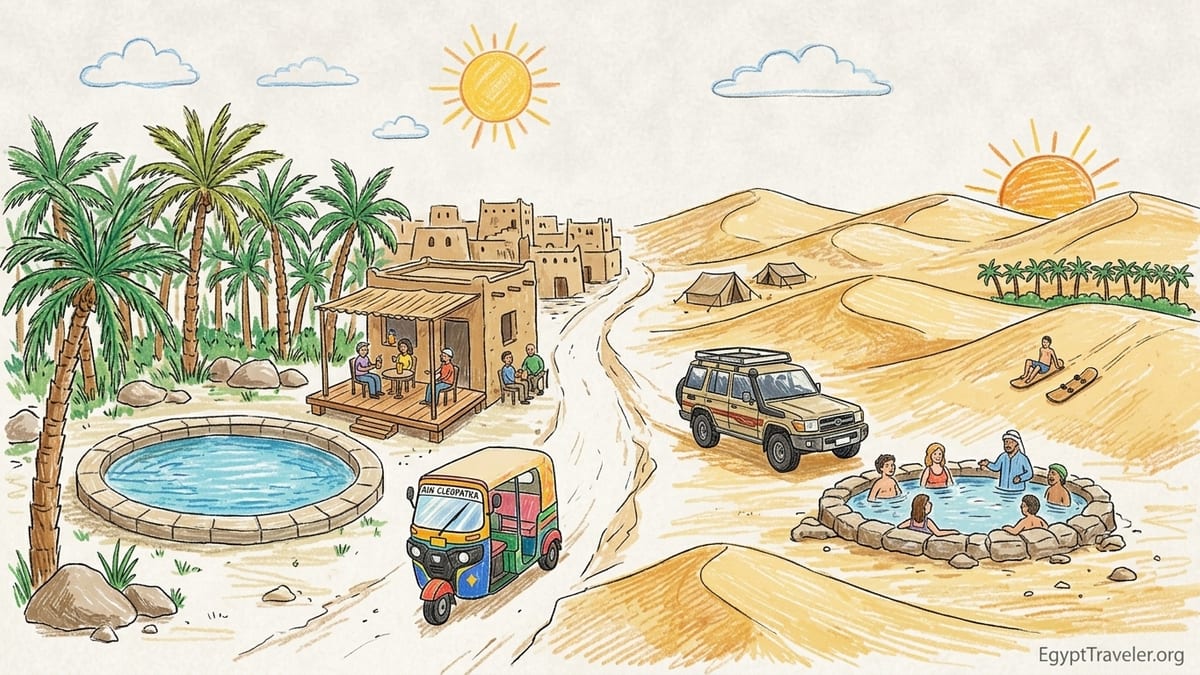
Getting To The Springs: Town Edge vs Deep Desert
Cleopatra’s Bath, also called Cleopatra’s Spring or Ain Juba, sits just east of central Siwa, a short ride from most guesthouses. On my last visit I left a small lodge near Shali’s old mud-brick citadel after breakfast, flagged a tuk-tuk on the main road, and asked simply for “Ain Cleopatra.” Ten minutes later we turned off the asphalt onto a short lane lined with palms and low cafés, the circular stone pool coming into view beside a cluster of wooden decks and shaded seating. There were no checkpoints, permits or advance bookings. I stepped out, paid the driver in cash and walked straight to the edge of the spring.
Bir Wahed, by contrast, required planning. The hot spring and its neighboring cool desert lake lie around 12 to 15 kilometers southwest of Siwa at the edge of the Great Sand Sea. I arranged a late-afternoon 4x4 safari through a local operator recommended by my guesthouse. A Toyota Land Cruiser collected me from town, then joined a rough track heading toward the dunes before dropping pressure from the tires and cutting into the sand. From there it was an hour of rolling over ridges, pausing at fossil beds and steep slipfaces, before the driver finally pointed to a low stand of palms in a hollow and said, “Bir Wahed.” No regular taxi will take you here and there is effectively no public transport; it is a guided or at least a 4x4-driver-access experience.
That difference in arrival shapes the mood. Cleopatra’s Bath feels like an easy mid-morning stop on a circuit that might also include the Temple of the Oracle and Gebel al-Mawta. Bir Wahed feels like a destination at the end of an outing, something you earn after white-knuckle descents off dune crests and a long, sun-blasted ride.
Access, Fees, And How You Actually Get In The Water
At Cleopatra’s Bath, there was no formal ticket booth when I visited, and recent visitors report much the same. Instead, you essentially pay through the cafés. I bought a fresh mango juice and a bottle of water from a raised terrace café directly overlooking the pool, then left my bag on one of their low benches with the owners keeping an eye on it. There were no lockers, and no one offered towels. Changing was handled in a very Siwan way: I arrived already wearing modest swim shorts under long linen trousers, slipped the trousers off behind a palm trunk near the café tables, and walked directly down the stone steps into the water.
At Bir Wahed, the “entry fee” was folded into the overall price of the desert safari, which also covered fuel, the driver, a local guide and sandboarding. The current going rate among reputable Siwa operators when booked locally tends to be a per-person price that varies with group size rather than a posted sign at the spring itself. When the Land Cruiser rolled to a stop by the hot spring, no one asked for additional payment. I left my bag on the sand near the vehicle along with the guide’s belongings, changed quickly behind the car, and stepped over a low lip of rock into the steaming pool.
In practical terms, Cleopatra’s Bath is open-access community water embedded in the oasis. You arrive under your own steam and swim at your own risk, in swimwear that should respect local norms. Bir Wahed is effectively controlled by whoever brings you there. Your stay is framed by the guide’s schedule, the jeep’s headlights, and the knowledge that once your group dries off, the desert goes dark and everyone climbs back into a vehicle for the long, sandy ride home.
Water Temperature, Smell, And The Feel Of Each Soak
Step into Cleopatra’s Bath and the first surprise is that the water is not hot in the same way a mountain onsen or volcanic pool might be. It is geothermally warmed and holds a temperature around the high twenties to about 30 degrees Celsius, which in Siwa’s dry heat feels almost perfectly neutral. The water flows constantly from an underground spring, clear enough that I could see the full arc of my toes against the stone even near the center. There was no pronounced sulphur smell, more a faint mineral tang like wet limestone and a trace of algae clinging to the lower stones.
Bir Wahed’s hot spring is a different story. The pool here is smaller, more irregular and more clearly a desert basin, with sand infiltrating the edges. When I lowered myself in after climbing down the rough stone ledge, the heat wrapped around my legs with a noticeable jolt. Local guides describe the temperature as roughly in the low thirties, and it felt significantly warmer than Cleopatra’s pool, especially around sunset when the desert air cooled quickly. There was a distinct sulphur whiff when the breeze shifted, not overwhelming but clearly present, accompanied by a very slight slickness on the skin that reminded me this was mineral water, not a chlorinated resort pool.
Texture matters as much as temperature. At Cleopatra’s Bath the stone rim is roughly built and easy on the feet, but the submerged ledges have patches of smooth algae that turn the first step or two slippery. I found myself gripping with my toes, taking care not to push off too hard near the curve of the pool. In Bir Wahed, the bottom underfoot felt mostly sandy with occasional rock outcrops, which meant a softer landing but also a shifting surface. I sank a centimeter or two into the warm sand, which was pleasant until I kicked up small clouds that swirled around my calves, clouding the water slightly and reminding me how organic and unfiltered this desert hot tub really is.
Crowds, Privacy, And How Long You Might Actually Stay
I visited Cleopatra’s Bath twice on separate trips, once in late afternoon and once shortly after 9 a.m. The late-afternoon visit coincided with a noticeable crowd: a mix of local young men perched on the stone edge, domestic Egyptian travelers stopping for selfies, and a handful of foreign visitors slipping in for a quick dip. At any one moment there were perhaps a dozen people in or right beside the water, with others coming and going. Conversation drifted from Arabic to Italian and back to English, and for long stretches it felt like a social square that happened to contain a spring. I stayed about forty minutes in total, but only around twenty minutes of that was actual soaking; the rest was people-watching from the café terrace and sipping juice in the shade.
The morning soak was different. By 9 a.m. the cafés were only just waking up, the air felt softer and there were only three other people in the water, two of them children with a local family. That day I stayed for nearly an hour, alternating between floating quietly in the spring and sitting on the edge with my feet in the flow, watching a man drive a donkey cart past the palm groves. Privacy in the strict sense does not exist here, but a quieter time of day gives you at least psychological space.
Bir Wahed offered a different rhythm. Our 4x4 convoy reached the hot spring about ninety minutes before sunset. Two other vehicles were already parked when we arrived, each with their own small group of travelers. Over the next half hour one group left, replaced by another. The maximum number of people in the water with me at any one time was six, spread around the pool’s perimeter, and for a full fifteen minutes I had one side of the basin entirely to myself, looking out at dune ridges without a single building or electric light in sight. Including changing, soaking and drying off, we spent around forty-five minutes in the hot spring before walking over to the cooler lake nearby.
In practice, Cleopatra’s Bath lends itself to brief, possibly repeated visits threaded through a day in town. Bir Wahed tends to be a single, defined block of time at the tail end of a half-day or full-day desert excursion. If you are hoping for solitude, it is not guaranteed at either, but an early-morning visit to Cleopatra’s Bath or a weekday sunset trip to Bir Wahed will usually feel calmer than midday at either spot.
Cafés, Facilities, And What You Give Up For Desert Silence
One of Cleopatra’s Bath’s biggest advantages is practical: it is surrounded by cafés. Around the pool are several simple, open-air spots with raised wooden decks, low cushions and palm-frond roofs. I sat barefoot at a table wedged against a railing with a full view of the water, drinking a thick mango juice made from fruit piled in crates behind the counter. Other travelers ordered hibiscus tea, Turkish coffee or soft drinks. A couple of cafés offered basic snacks like fries, omelets and crisps, and one had a rudimentary bathroom for customers. None of this is polished or spa-like, and not all cafés are equally well kept, but the convenience is undeniable when you want a shaded seat and a cold drink before or after your swim.
Bir Wahed has none of that. When we pulled up, there were no permanent buildings, only a low wall of stones defining one side of the hot spring and the parked 4x4s forming a loose barrier on the other. Our guide produced a tray with small glasses and pre-packed tea bags, boiled water on a gas burner balanced in the sand and handed around sweet desert tea. Toilets were essentially non-existent. Anyone who needed them took a short walk into the dunes. There were no changing cabins, only the side of the vehicle, and no lights apart from the setting sun and, later, the headlights when it was time to leave.
This absence of infrastructure is both the charm and the trade-off. At Cleopatra’s Bath, I disliked the clutter around parts of the pool, the occasional stray plastic bottle and the way some cafés let flies gather on sticky tables. At Bir Wahed, I missed having an easy place to rinse my feet and would have welcomed a simple screen or half-wall for changing. Yet it was precisely the lack of commercial trappings that made sitting in the hot water at Bir Wahed, tea cooling on the sand beside me, feel like time had slipped sideways into a quieter century.
Cleanliness, Comfort, And The Reality Of Desert Fatigue
Neither spring is a manicured spa, and it is worth adjusting expectations accordingly. At Cleopatra’s Bath the water itself looked and felt clean on each visit. The flow means fresh water constantly enters the pool and overflows into the surrounding channels. I did notice a light ring of algae on the inner stone and a few floating leaves, but nothing that made me question getting in. What bothered me more were small details above the waterline: a scattering of cigarette butts near one seating area, a used tissue tucked behind a rock, and café tables that had seen better days. It never tipped into anything like a hygiene hazard, but it did break the illusion of an untouched natural pool.
Bir Wahed felt different. The hot spring basin had some visible mineral staining and a faint milky sheen in places from the sulphur, but the water itself appeared clear when cupped in my hands. Sand underfoot meant any movement stirred up a temporary cloud. There were no obvious signs of soap or shampoo use, and my guide specifically asked the group to avoid using any products in the water. Cleanliness concerns were less about litter and more about the basic fact that this is wild desert water. I did not submerge my head or open my eyes underwater, and I rinsed my face afterward with bottled drinking water from the jeep.
Heat and fatigue play a role at both springs, especially after a Great Sand Sea excursion. After an afternoon of dune bashing, my body felt slightly rattled from the constant motion. Sitting in Bir Wahed’s hot water I initially felt the same deep relaxation you get from a hot bath after a long hike. After about twenty minutes, though, my heart rate felt a fraction higher and the combination of residual sun, warm water and mineral content tipped from soothing to mildly draining. I stepped out, sat on the edge with my feet in, and felt better within a few minutes.
At Cleopatra’s Bath the effect was gentler. On the morning visit I had walked only from town and up a small rise to the Temple of the Oracle, so I arrived with less accumulated fatigue. Ten minutes of floating took the edge off the desert heat but did not leave me woozy. The neutral temperature and shaded surroundings meant I could stay in longer without feeling overheated. If you are sensitive to heat, Bir Wahed after a long day in the dunes is worth treating like any hot spring: shorter sessions with breaks, plenty of water, and an awareness of your limits.
Atmosphere: A Social Spring Versus A Remote Desert Soak
The core difference between Cleopatra’s Bath and Bir Wahed lies in their atmospheres. Cleopatra’s Bath is, at heart, a social spring. On my crowded afternoon visit, teenagers took turns jumping off the stone edge with practiced ease, older men chatted under the trees, and families treated the cafés as an extension of their living rooms. The soundtrack was a mix of laughter, splashes and café music drifting from a tinny speaker. Even when I floated on my back in the center, I could hear someone placing an order for tea in quick-fire Arabic on the bank above.
Bir Wahed’s soundtrack is quieter: the murmur of a few conversations, the clink of tea glasses on a metal tray, the distant whoosh of wind running over dune ridges. At one point as the sun slid down, everyone in the water went silent for a few minutes, watching the sky shift from gold to deep orange, the dunes throwing long shadows that ringed the depression where the spring and lake sit. It felt far from electricity, shops and schedules. Even the vehicles, once parked, became dark, still shapes against the sand.
If you enjoy people-watching and like to connect briefly with local routines, Cleopatra’s Bath is compelling. You can sit side by side with Siwans and domestic visitors, hear fragments of conversation, and sense how integral water is to daily life here. If, instead, you are looking for something that feels more like a pilgrimage to the desert itself, Bir Wahed offers that slow, open silence. For me, both had value, but in entirely different registers.
Which Spring Would I Revisit, And Is It Worth It On A Two-Day Trip?
If I had to choose only one to revisit, it would be Bir Wahed at sunset after another run into the Great Sand Sea. I would time the 4x4 departure so that we were rolling down the last big dune with the sun still above the horizon, reaching the hot spring when the heat in the air began to drop. I would spend fifteen or twenty minutes soaking, then walk over to the cooler lake nearby to wade in up to my knees and skim the surface with my hands as the sky darkened. The combination of remote location, mineral water and the sense of being encircled by dunes made it one of the most memorable hours I have spent in Egypt.
That said, Cleopatra’s Bath earns its reputation as an essential Siwa stop, especially if you are short on time or prefer not to venture deep into the desert. If someone told me they had only two days in Siwa, I would still recommend a short soak there, paired with visits to the Temple of the Oracle and the old town of Shali, because it is easy to fit into a half-day of sightseeing. You can arrive by tuk-tuk or bike, spend thirty to forty-five minutes between the water and a café, and still have energy left for sunset at a salt lake or on Fatnas Island.
For those same two days, I would consider Bir Wahed a priority only if you are keen on desert landscapes and comfortable with a bumpy ride and basic facilities. A typical safari to the Great Sand Sea and Bir Wahed will absorb most of an afternoon and early evening. It is absolutely worth it if the idea of watching the sun set from a dune ridge, then easing your legs into a bubbling desert hot spring appeals to you. If you are primarily interested in Siwa’s history and town life, your limited time might instead go to temples, salt lakes and oasis walks, with Cleopatra’s Bath as your only spring experience.
The Takeaway
Cleopatra’s Bath and Bir Wahed share the same desert aquifer but offer very different encounters with Siwa’s water. One is wrapped in cafés and everyday life, reached by a quick tuk-tuk ride from mud-brick streets. The other lies in a hollow at the edge of a sea of sand, reached after a 4x4 scramble over dunes. In both cases, the water itself is the constant: clear, mineral-rich and quietly grounding after time in Egypt’s western desert.
My own days in Siwa ended with traces of both on my skin: the faint mineral softness from Bir Wahed’s sulphuric heat and the cool neutrality of Cleopatra’s stone-ringed pool. If you can, experience them in sequence: a morning float at Cleopatra’s Bath watching the oasis wake up, then a late-afternoon safari into the Great Sand Sea that deposits you at Bir Wahed in time for the sky to burn red above the dunes. If time or budget forces a choice, let your own travel style guide you. For social, easy access to Siwa’s water culture, choose Cleopatra’s Bath. For a quieter, more elemental soak that lingers in memory long after the sand has been washed from your clothes, choose Bir Wahed.
FAQ
Q1. Do I need a guide to visit Cleopatra’s Bath in Siwa?
For Cleopatra’s Bath you generally do not need a guide. Most travelers reach it by tuk-tuk, bicycle or on foot from central Siwa, and access is informal, with no standard ticket office. A guide can be useful if you are combining the visit with nearby historical sites, but is not essential just to enter the spring.
Q2. Is a guide or 4x4 mandatory for Bir Wahed?
Yes. Bir Wahed lies out by the Great Sand Sea in deep sand, and reaching it safely requires a 4x4 vehicle and a driver familiar with the dunes. Visitors usually book an organized desert safari that includes the hot spring and nearby cool lake rather than attempting to go in a regular car.
Q3. Are there entrance fees at Cleopatra’s Bath and Bir Wahed?
Cleopatra’s Bath typically has no set entrance ticket; instead, travelers support the small surrounding cafés by buying drinks or snacks and then using their seating. Bir Wahed’s cost is normally bundled into the overall price of a desert safari, so you do not pay at the spring itself but rather when booking the excursion.
Q4. What should I wear to swim at the Siwa springs?
Siwa is socially conservative, so modest swimwear is advisable. Men usually wear longer swim shorts, and many women choose one-piece suits with a cover-up or leggings, or swim in tops and shorts. It helps to arrive with swimwear already under your clothes and to use a towel or loose garment when moving between the water and cafés.
Q5. How hot is the water at Bir Wahed compared with Cleopatra’s Bath?
Cleopatra’s Bath feels warm but close to body-neutral, which is especially refreshing in Siwa’s heat. Bir Wahed’s hot spring is noticeably hotter, with a more bath-like warmth and a light sulphur scent. Most travelers find Cleopatra’s water suitable for longer, leisurely soaks, while Bir Wahed feels more like a traditional hot-spring session that is best enjoyed in shorter intervals.
Q6. Are there changing rooms or lockers at the springs?
Neither Cleopatra’s Bath nor Bir Wahed currently offers formal changing rooms or lockers. At Cleopatra’s Bath, people typically change discreetly behind palms or use café bathrooms where available, leaving bags near their table. At Bir Wahed, most visitors change beside their 4x4 and leave belongings in the vehicle under the driver’s watch.
Q7. Is the sulphur smell at Bir Wahed strong or unpleasant?
Bir Wahed has a noticeable sulphur smell when the breeze carries steam across the water, but most visitors describe it as moderate rather than overpowering. It is present enough to remind you that you are in a natural hot spring, yet it did not dominate the experience or linger heavily on skin once dried off.
Q8. How crowded do the springs get, and when is the best time to visit?
Cleopatra’s Bath can be lively in the late afternoon, with local families and travelers sharing the pool and cafés. Early morning is usually quieter and better for a more relaxed swim. Bir Wahed tends to host only a few small groups at any one time, and sunset is a popular yet still relatively calm window when the heat eases and the dunes glow.
Q9. Are the Siwa springs suitable for non-swimmers or children?
The stone pool at Cleopatra’s Bath is deep enough for adults to float but has ledges around the edges where non-swimmers can stand holding the rim, so attentive supervision is important for children. Bir Wahed’s hot pool also has areas where the bottom shelves more gently, but the absence of lifeguards and formal safety infrastructure means non-swimmers and young children need close adult supervision and, ideally, flotation aids.
Q10. If I only have two days in Siwa, which spring should I prioritize?
With just two days in Siwa, Cleopatra’s Bath is the easier spring to prioritize because it fits naturally into a town-based itinerary and requires no special transport. If you are particularly drawn to desert landscapes and have half a day to spare, adding a safari to Bir Wahed can be a highlight, but it will take more time and energy than a simple visit to Cleopatra’s Bath.