

By the time I reached Dakhla Oasis, after a night bus from Cairo and another hour in a shared microbus from Mut, I wanted shade more than scenery. Official tourism brochures describe Dakhla as a green basin in the Western Desert, surrounded by cliffs and dotted with neat fields and ancient villages. What I found on foot in Qasr al-Dakhla, Ezbet Bashendi and Balat was something quieter and more instructive: a living lesson in how people have used mud, shade and water to make dense, walkable settlements work in a very harsh climate.
Arriving in Dakhla: From Brochure Oasis to Lived-In Towns
Most visitors reach Dakhla by overnight bus from Cairo to Mut, the administrative town of the oasis. Tickets on major companies like Upper Egypt Bus can usually be booked a day or two ahead from Cairo’s main bus terminals, with the ride taking around 10 to 11 hours depending on checkpoints and traffic. Services are basic but functional: reclining seats, strong air conditioning and a single rest stop. From Mut, a short hop by shared microbus or pre-arranged hotel car, often 30 to 45 minutes, brings you to the older oasis villages that feature in official tourism descriptions.
Driving into the depression at dawn, the brochure language about a green oasis starts to make sense. After hours of beige plateau, you suddenly drop into a basin of date palms, alfalfa fields and citrus groves edged by pinkish limestone cliffs. Signs for sites like Deir al-Hagar, Muzawwaqa and Qila al-Dabba point into the fields, but my first stop was Al-Qasr, or Qasr al-Dakhla, which Egypt’s official tourism board calls a medieval capital and one of the best-preserved mud-brick towns in the Western Desert. The paved road ends at a modern cluster of houses and a small parking area, beyond which the older village rises like a compact mud citadel.
Unlike desert safaris that bounce you across dunes, exploring Dakhla’s historic settlements starts at human walking speed. In Mut, I arranged a local guide through a small family-run guesthouse for a half-day visit to Qasr al-Dakhla and nearby Ezbet Bashendi, at an agreed price comparable to hiring a car and driver elsewhere in rural Egypt. The guide was not mandatory, but he held the keys to several locked historic buildings and, more importantly, knew which alleys were still private residential space and which had become de facto open-air museum.
Before setting out, I had a mental image borrowed from glossy promotional photos: empty alleys, tidy restored walls, a sort of open-air architectural exhibit. What I encountered instead was messier, more lived in and far more interesting. The oasis was not a desert backdrop to be crossed between photo stops; it was a layered set of communities, each one using the same basic materials mud brick, palm wood, stone and water in subtly different ways.
Walking Qasr al-Dakhla: Lanes, Shade and a 21-Metre Minaret
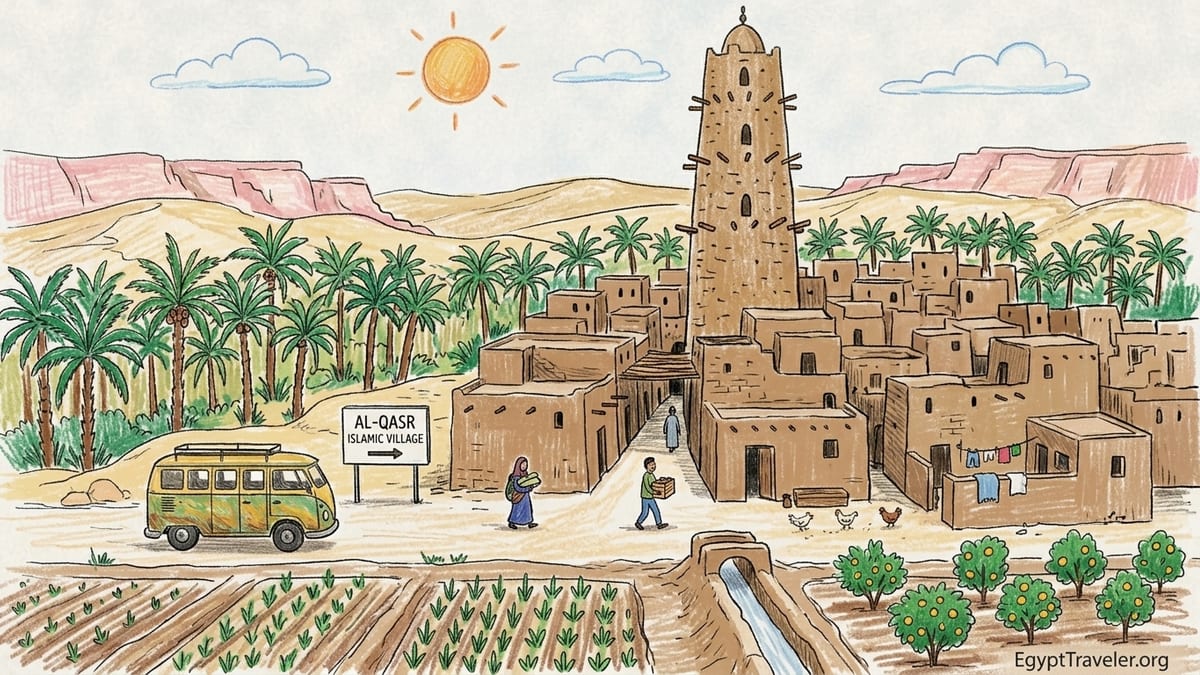
The formal entrance into Qasr al-Dakhla is easy to miss. A modest signboard near the parking area, in Arabic and English, introduces “Al-Qasr Islamic Village” and mentions its role as a medieval capital. From here, a gently rising dirt path leads straight toward the mass of mud-brick houses, but it is the first narrow lane bending left that really marks the start of the experience. Within a few steps, the sun drops away, replaced by a world of shadow, echo and cool air.
The alleys in Qasr are astonishingly narrow, often just wide enough for two people to pass. Many are roofed with palm trunks and mud, creating covered tunnels that function like natural air-conditioning. My guide explained that in summer, when air temperatures regularly soar, these covered passages remain noticeably cooler, acting as circulation routes that keep people and goods moving without prolonged exposure to direct sun. As we walked, light filtered through small shafts between roofs, illuminating lintels carved with Quranic verses and old wooden door beams inscribed with the dates of construction.
It took us around 90 minutes to make a full, unhurried loop through Qasr al-Dakhla, though you could easily linger for two to three hours if you stopped in every unlocked building. The route was not linear. We climbed shallow mud steps to elevated lanes, ducked under low beams, and emerged periodically onto small open courtyards where chickens scratched and laundry hung across the space. In sections that had been partially restored, the town felt almost museum-like, with neatly numbered buildings and interpretive panels. A few corners though felt purely residential: the smell of baking bread, a motorbike parked under an arch, a boy carrying a crate of vegetables home.
The visual and emotional anchor of the village is the Nasr al-Din Mosque and its distinctive 21-metre-high minaret, often singled out in national tourism materials. Turning one last corner, the lane suddenly opened to a small square, and the minaret rose above us like a textured clay spike. Built of sun-dried mud brick on a stone base and reinforced with wooden tie beams, it is slightly irregular and weathered, nothing like the symmetrical concrete minarets of modern Egyptian towns. My guide pointed out wooden stubs protruding from the sides used historically as scaffolding and as resting points during maintenance. Standing in its shade, I understood why scholars call Qasr one of Egypt’s most important Islamic mud-brick sites: the architecture is monumental, but the materials remain entirely local.
How Inhabited Is Qasr al-Dakhla Today?
One of the main things I wanted to verify on the ground was how much of Qasr al-Dakhla is still lived in, as opposed to being a frozen heritage exhibit. Walking through on a weekday morning, I saw both sides. Certain lanes, particularly around the main entrance, clearly cater to visitors. A small ticket kiosk collected a modest entrance fee, and a couple of doorways had been converted into simple craft stalls selling palm-leaf baskets and clay pots similar to those promoted in official oasis marketing. These areas felt lightly curated, with stable mud-brick walls, repaired roofs and discrete signage identifying former schools, storage spaces and religious buildings.
As we moved deeper into the maze, the atmosphere shifted. In some upper lanes, we stepped aside for elderly women carrying bundles of fodder, and more than once, someone leaning on a balcony called down to my guide by name to ask about family news. My guide pointed to doors where people still slept in the old houses and others where families had moved into newer concrete buildings along the main road but continued using the historical structures as storage or animal shelters. The town felt far from abandoned, but also far from densely inhabited. It occupied a middle ground, part living quarter, part historical shell slowly being stabilized.
The balance between museum and village became clearest whenever we came to a locked building. My guide produced a heavy iron key to open a former madrasa, its compact courtyard shaded by timber beams. The interior showed fragments of decoration and layout that required explanation to appreciate. Without a guide, these spaces would remain shut, and a casual visitor might conclude the whole town was closed. Outside, though, daily life went on: a boy pushed a wheelbarrow of feed through a side alley, a radio played from somewhere unseen, and the smell of cooking drifted from a rooftop kitchen.
Heat also shaped how inhabited the place felt. In mid-morning at the edge of winter, the contrast between sun and shade was already sharp. Inside the covered lanes, it was several degrees cooler, and the air barely moved. Residents chose their routes with precision, stepping into the light only to cross from one shaded cluster to another. My guide timed our circuit so that we would arrive at the mosque square when the sun was high enough to cast the minaret’s full shadow, which effectively turned the small plaza into a livable pocket of public space. This choreography of movement, shade and occupation made Qasr feel subtly but distinctly alive.
Ezbet Bashendi: Curving Houses and Color on the Walls
Later the same day, we drove east across the oasis fields to Ezbet Bashendi, sometimes called Bashendi or Bashandi in guidebooks. Tourism brochures describe it as a mud-brick village inhabited since around the 11th century, known for its curvy houses and decorated facades. The approach differs markedly from Qasr. Instead of looming cliffs and a compact citadel, you see a looser cluster of low, rounded structures rising gently from a patchwork of palms and crops. The main access road ends right at the village edge, where a small square doubles as a parking area and informal meeting point.
Walking into Bashendi, the first difference I noticed was color. While Qasr’s lanes are largely the natural hue of dried mud, Bashendi’s facades are often washed in pale blues, pinks or yellows, with hand-painted motifs of palms, camels and Quranic verses. Several doorways had stylized fish or geometric patterns above them, and one corner house had a bright mural of a wedding procession. The alleys were narrower than in many Nile Valley villages but felt more open than Qasr’s fully covered tunnels, with intermittent roofing that allowed more daylight to reach the ground.
Our route through Bashendi was less scripted than in Qasr. There was no formal ticket office at the time of my visit, only a local man who offered, for a small tip, to show us some of the older houses and introduce us to a family who still practiced traditional pottery. Inside their courtyard, a woman worked grey clay by hand, forming simple water jars that would later be fired in a small kiln behind the house. These were not staged demonstrations but part of daily life; when neighbors dropped by to talk, they barely noticed us watching. Prices for the pottery were modest, quoted in Egyptian pounds and negotiable, but my guide suggested paying close to the opening price as a gesture of respect in a village that does not yet see heavy tourist traffic.
Architecturally, Bashendi’s buildings share Qasr’s reliance on sun-dried mud brick and palm trunks, but the lines are softer. Exterior walls bulge slightly, and some upper stories project over the lane in rounded forms that feel almost sculpted. Inside, rooms are small, with thick walls and few windows, designed to hold coolness. One elder explained, through my guide, that families historically slept on the flat roofs in summer, spreading mats and watching the stars, then retreated to the insulated interior rooms in winter. Bashendi felt more clearly inhabited than Qasr, less of a preserved monument and more of a village that happens to retain an old building style.
Balat and Ain Asil: Ghosts of Governors and Caravan Routes
To round out the picture, we dedicated another half-day to Balat on the eastern side of the oasis. Modern Balat is a relatively quiet settlement, but its name is attached to one of Dakhla’s most important archaeological zones: the Old Kingdom settlement and governor’s palace at Ain Asil and the associated necropolis at Qila al-Dabba. Scholars have worked here for decades, tracing how Dakhla linked into pharaonic trade routes. For a visitor today, it is less visually spectacular than Qasr but offers a different layer of understanding.
From Mut, the drive to Balat took about an hour on a paved road that threaded through agricultural land, past clusters of houses and irrigation canals. At the village, we met another local guard who held the keys to the archaeological enclosure. The administrative town of Ain Asil now lies mostly as low mud-brick walls and eroded mounds, fenced off to protect ongoing research. Walking through, my guide described how this had once been a fortified seat of power, with a palace, storage facilities and bureaucratic offices managing grain, dates and routes toward the Nile and deeper into the desert.
Compared with Qasr’s vertical density and Bashendi’s curving houses, Ain Asil felt horizontal and abstract. The outlines of rooms and courtyards hinted at a town but did not enclose you in the same way. The most impressive experiences were imaginative rather than visual: standing in a former courtyard, looking out toward the distant cliffs and picturing caravans arriving from the plateau, or listening to my guide connect the site to sealed clay tablets now studied in museums. Here, the notion of “oasis settlement” expanded beyond picturesque alleys to include administrative decisions about where to dig wells, plant fields and store surplus.
Modern Balat itself keeps some traditional mud-brick architecture, but it feels more thoroughly mixed with concrete and modern materials compared with Qasr and Bashendi. We walked a short loop through older lanes, seeing a few abandoned clay houses alongside newer two-storey brick buildings. Children played football in a dusty square, and a small kiosk sold bottled water and biscuits. Balat’s value for a traveler lies less in photogenic corners and more in context: it anchors Dakhla’s story in deep time and shows how the oasis has been managed as a strategic node for thousands of years.
Learning from Mud, Shade and Water
Spending two full days moving between these villages on foot, rather than treating Dakhla as a quick overnight on a desert circuit, changed how I saw their architecture. In each settlement, mud brick is the primary building material, made from local soil, water and straw, shaped in simple wooden molds and dried in the sun. The result is a wall that insulates by virtue of its mass. In Qasr’s covered alleys, you can feel how the dawn coolness lingers on shaded surfaces well into the morning, while the thick walls reduce heat gain from the outside. It is a low-tech but extremely effective response to a climate of intense daytime heat and significant diurnal temperature swings.
Shade is the second crucial ingredient. In Qasr, the high density of building, combined with upper stories that project over the lanes, keeps sunlight off ground level for most of the day. Where lanes cross or open into small squares, strategic roof beams create partial covers that temper but do not entirely block light. In Bashendi, the pattern is different: fewer fully covered tunnels, more selective roofing and courtyard houses that create interior shade even when the alleys are in the sun. In Balat’s older quarters, the surviving mud houses show yet another approach, with slightly wider streets but deeper rooms. Together, these examples illustrate a regional vocabulary of shade-making shaped over centuries.
Water management is less visible but just as fundamental. Dakhla’s green impression comes from carefully channeled groundwater and springs feeding a network of irrigation canals known as sakia and more modern pumping systems. My guide in Mut pointed out older channels lined with mud and stone, some now partially replaced by concrete, that distribute water to date gardens, alfalfa fields and small family plots. In Qasr and Bashendi, drinking water now arrives via modern pipes, but remnants of older cisterns and small basins remain near some doorways, reminders of when families stored water closer to home. The villages themselves sit slightly raised relative to surrounding fields, an ancient strategy to avoid flooding and to keep living areas dry.
Most importantly, these settlements reveal how architecture and social habits intertwine. People structure their day to align with the environment the thickest-walled rooms used for mid-afternoon rest, rooftops for evening socializing, shaded alleys for commerce and circulation. Even without romanticizing hardship, you can see how this adaptation fosters a close relationship between built form and climate. It is a stark contrast to some newer concrete blocks at the edge of Mut, where large west-facing windows and unshaded streets create heat traps that then rely on energy-intensive air conditioning to be habitable.
Markets, Crafts and Everyday Encounters
Official descriptions of Dakhla encourage visitors to shop for pottery, palm-leaf baskets, kilim carpets and woven cloth in local markets. On the ground, these experiences exist, but they are smaller, quieter and more embedded in daily life than a list of attractions suggests. In Qasr, we came across a tiny workshop where an older man hammered metal over a charcoal forge, making simple tools and decorative door knockers. There was no signboard. My guide knew him by name and asked if I could watch for a few minutes. When I bought a small iron hook, the price was quoted casually, comparable to what you might pay for a handmade trinket in a non-touristy Cairo neighborhood.
The palm-leaf work appeared more often in Bashendi. Several houses had rolled mats and baskets drying on their flat roofs, and one courtyard doubled as a small workshop where women split and wove palm fronds into sturdy market baskets and lightweight trays. They did not have a display stall; instead, finished pieces were stacked in a corner or hung on pegs. When we expressed interest, a neighbor disappeared inside and returned with a selection. Prices were moderate, and negotiation remained polite rather than aggressive. It felt more like stepping into someone’s extended living room than entering a formal shop.
Textiles were least visible in the historic lanes. In Mut’s main market, a short walk from the bus station, I found a few shops selling synthetic blankets and mass-produced scarves from other parts of Egypt, with only occasional handwoven pieces whose origin the shopkeepers could not confidently trace. It would be misleading to suggest that Qasr or Bashendi today host bustling traditional textile markets. What you do find is a handful of crafts still practiced at home, offered incidentally to visitors who show interest and approach respectfully.
These encounters reinforced an important lesson about Dakhla: it functions first and foremost as a working oasis, not a curated open-air museum. People here are farmers, mechanics, school teachers and shopkeepers before they are hosts, and tourism is a welcome but still relatively modest layer on top of everyday life. Supporting local crafts means fitting into that rhythm, buying what is genuinely made and used here and accepting that some of the most picturesque objects, like very old doors or carved beams, are part of living houses, not souvenirs.
The Takeaway: Is Dakhla Worth More Than One Night?
Many organized Western Desert routes treat Dakhla as a brief pause between the more dramatic White Desert near Bahariya and the Roman temples and forts of Kharga. On some itineraries, groups arrive in Mut in the late afternoon, sleep at an eco-lodge, walk quickly through Qasr the next morning and then continue driving by midday. After walking through Qasr, Bashendi and Balat at a slower pace, I would argue that this underserves the oasis and the kind of traveler who might appreciate it most.
If your priority is dramatic dune landscapes, chalk formations and overnight desert camps, then a fast-moving White Desert safari may indeed satisfy you more than a multi-day stay in Dakhla. The oasis has scenery the palm groves against the cliffs, especially near Deir al-Hagar and west of Qasr but it does not deliver instant, spectacular vistas at every turn. Its strength lies instead in density and continuity: the feeling of passing from a medieval covered alley into a half-abandoned courtyard, then into a still-inhabited lane, and realizing that some version of this pattern has persisted here for centuries.
For travelers with a particular interest in architecture, archaeology and how communities adapt to environment, Dakhla deserves at least two nights and ideally three. That allows a full morning in Qasr al-Dakhla, another in Bashendi and Balat with time to visit the Ain Asil archaeological area, and an additional half day to see sites like Deir al-Hagar or the painted tombs of Muzawwaqa. It also leaves room to simply sit in a palm garden or on a guesthouse roof at dusk, watching the cliffs change color while the call to prayer from Qasr’s Nasr al-Din minaret drifts across the fields.
In the end, what I learned in Dakhla had less to do with ticking off specific monuments and more to do with how oasis settlements are built and lived in. The mud-brick houses are not relics of a vanished past; they are part of an ongoing conversation between people, climate and landscape. Qasr al-Dakhla, Ezbet Bashendi and Balat all express that conversation differently, which is exactly why visiting more than one village matters. Far from feeling identical, they form a small, walkable atlas of responses to sun, heat, water and time.
FAQ
Q1. How many days should I plan for Dakhla Oasis if I want to explore Qasr al-Dakhla properly?
Allow at least two nights so you can spend a full morning or more walking Qasr al-Dakhla, plus time for Ezbet Bashendi, Balat and other nearby sites without rushing.
Q2. Do I need a guide to visit Qasr al-Dakhla, or can I walk through the village alone?
You can enter the main alleys alone, but a local guide is highly recommended because they hold keys to locked historic buildings and know which passages are still private homes.
Q3. How long does it take to walk a full circuit through Qasr al-Dakhla’s lanes?
An unhurried circuit with pauses for photos and a mosque stop usually takes 90 minutes to two hours, although photography and conversations can easily stretch it longer.
Q4. Is Qasr al-Dakhla still inhabited, or is it just an open-air museum?
It is partly inhabited and partly preserved. Some families still use houses and storage rooms, while other sections feel more like stabilized historical architecture aimed at visitors.
Q5. How does Ezbet Bashendi compare with Qasr al-Dakhla for visitors?
Ezbet Bashendi feels more like a colorfully painted living village with softer, curving facades and small home-based craft activity, while Qasr is denser, shadier and more monumental.
Q6. What makes Balat and the Ain Asil site worth visiting if the remains are low walls?
Balat and Ain Asil provide historical depth, showing how ancient governors managed the oasis and controlled trade, which helps you understand the long continuum of settlement in Dakhla.
Q7. Are there real opportunities to buy local crafts like pottery and palm-leaf baskets in Dakhla?
Yes, but mostly on a small, informal scale, such as home courtyards in Bashendi or tiny workshops in Qasr, rather than in large, organized tourist markets.
Q8. How difficult is the walking in Qasr al-Dakhla and other villages for less active travelers?
The walking is mostly on level ground, but alleys can be uneven, with low beams and some steps, so sturdy shoes and unhurried pacing are important for comfort and safety.
Q9. Can Dakhla be combined with a White Desert safari, or is it better as a stand-alone trip?
It can be combined on a longer Western Desert loop, but travelers most interested in architecture and village life will benefit from giving Dakhla its own dedicated two or three days.
Q10. What type of traveler is most likely to appreciate Dakhla’s atmosphere?
Patient travelers who enjoy slow exploration, historic architecture, modest comforts and everyday encounters rather than fast-paced itineraries and spectacular desert scenery will value Dakhla most.