

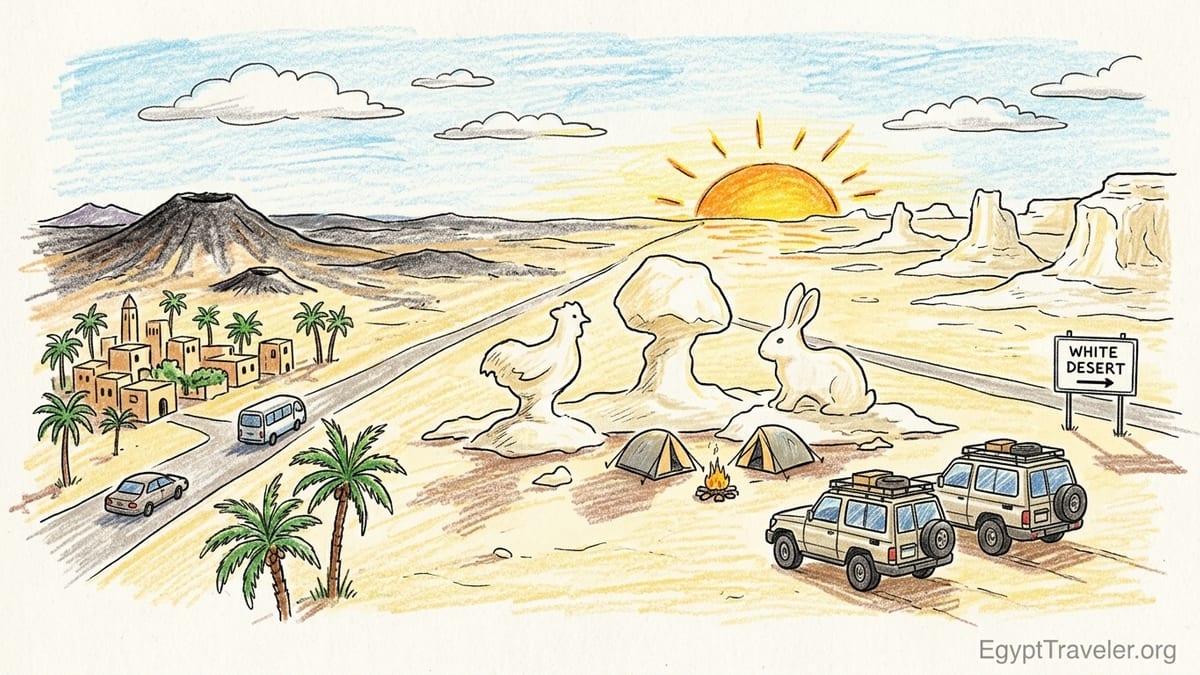
The White Desert in Egypt’s Western Desert is one of the country’s most surreal landscapes: a chalk plateau scattered with wind-sculpted towers, mushrooms and animal shapes that glow gold at sunset and icy white under the stars. For most travelers the practical gateway is Bahariya Oasis, the closest major oasis to Cairo and the launch point for 4x4 safaris that link the Black Desert, Crystal Mountain, Aqabat Valley and the White Desert itself into one continuous journey. This guide breaks down that route step by step, explains what to expect from day trips versus overnight and two-night safaris, and shows you how to book a safe, legally compliant tour using up-to-date information on permits and access rules.
Cairo to Bahariya Oasis: Your Gateway to the White Desert
Official Egyptian tourism materials place Bahariya Oasis about 370 kilometers southwest of Cairo by road, making it the closest significant oasis settlement to the capital and the most common base for White Desert trips. The main road runs through mostly flat, empty Western Desert terrain, and in current traffic conditions the drive from central Cairo or Giza to the oasis town of Bawiti typically takes around four to five hours in a private car or minibus, depending on security checks and rest stops along the way.
Most organized White Desert tours bundle the Cairo transfer into the package. A driver picks you up from your hotel early in the morning, around 06:00 to 07:30, and you ride in an air-conditioned sedan, van or minibus as far as Bahariya. Budget minded travelers can still reach Bahariya on public buses that run from Cairo’s Western Desert terminal, but these services change schedules and prices often and can be slower than private transfers. Several current Egypt based desert specialists advise that, by the time you pay separately for bus tickets, local transfers and a 4x4 in Bahariya, the cost difference between fully organized tours and building everything yourself often narrows significantly.
Independent drivers with their own vehicles sometimes consider doing the trip alone, but Egypt’s recent security guidance for the Western Desert requires tourists visiting Bahariya, Farafra, the White Desert and the Black Desert to hold advance permits and be accompanied by a licensed guide or operator. In practice that means even if you drive your own car from Cairo to Bahariya, you will almost certainly need to link up with a local operator there for the actual off road sections and to handle paperwork with the authorities. It is wise to confirm the latest requirements with your tour company before committing to dates and flights.
Whether you are on a private or group tour, the first part of the day is mostly about covering distance. You may stop once midway at a highway café for bathrooms and tea, but the real experience begins when the green palms of Bahariya rise out of the desert and you turn off the main road toward the oasis villages and their cluster of low key lodges and local tour garages.
Switching to Desert Vehicles and Understanding Permits
Once you reach Bahariya, the standard pattern is to have lunch or at least a tea break at a small lodge or local guesthouse, then transfer into a desert capable vehicle such as a Toyota Land Cruiser or Nissan Patrol. Even if your Cairo transfer vehicle is nominally a 4x4, operators usually insist on switching to one of these high clearance models with sand tires and recovery gear. The track between Bahariya and the White Desert includes soft sand, rock shelves and unmarked sections where local knowledge and proper equipment make a real difference to safety.
Official management plans for White Desert National Park allow camping and vehicle access only in certain zones, with specific regulations on where camp can be set up and how many vehicles can travel together. Current government guidance and foreign office advisories state that tourists entering Bahariya, Farafra, the White Desert and the Black Desert must use a licensed guide, travel in registered vehicles and hold valid permits issued in advance. In practice your operator collects passport copies before departure, applies for a desert permit that covers your group and vehicle, and presents it at military or police checkpoints on the way south from Bahariya. You should confirm in writing that your chosen operator will handle these permits and that the quoted price includes any associated fees.
When you step into the 4x4, it is also worth quietly scanning the condition of the vehicle. Look for at least one visible spare tire, working seatbelts, a roof rack secured with proper straps rather than makeshift rope, and some form of recovery equipment such as sand ladders or a shovel. Many reputable operators in Bahariya and Cairo advertise that they follow training and certification programs tied to the national park authorities. Travellers who have recently visited commonly report that a solid midrange operator will also carry a first aid kit, a satellite phone or radio and sufficient drinking water for the group, not just the bare minimum.
Farafra Oasis and its nearby desert areas share some of the same protected landscape as the White Desert, but current Experience Egypt style resources and local operators note that Farafra itself has no stand alone commercial tour agencies. Trips that use Farafra are normally planned and booked through hotels and agencies in Cairo, Alexandria, Bahariya or Dakhla. For this guide we focus on the classic Bahariya based loop and leave a deeper look at Farafra village and its springs for a dedicated article.
The Route: Black Desert, Crystal Mountain, Aqabat Valley
Leaving Bahariya, the first major landmark you encounter is the Black Desert, a sweeping plain scattered with dark volcanic mounds capped in black basalt. Rather than a single site, this is a broad band of landscape between Bahariya and the White Desert that looks almost lunar when you climb a low hill and look back over the valley. Many itineraries stop at one of the more accessible cones so you can scramble up a short path and photograph the sea of black topped hills against the pale sand below. In a well timed itinerary leaving Cairo before 08:00, you typically hit the Black Desert in mid afternoon, when the sun reveals the color contrast without the harsh midday glare.
Continuing south, the next classic pause is at Crystal Mountain, a small ridge where veins of quartz and calcite catch the light. It is not a literal mountain but more of a rocky rise beside the track, studded with translucent crystals and mineral formations. Guides usually stop here for 20 to 40 minutes so you can take photographs and inspect the rock close up. Responsible operators now discourage breaking off pieces of crystal or walking off the established paths, both to protect the fragile geology and to comply with protected area regulations that forbid removing natural material from the park.
After Crystal Mountain you enter the approach to Aqabat Valley, sometimes called Agabat, a striking corridor of pale limestone towers, ridges and dunes that national tourism descriptions identify as an ancient riverbed. Recent Egypt based travel guides describe this as one of the visual highlights of the journey: a wide amphitheater of cream colored cliffs, rolling golden sand and isolated pillars that catch the late afternoon light. Some operators time their stop here for soft sun and offer simple activities such as short sandboarding runs or quiet walks among the dunes, while others treat Aqabat as a scenic pause on the way to reach the White Desert camp before sunset.
Even on a fairly tight 2 day, 1 night itinerary from Cairo, you can expect this sequence of stops: lunch and 4x4 switch in Bahariya, then drive through the Black Desert, continue to Crystal Mountain, wind through Aqabat Valley and finally head into the heart of the White Desert national park where the chalk formations begin to rise. More relaxed 3 day tours repeat parts of this corridor at different times of day, allowing photographers to shoot Aqabat both in afternoon shadow and under sunrise light.
White Desert Formations, Sunset, Camp and Sunrise
The moment the first white chalk outcrops appear on the horizon, many travelers feel like they have arrived on a different planet. The White Desert is a protected area carved from a thick chalk plateau, where wind erosion has sculpted isolated towers, bulging mushrooms, strange animal shapes and flat terraces that glow a warm cream in late sunlight and turn icy white under the moon. Drivers steer between famous named formations such as the so called chicken and mushroom, rabbit and hawk, though exact nicknames vary between guides and languages. The point is not to tick a list but to roam among clusters of shapes, stopping where light and wind feel right.
As sunset approaches, your guide chooses a camping spot within the current legal camping zone, often on a patch of hard ground near a group of photogenic formations but away from other groups to preserve some sense of desert solitude. Current national park rules do not allow permanent structures inside the White Desert, so there are no fixed camps or cabins. Instead, crews carry all tents, cooking equipment and bedding in the 4x4s, pitch camp each afternoon and strike it again in the morning, leaving as little trace as possible.
Sunset is when the scene fully comes alive: the low sun backlights chalk towers, long shadows stretch across the sand and the rock glows in shades of pink and orange. On calm evenings the air can feel almost warm and still, and you may eat dinner in the open on low cushions or carpets, with trucks pulled into a rough windbreak. On windy nights, crews sometimes erect a simple wind screen of canvas or plastic around the cooking area and invite guests to take tea and dinner in the lee of the vehicles. Either way, most tours serve hearty, home style Egyptian dishes such as grilled chicken, rice, vegetable stews and salads, followed by fruit and very sweet tea.
After dark, the lack of artificial light is immediately apparent. On moonless nights you can see a dense scatter of stars, including the Milky Way as a pale band, and many operators dim their camp lanterns to let guests stargaze. On brighter moonlit nights, the chalk formations glow almost blue white and cast strong shadows, and some photographers consider this the more interesting time to shoot. Most visitors sleep early to catch sunrise, but it is worth stepping away from the camp circle for a quiet five or ten minutes to appreciate the size of the landscape and the distance from city noise.
Sunrise in the White Desert is usually a quieter, more private moment than sunset. Your guide will often wake you before first light, pour hot tea or instant coffee and let you wander to a nearby rise while the sky turns from dark blue to gold. After a simple breakfast of bread, spreads, eggs or beans, you help break camp or at least pack your own sleeping bag while the crew loads gear. The 4x4s then retrace their route toward Bahariya, sometimes including additional viewpoints in the Black Desert or stops at local hot or cold springs on the way back to the oasis and Cairo.
Day Trip, Overnight or Two-Night Safari: Choosing Your Format
Travelers with limited time sometimes ask if a White Desert day trip from Cairo is realistic. In pure distance terms it is possible: you could leave Cairo before dawn, drive four to five hours to Bahariya, swap into a 4x4, visit one or two Black Desert viewpoints, push on to a corner of the White Desert for quick photos and then drive all the way back, returning very late at night. A few agencies do advertise versions of this format, usually aimed at domestic travelers or those passing through Cairo on tight schedules.
However, most experienced operators, recent guidebooks and national tourism campaigns describe the classic experience as a 2 day, 1 night or 3 day, 2 night safari that includes at least one night of camping under the desert stars. A typical 2 day package from Cairo includes hotel pickup, private or small group transfer to Bahariya, lunch, the 4x4 sector through the Black Desert, Crystal Mountain and Aqabat, sunset and camp in the White Desert, then sunrise, breakfast and the return drive the following day. Prices as of late 2026 for a midrange 2 day, 1 night tour commonly fall in a band between roughly 150 and 350 US dollars per person depending on group size, level of comfort and how much of the fee is absorbed by private transfers versus shared transport.
For travelers who want a deeper immersion, a 3 day, 2 night safari allows you to slow the pace, revisit favorite areas such as Aqabat or the core White Desert formations at different times of day, and potentially add remoter sites such as Djara Cave when access conditions, security rules and weather cooperate. One current three day itinerary from Cairo, for example, spends the first night in the White Desert near the main formations, the second night further out toward Djara and uses Bahariya as the operational base both before and after. This format spreads the long driving legs over more days, which can be safer and less tiring for both guests and drivers.
Shorter or longer custom trips are sometimes available if you work directly with a Cairo or Bahariya based operator. Some photographers request dawn to dusk access on both days to maximize shooting light, while families with children may want a slower schedule with more time at oasis springs and less emphasis on remote tracks. Whatever format you choose, be prepared for changes if authorities adjust permit rules, close certain areas for environmental reasons or if weather conditions such as sandstorms make sections temporarily unsafe.
Camping Conditions: Toilets, Sleeping, Food and Weather
Camping in the White Desert is relatively simple and rustic, but with the right expectations it can feel like the highlight of a trip to Egypt. Most operators supply basic dome tents large enough for two people, foam mattresses or thin camping pads, and thick blankets. Some midrange and higher end tours now offer cotton covered mattresses and winter weight duvets instead of simple blankets, especially in the colder months from November to February. You can generally expect the crew to set up and take down the tents, while you handle your personal sleeping bag if you choose to bring one.
Toilet arrangements are one of the most common questions first time visitors ask about. There are no built facilities inside the camping zone, so practices vary. Many environmentally minded operators now bring a simple portable toilet seat and privacy tent, with waste collected in bags and taken back out of the park for proper disposal. Budget tours may still rely on the classic desert solution of a shovel and a quiet spot behind a rock, with sand used to cover waste. When comparing operators, it is worth asking specifically what toilet system they use, both for comfort and environmental reasons.
Meals are usually cooked fresh in camp or prepared at a simple kitchen shelter on the edge of the park and transported in coolers. Dinner tends to be communal and hearty, with grilled or stewed meat, rice or pasta, salads and vegetables. Breakfast is simpler, often bread, jams or honey, processed cheese triangles, eggs, beans and hot drinks. Many operators include drinking water and hot drinks in the tour price but may charge extra for canned soft drinks or bottled juices. It is still wise to bring your own reusable bottle and at least one extra liter or two of personal water from Cairo or Bahariya.
Weather is another factor that shapes the experience. In summer the Western Desert can reach daytime temperatures well above 35 degrees Celsius, with intense sun and dry air. In winter, daytime highs can feel comfortable in the low twenties, but nighttime temperatures often drop close to or below freezing. Even in spring and autumn the temperature swing between afternoon and pre dawn can be dramatic. Wind and sand are part of the environment: some evenings are calm, while others bring gusts that drive fine dust into tents and cameras. Packing a light scarf or buff to cover your face, and keeping electronics in zipped bags when not in use, can make these conditions easier to handle.
Connectivity, Photography and What to Pack
Phone coverage along the Cairo to Bahariya highway is generally decent near towns and service stations but patchy in long empty stretches. Once you leave Bahariya and head into the protected areas, signal fades quickly. Some travelers report catching a weak network at high points or near certain camps, but you should plan for several hours, and often the whole night, without reliable mobile or data service. Responsible operators carry either a satellite phone or radio to contact support in case of breakdowns or medical issues. It is reasonable to ask your tour company upfront what emergency communication equipment they use.
For photographers, the route from Bahariya to the White Desert offers a wide range of light and composition opportunities. A standard zoom lens such as a 24 to 70 millimeter allows you to capture both wide desert vistas and tighter details of chalk textures, while a wider lens can emphasize the sky and towering formations. Tripods help with night sky and star trail shots, but you should secure them against wind and sand. Some guides know exact spots where classic formations align with sunrise or sunset, but the most rewarding images often come from wandering a short distance from camp and finding your own angles, always staying within sight of the vehicles for safety.
Clothing choices matter in a desert with strong sun and big temperature swings. Most experienced visitors wear long, light colored trousers, a breathable long sleeve shirt, closed shoes suitable for walking on sand and rock and a wide brimmed hat. A fleece or down jacket, gloves and a knit hat are important for winter nights, while a lighter layer is enough in warmer months. Sunglasses, high factor sunscreen and a scarf or buff are useful year round. Because fine sand gets everywhere, it is better to bring older clothes and a simple cloth camera bag rather than delicate fashion pieces.
Operators usually supply tents, main bedding, cooking equipment, food, drinking water and basic tea and coffee. You should bring your own headlamp or small flashlight, a power bank for charging phones or cameras, any personal medication, preferred snacks and a small personal first aid kit. If you have specific dietary needs such as vegetarian, vegan or gluten free meals, notify the operator well ahead of time and confirm what they can realistically provide in a remote desert setting. Some travelers also like to carry earplugs and a sleep mask to help rest in a shared camp environment where others may stay up later talking around the fire.
How to Vet and Book a Reliable White Desert Operator
Because regulations, security guidance and park management rules in Egypt’s Western Desert can change with little notice, choosing a serious, licensed operator is one of the most important parts of planning your trip. Experience Egypt style advisory materials and current national tourism resources emphasize that Farafra and the surrounding desert areas are best explored with specialized and licensed operators, and that there are no independent tour agencies based in Farafra village itself. Instead, trips are typically booked through established agencies and hotels in Cairo, Alexandria, Bahariya or Dakhla, many of which work directly with locally based 4x4 drivers who know the routes and rules in detail.
When comparing options, start by asking each operator for their Egyptian Tourism Ministry license number, confirmation that their vehicles are registered for desert travel, and details on what is included in the quoted price. A transparent company will specify the size and type of vehicle, whether the guide is a driver guide or there is a separate guide, how many travelers share one car, where you will camp, which meals are included, and whether permits, national park entry and camping fees are built into the cost. For example, some midrange agencies currently quote sample prices of around 300 to 400 US dollars per person for a private 2 day, 1 night Cairo to White Desert safari for two travelers, with lower per person rates for small group departures.
Insurance is another key point. Ask explicitly whether the operator carries liability insurance and what kind of coverage applies to guests in the event of accidents. International travel insurance policies often list adventure or off road activities as exclusions unless you choose higher coverage levels, so it is sensible to read your policy fine print and, if necessary, select an option that covers guided desert trips by 4x4 in Egypt. Reputable operators will also discuss safety protocols such as convoy travel in remote stretches, maximum driving hours per day and what they do if a guest becomes ill or injured overnight in the desert.
Finally, you should understand why this article and any other planning resources need to live check access rules before each publication or major edit. White Desert National Park and the broader Western Desert have experienced occasional temporary closures, route changes and stricter permit enforcement linked to security, environmental protection or weather events. As of October 2026, guidance indicates that tourists must hold advance permits and travel with official guides in Bahariya, Farafra, the White Desert and the Black Desert, but the exact interpretation on the ground is subject to change. Before you fix your itinerary, ask your chosen operator for the latest information on which areas are open, what activities are allowed and whether any special restrictions apply to photography or overnight camping during your planned dates.
FAQ
Q1. How long does it take to travel from Cairo to Bahariya Oasis and then on to the White Desert?
From central Cairo or Giza it usually takes about four to five hours by road to reach Bahariya Oasis, which lies roughly 370 kilometers southwest of the capital. After lunch and a vehicle change, expect about another hour or slightly more in a 4x4 to reach the heart of the White Desert, depending on road conditions and how many stops you make in the Black Desert, at Crystal Mountain and in Aqabat Valley.
Q2. Is a day trip from Cairo to the White Desert worth it, or should I stay overnight?
A day trip is technically possible but makes for a very long day of mostly driving, with limited time among the chalk formations and no chance to experience sunset, stars or sunrise in the desert. Most travelers and experienced operators strongly recommend at least a 2 day, 1 night trip so you can see the route in daylight, camp under the stars and return to Cairo the following afternoon without rushing.
Q3. What are camping conditions like in the White Desert, especially toilets and showers?
Camps are temporary and fairly simple because permanent structures are not allowed inside White Desert National Park. You sleep in small dome tents with foam mattresses and thick blankets or duvets. There are no fixed toilets or showers. Better operators provide a portable toilet and privacy tent and carry waste back out of the park, while budget trips may still rely on a shovel and natural cover. There are no showers overnight, so most people freshen up with wet wipes and wash properly on their return to Bahariya or Cairo.
Q4. Do I need a special permit or guide to visit the White Desert and Black Desert?
Yes. Current Egyptian regulations and foreign office guidance state that tourists entering Bahariya, Farafra, the White Desert and the Black Desert must hold advance permits and travel with an official guide or licensed operator. In practice, your tour company arranges the necessary desert permit using your passport details and presents it at checkpoints along the route. Independent self drive trips into the protected areas are not recommended and may not be allowed without registered local support.
Q5. What should I pack for an overnight White Desert safari in terms of clothing and gear?
Plan for strong sun by day and potentially cold temperatures at night. Pack light, long trousers, a breathable long sleeve shirt, a wide brimmed hat, sunglasses and sunscreen, plus a warm layer such as a fleece or down jacket for evenings and early mornings. Closed shoes suitable for sand and rock, a scarf or buff, a headlamp, a power bank, personal medications and basic toiletries are important. Operators normally supply tents, main bedding, meals and drinking water, but you should bring your own reusable water bottle and any favorite snacks.
Q6. Is there mobile phone signal or internet access in the White Desert?
You will have mobile coverage along parts of the Cairo to Bahariya highway and in or near the oasis villages. Once you leave Bahariya and enter the protected area, signal drops off quickly and you should expect several hours, including the whole night, with little or no reliable phone or data service. Reputable operators carry a satellite phone or radio for emergencies, but you should plan to be offline until you return closer to Bahariya the next day.
Q7. How much does a White Desert tour from Cairo typically cost in 2026?
Prices vary by group size, comfort level and season, but recent examples from licensed operators place many 2 day, 1 night Cairo to White Desert camping packages in a rough range between about 150 and 350 US dollars per person. Lower group tour prices usually assume four to six people sharing a vehicle, while private trips for one or two people cost more per head. Always confirm exactly what the quoted price includes, particularly permits, park fees, meals and transfers.
Q8. What is the best time of year to visit the White Desert from Bahariya?
The most comfortable months for camping are generally from October to April, when daytime temperatures are lower and nights, while cold, are manageable with proper bedding and clothing. December and January nights can be very cold, sometimes close to freezing, but skies are often clear and the air is crisp. Summer visits are possible but bring intense heat and stronger sun, so itineraries may adjust to include more rest time in shade and late afternoon driving.
Q9. Are children and older travelers able to do White Desert camping trips?
Many families with school age children and older travelers in reasonable health successfully complete 2 day, 1 night safaris from Cairo each season. The key considerations are tolerance for long drives, basic mobility on uneven sand and rock, and comfort with simple camping conditions without bathrooms or showers. If you are traveling with very young children, have mobility limitations or manage chronic health conditions, choose a private or small group operator who can adapt driving hours, camp setup and daily pace to your needs and discuss these requirements in detail before booking.
Q10. How can I make sure my White Desert tour is environmentally responsible and safe?
Choose a licensed operator who follows park regulations, uses local guides and drivers, limits vehicle numbers, packs out all rubbish and avoids damaging fragile chalk formations. Ask about their toilet arrangements, waste management practices, emergency communication equipment and maximum group size. Traveling in a small group, staying on established tracks and respecting wildlife and rock features helps reduce your footprint. Before confirming, also check that both your operator and your personal travel insurance provide appropriate coverage for guided 4x4 desert trips in Egypt.