


The White Desert in Egypt is one of the most astonishing landscapes I have ever seen. Chalk-white mushroom pinnacles glow pink at sunset, the Milky Way spills overhead and there are moments when the desert feels almost lunar. Yet my overnight safari from Cairo was also one of the most physically demanding short trips I have taken: long, repetitive highway driving, jolting hours in a 4x4, basic camping and little privacy. This is not a gentle side excursion from the pyramids. It is a compact expedition, and anyone considering it should weigh the stunning scenery against the real cost in time and comfort.
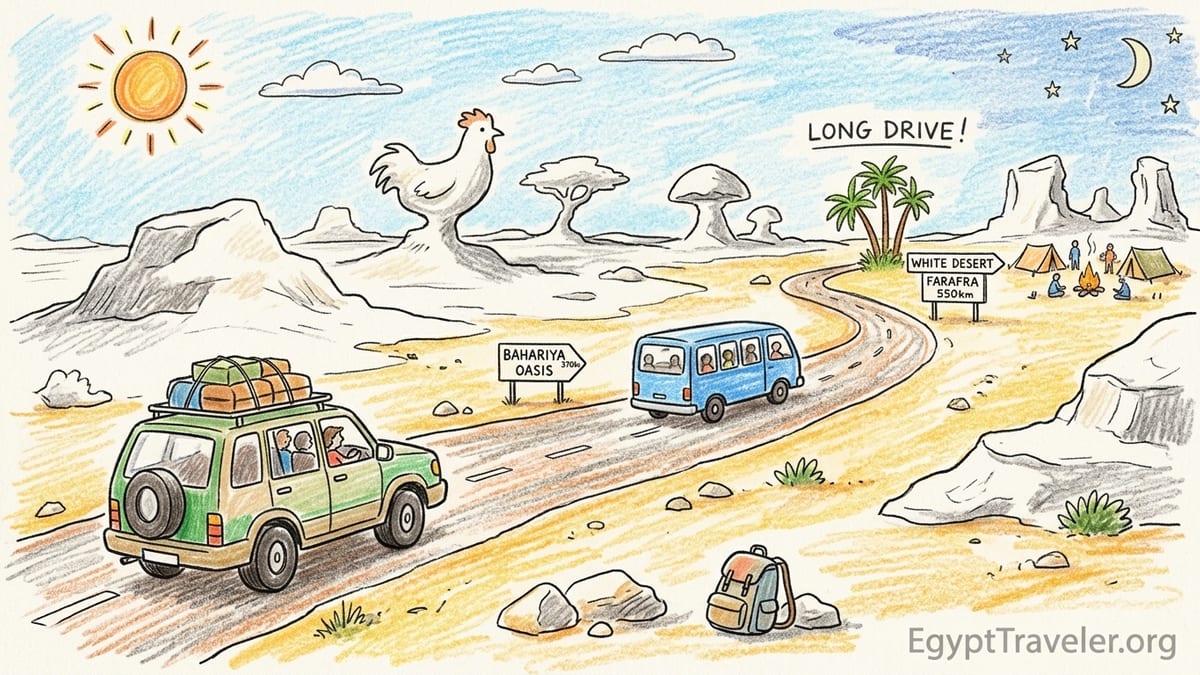
Where the White Desert Actually Is, and Why the Drive Dominates
On most Cairo travel brochures, the White Desert looks deceptively close. In reality, the experience hinges on distance. Bahariya Oasis, the main gateway, sits roughly 365 to 370 kilometers southwest of Cairo along a desert highway. Current Egyptian and regional tourism guides describe that drive as four to five hours in good conditions, in a private car or minibus. Once you reach Bahariya, the chalk formations that people call the “White Desert” are still significantly farther south near the Farafra depression, with total road distance from Cairo to Farafra itself in the range of 540 to 550 kilometers. That is the scale you are dealing with.
On my two-day, one-night safari, the operator advertised the tour as “Cairo to White Desert overnight” with photographs full of starlit camps and surreal rocks. Only when I studied the fine print and then lived the itinerary did the proportions become clear. Out of roughly 36 hours door to door, about 16 to 18 were spent sitting in vehicles. The White Desert is genuinely far, and there is no realistic way to shortcut the road portion without a charter flight, which is not part of normal tour offerings.
This geography matters for expectations. Travelers who imagine a quick escape from Cairo or a leisurely scenic drive will find the reality closer to a long-haul road trip stitched to an off-road mini-expedition. The reward is extraordinary scenery few people see, but the price is hours of dead-straight tarmac followed by bumpy pistes and only a few windows of actual walking among the formations.
Breaking Down the Time: From First Pickup to Final Drop-off
Most overnight safaris now pick up guests in Cairo or Giza between 06:30 and 08:00. My driver arrived at 07:15 outside a downtown hotel. By the time we collected other travelers across central Cairo and Giza, loaded bags and navigated the morning ring-road traffic, it was after 08:30 before the vehicle finally pointed southwest into the open desert. The first lesson: “07:00 pickup” usually means at least 60 to 90 minutes of urban logistics before the real journey begins.
The drive from Cairo to Bahariya in our air-conditioned minibus took just under five hours, including two short stops at roadside service stations. Each pause was about 10 to 15 minutes: a quick bathroom line, instant coffee from a counter and a chance to stretch legs on hot tarmac beside parked fuel trucks. For that entire leg, I estimate we spent four to four and a half hours actually moving and 20 to 30 minutes stopped, all of it in or immediately around the vehicle.
We reached Bahariya around 13:30. Lunch and a brief rest took an hour and a half at a simple lodge in the oasis, after which came the 4x4 transfer. At approximately 15:00, we climbed into Toyota Land Cruisers for the afternoon safari: Black Desert, Crystal Mountain, Agabat valley and finally the White Desert. That portion involved roughly three hours of driving mixed with a series of short scenic stops. Altogether, on day one, I spent about nine to ten hours either seated in a vehicle or standing within a few steps of it, and less than an hour actually walking freely in the landscape.
Day two reversed the pattern. After sunrise and breakfast at camp, we were back in the 4x4 by around 08:00, rolling out through the formations and desert tracks for about two hours before returning to Bahariya. There was a quick shower stop and early lunch in the oasis, then another four to five hours on the highway and one or two brief service-station breaks. Door to door, my group left camp around 08:00 and reached central Cairo close to 18:30. Again, the bulk of the day was spent sitting.
Highway vs 4x4: Different Kinds of Tired
The highway leg from Cairo to Bahariya is mentally tiring more than physically painful. The road itself is paved and, based on both official tourism material and recent tour descriptions, reasonably well maintained. The monotony is what wears you down: a straight line through beige rock and low desert, occasional police or military checkpoints, and the same view of cracked earth and sky. The main movement is the sway of the bus, the hum of air-conditioning and the low vibration through the seat.
The desert 4x4 segment is another matter. Once we transferred vehicles in Bahariya, the ride changed character. The first part followed asphalt south toward the White Desert corridor, but soon the driver steered off onto rougher tracks through dark, volcanic-looking hills of the Black Desert and along gravel and sand near Crystal Mountain and Agabat. These sections introduced jarring lateral movement and constant small impacts. Several travelers in my group, especially those in the back row, reported sore necks and lower backs by the time we reached camp.
In numbers, I would estimate around three to four hours of 4x4 travel over the two days, of which at least half involved surfaces rough enough that conversation and photography became difficult. It felt a little like being inside a gently shaken box for long stretches. For healthy, reasonably fit adults, it was tolerable and sometimes exhilarating, particularly when driving across wide sand pans. For anyone with existing back or joint issues, or who is unused to off-road travel, the constant bouncing could quickly become the defining memory of the trip.
It is important to understand that much of this is inherent to the route. The White Desert’s most striking chalk formations sit inside a national park reached only by a web of tracks over sand and rock. Tour operators can choose smoother lines and adjust speed, but they cannot turn it into a paved scenic drive without fundamentally changing the experience and, in some cases, breaching park rules on where vehicles may go.
How Much Time Do You Actually Spend in the Desert Itself?
People book the White Desert in order to walk among spectacular chalk sculptures: the famous chicken and tree formation, mushroom-like towers and wind-carved ridges that glow orange at dusk. The surprise for many travelers, myself included, is how compressed the on-foot time feels once you subtract transfers and camp chores.
On our first afternoon in the 4x4s, we stopped at a handful of classic viewpoints. The Black Desert stop involved a quick climb up a low hill of black stone for a panoramic photo and then straight back to the vehicles. At Crystal Mountain, we had around 15 minutes to wander the jumble of quartz-like rock and take pictures. In Agabat valley, a graceful arena of cream-colored cliffs and sand, we had another half hour or so for photos and optional sandboarding. Each stop felt a little rushed, with the guide glancing at his watch as sunset drew near.
By the time we entered the White Desert proper, the light had turned golden and time pressure intensified. We had perhaps 40 minutes to one hour to stroll among some of the isolated chalk pinnacles near camp before dinner preparations began. After dark, a few guests lay on mats to stargaze while others hovered near the fire. Including sunrise the next morning, my best estimate is that I spent two to three hours truly immersed in the White Desert formations on foot, compared to roughly 12 hours across both days inside a vehicle.
This imbalance is not necessarily a sign of bad planning. The distances inside the protected area are real, sunset and sunrise times are fixed and there are speed and access restrictions. However, it does mean that anyone expecting a long hike-style experience or full day of walking among the rocks may be disappointed on a standard two-day, one-night safari. Longer itineraries that include a second night in the desert or an extra day of exploration can tilt the ratio more toward landscape and less toward transit.
Basic Camping: Cold, Dusty and Shared With Strangers
Most operators offer “camping in the White Desert” without much fine detail. What I found on arrival was far from glamping. Our camp was a simple set-up on a flat sandy area between chalk outcrops: windbreak walls of canvas and poles, a ring for the fire, stacks of thin foam mattresses, heaps of blankets and a basic kitchen area behind the vehicles. Some groups sleep entirely under the open sky; ours had low canvas windbreaks that suggested rooms but offered little privacy.
As night fell, the temperature dropped rapidly. In winter months, several recent reports from tour operators and visitors mention nighttime lows near freezing, and while I did not see a thermometer on my trip, my layered clothing, hat and gloves felt barely adequate once the wind picked up. We were given a pillow and two thick but well-used blankets each. They did the job, but anyone expecting duvets, real beds or heated tents will be unhappy. Fine desert dust got into everything, from sleeping bags to camera lenses, and there was no way to avoid it entirely.
Toilets were a simple screen set slightly downwind from camp with a shallow hole in the sand. There was no running water on site, only jerrycans for hand washing and dish cleanup. This is in line with the low-impact requirements that apply inside the national park, where permanent facilities are not encouraged in the core wilderness zone, but it came as a shock to some travelers who had pictured something closer to a structured desert camp with plumbed bathrooms.
Privacy was limited. Our small group of eight shared the same sleeping area, eating circle and toilet screen. Conversations carried clearly, snoring echoed and luggage had to be stored together near the vehicles. For solo travelers comfortable with communal hiking refuges or mountain huts, this may feel familiar. For couples on a romantic Cairo getaway, it can be a jarring contrast to city hotel life.
Why Many “Problems” Are Inherent and Not Operator Failures
It is easy to blame the tour company for long drives, sore backs or basic facilities, and there are certainly differences in quality between operators. Some provide newer vehicles and more experienced drivers, better food, extra blankets and clearer communication. However, a significant portion of what travelers experience on a Bahariya and White Desert safari is dictated by geography, park rules and limited infrastructure rather than poor service.
The distance from Cairo to Bahariya and then on toward Farafra is fixed and substantial. Even the most efficient schedule cannot turn eight to ten hours of required driving into something shorter without breaking speed limits or skipping safety stops. Highway checkpoints and traffic around Cairo add uncertainty that operators do not control. On my trip, both the outward and return legs were roughly within the four to five hour range that official and private guides describe, yet the drives still dominated the experience.
Similarly, the roughness of off-road segments is a feature of the terrain and the fact that the most dramatic formations lie away from the main asphalt. Drivers can take more conservative lines or slow down to reduce impact, but dry riverbeds, soft sand and rock shelves will always translate into bump and sway. The alternative would be to avoid the most interesting sections entirely, which would undermine the reason to come.
As for camping comfort, regulations in and around the national park limit permanent construction. This is partly to protect fragile chalk surfaces and partly to keep the desert feeling wild. Operators therefore carry in and out everything they use: water, food, mattresses, tents, windbreaks and waste. Even high-end providers who charge more tend to work within the same constraints, upgrading mainly through better gear, smaller groups and extra staff rather than building semi-permanent luxury camps. Expecting hotel-level bathrooms and privacy on a standard overnight out here sets the bar in the wrong place.
Who Should Think Twice Before Booking
Based on both the structure of the trip and what I personally experienced, there are several traveler profiles for whom a quick White Desert overnight from Cairo may not be a good idea. First are people with back, neck or serious joint problems. Between the long bus ride and the 4x4 jolting, there is no way to avoid prolonged sitting and intermittent impact. If a three-hour flight leaves you sore, this safari is likely to make you miserable.
Second are travelers hoping for glamping. If your mental image involves large canvas suites, private en-suite bathrooms, electricity for hairdryers and curated design touches, the reality of foam mattresses on sand, shared screens for toilets and cold night air will feel not just rustic but inadequate. While there are a few private, higher-budget arrangements available through specialized operators, the mainstream two-day products sold in Cairo and online are squarely in the realm of simple wild camping.
Families with very young children should also think carefully. The lack of fixed toilets, long confined hours in vehicles and sharp temperature swings can be hard on small kids and stressful for parents. Several Egyptian tourism resources suggest that older children who enjoy camping and can follow safety instructions tend to cope well, but toddlers and preschoolers may struggle with dust, cold and boredom on the highway. There are usually no child-specific facilities, and the campfire atmosphere runs on late into the evening.
Finally, anyone with only two full days in Cairo probably should not allocate both of them to the White Desert. By the time you subtract the transfer periods, you will have seen little of the capital and will mostly remember vehicle interiors and a short, intense burst of desert beauty. Official tourism planning guides increasingly recommend that short-stay visitors who have one spare day outside central Cairo look instead at nearer sites such as Saqqara, Dahshur or the Fayoum depression, all of which involve far less driving and more time on the ground.
How to Make the Experience Worth the Effort
For travelers who understand the trade-offs and still feel the pull of the White Desert, thoughtful planning can significantly improve the balance between hardship and reward. The first decision is trip length. A third day, whether spent with a second night under the stars or in an oasis lodge at Bahariya or Farafra, dramatically reduces the feeling of being rushed from checkpoint to photo stop to camp. Spreading the same route over more time allows for longer walks in Agabat valley and among the chalk pillars, gentler driving schedules and a little space for weather delays.
Choosing a smaller group also changes the dynamic. On my tour, eight guests shared one 4x4 convoy. With that many people, every bathroom stop took longer, photo sessions became competitive and the group had trouble moving as one. Talking afterward with travelers who had gone privately or in pairs, it was clear that smaller parties enjoyed more flexibility in where to linger, when to stop and how fast to drive over rough sections. The cost per person was higher, but not dramatically more than some hotel markups within Cairo itself.
Vet operators on specifics, not just star ratings. When inquiring, ask direct questions: what type of vehicles they use, how many travelers per car, how many blankets per person, whether there is a separate shade area at camp, how they handle cold-season temperatures and what the approximate drive times and stops look like. Reputable providers are usually transparent that the trip involves four to five hours to Bahariya each way, plus two to four hours of 4x4 time, and that toilets are simple screens rather than installed facilities.
Packing strategically can also shift comfort levels. I was grateful for a compact inflatable pillow, a lightweight down jacket, a buff to cover my mouth and nose in dusty wind and a headlamp so I could move around camp at night without relying on phone light. A thin sleeping bag liner made the provided blankets feel cleaner and warmer. None of this changes the underlying roughness of the experience, but it does keep minor discomforts from piling up into major irritations.
The Takeaway
My overnight safari to the White Desert was both one of the most memorable and one of the most tiring side trips I have taken from a major city. The vastness of the Western Desert, the eerie beauty of the chalk formations and the brilliance of the stars were every bit as powerful as the photographs suggest. At the same time, the hours of highway, the off-road jolting, the dust, the basic toilets and the cold night were real, and at moments they overshadowed the magic.
Would I do it again? Yes, under clearer terms. Next time I would choose a smaller group with a proven operator, aim for a two-night version that allows more time walking in the formations and accept from the outset that the journey itself is part of the adventure rather than an inconvenient prelude. I would also reserve it for a trip when I have several days to spare beyond Cairo’s own wealth of sights, so that the desert feels like an extension of Egypt rather than a rushed, isolated detour.
For travelers who are honest with themselves about their comfort levels and who approach the safari as a compact expedition instead of a relaxed excursion, the White Desert can be extraordinary. For others, especially those with limited time, health concerns or expectations shaped by luxury desert camps elsewhere, it may be better admired from photographs while focusing on Egypt’s many wonders that are easier to reach. Knowing which side you fall on before you book is the real key to a successful trip.
FAQ
Q1. How long is the drive from Cairo to the White Desert on a typical overnight tour?
Most operators plan on about four to five hours from Cairo to Bahariya Oasis by highway each way, plus roughly two to three hours of 4x4 driving in the desert over the two days.
Q2. How much actual walking time can I expect in the White Desert on a two-day, one-night trip?
On a compact overnight itinerary you might get two to three hours total of real on-foot exploration among the rock formations, split between the first evening and sunrise the next morning.
Q3. What are the camping conditions like in the White Desert?
Camping is simple and wild: foam mattresses on the sand or in low tents, shared blankets, no permanent toilets and only basic privacy screens plus jerrycans of water for hand washing.
Q4. How cold does it get at night, and what should I bring?
In the cooler months, temperatures can drop near or below single digits Celsius at night, so bring warm layers, a hat, gloves and, if possible, a light sleeping bag or liner in addition to what the operator provides.
Q5. Are there proper toilets or showers during the safari?
On the highway and in Bahariya Oasis you will find standard bathrooms and basic showers, but at the desert camp you should expect a simple screened toilet area and no fixed showers.
Q6. Is the trip suitable for people with back or neck problems?
The combination of long highway hours and bumpy 4x4 tracks makes this itinerary challenging for anyone with back, neck or serious joint issues, and they should seek medical advice before booking.
Q7. Can families with young children enjoy the White Desert overnight safari?
Older children who like camping and can tolerate long drives often do well, but the lack of amenities, dust, cold and confined vehicle time can be tough for very young kids.
Q8. How does a two-night safari improve the experience compared with one night?
A two-night version typically reduces rushing, adds more time walking in places like Agabat and the chalk fields and makes the driving feel less overwhelming across three days.
Q9. What questions should I ask tour operators before booking?
Ask about group size, vehicle type, approximate driving hours, the number of blankets, how toilets are arranged, what is included in meals and how they handle cold weather and safety.
Q10. Under what conditions is the White Desert safari most worth it?
It is most rewarding if you have at least a couple of spare days beyond Cairo, accept the rough camping and long drives as part of the experience and travel with a reputable, small-group operator.