

By the time the last day-trip Land Cruisers revved away toward Bahariya Oasis and their hotel hot showers, our small camp in Egypt’s White Desert suddenly felt very far from Cairo. The famous chalk “mushroom” formations glowed peach in the sinking sun, the wind picked up just enough to sting our faces with sand, and my brain did a quick inventory: no toilets, no tents in the usual sense, a long drive back if anything went wrong. I had wanted the full overnight experience in this lunar landscape, and now there was no turning back. This is what that night was actually like once the crowds disappeared.
How I Booked My White Desert Overnight
My trip started in Cairo and ran in early March 2026, at the tail end of winter when nights in the Western Desert can still be sharply cold. I booked a two-day, one-night White Desert safari with a Bahariya-based operator called Tamer Safari, one of several local outfits that run permitted camping trips inside White Desert National Park using 4x4 vehicles and Bedouin drivers. The group was capped at six people and on my departure there were five of us, plus the driver-guide and a camp cook. We met at 6:30 in the morning outside a downtown Cairo hotel and drove roughly four and a half hours to Bahariya Oasis, the usual gateway town for White Desert excursions about 360 kilometers southwest of Cairo.
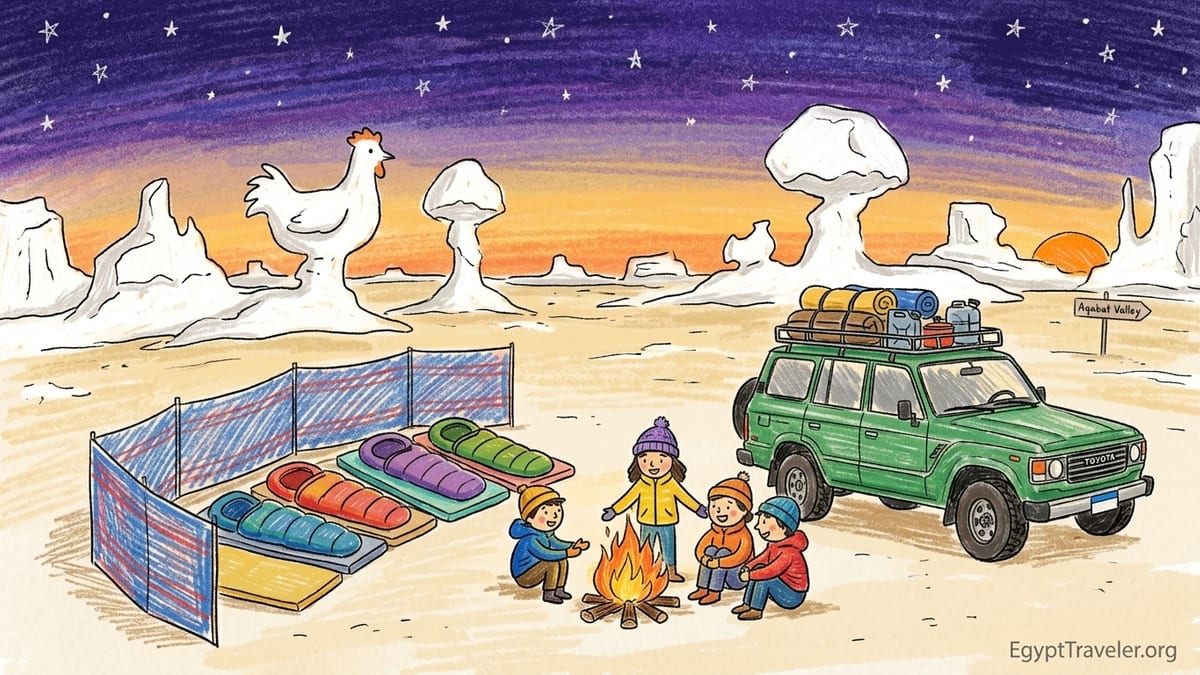
From Bahariya we transferred from the Cairo minibus to an aging but well-maintained Toyota Land Cruiser, one of dozens that work the route between Bahariya, the Black Desert, Crystal Mountain, Aqabat Valley and the White Desert chalk formations. The rear of the vehicle held rolled foam mattresses, folded wool blankets, a pile of sleeping bags, cooking pots tied together with rope, large jerry cans of water and a collapsible windbreak that would later become part of our “camp.” It looked basic rather than glamorous, a good early reality check compared with the dreamy photos I had seen online.
The trip cost the equivalent of roughly 160 to 190 US dollars per person at the time of travel for a shared group, including transport from Cairo, permits, park entrance, three meals and camping gear. Private trips with the same operator and others I researched in Bahariya were quoting between about 220 and 300 US dollars per person for two people, slightly less if you added more friends to fill a vehicle. Prices vary with fuel costs and the exchange rate, but for a legal, permitted overnight with a licensed Bahariya crew you can expect to be in that general range rather than the rock-bottom rates sometimes advertised by middlemen online.
The route followed the classic loop that Experience Egypt promotes: from Bahariya through the Black Desert, a stop at the crystal-studded ridge known as Crystal Mountain, into the sculpted dunes and cliffs of Aqabat Valley, and finally out onto the pancake-flat chalk plain of the White Desert itself, where the most photogenic “chicken and mushroom” formations stand. Farafra Oasis, which Egypt’s tourism board describes as a gateway to the White Desert and nearby landscapes, lay further south; on our short itinerary we only passed its wider region in the distance rather than visiting the oasis town itself.
Setting Up Camp After the Day-Trippers Leave
Most of the daylight hours looked similar to what any day-tour passenger would see: the black-capped hills, an hour’s wander among the formations, the obligatory sandboarding slope near Aqabat. The real change came just before sunset, when our driver turned off toward a cluster of chalk towers, killed the engine and announced, “Here is our hotel.” Around us, the other vehicles that had been hopping between stops began to disappear, heading back toward Bahariya or the roadside fixed camps. Within thirty minutes, only three jeeps remained scattered across the valley.
Our “camp” setup was simple. There were no permanent structures, no pre-pitched tents and certainly no bathrooms. The crew unloaded a stack of thick foam mattresses and laid them in a double row directly on the sand, long sides touching, so the five guests would sleep side by side. They then hammered short metal stakes into the ground and strung a low, L-shaped fabric windbreak about waist-high on two sides, open to the rock formations on the third. A woven Bedouin rug went on the sand in the center to form a communal seating area, and a metal grill was placed where the small fire would be lit once charcoal caught. A folding table appeared from the roof rack, along with battered enamel mugs, plates and a kettle blackened from years of tea.
Each of us was issued a pillow, a sleeping bag and two heavy wool blankets. Temperatures in March in this part of the Western Desert often drop from daytime highs in the low or mid-twenties Celsius to near or just above freezing at night, so the crew took the bedding seriously even if the rest of the setup looked spartan. Tents were available on request, the guide said, but only if the forecast included wind or light rain. The default was to sleep under the open sky among the chalk formations, which sounded wonderfully romantic as long as I did not think too hard about sand blowing into my eyes at 3 a.m.
There was no fixed toilet. Instead, the guide pointed to a low chalk ridge about fifty meters away and explained that this side would be the “ladies’ bathroom” and the opposite side for men. A small shovel and a roll of toilet paper were placed next to the car wheel. If you needed to go, you were expected to walk out of sight, dig a shallow hole for solid waste, cover it and pack out any paper in the provided trash bag. It was functional and, to be fair, as private as it could be in an open desert, but anyone who needs a flush toilet to relax will find this part of the experience uncomfortable.
Sunset, Dinner and the Moment the Cold Arrived
Sunset in the White Desert earns its reputation. As the sun sank toward the horizon, the chalk towers shifted from white to apricot to deep orange, throwing long, sharp shadows onto the sand. Our guide walked us up a nearby ridge to watch the last moments of light, and from there the landscape really did resemble a flooded sea where only the peaks of chalk “icebergs” were visible. In the distance we could just trace the vehicle tracks back toward Bahariya, then they dissolved into the haze. For the first time all day, the silence felt total.
The drop in temperature after dark was not gradual. One moment I was in a light fleece. Twenty minutes later I had added a down jacket, beanie and gloves while our cook crouched by the growing campfire in a thick galabeya and scarf. The dry air pulls heat away quickly, and because there are no buildings or vegetation to hold residual warmth, you feel exposed to the change. Our group huddled close to the flames while the cook slid marinated chicken pieces and vegetables over the grill and set a dented pot of rice to simmer.
Dinner itself was better than I had expected from the equipment that came off the Land Cruiser. We were served grilled chicken, rice, a simple tomato and cucumber salad, tahini, lentil soup and piles of round Egyptian bread. Tea was brewed repeatedly in the same soot-black kettle, and after main plates were cleared the crew produced bananas and oranges for dessert. Vegetarian travelers I spoke to in Bahariya before the trip said their meals had swapped chicken for extra eggplant and beans but were otherwise similar. Portions were generous, which mattered because the cold and the day’s driving had left everyone hungry.
It is in the quiet moments after dinner that the difference between an overnight camp and a day trip really becomes clear. Once the plates were cleared and the fire burned low, there was no nightlife, no phone signal and no pending itinerary beyond “sleep and watch sunrise.” The nearest lights were a faint orange glow far across the plain from another camp. The chalk formations loomed as pale ghosts against a sky that looked impossibly crowded with stars. I realized that even the photos that drew me here had not captured how remote it feels once the last city sounds have faded from memory.
Sleeping Arrangements, Sand and a Long Cold Night
Our sleeping setup was as basic as it had looked in the back of the 4x4. After dinner, the crew unrolled each mattress, fluffed the thin pillows and handed out sleeping bags and blankets. The foam pads were thicker than standard camping mats but far from luxury; you could feel uneven patches of sand through them unless you took a moment to smooth the ground first. I slept in my thermal base layers, hiking pants, wool socks, fleece, down jacket and hat. I placed my daypack at the head of the mattress as a barrier against drifting sand and used a buff over my nose and mouth.
Online photos of White Desert camping often show pristine white bedding against sculptural rock, but reality is grittier. The wind had picked up just enough to move sand across the camp, and even with the low windbreak we woke up to a fine layer over everything: sleeping bags, cameras, cups, our hair. Sand worked its way into the zipper of my bag and under my clothes. It was not unbearable, and the desert silence more than compensated, but anyone expecting hotel-like cleanliness will be disappointed.
Temperature was the other challenge. In March our guide estimated that it dropped close to 4 or 5 degrees Celsius before dawn. The supplied sleeping bags were warm but well-used, so I was glad I had packed an extra silk liner and thick socks. After the fire was allowed to die down for safety, the cold settled into my hands and face, and I found myself curling into a tighter ball to stay warm. I dozed in short stretches, waking each time a gust of wind rattled the windbreak or a car jackal yipped faintly in the distance. By morning I had probably managed three to four hours of fragmented sleep at most.
Animal sounds were subtle rather than dramatic. There were no roaring camels or close-up foxes rifling the rubbish as some social media posts imply. Instead, the night was dominated by silence punctuated by the distant bark of what our guide said was a desert fox and, once, the barely audible buzz of another vehicle far off in the dark. If you are a light sleeper used to city noise, the sheer quiet can be disorienting; every rustle of your sleeping bag zipper sounds amplified.
Toilets, Privacy and the Unromantic Details
No part of the White Desert overnight stripped away the Instagram romance faster than the bathroom situation. In the dark, walking 50 meters over uneven sand with a headlamp and a roll of toilet paper felt much longer, especially in the cold wind. There was no structure to block the view entirely, so privacy depended on choosing a hollow behind a chalk outcrop and trusting that everyone respected the invisible boundary the guide had set during his briefing.
Using a makeshift pit toilet in the middle of the night is not complex, but it is far from the lantern-lit, bohemian camp image used in some marketing photos. There is the practical matter of balance on sloping sand while holding your clothes out of the way, the mental adjustment to the lack of running water, and the necessity of packing used paper into a rubbish bag rather than burying it. Hand sanitizer and a small pack of biodegradable wet wipes were easily the most valuable things I brought from Cairo.
Privacy in camp itself was also different from what glossy images suggest. Because the mattresses were laid side by side in a single row, you sleep in very close proximity to other people, sometimes strangers. There are usually no individual tents with zip-up doors unless you have booked a more expensive private or “luxury” version, which tends to operate from semi-fixed camps outside the national park. On a standard Bahariya-based overnight, you should assume you will be changing clothes inside your sleeping bag or ducking behind the Land Cruiser rather than inside a private canvas room.
For some travelers this intimacy is part of the appeal: you share tea, stories and the cold, and the sense of group adventure is strong. For others, especially those who value their own space at the end of the day, it can feel intrusive. If you know you are in the latter category, it is worth paying for a private departure and asking in advance for separate tents or at least a bit more space between mattresses.
Why the Overnight Is Still Worth It
Given the sand in the bedding, basic toilets and limited sleep, it is fair to ask why someone would choose the overnight at all when there are long day trips from Cairo that promise the highlights. For me, the answer arrived just before sunrise. Around 5:30 a.m., while the sky was still an indigo ribbon over a black horizon, the cook moved quietly between the mattresses, asking “Tea? Coffee?” in a low voice. Most of us were already awake, noses cold, watching our breath in the air. He rekindled the fire, and we wrapped blankets around our shoulders and climbed onto a nearby rise with hot mugs in hand.
As the first light filtered across the plain, the White Desert formations went through another color transformation. The eastern sky shifted from navy to pale turquoise and then to a soft, milky gold that reflected off the chalk in a way I had not seen the previous afternoon. Long before the first day-trip vehicles arrived, we had an hour where it felt like we were the only people in that part of the park, with 360-degree views uninterrupted by dust trails or voices. That combination of cold, silence and slowly changing light is simply not available to anyone who leaves for Bahariya before dark.
The overnight also changes your relationship with the landscape. When you sleep directly on the sand, wake with grains in your eyelashes and have to judge wind direction before choosing where to put your mug, the White Desert stops being a backdrop for photos and becomes a place you have really inhabited, however briefly. The chalk towers you drive past later that morning are now landmarks near “your” camp rather than anonymous shapes. The long drive back to Cairo feels earned rather than like an overlong transfer.
Compared with a rushed day tour, the overnight allows for a slower pace in Aqabat Valley and at Crystal Mountain, both of which are marketed by Experience Egypt as key features of this broader desert circuit from Farafra and Bahariya. Instead of watching the clock to make sure you do not miss sunset on the highway, you can sit on a dune in Aqabat without hurrying, knowing that camp is nearby and the best light is yet to come. It is hardly luxurious, but it feels like a complete experience rather than a checklist.
What I Wore, Packed and Wished I Had Brought
Packing for a White Desert overnight is less about fashion and more about managing cold, sand and the lack of power or plumbing. During the day I wore lightweight hiking pants, a long-sleeved breathable shirt and a wide-brimmed hat. After sunset I layered a fleece, a lightweight down jacket, a beanie and gloves. Closed shoes were essential; I was glad I chose ankle-high hiking boots rather than sandals, both for warmth and for walking over gravel and chalk fragments near Crystal Mountain.
For sleeping, thermal base layers made a big difference. I added a silk sleeping bag liner inside the provided bag, which added noticeable warmth and an extra barrier between me and any sand embedded in the fabric from previous trips. A buff or light scarf to cover my nose and mouth kept the cold, dry air and blowing sand from waking me as often. If you feel the cold easily and are traveling outside the hottest months, consider packing a compact down vest or an extra fleece even if the daytime forecast looks mild.
On the power and camera front, there were no charging facilities once we left Bahariya. I carried two fully charged mirrorless camera batteries and a power bank for my phone, which I mostly used as a backup camera and flashlight. The desert cold can drain batteries faster than expected, so I kept spares in an inner pocket of my jacket overnight. A zoom lens in the 24–70mm range covered almost everything I wanted to photograph, from close-ups of quartz at Crystal Mountain to wide shots of chalk towers at sunrise, while a wider lens would be helpful for night sky photos if you know how to shoot long exposures.
For water and hygiene, the operator supplied large jerry cans and repeatedly refilled our bottles during the day. I carried a 1.5-liter bottle from Cairo and drank that plus several refills by the time we returned to Bahariya, which felt adequate for March but would be the bare minimum in hotter months. Hygiene boiled down to hand sanitizer, a small pack of wet wipes and a toothbrush. There were no showers, and you should assume you will go to bed without washing more than your hands and face. A small headlamp proved essential for late-night bathroom trips and for packing up before dawn.
One Night or Two, and Who Should Sleep in Bahariya Instead
After a single night in the White Desert, followed by the long drive back to Cairo with a lunch stop in Bahariya, I felt pleasantly exhausted. For most travelers, one night is enough to capture the essence of the experience: the changing light at sunset and sunrise, the sense of remoteness once the day-trippers leave, and the reality of sleeping out in a harsh environment. If you have limited time in Egypt or are not sure how you cope with cold, basic bathrooms and shared sleeping space, I would recommend starting with one night rather than booking a longer desert expedition straight away.
Two nights in the desert make sense for a specific type of traveler. Photographers who want multiple chances at clear starry skies, sunrise from different formations or softer light in Aqabat Valley will value the extra evening and morning. Hikers who enjoy walking longer distances over dunes and chalk ridges can use the second day to explore more remote corners of the park, or even push closer toward the Farafra side of the White Desert region that national tourism materials describe as a broader playground of dunes and rock. If you are deeply interested in Western Desert geology or simply love the feeling of being far from cities, a two-night circuit that splits time between Bahariya and the wider Farafra area can be rewarding.
On the other hand, some visitors will be happier sleeping in Bahariya and visiting the desert only during the day. If you have back issues that make sleeping on the ground difficult, need reliable access to a proper bathroom, or know that you struggle with cold, the combination of foam mats, shared open-air camp and pit toilets is unlikely to feel like an adventure and more like hardship. Families with very young children or travelers anxious about medical access may also prefer a guesthouse or hotel in Bahariya, joining shorter drives to the Black Desert, Crystal Mountain and the edge of the White Desert before returning to a real bed.
The key is to be honest about your comfort threshold. The overnight is not a test of toughness, and there is no shame in choosing a day tour if that allows you to appreciate the landscape without resenting the conditions. What matters most is knowing in advance that White Desert camping, at least with standard Bahariya operators, is closer to old-fashioned desert travel than to a curated “glamping” retreat.
The Takeaway
Sleeping in Egypt’s White Desert is not the soft-focus escapist fantasy that some social media posts imply. It is colder, sandier and more basic, with no permanent toilets, simple foam mattresses instead of beds, and long transfers by road on either side. You may not sleep well, and you will probably return to Cairo with dust in your hair and camera bag, wondering when you will next see a proper shower. For me, though, those discomforts faded quickly compared with the memory of drinking hot, overly sweet tea while the chalk formations around camp shifted from white to gold at sunrise and the sky above filled with more stars than I had ever seen in Egypt.
If you are drawn to big desert skies, can tolerate a night without a bathroom and understand that “camping” here means a cluster of mattresses on the sand with a shared windbreak, the overnight is one of the most memorable short trips you can add to a Cairo itinerary. If you need more comfort or privacy, staying in Bahariya and visiting the White Desert as a day trip remains an entirely valid way to see this unique national park. Either way, going in with clear expectations will make the difference between disappointment and a story you will retell for years, long after the sand has finally shaken out of your shoes.
FAQ
Q1: Where do most White Desert overnight trips start and how long is the drive?
Most group overnights start in Cairo, driving about four to five hours to Bahariya Oasis by road before switching to a 4x4 for the desert section.
Q2: How much does an overnight White Desert camp usually cost?
In 2026 many reputable Bahariya-based operators charge roughly 160 to 190 US dollars per person for a shared two-day, one-night trip including transport, permits, meals and camping gear.
Q3: What kind of vehicle and group size should I expect?
Most trips use Toyota Land Cruiser or similar 4x4 vehicles, typically carrying four to six guests plus a driver-guide and sometimes a cook or assistant.
Q4: Are there proper toilets or showers at the White Desert camp?
No. Standard overnight trips use simple pit-style toilets behind rocks with a shovel and toilet paper provided, and there are no showers until you return to Bahariya or Cairo.
Q5: How cold does it get at night and what should I wear?
Outside the hottest months, night temperatures can fall close to or just above freezing. Pack thermal layers, a warm fleece or down jacket, hat, gloves and thick socks.
Q6: What camping equipment is normally included?
Operators usually provide foam mattresses, sleeping bags, wool blankets, a shared windbreak or simple shelter, cooking gear, dishes and drinking water, but not personal headlamps or toiletries.
Q7: Is one night in the White Desert enough?
For most travelers one night is enough to experience sunset, a starry sky and sunrise among the formations. Photographers or desert enthusiasts may appreciate adding a second night.
Q8: What food is served during an overnight camp?
Dinners are typically grilled chicken or vegetables with rice, salad, bread and lentil soup, with fruit and sweet tea. Breakfast may include bread, cheese, jam, eggs and hot drinks.
Q9: How can I protect my camera and batteries in the desert?
Use a zippered camera bag, keep gear off the sand, carry spare batteries close to your body in the cold, and bring a soft brush or blower to clear dust from lenses.
Q10: Who might be happier staying in Bahariya instead of camping?
Travelers who need proper bathrooms, comfortable beds, more privacy, or who worry about cold nights and basic conditions will likely prefer a guesthouse or hotel in Bahariya with shorter day excursions.